
Synopsis
Is it possible for businesses to have a bottom line that is not profit and endless growth, but human dignity, justice, sustainability and democracy? Or an alternative economic model that is untainted by the greed and crises of current financial systems? Christian Felber says it is. Moreover, in Change Everything he shows us how. The Economy for the Common Good is not just an idea, but has already become a broad international movement with thousands of people, hundreds of companies, and dozens of communities and organizations participating, developing and implementing it. Published in English for the first time, this is a remarkable blueprint for change that will profoundly influence debates on reshaping our economy for the future.
"synopsis" may belong to another edition of this title.
About the Author
Christian Felber is an Austrian alternative economist and university lecturer. He is an internationally renowned speaker, author of several award-winning bestsellers and a regular commentator on ethics, business and economics in various media. He co-founded the NGO Attac Austria and initiated the Economy for the Common Good as well as the planned Bank for the Common Good, which will be Austria's first ethical finance institute.
Excerpt. © Reprinted by permission. All rights reserved.
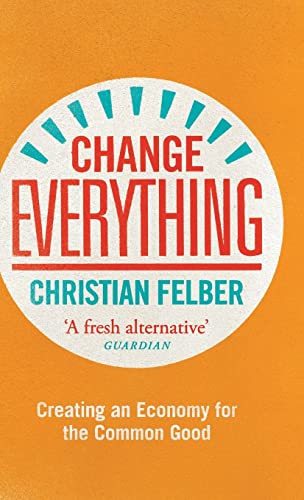
Change Everything
Creating an Economy for the Common Good
By Christian Felber, Susan NurmiZed Books Ltd
Copyright © 2012 Deuticke im Paul Zsolnay Verlag, Wien
All rights reserved.
ISBN: 978-1-78360-473-9All rights reserved.
Contents
Acknowledgements,
Foreword by Eric Maskin,
Preface,
1 A broken system,
2 Defining the economy for the common good,
3 The democratic bank,
4 Property,
5 Motivation and meaning,
6 Advancing democracy,
7 Real world examples,
8 Putting it into practice,
Appendix 1 Frequently asked questions,
Appendix 2 Facts, figures and a twenty-point summary,
Notes,
Bibliography,
Index,
CHAPTER 1
A BROKEN SYSTEM
Cooperating, helping others and ensuring that justice prevails is a basic, biologically rooted human motivation which is found all over the globe. This pattern manifests itself beyond all cultural boundaries.
Joachim Bauer
HUMAN VALUES – VALUES OF THE ECONOMY
It's peculiar: although values are meant to offer basic orientation, serving as the "guiding lights" of our lives, the values which hold for the economy today are completely different from those which apply to our daily interpersonal relationships. In regard to our friendships and everyday relationships, we thrive when we live in accordance with human values: the building of trust, honesty, esteem, respect, empathy, cooperation, mutual help and sharing. The "free" market economy is based on the rules of the systematic pursuit of profit and competition. These pursuits promote egoism, greed, avarice, envy, ruthlessness and irresponsibility. This contradiction is not merely a blemish in a complex or multivalent world; rather, it is a cultural catastrophe; it divides us inwardly – as individuals and as a society.
VALUES ARE GUIDING LIGHTS
The contradiction is fatal because values are the foundation of communal life. We set life goals and orient our actions according to them, investing them with meaning. In Spanish the word "sentido" denotes meaning as well as direction. Values are like a guiding light which gives the road of life direction. But if our guiding light for daily life points in an ethical direction – towards building of trust, cooperation, sharing – and suddenly, in a partial realm of life, namely the market economy, a second "guiding light" points in the opposite direction – in the direction of egoism, competition, greed – then we are plagued by a terrible quandary: should we act in the spirit of solidarity and cooperation, help each other and always be mindful of everyone's welfare? Or should we always look to our own advantage first and short-change others as our competitors? The direness of the conflict lies in the fact that legislators favour the false guiding light, thus promoting values that we all suffer from. This does not necessarily become evident immediately because no law says that you should be egoistic, greedy, avaricious, ruthless and irresponsible. But what the law does say is that we should pursue financial profit in business and compete with one another. This is reflected in numerous laws, regulations and treaties of nation-states, the European Union (EU) and the World Trade Organization (WTO). The result is an epidemic emergence of antisocial behaviour in business – because these kinds of behaviours lead to entrepreneurial "success".
TURNING EGOISM INTO COMMON GOOD
The "imperative" that we should compete in business and pursue the largest possible amount of personal financial gain (i.e. behave egoistically) stems from the paradoxical hope that the good of all will result from the egoistic behaviour of the individual. This ideology was established 250 years ago by Adam Smith, the first major national economist. Smith literally said: "It is not from the benevolence of the butcher, the brewer, or the baker that we expect our dinner, but from their regard to their own interest."
My aim is not to berate Smith. At the time it was an understandable notion. The pursuit of self-interest on the part of "individuals" was new; "enterprises" were primarily tiny and powerless and, in addition, locally integrated and personally responsible. In many cases company founder, proprietor, employer and employee were still united in one person (the baker, the carpenter, etc.). There was no free movement of capital, there were no anonymous global corporations, no multi-billion-dollar investment funds.
Smith hoped that an "invisible hand" would guide the egoism of individuals for the maximum welfare of all. From a metaphysical perspective – Smith was a moral philosopher – he might well have meant the hand of God. This is what Smith experts assume. Today, we know that the invisible hand does not exist. It is a pure hope, and neither economics nor economic policy operates on the basis of hopes. Markets do not automatically transform their participants' pursuit of self-interest into the common good. The constitutional mandate that "the use of property is also to serve the common good" falls short if there is no legal instrument like a common good balance sheet that documents how companies obey it. In fact, the probability that they violate the mandate is higher than that they comply, because in the global competition the decisive factor of survival is not to be "good" but to be "profitable". As long as financial gain remains the "bottom line" of business, Smith's dream is only a soap bubble. What happens in the real world if the utmost goal of human beings is to pursue their own advantage and to act against others is that they learn to take advantage of others and deem this to be right and normal. But if we take advantage of others we do not treat them as equals; we violate their dignity.
DIGNITY IS THE HIGHEST GOOD
When I ask students attending my lectures at the Vienna University of Economics and Business what they understand human dignity to be, I frequently encounter a general, awkward silence. The students do not appear to have heard or learned anything about it in the course of their studies. This is all the more alarming considering the fact that dignity is the highest value: it is the first-named value in countless constitutions and it forms the basis of the Universal Declaration of Human Rights.
Dignity signifies value: the same, unconditional, unalienable value of all human beings. Dignity requires no "achievement" other than existence. It is from the equal value of all human beings that our equality derives – in the sense that all human beings living in a democracy should have the same liberties, rights and opportunities. And only if everyone really does have the same liberties is the condition fulfilled for enabling everyone to be really free. Immanuel Kant wrote that human dignity can only be preserved in daily life and interactions if we deem and treat each other as being of equal value: "So act that you use humanity, whether in your own person or in the person of any other, always at the same time as an end, never merely as a means." [emphasis Kant's] We may indeed derive advantages from dignified encounters as a by-product; according to Kant and common sense this happens automatically if everyone wants the best for all, builds up a foundation of trust, takes others seriously, listens to and esteems all others. But gaining an advantage should not be the objective of the encounter. By contrast, on the free market it is legal and customary to instrumentalize our fellow human beings, violating their dignity because our goal is not to protect it. Our goal is to gain personal advantage, and in many cases this can be achieved more easily if we take advantage of others and violate their dignity. What is decisive is my attitude and my priority: am I interested in the greatest good and the preservation of the dignity of all, which is something which affects me automatically and which I benefit from as well, or am I primarily interested in my own welfare and my own advantage, which others might, but will not necessarily draw benefit from?
If we pursue our own advantage as our supreme goal, the customary practice is to use others as means to achieve this goal and to take advantage of them accordingly. For this reason, Smith's perversion of goal and by-product leads to widespread violations of human dignity and the systematic restriction of the liberty of many.
A FREE MARKET?
The so-called free market would only be free if all its active participants could withdraw from any barter transaction without harm. But this is the case for only some of the transactions made on the market. In many cases, one party might find it harder to refrain from engaging in a particular transaction than the other because he or she depends on it to a higher degree. Many people cannot decide whether to buy food on a certain day or not, whether to rent an apartment or not; many enterprises cannot decide whether to take out a loan on a certain day or not – if they do not, they might be bankrupt the next day; many farmers cannot decide freely if they want to deliver their goods or not – they often have only one or a handful of buyers to "choose" from, all of whom treat them equally poorly. For typical barter transactions the following applies:
• An average employer has an easier time terminating a work contract and is thus more able to determine the conditions of the work contract than the average employee is.
• An average creditor has an easier time terminating a credit agreement and is thus more able to determine the conditions of the agreement than the average borrower is.
• An average landlord has an easier time deciding not to sign a rent contract and is thus more able to determine the conditions of the rent contract than the average lessee is.
• An average global corporation has an easier time dispensing with one of its thousands of suppliers and is thus more able to determine the conditions of supply contracts than the average supplier is.
An imbalance in private barter relations would not matter so much if everyone were to treat each other with respect and the intention of preserving the other's dignity. Then the more powerful person would meet the less powerful at eye level, perceive them, take their needs and feelings as seriously as their own, and not be happy with the result until both found it acceptable. In market capitalism, however, the more powerful individual is outright encouraged to utilize their edge, and the imbalance of power, in the pursuit of their own advantage. The competition which results from this is what creates the particular "efficiency" of the free market.
If a human community does not systematically preserve the dignity of the individual then liberty will not be granted either, for the preservation of dignity – human beings treating each other as equals – is the precondition for liberty in every community. If all have an eye on their own advantage they do not treat others as equals any more but rather as "instruments", thus endangering the liberty of all. For this reason a market economy which is based on profit maximization and competition cannot be called a "free" economy; this would constitute an intrinsic contradiction.
TRUST IS MORE IMPORTANT THAN EFFICIENCY
If we must constantly fear that our fellow human beings will take advantage of us in the market as soon as they are in a position to do so, something else will be systematically destroyed: trust. Some economists say this doesn't matter because the economy focuses completely on efficiency. But such a view must be disputed, for trust is the highest social and cultural good we know. Trust is what holds societies together from the inside – not efficiency! Imagine a society in which you can trust every person completely – would that not be the society with the highest quality of life? And imagine the opposite, a society in which you had to mistrust everyone – would that not be the society with the lowest quality of life?
The interim conclusion to be drawn is radical: so long as a market economy is based on pursuit of profit and competition and the mutual exploitation that results from it, it is reconcilable with neither human dignity nor liberty. It systematically destroys societal trust in the hope that the efficiency it yields will surpass that achieved by any other form of economy. When such matters are pointed out to mainstream economists three familiar responses are commonly elicited:
1. There is no alternative to the market economy; this is common knowledge and thus all further discussion is unnecessary.
2. Whoever does not acknowledge this wants to catapult society back into poverty and the nineteenth century or drive it straight to communism, and we all know how that ended.
3. The market economy is the most productive form of economy there is; history has proved this. Competition spurs human beings to the highest levels of performance – this is in addition to the fact that it is rooted in human nature and is thus unavoidable.
We need to take a closer look at this last fundamental myth of the market economy: "Competition is in most cases the most efficient method we know," writes Nobel Prize laureate for economics Friedrich August von Hayek. If a "Nobel Prize laureate" says this, it must be true – although there is no Nobel Prize for economics. I have tried to find the empirical studies which led Hayek to this insight but I have found none. I explored other economists as well, for in the scientific community it is customary for colleagues to cite each other. And yet I found nothing here either. None of the economists who have won a Nobel Prize have ever proved through a study that "competition is the most efficient method we know". This cornerstone of economics is a mere claim which is believed by the large majority of economists. And capitalism and free enterprise, the world's dominant economic model for the past 250 years, is based on this belief.
Regarding the crucial question, does competition create stronger motivation than any other method? a plethora of studies have been conducted in numerous disciplines (educational science, social psychology, game theory, neurobiology) 369 of which studies were evaluated in a meta-study. And of those with a clear result an amazing majority of 87 percent found that competition is not the most efficient method we know; cooperation is. The reason for this lies in the fact that cooperation motivates people differently. Competition motivates people too; no one contests this, and market capitalism has proved this, but it motivates them less. Cooperation motivates people through successful relationships, recognition, esteem, mutual goals and mutual achievements. This latter is the definition of cooperation. In contrast, the definition of competition is "mutually exclusive achievement of objectives". I can only be successful if someone else is unsuccessful. Competition primarily "motivates" people through fear. For this reason, fear is also a widespread phenomenon in market capitalism; many fear losing their job, their income, their status, their social recognition and place in the community. When people compete for scarce goods there are many losers, and most of them fear being affected themselves. And there is another component of motivation when it comes to competition. Aside from fear, competition elicits a form of delight – the delight in triumphing, in being better than someone else. And thisis, when viewed from a psychological perspective, a very problematic motive, for the goal of our actions should not be to be better than the others but rather to perform our task well because we find purpose in it and do it gladly. This is what we should derive self-value from. Whoever derives self-value from being better than others is dependent upon others being worse. Psychologically speaking, this constitutes pathological narcissism: feeling better because others are worse is sick. The healthy thing to do would be to nourish our sense of self-worth by means of activities which we enjoy performing because we have chosen to do them of our own free will and see purpose in them. If we concentrated on being ourselves instead of being better, no one would be jeopardized and there would be no need for losers.
It is a matter of objectives. If I am better at performing a certain task than someone else but this is a by-product rather than my objective, then there is no problem. I will pay no attention to my being better and will not evaluate it as a "triumph" – and will help the other person. A problem ensues if my objective is to be better than someone else, if I am striving for a "win–lose situation" – which is the definition of competition used here. If my goal is to do my task well and I do not care how others do theirs, then I do not need any competition – but that is the very essence of the myth, namely that without competition human beings would have no incentive to perform, would not be motivated to do their tasks well. But according to psychological insights it is the other way around: motivation is stronger if it comes from within (one speaks of "intrinsic motivation") than if it comes from external sources ("extrinsic motivation"), for example from competition. The best performance is achieved not when there are competitors but rather when human beings are energized by devoting themselves to something and are utterly fulfilled by it. They do not need any competition for that.
(Continues...)
Excerpted from Change Everything by Christian Felber, Susan Nurmi. Copyright © 2012 Deuticke im Paul Zsolnay Verlag, Wien. Excerpted by permission of Zed Books Ltd.
All rights reserved. No part of this excerpt may be reproduced or reprinted without permission in writing from the publisher.
Excerpts are provided by Dial-A-Book Inc. solely for the personal use of visitors to this web site.
"About this title" may belong to another edition of this title.
Other Popular Editions of the Same Title

Search results for Change Everything: Creating an Economy for the Common...

Stock Image
Change Everything: Creating an Economy for the Common Good
Seller: Bay State Book Company, North Smithfield, RI, U.S.A.
Seller rating 5 out of 5 stars

Condition: good. The book is in good condition with all pages and cover intact, including the dust jacket if originally issued. The spine may show light wear. Pages may contain some notes or highlighting, and there might be a "From the library of" label. Boxed set packaging, shrink wrap, or included media like CDs may be missing. Seller Inventory # BSM.18GZS
Stock Image
Change Everything: Creating an Economy for the Common Good
Seller: Midtown Scholar Bookstore, Harrisburg, PA, U.S.A.
Seller rating 5 out of 5 stars
Hardcover. Condition: Very Good. Very Good - Crisp, clean, unread book with some shelfwear/edgewear, may have a remainder mark - NICE Standard-sized. Seller Inventory # M1783604735Z2
Stock Image
Change Everything: Creating an Economy for the Common Good
Seller: Midtown Scholar Bookstore, Harrisburg, PA, U.S.A.
Seller rating 5 out of 5 stars
Hardcover. Condition: Acceptable. Acceptable - This is a significantly damaged book. It should be considered a reading copy only. Please order this book only if you are interested in the content and not the condition. May be ex-library. Standard-sized. Seller Inventory # M1783604735Z4
Stock Image
Change Everything: Creating an Economy for the Common Good
Seller: Midtown Scholar Bookstore, Harrisburg, PA, U.S.A.
Seller rating 5 out of 5 stars
Hardcover. Condition: Good. HARDCOVER Good - Bumped and creased book with tears to the extremities, but not affecting the text block, may have remainder mark or previous owner's name - GOOD Standard-sized. Seller Inventory # M1783604735Z3
Stock Image
Change Everything: Creating an Economy for the Common Good
Seller: Buchpark, Trebbin, Germany
Seller rating 5 out of 5 stars
Condition: Hervorragend. Zustand: Hervorragend | Seiten: 272 | Sprache: Englisch | Produktart: Bücher | Keine Beschreibung verfügbar. Seller Inventory # 25382175/1001