
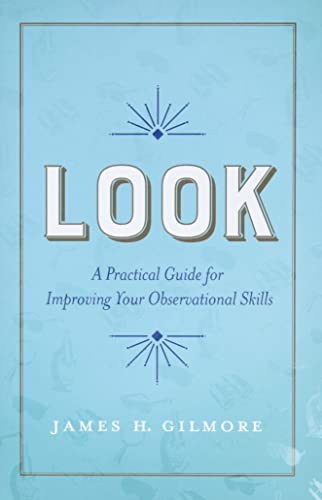
Items related to Look: A Practical Guide for Improving Your Observational...
Synopsis
Mastering the Way You See the World
?Inspired by Edward de Bono’s Six Thinking Hats method, Jim Gilmore has created a unique and useful tool to help our ability to perceive. In his latest book, Look: A Practical Guide for Improving Your Observational Skills, Gilmore introduces the metaphor of “six looking glasses.” Each looking glass represents a particular skill to master in order to enhance the way we look at the world.
The six skills include binoculars, bifocals, magnifying glass, microscope, rose-colored glasses, and blindfold looking. Each looking glass provides an observational lens through which to see the world differently. This framework will help its users to:
• See the big picture
• Overcome personal bias
• Pinpoint significance
• Better scrutinize numerous details
• Uncover potential opportunities
• See what’s in the mind’s eye
These varying perspectives offer myriad practical applications: They can help any executive, manager, or designer more richly observe customer behavior, philanthropists and policy makers more keenly identify human needs, and anyone else interested in innovative thinking to first ground their ideation in practical observation.
Gilmore helps readers grasp the Six Looking Glasses by including helpful everyday examples and practice exercises throughout. Put into practice, this method of looking will help you see the world with new eyes.
?Inspired by Edward de Bono’s Six Thinking Hats method, Jim Gilmore has created a unique and useful tool to help our ability to perceive. In his latest book, Look: A Practical Guide for Improving Your Observational Skills, Gilmore introduces the metaphor of “six looking glasses.” Each looking glass represents a particular skill to master in order to enhance the way we look at the world.
The six skills include binoculars, bifocals, magnifying glass, microscope, rose-colored glasses, and blindfold looking. Each looking glass provides an observational lens through which to see the world differently. This framework will help its users to:
• See the big picture
• Overcome personal bias
• Pinpoint significance
• Better scrutinize numerous details
• Uncover potential opportunities
• See what’s in the mind’s eye
These varying perspectives offer myriad practical applications: They can help any executive, manager, or designer more richly observe customer behavior, philanthropists and policy makers more keenly identify human needs, and anyone else interested in innovative thinking to first ground their ideation in practical observation.
Gilmore helps readers grasp the Six Looking Glasses by including helpful everyday examples and practice exercises throughout. Put into practice, this method of looking will help you see the world with new eyes.
"synopsis" may belong to another edition of this title.
About the Author
Jim Gilmore is co-founder of Strategic Horizons LLP, based in Aurora, Ohio. He is a Batten fellow and adjunct lecturer at the Darden Graduate School of Business at the University of Virginia, where he teaches a course on the Experience Economy. Gilmore is a visiting lecturer in Apologetics at Westminster Seminary California, where he teaches a course on cultural hermeneutics. He also teaches a design course at the Weatherhead School of Management at Case Western Reserve University.
Gilmore is a graduate of the Wharton School of the University of Pennsylvania, an alumnus of Procter & Gamble, and, before co-founding Strategic Horizons LLP, was head of CSC Consulting's Process Innovation practice. Look is his third book. His other books include the highly influential, The Experience Economy: Work Is Theatre & Every Business a Stage and Authenticity: What Consumers Really Want.
Excerpt. © Reprinted by permission. All rights reserved.
Look
A Practical Guide For Improving Your Observational Skills
By James H. GilmoreGreenleaf Book Group Press
Copyright © 2016 Strategic Horizons LLP
All rights reserved.
ISBN: 978-1-62634-299-6All rights reserved.
Contents
Introduction,
LEARNING TO LOOK,
1 Why Look?,
2 Looking as a Skill,
3 Wearing Glasses,
4 The Six Looking Glasses,
5 Where to Look,
6 Looking Short and Slow, Long and Fast,
BINOCULARS LOOKING,
7 Looking Across: Surveying and Scanning,
8 Keeping a Distance,
9 Picking a Vantage Point,
10 What Does Binoculars Looking Look Like?,
11 Binoculars Exercises,
12 Summary of Binoculars Looking,
BIFOCALS LOOKING,
13 Looking Between: Comparing and Contrasting,
14 Pairing Opposites,
15 Altering Directions,
16 What Does Bifocals Looking Look Like?,
17 Bifocals Exercises,
18 Summary of Bifocals Looking,
MAGNIFYING-GLASS LOOKING,
19 Looking Closer: Pausing and Pinpointing,
20 Spotting One Main Point,
21 Finding the Significance,
22 What Does Magnifying-Glass Looking Look Like?,
23 Magnifying Glass Exercises,
24 Summary of Magnifying-Glass Looking,
MICROSCOPE LOOKING,
25 Looking Around: Scrutinizing and Studying,
26 Checking for More Details,
27 Shifting the Object,
28 What Does Microscope Looking Look Like?,
29 Microscope Exercises,
30 Summary of Microscope Looking,
ROSE-COLORED-GLASSES LOOKING,
31 Looking Past: Enhancing and Enriching,
32 Forsaking the Flaws,
33 Foreseeing Opportunities,
34 What Does Rose-Colored-Glasses Looking Look Like?,
35 Rose-Colored-Glasses Exercises,
36 Summary of Rose-Colored-Glasses Looking,
BLINDFOLD LOOKING,
37 Looking Back: Looking at Looking,
38 Assessing the Looking,
39 Recalling the Looking,
40 What Does Blindfold Looking Look Like?,
41 Blindfold Exercises,
42 Summary of Blindfold Looking,
LOOKING TO LEARN,
43 Everyday Looking,
44 Looking Routines,
45 Looking Excursions,
46 Looking with All Five Senses,
47 Capturing What You See,
48 Look Here,
APPENDICES,
A Looking at Yourself: A Self-Assessment,
B Construction of the Six Looking Glasses,
Acknowledgments,
About the Author,
CHAPTER 1
WHY LOOK?
We spend most all of our lives with our eyes open. Yet there are different degrees to which we use our open eyes. The very phrase "eyes wide open" suggests there are many occasions when our open eyes are not completely open, when we miss perceiving some aspect of the world before us. Indeed, we are often inattentive to what exists right around us.
We look, but we don't see. And we don't see, because we're not really there, looking. This "being elsewhere" is particularly pronounced in an age of distraction, exemplified by the pedtextrian (a term someone coined for a pedestrian texting while walking), or the screenager, which includes any of us using digital devices while not walking. I have witnessed many screenagers (usually at an airport) three screens deep, with laptop, tablet, and smartphone — all turned on, commanding complete and divided attention. There is not much looking going on in such circumstances — at least not at the embodied world in which one is immediately situated. Interestingly, observing this three-screens-deep behavior triggered this thought: Screens were once things we only looked at, but then we started holding screens; then we started touching them. Now, people are starting to wear screens on their wrists, arms, heads, and even torsos. Are digital implants next?
To really look is to make an observation such as this noticeable progression. To look takes note of something as important or meaningful. It is the kind of observation that registers an "aha." It is the kind of looking that sees something anew. It is a way of noticing.
Such noticing is not easy. The inability to see something can strike us even when we are most consciously and intently looking. Most of us have had the experience of looking for some misplaced item, growing ever more frustrated by our inability to locate it, and only after we have "looked everywhere" (or so we say) does the lost item suddenly appear.
Let me share a true story of one such incident. It was the evening of my wedding. After the ceremony and reception, close friends and family gathered at my in-laws' home to spend some additional time together. At the end of the night, all the men who had worn rented tuxedos collected their garments — shoes, pants, jackets, shirts, ties, and so forth — and put them in a pile to be returned en masse the next day. As we made an accounting of all the items, one piece was missing: one last cummerbund. Everyone frantically searched the house for the wayward cummerbund. After what seemed like an eternity, we gave up the hunt, resigned to pay whatever penalty would be incurred the next day. It was then that someone noticed the cummerbund. My father was still wearing it! The cummerbund had been curled up around my dad's waist the whole time, unnoticed, under his belly.
Why look? We need to look in order to notice that which we do not normally see. We must come to recognize the value to be had in making new discoveries of people and places, products and processes, and objects and occasions that otherwise sit unnoticed, along the underbelly of everyday life.
But seriously: Why look?
First of all, take a step back and consider that the world is intrinsically worth looking at. Both nature (nurtured by mankind) and artificial environments (constructed by mankind) are wondrously created. To not see this is to not be human. We should look in order to better appreciate the circumstances in which we are situated in our work, our homes, our communities, our schools, our churches, and our recreations.
Secondly, there is so much variation in the world to be compared. In making comparisons — within any field of study — greater understanding is gained. Without looking for this kind of comparative understanding, all thought and action stagnates. We should look in order to change the context in which certain problems and issues are understood and addressed.
Thirdly, what matters does not just exist in a single field of study. There are worlds and worlds of details existing in many different disciplines. Just as value can be unlocked by making comparisons within an individual field, opportunities for new insights often only emerge when looking across multiple disciplines. Such cross-disciplinary looking is too often neglected in the present era of specialization. Some breakthroughs may only come when specialists look more richly outside their normal purview. We should look in order to alter the state of mind with which we approach any situation.
Fourthly, a surface-level understanding of the world and a superficial approach to problem-solving will not suffice to address many critical problems faced today locally, regionally, nationally, and globally. Opportunities to better address these concerns will only emerge when life is examined up close and in detail. We should look in order to be more attentive to what really matters.
Fifthly, the world can be made a better place. Beyond the world's known problems, other real troubles often exist unseen or ignored in society. These troubles need to be brought to light. And our known problems are often addressed via the same tired old paradigms. We should look in order to release new energies into the marketplace of ideas and action.
Finally, take a look back at the reasons cited. Does anything seem missing? Has something gone unnoticed in sharing this list? Surely it's this: Looking itself has intrinsic worth. Looking is pleasurable. A life spent looking is a life worth living. And those who routinely and richly look are generally much more interesting and more influential people than those who don't! We should look just to be dutifully present in the world.
It should be clear: We need to invest more time looking. We need to take the time to learn to more skillfully look in order to help make us better observers, and thus more creative thinkers and more innovative practitioners in the various callings in which we labor. Take heart: The Six Looking Glasses method promises to guide you to become a more skilled observer by enriching your time spent looking.
We will introduce the Six Looking Glasses tool a few chapters from now. Before doing that, however, let's briefly examine looking as a skill and the role of wearing glasses to improve sight.
CHAPTER 2LOOKING AS A SKILL
Want to be more skilled at observing? One word of advice: Look. Not satisfied with that one-word exhortation? Here are two: Pay attention. These two words capture the very essence of looking as a skill. To learn to look, you need to learn to pay attention.
Many of us, too many of us, take our sight for granted. Sure, we look. But we pay little attention to our looking. We seldom stop in our tracks to just look and listen to what is there to see and hear. We're often so busy, so on the go, that we're too distracted to really look.
So stop, look, and listen. Paying attention is just that.
Interestingly, these three words comprise the title of my favorite childhood book — Stop Look Listen by Virginia Mathews — that I recall reading over and over as a little boy. These three verbs define what it means to pay attention.
Now let me ask you this: What do you recall as your favorite childhood book?
I have asked that question to countless people, and based on their responses — which include many aha moments of self-discovery for those answering — have concluded that identifying your favorite childhood book reveals much about your calling, or who you are. (Perhaps you are having such an aha moment right now!) There is a reason that particular book resonated with you as a child.
Listen to what Os Guinness has to say in his book, The Call: Finding and Fulfilling the Central Purpose of Your Life. Guinness writes, "Calling reverses the way most people think. ... Instead of 'You are what you do,' calling says, 'Do what you are.'"
Want to improve how skillfully you look? Start with taking a good look at who you are. Look at yourself. That may and should strike you as odd advice for the topic of how to develop the skill of looking. But paying attention to who you are will help you pay more attention to where you are. Why? Because how you see yourself influences what you see when you look.
David Finn, an acclaimed professional photographer and lifelong New Yorker, wrote a fascinating book, How to Look at Everything. (How do you not take hold of this book when you see that title on the shelf?) Finn recounts how he was affected by a single photograph he took while amassing a portfolio of shots for use in a book documenting life in New York City. This particular photo was taken out a car window and captured a man walking down the street while reading a book (a pedtextrian in the predigital age). Only after Finn had developed the film, did he notice a second man seated on a stoop as the reader-walker went by. The juxtaposition of the two men made for a most arresting image, one that prompted inner refection. Finn shares his epiphany, "Why did I consider it such a revelation? Why did so many familiar sights now look so different? It was because I had never looked so intently at the scenes of daily life before. And as I looked through my viewfinder, my mind gave new meaning to what I was seeing. I saw more than what was there because I was paying such close attention to what I was photographing." Finn no longer saw himself as just a photographer, but rather a "walker in the city." This different look at himself transformed his ability to look outside himself.
Want to be more skilled at looking? Look at yourself. Look intently at the scenes of your daily life. Pay closer attention to where you are and what you are doing. See yourself as an observer, a walker in your city.
Stop. Look. Listen.
CHAPTER 3WEARING GLASSES
In fourth grade a major event happened in my life. The results of a routine physical examination at school concluded that I should visit an optometrist. Further tests confirmed that I needed eyeglasses. Devastated by the news, I remember crying. (I suspect many children receive this news the same way.) But good news soon followed. Having previously been a B/C student, my grades suddenly improved. I started to get straight As. No one — not my parents, not my teachers, not myself — had previously realized that my eyesight was deficient. I had been "wearing" bad eyesight like a hidden cummerbund. But by wearing glasses, I could see like never before — and my grades proved it.
Looking is a skill that can often be aided with better viewfinders — to borrow the term used by David Finn to describe the lens through which he sees the world. Better viewfinders — looking glasses — are employed in any number of situations to improve looking. A hunter may use a scope to lock in on his prey. A soldier might wear night goggles to see in the dark. A submarine commander must rely upon a periscope to look above the surface of the water. A jeweler may use a monocular to examine the quality and cut of a diamond. A physician uses a gastroscope to peer inside a patient's stomach. An astronomer employs a telescope to see the stars. And most all of us use sunglasses to cut the sun's glare.
Wearing these glasses helps us see the world in ways that we cannot without them. So it is with "wearing" the Six Looking Glasses — using each in different circumstances, based on the particular observational needs of the moment.
This then is the twofold premise for wearing any of the Six Looking Glasses:
* Looking is a skill; more precisely, looking is a set of skills.
* That set of skills can be greatly enhanced through the use of a distinct set of looking glasses.
CHAPTER 4THE SIX LOOKING GLASSES
Each of the Six Looking Glasses promotes a different way of making observations. Each functions uniquely as a particular kind of viewfinder. To assist with remembering these six looking functions, each method of looking is metaphorically associated with a particular device or apparatus used to enhance one's looking, to help see and discover.
Each function should be readily understood based upon the name of the associated device and its primary purpose. For example:
* Binoculars are used to look across and survey at a distance.
* Bifocals are used to alternatingly look between two contrasting views or directions.
* Magnifying glasses are used to look closely at one main spot.
* Microscopes are used to look around for more and greater details.
* Rose-colored glasses are used to look at something better than it actually is.
* Blindfolds are used to look back and recall.
Assigning each function to a particular way of looking yields the Six Looking Glasses, or six ways of looking.
BINOCULARS LOOKING
Binoculars are useful when you "can't see the forest for the trees." Binoculars looking takes place at a distance from what is being observed, surveying and scanning for what might be noteworthy. This type of looking determines what may be worth examining with other looking glasses. Binoculars looking involves taking a step or two back from the situation and picking a vantage point to better observe the overall scene.
BIFOCALS LOOKING
Bifocals looking takes two alternating views of any given situation or circumstance. Looking with bifocals compares and contrasts different aspects of what's being observed, seeking to uncover various levels and layers of significance. This type of looking either pairs obvious opposites, or it looks for not-so-obvious combinations to pair as opposites. Bifocals looking then alternates between these two different or opposing views.
MAGNIFYING-GLASS LOOKING
A magnifying glass spots one thing to look at more closely. Magnifying-glass looking takes a break from other ways of looking to examine one particular feature in more detail. It pinpoints that which may not otherwise be seen as significant, taking time to put everything else aside in order to look "up close and personal." Magnifying-glass looking spots something to be seen inside the overall scene.
MICROSCOPE LOOKING
Looking with a microscope involves looking for more and greater details. Rather than zeroing in on one particular point, microscope looking slides up and down, left and right, seeking to identify yet more features worth examining. It looks around. It often explores the scene by shifting the viewed object itself — to observe even more details at the edges of the scene. Microscope looking involves scrutinizing and studying the scene.
ROSE-COLORED-GLASSES LOOKING
Looking with rose-colored glasses sees the potential that may not be readily apparent when using the other looking glasses. This view looks past readily apparent flaws to observe the opportunities that could be and maybe should be there. Rose-colored glasses look ahead to improve the scene by uncovering hidden opportunities.
BLINDFOLD LOOKING
Blindfold looking is "looking at looking." In this regard, it fundamentally differs from the other five looking glasses. This may seem counterintuitive — and it is! But therein resides its usefulness. Having employed the other ways of looking, blindfold looking reflects upon and recalls what was seen (or not seen) and how it was seen (or not). It serves to both summon what has already been noticed and to redirect further looking based on how and why something was missed or mistaken in the scene.
These different ways of looking should be referred to by their respective names: binoculars looking, bifocals looking, magnifying-glass looking, microscope looking, rose-colored-glasses looking, and blindfold looking. Once users of the Six Looking Glasses method become familiar with each way of looking, the individual function of each lens should quickly and easily come to mind. For example:
* "Let's get out our binoculars to survey."
* "We should all wear our bifocals now."
* "Try magnifying-glass looking and see what you spot."
* "Spend some time doing microscope looking for a while."
* "Don't be so upset at what you're seeing; put on your rose-colored glasses."
* "Okay now, let's switch to blindfold looking."
Theoretically, more types of glasses could be added to the portfolio: rifle-scope looking, night-goggles looking, periscope looking, monocular looking, gastroscope looking, telescope looking, or sunglasses looking, for example. But there is wisdom in picking just six. As Dr. de Bono likes to put it concerning Hats and Shoes: fewer than six is inadequate, more than six is cumbersome.
There are reasons certain types of glasses were excluded from the portfolio. A telescope can be considered supersized binoculars — for surveying at even greater distances. Night goggles and sunglasses are covered with bifocals looking, as night/day and bright/dark are particular kinds of opposites. And other glasses often have a too specialized use to be very useful as a metaphor.
The Six Looking Glasses offered here prove in practice to be a sufficient set of instruments for more richly looking at any situation.
(Continues...)
Excerpted from Look by James H. Gilmore. Copyright © 2016 Strategic Horizons LLP. Excerpted by permission of Greenleaf Book Group Press.
All rights reserved. No part of this excerpt may be reproduced or reprinted without permission in writing from the publisher.
Excerpts are provided by Dial-A-Book Inc. solely for the personal use of visitors to this web site.
"About this title" may belong to another edition of this title.
Search results for Look: A Practical Guide for Improving Your Observational...

Stock Image
Look: A Practical Guide for Improving Your Observational Skills
Published by
Greenleaf Book Group Press, 2016
ISBN 10: 1626342997
ISBN 13: 9781626342996
Used
Hardcover
Seller: World of Books (was SecondSale), Montgomery, IL, U.S.A.
Seller rating 5 out of 5 stars

Hardback. Condition: Good. Jim Gilmore teaches us that something as seemingly simple as looking can be crucial for success in any field. So get this book-and learn to look with whole new eyes.-Daniel H. Pink, Author of Drive and A Whole New MindMastering the Way You See the WorldInspired by Edward de Bono's Six Thinking Hats method, Jim Gilmore has created a unique and useful tool to help our ability to perceive. In his latest book, Look: A Practical Guide for Improving Your Observational Skills, Gilmore introduces the metaphor of ''six looking glasses.'' Each looking glass represents a particular skill to master in order to enhance the way we look at the world.The six skills include binoculars, bifocals, magnifying glass, microscope, rose-colored glasses, and blindfold looking. Each looking glass provides an observational lens through which to see the world differently. This framework will help its users to: -See the big picture-Overcome personal bias-Pinpoint significance-Better scrutinize numerous details-Uncover potential opportunities-See what's in the mind's eyeThese varying perspectives offer myriad practical applications: They can help any executive, manager, or designer more richly observe customer behavior, philanthropists and policy makers more keenly identify human needs, and anyone else interested in innovative thinking to first ground their ideation in practical observation.Gilmore helps readers grasp the Six Looking Glasses by including helpful everyday examples and practice exercises throughout. Put into practice, this method of looking will help you see the world with new eyes. Seller Inventory # 00099335380
Stock Image
Look: A Practical Guide for Improving Your Observational Skills
Published by
Greenleaf Book Group Press, 2016
ISBN 10: 1626342997
ISBN 13: 9781626342996
Used
Hardcover
Seller: World of Books (was SecondSale), Montgomery, IL, U.S.A.
Seller rating 5 out of 5 stars
Hardback. Condition: Fair. Jim Gilmore teaches us that something as seemingly simple as looking can be crucial for success in any field. So get this book-and learn to look with whole new eyes.-Daniel H. Pink, Author of Drive and A Whole New MindMastering the Way You See the WorldInspired by Edward de Bono's Six Thinking Hats method, Jim Gilmore has created a unique and useful tool to help our ability to perceive. In his latest book, Look: A Practical Guide for Improving Your Observational Skills, Gilmore introduces the metaphor of ''six looking glasses.'' Each looking glass represents a particular skill to master in order to enhance the way we look at the world.The six skills include binoculars, bifocals, magnifying glass, microscope, rose-colored glasses, and blindfold looking. Each looking glass provides an observational lens through which to see the world differently. This framework will help its users to: -See the big picture-Overcome personal bias-Pinpoint significance-Better scrutinize numerous details-Uncover potential opportunities-See what's in the mind's eyeThese varying perspectives offer myriad practical applications: They can help any executive, manager, or designer more richly observe customer behavior, philanthropists and policy makers more keenly identify human needs, and anyone else interested in innovative thinking to first ground their ideation in practical observation.Gilmore helps readers grasp the Six Looking Glasses by including helpful everyday examples and practice exercises throughout. Put into practice, this method of looking will help you see the world with new eyes. Seller Inventory # 00099402069
Stock Image
Look: A Practical Guide for Improving Your Observational Skills
Published by
Greenleaf Book Group Press, 2016
ISBN 10: 1626342997
ISBN 13: 9781626342996
Used
Hardcover
Seller: World of Books (was SecondSale), Montgomery, IL, U.S.A.
Seller rating 5 out of 5 stars
Hardback. Condition: Very Good. Jim Gilmore teaches us that something as seemingly simple as looking can be crucial for success in any field. So get this book-and learn to look with whole new eyes.-Daniel H. Pink, Author of Drive and A Whole New MindMastering the Way You See the WorldInspired by Edward de Bono's Six Thinking Hats method, Jim Gilmore has created a unique and useful tool to help our ability to perceive. In his latest book, Look: A Practical Guide for Improving Your Observational Skills, Gilmore introduces the metaphor of ''six looking glasses.'' Each looking glass represents a particular skill to master in order to enhance the way we look at the world.The six skills include binoculars, bifocals, magnifying glass, microscope, rose-colored glasses, and blindfold looking. Each looking glass provides an observational lens through which to see the world differently. This framework will help its users to: -See the big picture-Overcome personal bias-Pinpoint significance-Better scrutinize numerous details-Uncover potential opportunities-See what's in the mind's eyeThese varying perspectives offer myriad practical applications: They can help any executive, manager, or designer more richly observe customer behavior, philanthropists and policy makers more keenly identify human needs, and anyone else interested in innovative thinking to first ground their ideation in practical observation.Gilmore helps readers grasp the Six Looking Glasses by including helpful everyday examples and practice exercises throughout. Put into practice, this method of looking will help you see the world with new eyes. Seller Inventory # 00102017562
Stock Image
Look: A Practical Guide for Improving Your Observational Skills
Published by
Greenleaf Book Group Press (edition 1), 2016
ISBN 10: 1626342997
ISBN 13: 9781626342996
Used
Hardcover
Seller: BooksRun, Philadelphia, PA, U.S.A.
Seller rating 5 out of 5 stars
Hardcover. Condition: Very Good. 1. With dust jacket. It's a well-cared-for item that has seen limited use. The item may show minor signs of wear. All the text is legible, with all pages included. It may have slight markings and/or highlighting. Seller Inventory # 1626342997-8-1-29
Seller Image
Look: A Practical Guide for Improving Your Observational Skills
Published by
Greenleaf Book Group Press, 2016
ISBN 10: 1626342997
ISBN 13: 9781626342996
Used
Hardcover
Seller: Greenworld Books, Arlington, TX, U.S.A.
Seller rating 5 out of 5 stars
Condition: very_good. Fast Free Shipping â" Very Good condition book with a firm cover and clean pages. Shows normal use and some light wear or limited notes markings. A solid, nice copy to enjoy. Seller Inventory # GWV.1626342997.VG
Seller Image
Look: A Practical Guide for Improving Your Observational Skills
Published by
Greenleaf Book Group Press, 2016
ISBN 10: 1626342997
ISBN 13: 9781626342996
Used
Hardcover
Seller: Windflower Bookstore, Rockford, IL, U.S.A.
Seller rating 4 out of 5 stars

Condition: very_good. Seller Inventory # WFBV.1626342997.VG
Stock Image
Look: A Practical Guide for Improving Your Observational Skills
Published by
Greenleaf Book Group Press, 2016
ISBN 10: 1626342997
ISBN 13: 9781626342996
Used
Hardcover
Seller: ThriftBooks-Atlanta, AUSTELL, GA, U.S.A.
Seller rating 5 out of 5 stars
Hardcover. Condition: Very Good. No Jacket. May have limited writing in cover pages. Pages are unmarked. ~ ThriftBooks: Read More, Spend Less. Seller Inventory # G1626342997I4N00
Stock Image
Look: A Practical Guide for Improving Your Observational Skills
Published by
Greenleaf Book Group Press, 2016
ISBN 10: 1626342997
ISBN 13: 9781626342996
Used
Hardcover
Seller: ThriftBooks-Phoenix, Phoenix, AZ, U.S.A.
Seller rating 5 out of 5 stars
Hardcover. Condition: Very Good. No Jacket. May have limited writing in cover pages. Pages are unmarked. ~ ThriftBooks: Read More, Spend Less. Seller Inventory # G1626342997I4N00
Stock Image
Look: A Practical Guide for Improving Your Observational Skills
Published by
Greenleaf Book Group Press, 2016
ISBN 10: 1626342997
ISBN 13: 9781626342996
Used
Hardcover
Seller: ThriftBooks-Dallas, Dallas, TX, U.S.A.
Seller rating 5 out of 5 stars
Hardcover. Condition: Very Good. No Jacket. May have limited writing in cover pages. Pages are unmarked. ~ ThriftBooks: Read More, Spend Less. Seller Inventory # G1626342997I4N00
Stock Image
Look: A Practical Guide for Improving Your Observational Skills
Published by
Greenleaf Book Group Press, 2016
ISBN 10: 1626342997
ISBN 13: 9781626342996
Used
Hardcover
Seller: ThriftBooks-Atlanta, AUSTELL, GA, U.S.A.
Seller rating 5 out of 5 stars
Hardcover. Condition: Very Good. No Jacket. Former library book; May have limited writing in cover pages. Pages are unmarked. ~ ThriftBooks: Read More, Spend Less. Seller Inventory # G1626342997I4N10