
Items related to The Story of a New Name: My Brilliant Friend Book 2:...
The Story of a New Name: My Brilliant Friend Book 2: Youth (Neapolitan Quartet, 2) - Softcover
Book 2 of 4: Neapolitan Novels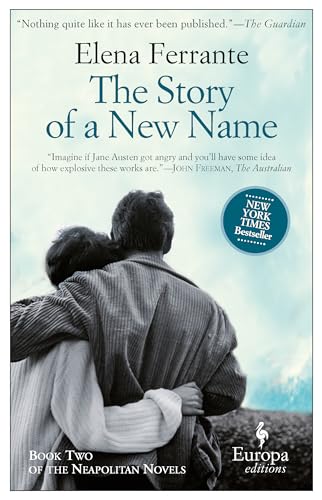
Synopsis
In 2012, Elena Ferrante’s My Brilliant Friend introduced readers to the unforgettable Elena and Lila, whose lifelong friendship provides the backbone for the Neapolitan Novels.
The Story of a New Name is the second book in this series. With these books, which the New Yorker’s James Wood described as “large, captivating, amiably peopled...a beautiful and delicate tale of confluence and reversal,” Ferrante proves herself to be one of Italy’s most accomplished storytellers. She writes vividly about a specific neighborhood of Naples from the late-1950s through to the current day and about two remarkable young women who are very much the products of that place and time. Yet in doing so she has created a world in which readers will recognize themselves and has drawn a marvelously nuanced portrait of friendship.
In The Story of a New Name, Lila has recently married and made her entrée into the family business; Elena, meanwhile, continues her studies and her exploration of the world beyond the neighborhood that she so often finds stifling. Love, jealousy, family, freedom, commitment, and above all friendship: these are signs under which both women live out this phase in their stories. Marriage appears to have imprisoned Lila, and the pressure to excel is at times too much for Elena. Yet the two young women share a complex and evolving bond that is central to their emotional lives and is a source of strength in the face of life’s challenges. In these Neapolitan Novels, Elena Ferrante, the acclaimed author of The Days of Abandonment, gives readers a poignant and universal story about friendship and belonging.
"synopsis" may belong to another edition of this title.
About the Authors
Elena Ferrante is the author of The Days of Abandonment (Europa, 2005), Troubling Love (Europa, 2006), The Lost Daughter (Europa, 2008), and the four novels known as the Neapolitan Quartet (My Brilliant Friend, The Story of a New Name, Those Who Leave and Those Who Stay, and The Story of the Lost Child) which were published by Europa Editions between 2012 and 2015. My Brilliant Friend, the HBO series directed by Saverio Costanzo, premiered in 2018. Ferrante is also the author of Frantumaglia: A Writer’s Journey (Europa, 2016), a children’s picture book illustrated by Mara Cerri, The Beach at Night (Europa, 2016), and a collection of personal essays illustrated by Andrea Ucini entitled Incidental Inventions (Europa, 2019). The Lost Daughter was made into a feature film directed by Maggie Gyllenhaal and starring Olivia Colman. Her most recent novel is The Lying Life of Adults (Europa, 2020). In the Margins, a collection of original essays on reading and writing, was published by Europa in 2022.
Ann Goldstein is one of the most accomplished translators from the Italian working today. Best known for her translations of Elena Ferrante’s oeuvre, she has also brought to Anglo-Saxon readers novels by Primo Levi, Pierpaolo Pasolini, Alessandro Baricco and other classic and contemporary Italian writers.
Excerpt. © Reprinted by permission. All rights reserved.
The Story of A New Name
Book Two of the Neapolitan novels
By Elena Ferrante, Ann GoldsteinEuropa Editions
Copyright © 2012 Edizioni E/O
All rights reserved.
ISBN: 978-1-60945-134-9All rights reserved.
CHAPTER 1
1.
In the spring of 1966, Lila, in a state of great agitation, entrusted to me a metal box that contained eight notebooks. She said that she could no longer keep them at home, she was afraid her husband might read them. I carried off the box without comment, apart from some ironic allusions to the excessive amount of string she had tied around it. At that time our relationship was terrible, but it seemed that only I considered it that way. The rare times we saw each other, she showed no embarrassment, only affection; a hostile word never slipped out.
When she asked me to swear that I wouldn't open the box for any reason, I swore. But as soon as I was on the train I untied the string, took out the notebooks, began to read. It wasn't a diary, although there were detailed accounts of the events of her life, starting with the end of elementary school. Rather, it seemed evidence of a stubborn self-discipline in writing. The pages were full of descriptions: the branch of a tree, the ponds, a stone, a leaf with its white veinings, the pots in the kitchen, the various parts of a coffeemaker, the brazier, the coal and bits of coal, a highly detailed map of the courtyard, the broad avenue of stradone, the rusting iron structure beyond the ponds, the gardens and the church, the cut of the vegetation alongside the railway, the new buildings, her parents' house, the tools her father and her brother used to repair shoes, their gestures when they worked, and above all colors, the colors of every object at different times of the day. But there were not only pages of description. Isolated words appeared, in dialect and in Italian, sometimes circled, without comment. And Latin and Greek translation exercises. And entire passages in English on the neighborhood shops and their wares, on the cart loaded with fruit and vegetables that Enzo Scanno took through the streets every day, leading the mule by the halter. And many observations on the books she read, the films she saw in the church hall. And many of the ideas that she had asserted in the discussions with Pasquale, in the talks she and I used to have. Of course, the progress was sporadic, but whatever Lila captured in writing assumed importance, so that even in the pages written when she was eleven or twelve there was not a single line that sounded childish.
Usually the sentences were extremely precise, the punctuation meticulous, the handwriting elegant, just as Maestra Oliviero had taught us. But at times, as if a drug had flooded her veins, Lila seemed unable to bear the order she had imposed on herself. Everything then became breathless, the sentences took on an overexcited rhythm, the punctuation disappeared. In general it didn't take long for her to return to a clear, easy pace. But it might also happen that she broke off abruptly and filled the rest of the page with little drawings of twisted trees, humped, smoking mountains, grim faces. I was entranced by both the order and the disorder, and the more I read, the more deceived I felt. How much practice there was behind the letter she had sent me on Ischia years earlier: that was why it was so well written. I put everything back in the box, promising myself not to become inquisitive again.
But I soon gave in—the notebooks exuded the force of seduction that Lila had given off since she was a child. She had treated the neighborhood, her family, the Solaras, Stefano, every person or thing with ruthless accuracy. And what to say of the liberty she had taken with me, with what I said, with what I thought, with the people I loved, with my very physical appearance. She had fixed moments that were decisive for her without worrying about anything or anyone. Here vividly was the pleasure she had felt when at ten she wrote her story, The Blue Fairy. Here just as vivid was what she had suffered when our teacher Maestra Oliviero hadn't deigned to say a single word about that story, in fact had ignored it. Here was the suffering and the fury because I had gone to middle school, neglecting her, abandoning her. Here the excitement with which she had learned to repair shoes, the desire to prove herself that had induced her to design new shoes, and the pleasure of completing the first pair with her brother Rino. Here the pain when Fernando, her father, had said that the shoes weren't well made. There was everything, in those pages, but especially hatred for the Solara brothers, the fierce determination with which she had rejected the love of the older, Marcello, and the moment when she had decided, instead, to marry the gentle Stefano Carracci, the grocer, who out of love had wanted to buy the first pair of shoes she had made, vowing that he would keep them forever. Ah, the wonderful moment when, at fifteen, she had felt herself a rich and elegant lady, on the arm of her fiance, who, all because he loved her, had invested a lot of money in her father and brother's shoe business: Cerullo shoes. And how much satisfaction she had felt: the shoes of her imagination in large part realized, a house in the new neighborhood, marriage at sixteen. And what a lavish wedding, how happy she was. Then Marcello Solara, with his brother Michele, had appeared in the middle of the festivities, wearing on his feet the very shoes that her husband had said were so dear to him. Her husband. What sort of man had she married? Now, when it was all over, would the false face be torn off, revealing the horribly true one underneath? Questions, and the facts, without embellishment, of our poverty. I devoted myself to those pages, for days, for weeks. I studied them. I ended up learning by heart the passages I liked, the ones that thrilled me, the ones that hypnotized me, the ones that humiliated me. Behind their naturalness was surely some artifice, but I couldn't discover what it was.
Finally, one evening in November, exasperated, I went out carrying the box. I couldn't stand feeling Lila on me and in me, even now that I was esteemed myself, even now that I had a life outside of Naples. I stopped on the Solferino bridge to look at the lights filtered through a cold mist. I placed the box on the parapet, and pushed it slowly, a little at a time, until it fell into the river, as if it were her, Lila in person, plummeting, with her thoughts, words, the malice with which she struck back at anyone, the way she appropriated me, as she did every person or thing or event or thought that touched her: books and shoes, sweetness and violence, the marriage and the wedding night, the return to the neighborhood in the new role of Signora Raffaella Carracci.
2.
I couldn't believe that Stefano, so kind, so in love, had given Marcello Solara the vestige of the child Lila, the evidence of her work on the shoes she had designed.
(Continues...)
Excerpted from The Story of A New Name by Elena Ferrante, Ann Goldstein. Copyright © 2012 Edizioni E/O. Excerpted by permission of Europa Editions.
All rights reserved. No part of this excerpt may be reproduced or reprinted without permission in writing from the publisher.
Excerpts are provided by Dial-A-Book Inc. solely for the personal use of visitors to this web site.
"About this title" may belong to another edition of this title.
Search results for The Story of a New Name: My Brilliant Friend Book 2:...

Stock Image
The Story of a New Name: A Novel (Neapolitan Novels, 2)
Seller: Your Online Bookstore, Houston, TX, U.S.A.
Seller rating 5 out of 5 stars

Paperback. Condition: Fair. Seller Inventory # 1609451341-4-24717970
Seller Image
The Story of a New Name: A Novel (Neapolitan Novels, 2)
Seller: Dream Books Co., Denver, CO, U.S.A.
Seller rating 5 out of 5 stars
Condition: acceptable. This copy has clearly been enjoyedâ"expect noticeable shelf wear and some minor creases to the cover. Binding is strong, and all pages are legible. May contain previous library markings or stamps. Seller Inventory # DBV.1609451341.A
Stock Image
The Story Of A New Name: Book 2
Seller: World of Books (was SecondSale), Montgomery, IL, U.S.A.
Seller rating 5 out of 5 stars
Paperback. Condition: Good. A novel in the bestselling quartet about two very different women and their complex friendship: "Everyone should read anything with Ferrante's name on it" (The Boston Globe). The follow-up to My Brilliant Friend, The Story of a New Name continues the epic New York Times-bestselling literary quartet that has inspired an HBO series, and returns us to the world of Lila and Elena, who grew up together in post-WWII Naples, Italy. In The Story of a New Name, Lila has recently married and made her entrée into the family business; Elena, meanwhile, continues her studies and her exploration of the world beyond the neighborhood that she so often finds stifling. Marriage appears to have imprisoned Lila, and the pressure to excel is at times too much for Elena. Yet the two young women share a complex and evolving bond that is central to their emotional lives and a source of strength in the face of life's challenges. In these Neapolitan Novels, Elena Ferrante, "one of the great novelists of our time" (The New York Times), gives us a poignant and universal story about friendship and belonging, a meditation on love and jealousy, freedom and commitment--at once a masterfully plotted page-turner and an intense, generous-hearted family saga. "Imagine if Jane Austen got angry and you'll have some idea of how explosive these works are."--The Australian "Brilliant . . . captivating and insightful . . . the richness of her storytelling is likely to please fans of Sara Gruen and Silvia Avallone."--Booklist (starred review). Seller Inventory # 00108920069
Stock Image
The Story Of A New Name: Book 2
Seller: World of Books (was SecondSale), Montgomery, IL, U.S.A.
Seller rating 5 out of 5 stars
Paperback. Condition: Fair. A novel in the bestselling quartet about two very different women and their complex friendship: "Everyone should read anything with Ferrante's name on it" (The Boston Globe). The follow-up to My Brilliant Friend, The Story of a New Name continues the epic New York Times-bestselling literary quartet that has inspired an HBO series, and returns us to the world of Lila and Elena, who grew up together in post-WWII Naples, Italy. In The Story of a New Name, Lila has recently married and made her entrée into the family business; Elena, meanwhile, continues her studies and her exploration of the world beyond the neighborhood that she so often finds stifling. Marriage appears to have imprisoned Lila, and the pressure to excel is at times too much for Elena. Yet the two young women share a complex and evolving bond that is central to their emotional lives and a source of strength in the face of life's challenges. In these Neapolitan Novels, Elena Ferrante, "one of the great novelists of our time" (The New York Times), gives us a poignant and universal story about friendship and belonging, a meditation on love and jealousy, freedom and commitment--at once a masterfully plotted page-turner and an intense, generous-hearted family saga. "Imagine if Jane Austen got angry and you'll have some idea of how explosive these works are."--The Australian "Brilliant . . . captivating and insightful . . . the richness of her storytelling is likely to please fans of Sara Gruen and Silvia Avallone."--Booklist (starred review). Seller Inventory # CIN1609452860A
Seller Image
The Story of a New Name: A Novel (Neapolitan Novels, 2)
Seller: Books for Life, LAUREL, MD, U.S.A.
Seller rating 5 out of 5 stars
Condition: very_good. Book is in very good condition. Clean with little to no signs of wear or markings highlights. Seller Inventory # LFM.9PSM
Stock Image
The Story of a New Name: A Novel (Neapolitan Novels, 2)
Seller: New Legacy Books, Annandale, NJ, U.S.A.
Seller rating 5 out of 5 stars
paperback. Condition: Good. Fast shipping and order satisfaction guaranteed. A portion of your purchase benefits Non-Profit Organizations, First Aid and Fire Stations! Seller Inventory # mon-ug-1609451341
Stock Image
The Story of a New Name: A Novel (Neapolitan Novels, 2)
Seller: Once Upon A Time Books, Siloam Springs, AR, U.S.A.
Seller rating 4 out of 5 stars

paperback. Condition: Acceptable. This is a used book. It may contain highlighting/underlining and/or the book may show heavier signs of wear . It may also be ex-library or without dustjacket. This is a used book. It may contain highlighting/underlining and/or the book may show heavier signs of wear . It may also be ex-library or without dustjacket. Seller Inventory # mon0003435143
Seller Image
The Story of a New Name: A Novel (Neapolitan Novels, 2)
Seller: Greenworld Books, Arlington, TX, U.S.A.
Seller rating 5 out of 5 stars
Condition: good. Fast Free Shipping â" Good condition. It may show normal signs of use, such as light writing, highlighting, or library markings, but all pages are intact and the book is fully readable. A solid, complete copy that's ready to enjoy. Seller Inventory # GWV.1609451341.G
Stock Image
The Story Of A New Name: Book 2
Seller: World of Books Inc, Montgomery, IL, U.S.A.
Seller rating 4 out of 5 stars
Paperback. Condition: Good. A novel in the bestselling quartet about two very different women and their complex friendship: "Everyone should read anything with Ferrante's name on it" (The Boston Globe). The follow-up to My Brilliant Friend, The Story of a New Name continues the epic New York Times-bestselling literary quartet that has inspired an HBO series, and returns us to the world of Lila and Elena, who grew up together in post-WWII Naples, Italy. In The Story of a New Name, Lila has recently married and made her entrée into the family business; Elena, meanwhile, continues her studies and her exploration of the world beyond the neighborhood that she so often finds stifling. Marriage appears to have imprisoned Lila, and the pressure to excel is at times too much for Elena. Yet the two young women share a complex and evolving bond that is central to their emotional lives and a source of strength in the face of life's challenges. In these Neapolitan Novels, Elena Ferrante, "one of the great novelists of our time" (The New York Times), gives us a poignant and universal story about friendship and belonging, a meditation on love and jealousy, freedom and commitment--at once a masterfully plotted page-turner and an intense, generous-hearted family saga. "Imagine if Jane Austen got angry and you'll have some idea of how explosive these works are."--The Australian "Brilliant . . . captivating and insightful . . . the richness of her storytelling is likely to please fans of Sara Gruen and Silvia Avallone."--Booklist (starred review). Seller Inventory # CIN1609452860G
Stock Image
The Story Of A New Name: Book 2
Seller: World of Books Inc, Montgomery, IL, U.S.A.
Seller rating 4 out of 5 stars
Paperback. Condition: Fair. A novel in the bestselling quartet about two very different women and their complex friendship: "Everyone should read anything with Ferrante's name on it" (The Boston Globe). The follow-up to My Brilliant Friend, The Story of a New Name continues the epic New York Times-bestselling literary quartet that has inspired an HBO series, and returns us to the world of Lila and Elena, who grew up together in post-WWII Naples, Italy. In The Story of a New Name, Lila has recently married and made her entrée into the family business; Elena, meanwhile, continues her studies and her exploration of the world beyond the neighborhood that she so often finds stifling. Marriage appears to have imprisoned Lila, and the pressure to excel is at times too much for Elena. Yet the two young women share a complex and evolving bond that is central to their emotional lives and a source of strength in the face of life's challenges. In these Neapolitan Novels, Elena Ferrante, "one of the great novelists of our time" (The New York Times), gives us a poignant and universal story about friendship and belonging, a meditation on love and jealousy, freedom and commitment--at once a masterfully plotted page-turner and an intense, generous-hearted family saga. "Imagine if Jane Austen got angry and you'll have some idea of how explosive these works are."--The Australian "Brilliant . . . captivating and insightful . . . the richness of her storytelling is likely to please fans of Sara Gruen and Silvia Avallone."--Booklist (starred review). Seller Inventory # CIN1609452860A