
Items related to Way To Go, The - Sample Copies
Synopsis
"Is it possibly to write a stunning book about infrastructure? Kate Ascher’s books are bliss... Using gorgeous graphics and clear, simple, language, Ascher explains the infrastructure and engineering marvels around us." --Slate.com
In our digital age, it’s easy to forget that almost everything we enjoy about modern life depends on motion. We ride in cars and on buses and trains to work; enjoy food shipped over oceans; fly high in the sky to any point on the planet. Over the last century, the world has come to rely on its ability to move just about anywhere effortlessly. But what prompted this transformation? What inventions allowed it to happen? And how do the vehicles and systems that keep us in motion today?airports, trains, cars, and satellites?really work?
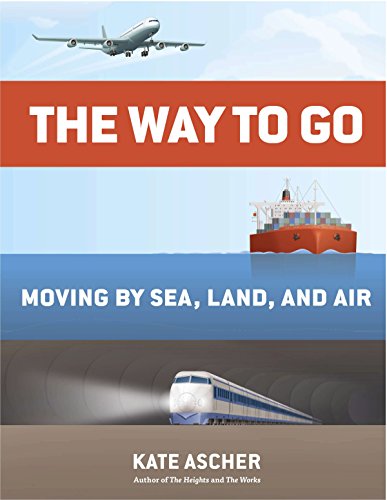
Exploring our incredible interconnected world is the task of Kate Ascher’s The Way to Go: Moving by Sea, Land, and Air. Lusciously illustrated and meticulously researched, The Way to Go reveals the highly complex and largely invisible network of global transportation. How is cargo moved from inland factory to seaside port, and how is it transferred from shore to ship? How do ships and planes navigate their routes without landmarks? What happens under the hood of a car or in the undercarriage of a people mover? How did planes become cheaper than ships or trains? Why are some spaceships reusable and others not? What tools are needed to build today’s immense bridges and tunnels, and what ensures they don’t collapse? How does a helicopter really stay aloft? What happens when lightning strikes an airplane or when one satellite crashes with another? What will the car of tomorrow look like?
Focusing on the machines that underpin our lives, Ascher’s The Way to Go also introduces the systems that keep those machines in business?the emergency communication networks that connect ships at sea, the automated tolling mechanisms that maintain the flow of highway traffic, the air control network that keeps planes from colliding in the sky. Equally fascinating are the technologies behind these complex systems: baggage tag readers that make sure people’s bags go where they need to; automated streetlights that adjust their timing based on traffic flow; GPS devices that pinpoint where we are on earth at any second. Together these technologies move more people farther, faster, and more cheaply than at any other time in history.
As our lives and our businesses become more entwined with others across the globe, there has never been a better time to understand how transportation works. Indispensable and unforgettable, Kate Ascher’s The Way to Go is a gorgeous graphic guide to a world moving as never before.
"synopsis" may belong to another edition of this title.
About the Authors
KATE ASCHER serves on the faculty of Columbia University’s Graduate School of Architecture, Planning and Preservation and manages Happold Consulting’s U.S. practice. Prior to taking up her current positions, she worked at the Port Authority of New York and New Jersey, the New York City Economic Development Corporation, and Vornado Realty Trust. Her former books include The Works: Anatomy of a City and The Heights: Anatomy of a Skyscraper.
KATE ASCHER serves on the faculty of Columbia University’s Graduate School of Architecture, Planning and Preservation and manages Happold Consulting’s U.S. practice. Prior to taking up her current positions, she worked at the Port Authority of New York and New Jersey, the New York City Economic Development Corporation, and Vornado Realty Trust. Her former books includeThe Works: Anatomy of a City and The Heights: Anatomy of a Skyscraper.
"About this title" may belong to another edition of this title.
Search results for Way To Go, The - Sample Copies

Stock Image
The Way to Go: Moving by Sea, Land, and Air
Seller: Once Upon A Time Books, Siloam Springs, AR, U.S.A.
Seller rating 4 out of 5 stars

hardcover. Condition: Acceptable. This is a used book. It may contain highlighting/underlining and/or the book may show heavier signs of wear . It may also be ex-library or without dustjacket. This is a used book. It may contain highlighting/underlining and/or the book may show heavier signs of wear . It may also be ex-library or without dustjacket. Seller Inventory # mon0003477679
Stock Image
Way To Go, The - Sample Copies
Seller: World of Books (was SecondSale), Montgomery, IL, U.S.A.
Seller rating 5 out of 5 stars

Hardback. Condition: Good. In our digital age, it's easy to forget that almost everything we enjoy about modern life depends on motion. We ride in cars and on buses and trains to work; enjoy food shipped over oceans; fly high in the sky to any point on the planet. Over the last century, the world has come to rely on its ability to move just about anywhere effortlessly. But what prompted this transformation? What inventions allowed it to happen? And how do the vehicles and networks that keep us in motion today - airports, trains, cars, and satellites - really work? Exploring our incredible interconnected world is the task of Kate Ascher's The Way to Go- Moving Through Sea, Land, and Air. Lusciously illustrated and meticulously researched, The Way to Goreveals the highly complex and largely invisible network of global transportation. How is cargo moved inland factory to seaside port, and how is it transferred from shore to ship? How do ships and planes navigate their routes without landmarks? What happens under the hood of a car or in the undercarriage of a people mover? How did planes become cheaper than ships or trains? Why are some spaceships reusable and others not? What tools are needed to build today's immense bridges and tunnels, and what ensures they don't collapse? How does a helicopter really stay aloft? What happens when lightning strikes an airplane or when one satellite crashes with another? What will the car of tomorrow look like? Focusing on the machines that underpin our lives, Ascher's The Way to Goalso introduces the systems that keep those machines in business - the emergency communication networks that connect ships at sea, the automated tolling systems that maintain the flow of highway traffic, the air control network that keeps planes from colliding in the sky. Equally fascinating are the technologies behind these complex systems- baggage tag readers that make sure people's bags go where they need to; automated street lights that adjust their timing based on traffic flow; GPS devices that pinpoint where we are on earth at any second. Together these technologies move more people farther, faster, and more cheaply than at any other time in history. As our lives and our businesses become more entwined with others across the globe, there has never been a better time to understand how transportation works. Indispensable and unforgettable, Kate Ascher's The Way to Gois a gorgeous graphic guide to a world moving as never before. Seller Inventory # 00110076718
Stock Image
The Way to Go: Moving by Sea, Land, and Air
Published by
Penguin Press (edition First Edition), 2014
ISBN 10: 1594204683
ISBN 13: 9781594204685
Used
Hardcover
First Edition
Seller: BooksRun, Philadelphia, PA, U.S.A.
Seller rating 5 out of 5 stars
Hardcover. Condition: Fair. First Edition. With dust jacket. The item might be beaten up but readable. May contain markings or highlighting, as well as stains, bent corners, or any other major defect, but the text is not obscured in any way. Seller Inventory # 1594204683-7-1-29
Stock Image
The Way to Go: Moving by Sea, Land, and Air
Seller: ThriftBooks-Phoenix, Phoenix, AZ, U.S.A.
Seller rating 5 out of 5 stars
Hardcover. Condition: Good. No Jacket. Pages can have notes/highlighting. Spine may show signs of wear. ~ ThriftBooks: Read More, Spend Less. Seller Inventory # G1594204683I3N00
Stock Image
The Way to Go: Moving by Sea, Land, and Air
Seller: ThriftBooks-Atlanta, AUSTELL, GA, U.S.A.
Seller rating 5 out of 5 stars
Hardcover. Condition: Good. No Jacket. Pages can have notes/highlighting. Spine may show signs of wear. ~ ThriftBooks: Read More, Spend Less. Seller Inventory # G1594204683I3N00
Stock Image
The Way to Go: Moving by Sea, Land, and Air
Seller: ThriftBooks-Dallas, Dallas, TX, U.S.A.
Seller rating 5 out of 5 stars
Hardcover. Condition: Good. No Jacket. Pages can have notes/highlighting. Spine may show signs of wear. ~ ThriftBooks: Read More, Spend Less. Seller Inventory # G1594204683I3N00
Stock Image
The Way to Go : Moving by Sea, Land, and Air
Published by
Penguin Publishing Group, 2014
ISBN 10: 1594204683
ISBN 13: 9781594204685
Used
Hardcover
Seller: Better World Books: West, Reno, NV, U.S.A.
Seller rating 5 out of 5 stars
Condition: Good. Former library copy. Pages intact with minimal writing/highlighting. The binding may be loose and creased. Dust jackets/supplements are not included. Includes library markings. Stock photo provided. Product includes identifying sticker. Better World Books: Buy Books. Do Good. Seller Inventory # 8018452-20
Stock Image
The Way to Go : Moving by Sea, Land, and Air
Published by
Penguin Publishing Group, 2014
ISBN 10: 1594204683
ISBN 13: 9781594204685
Used
Hardcover
Seller: Better World Books, Mishawaka, IN, U.S.A.
Seller rating 5 out of 5 stars
Condition: Very Good. Former library copy. Pages intact with possible writing/highlighting. Binding strong with minor wear. Dust jackets/supplements may not be included. Includes library markings. Stock photo provided. Product includes identifying sticker. Better World Books: Buy Books. Do Good. Seller Inventory # 6031168-6
Stock Image
Way To Go, The - Sample Copies
Seller: World of Books Inc, Montgomery, IL, U.S.A.
Seller rating 4 out of 5 stars
Hardback. Condition: Good. In our digital age, it's easy to forget that almost everything we enjoy about modern life depends on motion. We ride in cars and on buses and trains to work; enjoy food shipped over oceans; fly high in the sky to any point on the planet. Over the last century, the world has come to rely on its ability to move just about anywhere effortlessly. But what prompted this transformation? What inventions allowed it to happen? And how do the vehicles and networks that keep us in motion today - airports, trains, cars, and satellites - really work? Exploring our incredible interconnected world is the task of Kate Ascher's The Way to Go- Moving Through Sea, Land, and Air. Lusciously illustrated and meticulously researched, The Way to Goreveals the highly complex and largely invisible network of global transportation. How is cargo moved inland factory to seaside port, and how is it transferred from shore to ship? How do ships and planes navigate their routes without landmarks? What happens under the hood of a car or in the undercarriage of a people mover? How did planes become cheaper than ships or trains? Why are some spaceships reusable and others not? What tools are needed to build today's immense bridges and tunnels, and what ensures they don't collapse? How does a helicopter really stay aloft? What happens when lightning strikes an airplane or when one satellite crashes with another? What will the car of tomorrow look like? Focusing on the machines that underpin our lives, Ascher's The Way to Goalso introduces the systems that keep those machines in business - the emergency communication networks that connect ships at sea, the automated tolling systems that maintain the flow of highway traffic, the air control network that keeps planes from colliding in the sky. Equally fascinating are the technologies behind these complex systems- baggage tag readers that make sure people's bags go where they need to; automated street lights that adjust their timing based on traffic flow; GPS devices that pinpoint where we are on earth at any second. Together these technologies move more people farther, faster, and more cheaply than at any other time in history. As our lives and our businesses become more entwined with others across the globe, there has never been a better time to understand how transportation works. Indispensable and unforgettable, Kate Ascher's The Way to Gois a gorgeous graphic guide to a world moving as never before. Seller Inventory # CIN1594204683G