
Items related to Parallel Paths to Constructivism: Jean Piaget and Lev...
Synopsis
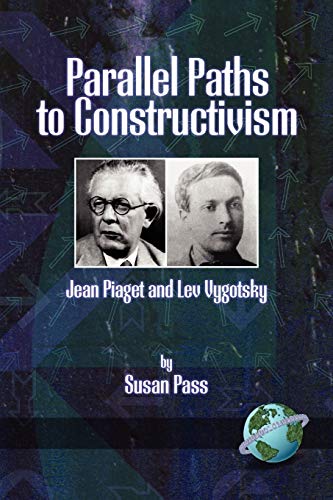
No two people were more responsible for the current way lessons are taught worldwide than Jean Piaget and Lev Vygotsky. Both men had an important impact worldwide on how a person should be taught--starting in the last century and continuing today. Jean Piaget's Genetic Epistemology concentrated on the individual in learning. Lev Vygotsky's CulturalHistorical Theory concentrated on the social in learning. All over the world, teachers today use each man's ideas. Some use them at different times in their classrooms and others have learned to use them combined into the same lesson--bringing us to the crux of this book; namely, there are many lessons to learn by discovering the dynamics in the lives of both men. While both were from very different countries, there are many similarities in their lives. While most professors teaching introductory educational psychology courses focus on the difference in their lesson strategies, there are some remarkable similarities between their respective pedagogies. While differences in their families and countries were obviously significant, the two men differed surprisingly little in their pedagogical views and their basic ideas. Their similarities in views and ideas are due to the similarities in their lives. Chapter 1 looks at those similarities by looking at influences in their childhood. Chapter 2 observes their adolescence. Chapter 3 concentrates on young adulthood. Chapter 4 covers their postgraduate work. Chapter 5 traces the origins of their major ideas. For Jean Piaget, we look at the origin of chronological stages of development, the role of language, the role of the teacher, optimal mismatch, equilibration, error, and play. For Lev Vygotsky, we look at the origin of zone of proximal development, internalization, stage of development, "the social other," role of language, error, sociohistorical context of learning, scaffolding and play. Chapter 6 deals with how Jean Piaget and Lev Vygotsky were able to overcome adversity and the lessons that can be learned by such overcoming. Chapter 7 provides a new pedagogy based on the communications that Jean Piaget and Lev Vygotsky had with each other, noting the influence such communications had on their mutual ideas.
"synopsis" may belong to another edition of this title.
Synopsis
Psychological historian Pass looks at how the life experiences of Swedish scientist Piaget (1896-1980) and Russian psychologist Vygotsky (1896-1934) led to their influential theories about teaching and learning. She also points out similarities between Piaget's genetic epistemology concentrated on the individual and Vygotsky's cultural-historical t
"About this title" may belong to another edition of this title.
Search results for Parallel Paths to Constructivism: Jean Piaget and Lev...

Stock Image
Parallel Paths to Constructivism: Jean Piaget and Lev Vygotsky
Seller: World of Books (was SecondSale), Montgomery, IL, U.S.A.
Seller rating 5 out of 5 stars

Paperback. Condition: Good. Psychological historian Pass looks at how the life experiences of Swedish scientist Piaget (1896-1980) and Russian psychologist Vygotsky (1896-1934) led to their influential theories about teaching and learning. She also points out similarities between Piaget's genetic epistemology concentrated on the individual and Vygotsky's cultural-historical t. Seller Inventory # 00098550126
Stock Image
Parallel Paths to Constructivism : Jean Piaget and Lev Vygotsky
Published by
Information Age Publishing, Incorporated, 2004
ISBN 10: 1593111452
ISBN 13: 9781593111458
Used
Softcover
Seller: Better World Books: West, Reno, NV, U.S.A.
Seller rating 5 out of 5 stars
Condition: Good. Former library copy. Pages intact with minimal writing/highlighting. The binding may be loose and creased. Dust jackets/supplements are not included. Includes library markings. Stock photo provided. Product includes identifying sticker. Better World Books: Buy Books. Do Good. Seller Inventory # GRP97024758
Stock Image
Parallel Paths to Constructivism : Jean Piaget and Lev Vygotsky
Published by
Information Age Publishing, Incorporated, 2004
ISBN 10: 1593111452
ISBN 13: 9781593111458
Used
Softcover
Seller: Better World Books, Mishawaka, IN, U.S.A.
Seller rating 5 out of 5 stars
Condition: Good. Former library copy. Pages intact with minimal writing/highlighting. The binding may be loose and creased. Dust jackets/supplements are not included. Includes library markings. Stock photo provided. Product includes identifying sticker. Better World Books: Buy Books. Do Good. Seller Inventory # GRP97024758
Stock Image
Parallel Paths to Constructivism : Jean Piaget and Lev Vygotsky
Published by
Information Age Publishing, Incorporated, 2004
ISBN 10: 1593111452
ISBN 13: 9781593111458
Used
Softcover
Seller: Better World Books, Mishawaka, IN, U.S.A.
Seller rating 5 out of 5 stars
Condition: Very Good. Former library copy. Pages intact with possible writing/highlighting. Binding strong with minor wear. Dust jackets/supplements may not be included. Includes library markings. Stock photo provided. Product includes identifying sticker. Better World Books: Buy Books. Do Good. Seller Inventory # 8930376-6
Seller Image
Parallel Paths to Constructivism: Jean Piaget and Lev Vygotsky
Published by
Information Age Publishing, 2004
ISBN 10: 1593111452
ISBN 13: 9781593111458
Used
Softcover
Seller: ZBK Books, Carlstadt, NJ, U.S.A.
Seller rating 5 out of 5 stars
Condition: very_good. Fast & Free Shipping â" Very Good condition book with a firm cover and clean pages. Shows normal use and some light wear or limited notes markings. A solid, nice copy to enjoy. Seller Inventory # ZWV.1593111452.VG
Stock Image
Parallel Paths to Constructivism: Jean Piaget and Lev Vygotsky
Seller: World of Books Inc, Montgomery, IL, U.S.A.
Seller rating 4 out of 5 stars

Paperback. Condition: Good. Psychological historian Pass looks at how the life experiences of Swedish scientist Piaget (1896-1980) and Russian psychologist Vygotsky (1896-1934) led to their influential theories about teaching and learning. She also points out similarities between Piaget's genetic epistemology concentrated on the individual and Vygotsky's cultural-historical t. Seller Inventory # CIN1593111452G
Stock Image
Parallel Paths to Constructivism : Jean Piaget and Lev Vygotsky
Published by
Information Age Publishing, Incorporated, 2004
ISBN 10: 1593111452
ISBN 13: 9781593111458
Used
Softcover
Seller: Better World Books Ltd, Dunfermline, United Kingdom
Seller rating 5 out of 5 stars
Condition: Good. Former library copy. Pages intact with minimal writing/highlighting. The binding may be loose and creased. Dust jackets/supplements are not included. Includes library markings. Stock photo provided. Product includes identifying sticker. Better World Books: Buy Books. Do Good. Seller Inventory # GRP97024758
Buy Used
£ 6.92
£ 5 shipping
Ships from United Kingdom to U.S.A.
Ships from United Kingdom to U.S.A.
Quantity: 2 available
Stock Image
Parallel Paths to Constructivism: Jean Piaget and Lev Vygotsky
Published by
Information Age Publishing, 2004
ISBN 10: 1593111452
ISBN 13: 9781593111458
Used
Softcover
Seller: Anybook.com, Lincoln, United Kingdom
Seller rating 5 out of 5 stars
Condition: Good. This is an ex-library book and may have the usual library/used-book markings inside.This book has soft covers. In good all round condition. Please note the Image in this listing is a stock photo and may not match the covers of the actual item,350grams, ISBN:9781593111458. Seller Inventory # 4327785
Buy Used
£ 30.40
£ 13.04 shipping
Ships from United Kingdom to U.S.A.
Ships from United Kingdom to U.S.A.
Quantity: 1 available
Seller Image
Parallel Paths To Constructivism : Jean Piaget And Lev Vygotsky
Published by
Information Age Publishing, 2004
ISBN 10: 1593111452
ISBN 13: 9781593111458
Used
Softcover
Seller: GreatBookPrices, Columbia, MD, U.S.A.
Seller rating 5 out of 5 stars
Condition: As New. Unread book in perfect condition. Seller Inventory # 3246539
Stock Image
Parallel Paths to Constructivism: Jean Piaget and Lev Vygotsky (PB)
Published by
Information Age Publishing 2004-11, 2004
ISBN 10: 1593111452
ISBN 13: 9781593111458
New
PF
Seller: Chiron Media, Wallingford, United Kingdom
Seller rating 5 out of 5 stars
PF. Condition: New. This item is printed on demand. Brand new book, sourced directly from publisher. Dispatch time is 6-7 days from our warehouse. Book will be sent in robust, secure packaging to ensure it reaches you securely. Seller Inventory # 6666-IUK-9781593111458
Buy New
£ 47.48
£ 4.49 shipping
Ships from United Kingdom to U.S.A.
Ships from United Kingdom to U.S.A.
Quantity: 20 available