
Items related to Trees of Texas Field Guide (Tree Identification Guides)
Synopsis
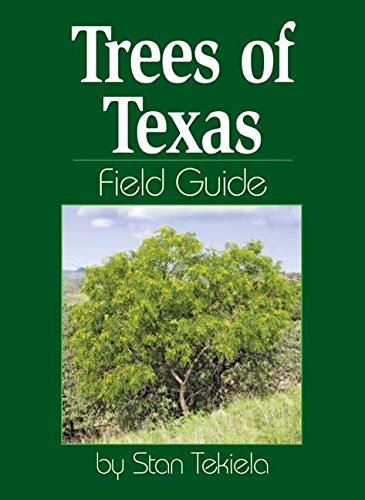
Make tree identification in Texas even more enjoyable!
Now tree identification is simple and productive.
- 180 species―only Texas trees! No need to look through dozens of photos of trees that don’t grow in Texas
- Fact-filled information and stunning, professional photographs
- Easy-to-use thumb tabs showing leaf type and attachment and compare feature showing average tree height
- Stan’s Notes, including naturalist information and gee-whiz facts
"synopsis" may belong to another edition of this title.
About the Author
Naturalist, wildlife photographer and writer Stan Tekiela is the originator of the popular state-specific field guide series. Stan has authored more than 190 educational books, including field guides, quick guides, nature books, children’s books, playing cards and more, presenting many species of animals and plants. With a Bachelor of Science degree in Natural History from the University of Minnesota and as an active professional naturalist for more than 30 years, Stan studies and photographs wildlife throughout the United States and Canada. He has received various national and regional awards for his books and photographs. Also a well-known columnist and radio personality, his syndicated column appears in more than 25 newspapers, and his wildlife programs are broadcast on a number of Midwest radio stations. Stan can be followed on Facebook and Twitter.
Excerpt. © Reprinted by permission. All rights reserved.
Green Ash
Fraxinus pennsylvanica
Family: Olive (Oleaceae)
Height: 50-60' (15-18 m)
Tree: single straight trunk with ascending branches and irregular crown
Leaf: compound, 9-16" (22.5-40 cm) long, oppositely attached, made of 5-9 stalked leaflets, each leaflet 1-2" (2.5-5 cm) long, lacking teeth or with a very fine-toothed margin, on a very short leaflet stalk (petiolule), 1⁄8" (.3 cm) long
Bark: brown with deep furrows and narrow interlacing ridges, often appearing diamond-shaped
Fruit: green winged seed (samara), turning brown when mature, 1-2" (2.5-5 cm) in length, mostly round-ended, sometimes notched, in clusters, frequently remaining on tree into winter
Fall Color: yellow
Origin/Age: native, 75-100 years
Habitat: wet soils, along streams, lowland forest, shade
Range: eastern half of Texas, scattered in the panhandle, planted in parks and yards
Stan’s Notes: The most wide-ranging of the ash trees in Texas. Also known as Red Ash because it was once thought that the Green Ash and Red Ash trees were separate species. These are now considered one species. Able to survive with its roots under water for several weeks early in spring. Often has a large unattractive growth (insect gall) at the ends of small branches that persists on the tree throughout the year. The strong white wood is used to make baseball bats, tennis racquets, skis and snowshoes.
"About this title" may belong to another edition of this title.
Search results for Trees of Texas Field Guide (Tree Identification Guides)

Stock Image
Trees of Texas Field Guide
Published by
Advance Publishing In.,US, 2009
ISBN 10: 1591932157
ISBN 13: 9781591932154
Used
Paperback
Seller: World of Books (was SecondSale), Montgomery, IL, U.S.A.
Seller rating 5 out of 5 stars

Paperback. Condition: Fair. Make tree identification in Texas even more enjoyable! Now tree identification is simple and productive. 180 species--only Texas trees! No need to look through dozens of photos of trees that don't grow in Texas Fact-filled information and stunning, professional photographs Easy-to-use thumb tabs showing leaf type and attachment and compare feature showing average tree height Stan's Notes, including naturalist information and gee-whiz facts. Seller Inventory # 00109534500
Stock Image
Trees of Texas Field Guide
Published by
Advance Publishing In.,US, 2009
ISBN 10: 1591932157
ISBN 13: 9781591932154
Used
Paperback
Seller: World of Books (was SecondSale), Montgomery, IL, U.S.A.
Seller rating 5 out of 5 stars
Paperback. Condition: Good. Make tree identification in Texas even more enjoyable! Now tree identification is simple and productive. 180 species--only Texas trees! No need to look through dozens of photos of trees that don't grow in Texas Fact-filled information and stunning, professional photographs Easy-to-use thumb tabs showing leaf type and attachment and compare feature showing average tree height Stan's Notes, including naturalist information and gee-whiz facts. Seller Inventory # 00109595570
Stock Image
Trees of Texas Field Guide (Tree Identification Guides)
Seller: Half Price Books Inc., Dallas, TX, U.S.A.
Seller rating 5 out of 5 stars
Paperback. Condition: Very Good. Connecting readers with great books since 1972! Used books may not include companion materials, and may have some shelf wear or limited writing. We ship orders daily and Customer Service is our top priority! Seller Inventory # S_479288547
Stock Image
Trees of Texas Field Guide (Tree Identification Guides)
Seller: HPB-Ruby, Dallas, TX, U.S.A.
Seller rating 5 out of 5 stars
Paperback. Condition: Very Good. Connecting readers with great books since 1972! Used books may not include companion materials, and may have some shelf wear or limited writing. We ship orders daily and Customer Service is our top priority! Seller Inventory # S_478348725
Stock Image
Trees of Texas Field Guide (Tree Identification Guides)
Seller: HPB-Red, Dallas, TX, U.S.A.
Seller rating 5 out of 5 stars
Paperback. Condition: Good. Connecting readers with great books since 1972! Used textbooks may not include companion materials such as access codes, etc. May have some wear or writing/highlighting. We ship orders daily and Customer Service is our top priority! Seller Inventory # S_481874046
Seller Image
Trees of Texas Field Guide (Tree Identification Guides)
Seller: Goodwill San Antonio, San Antonio, TX, U.S.A.
Seller rating 5 out of 5 stars
Condition: good. Seller Inventory # SANV.1591932157.G
Stock Image
Trees of Texas Field Guide (Tree Identification Guides)
Seller: GoldBooks, Denver, CO, U.S.A.
Seller rating 5 out of 5 stars
Paperback. Condition: new. New Copy. Customer Service Guaranteed. Seller Inventory # 74U51_78_1591932157
Stock Image
Trees of Texas Field Guide
Seller: Revaluation Books, Exeter, United Kingdom
Seller rating 5 out of 5 stars
Paperback. Condition: Brand New. 374 pages. 6.00x4.50x0.75 inches. In Stock. Seller Inventory # 1591932157
Buy New
£ 43.11
£ 10 shipping
Ships from United Kingdom to U.S.A.
Ships from United Kingdom to U.S.A.
Quantity: 1 available
Stock Image
Trees of Texas Field Guide (Tree Identification Guides)
Seller: BennettBooksLtd, Los Angeles, CA, U.S.A.
Seller rating 5 out of 5 stars
paperback. Condition: New. In shrink wrap. Looks like an interesting title! Seller Inventory # Q-1591932157