
Items related to Miserable Miracle: Mescaline (New York Review Books...
Synopsis
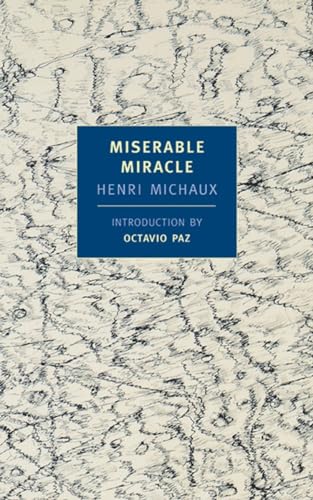
"This book is an exploration. By means of words, signs, drawings. Mescaline, the subject explored." In Miserable Miracle, the great French poet and artist Henri Michaux, a confirmed teetotaler, tells of his life-transforming first encounters with a powerful hallucinogenic drug. At once lacerating and weirdly funny, challenging and Chaplinesque, his book is a breathtaking vision of interior space and a piece of stunning writing wrested from the grip of the unspeakable.
"synopsis" may belong to another edition of this title.
About the Author
Henri Michaux (1899 -1984) was born in Namur, Belgium, the son of a lawyer, and educated at a Jesuit school in Brussels. He contemplated entering the priesthood, turned to the study of medicine, then left school entirely, enlisting instead as a stoker in the French merchant marine. Michaux's travels, throughout the Americas, Asia, and Africa, were to inspire his first two books, the extraordinary travelogues Ecuador and A Barbarian in Asia (later translated into Spanish by Jorge Luis Borges). Settling in Paris, Michaux began to write and paint, and his work, especially his prose poems recounting the strange and very funny misadventures of the character he called Monsieur Plume, drew the attention and praise of other writers, among them André Gide. In 1948 Michaux's wife died after accidentally setting her nightgown on fire; devastated, Michaux devoted himself increasingly to his distinctive calligraphic drawings in ink. He also began to take mescaline at regular intervals, recording his deeply disorienting, often traumatic experiences in a series of unflinching texts beginning with Miserable Miracle. Celebrated in France and around the world for his accomplishments as a writer and artist, Michaux remained averse to publicity and public honors throughout his life, and in 1965 refused the French Grand Prix National des Lettres. For many years the only photograph of himself that he allowed to circulate showed his right hand holding a pen over a sheet of paper on a chaotic writing desk.<br /><br />Octavio Paz (1914-1998) was born in Mexico City, and his extraordinarily busy and fruitful life took him from civil-war Spain to surrealist Paris, from US universities to the Mexican embassy in New Delhi, where he served for six years as ambassador before resigning in protest after his government's suppression of student demonstrations at the 1968 Olympic Games. A great poet, Paz was also the author of many essays and a study of Mexican identity, The Labyrinth of Solitude, as well as the founder and editor of two important journals, Plural and Vuelta. Octavio Paz received the Nobel Prize for Literature in 1990.
"About this title" may belong to another edition of this title.
Search results for Miserable Miracle: Mescaline (New York Review Books...

Seller Image
Miserable Miracle : Mescaline
Seller: GreatBookPrices, Columbia, MD, U.S.A.
Seller rating 5 out of 5 stars

Condition: New. Seller Inventory # 591072-n
Stock Image
Miserable Miracle
Published by
New York Review of Books, Incorporated, The, 2002
ISBN 10: 1590170016
ISBN 13: 9781590170014
Used
Softcover
Seller: Better World Books, Mishawaka, IN, U.S.A.
Seller rating 5 out of 5 stars
Condition: Good. Pages intact with minimal writing/highlighting. The binding may be loose and creased. Dust jackets/supplements are not included. Stock photo provided. Product includes identifying sticker. Better World Books: Buy Books. Do Good. Seller Inventory # 13052998-6
Seller Image
Miserable Miracle
Published by
New York Review Books, US, 2002
ISBN 10: 1590170016
ISBN 13: 9781590170014
New
Paperback
Seller: Rarewaves USA, HEBRON, KY, U.S.A.
Seller rating 5 out of 5 stars
Paperback. Condition: New. Main. Seller Inventory # LU-9781590170014
Seller Image
Miserable Miracle (New York Review Books Classics)
Seller: Goodwill of Central and Coastal Virginia, Richmond, VA, U.S.A.
Seller rating 4 out of 5 stars

Condition: acceptable. Seller Inventory # CCVV.1590170016.A
Seller Image
Miserable Miracle : Mescaline
Seller: GreatBookPrices, Columbia, MD, U.S.A.
Seller rating 5 out of 5 stars
Condition: As New. Unread book in perfect condition. Seller Inventory # 591072
Stock Image
Miserable Miracle Format: Paperback
Seller: INDOO, Avenel, NJ, U.S.A.
Seller rating 5 out of 5 stars
Condition: As New. Unread copy in mint condition. Seller Inventory # RH9781590170014
Stock Image
Miserable Miracle Format: Paperback
Seller: INDOO, Avenel, NJ, U.S.A.
Seller rating 5 out of 5 stars
Condition: New. Brand New. Seller Inventory # 9781590170014
Stock Image
Miserable Miracle: Mescaline
Seller: Magers and Quinn Booksellers, Minneapolis, MN, U.S.A.
Seller rating 5 out of 5 stars
paperback. Condition: Like New. May have light shelf wear and/or a remainder mark. Complete. Clean pages. paperback. Seller Inventory # 639904
Seller Image
Miserable Miracle (Paperback)
Published by
New York Review Books, New York, 2002
ISBN 10: 1590170016
ISBN 13: 9781590170014
New
Paperback
Seller: Grand Eagle Retail, Bensenville, IL, U.S.A.
Seller rating 5 out of 5 stars
Paperback. Condition: new. Paperback. "This book is an exploration. By means of words, signs, drawings. Mescaline, the subject explored." In Miserable Miracle, the great French poet and artist Henri Michaux, a confirmed teetotaler, tells of his life-transforming first encounters with a powerful hallucinogenic drug. At once lacerating and weirdly funny, challenging and Chaplinesque, his book is a breathtaking vision of interior space and a piece of stunning writing wrested from the grip of the unspeakable.Includes forty pages of black-and-white drawings. In Miserable Miracle, the great French poet and artist Henri Michaux, a confirmed teetotaler, tells of his life-transforming first encounters with a powerful hallucinogenic drug. Shipping may be from multiple locations in the US or from the UK, depending on stock availability. Seller Inventory # 9781590170014
Stock Image
Miserable Miracle
Seller: Massive Bookshop, Erving, MA, U.S.A.
Seller rating 4 out of 5 stars
Paperback. Condition: New. Seller Inventory # 9781590170014