
Items related to Trauma and Disaster Responses and Management (Review...
Trauma and Disaster Responses and Management (Review of Psychiatry) (Review of Psychiatry): Review of Psychiatry, Volume 22 - Softcover
Synopsis
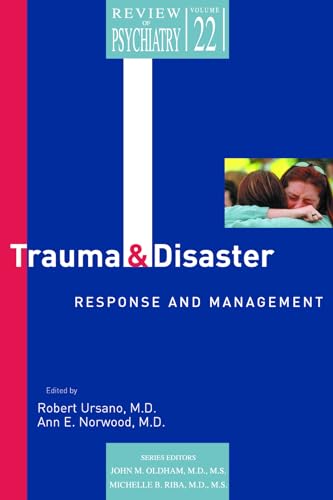
In our increasingly dangerous world - brought into urgent focus by the September 11th attacks - the need to manage the psychiatic consequences of traumatic events and disasters has never been greater. The editors of this reference summarize our current understanding of the complex psychological, behavioural, and social responses to disaster, and present a case for intensifying our focus on delivery and intervention efforts. After a discussion of neurobiological and neuroanatomic responses to severe traumatic events, chapter two focuses on the psychiatric epidemiology of disasters, presenting a guide for clinicians in identifying and following groups at high risk of developing psychiatric disorders and an empirical blueprint for developing community interventions. Chapter three focuses on the impact of traumatic stressors on children, debunking the myth that children are more resilient than adults. Chapter four discusses the psyhological interventions following mass violence. Chapter five presents the special dilemmas posed by weapons of mass destruction and offers recommendations on how nations can enhance preparedness against these novel weapons.
"synopsis" may belong to another edition of this title.
About the Author
Robert J. Ursano, M.D., is Professor and Chairman in the Department of Psychiatry at F. Herbert School of Medicine of Uniformed Services University of the Health Sciences in Bethesda, Maryland. Ann E. Norwood, M.D., is Associate Professor and Associate Chair in the Department of Psychiatry at F. Herbert School of Medicine of Uniformed Services University of the Health Sciences in Bethesda, Maryland.
From the Back Cover
In our increasingly dangerous world--brought into urgent focus by the September 11, 2001, attacks--the need to manage the psychiatric consequences of traumatic events and disasters has never been greater.
The editors of this powerful reference summarize our current understanding of the complex psychological, behavioral, and social responses to disaster, and present a compelling case for intensifying our focus on delivery and intervention efforts.
In just five chapters, 16 distinguished contributors examine the impact of trauma from the personal to the community level. After a discussion of neurobiologic and neuroanatomic responses to severe traumatic events, authors of subsequent chapters focus on the psychiatric epidemiology of disaster; the impact of traumatic stressors on children--debunking the myth that children are more resilient than adults; the psychological interventions following mass violence, such as psychological debriefing, treatment of traumatic grief, pharmacotherapy, cognitive-behavioral therapy, and interventions for children; and the special dilemmas posed by weapons of mass destruction, with recommendations on how nations can enhance preparedness against these weapons.
This volume is a must-read for educators, students, residents, clinicians, and social workers--in short, anyone interested in helping to heal the psychological fallout from traumatic events and disasters.
From the Inside Flap
In our increasingly dangerous world -- brought into urgent focus by the September 11, 2001, attacks -- the need to manage the psychiatric consequences of traumatic events and disasters has never been greater.
The editors of this powerful reference summarize our current understanding of the complex psychological, behavioral, and social responses to disaster, and present a compelling case for intensifying our focus on delivery and intervention efforts.
In just five chapters, 16 distinguished contributors examine the impact of trauma from the personal to the community level. After a discussion of neurobiologic and neuroanatomic responses to severe traumatic events, authors of subsequent chapters focus on the psychiatric epidemiology of disaster; the impact of traumatic stressors on children -- debunking the myth that children are more resilient than adults; the psychological interventions following mass violence, such as psychological debriefing, treatment of traumatic grief, pharmacotherapy, cognitive-behavioral therapy, and interventions for children; and the special dilemmas posed by weapons of mass destruction, with recommendations on how nations can enhance preparedness against these weapons.
This volume is a must-read for educators, students, residents, clinicians, and social workers -- in short, anyone interested in helping to heal the psychological fallout from traumatic events and disasters.
"About this title" may belong to another edition of this title.
Search results for Trauma and Disaster Responses and Management (Review...

Seller Image
Trauma and Disaster Responses and Management (Review of Psychiatry Series, Vol 22, No 1)
Published by
American Psychiatric Association Publishing, 2003
ISBN 10: 1585621153
ISBN 13: 9781585621156
Used
Softcover
Seller: -OnTimeBooks-, Phoenix, AZ, U.S.A.
Seller rating 5 out of 5 stars

Condition: good. A copy that has been read, remains in good condition. All pages are intact, and the cover is intact. The spine and cover show signs of wear. Pages can include notes and highlighting and show signs of wear, and the copy can include "From the library of" labels or previous owner inscriptions. 100% GUARANTEE! Shipped with delivery confirmation, if you're not satisfied with purchase please return item! Ships via media mail. Seller Inventory # OTV.1585621153.G
Stock Image
Trauma and Disaster Responses and Management (Review of Psychiatry Series, Vol 22, No 1)
Published by
American Psychiatric Association Publishing, 2003
ISBN 10: 1585621153
ISBN 13: 9781585621156
Used
Softcover
Seller: Phatpocket Limited, Waltham Abbey, HERTS, United Kingdom
Seller rating 5 out of 5 stars
Condition: Good. Your purchase helps support Sri Lankan Children's Charity 'The Rainbow Centre'. Ex-library, so some stamps and wear, but in good overall condition. Our donations to The Rainbow Centre have helped provide an education and a safe haven to hundreds of children who live in appalling conditions. Seller Inventory # Z1-M-001-02543
Buy Used
£ 28.27
£ 10.64 shipping
Ships from United Kingdom to U.S.A.
Ships from United Kingdom to U.S.A.
Quantity: 1 available
Stock Image
Trauma and Disaster Responses and Management (Review of Psychiatry Series, Vol 22, No 1)
Published by
American Psychiatric Association Publishing, 2003
ISBN 10: 1585621153
ISBN 13: 9781585621156
New
Paperback
Seller: GoldBooks, Denver, CO, U.S.A.
Seller rating 5 out of 5 stars
Paperback. Condition: new. New Copy. Customer Service Guaranteed. Seller Inventory # 74W45_45_1585621153
Stock Image
Trauma and Disaster Responses and Management
Published by
American Psychiatric Association Publishing, 2003
ISBN 10: 1585621153
ISBN 13: 9781585621156
New
PAP
Seller: PBShop.store UK, Fairford, GLOS, United Kingdom
Seller rating 5 out of 5 stars
PAP. Condition: New. New Book. Shipped from UK. Established seller since 2000. Seller Inventory # CX-9781585621156
Buy New
£ 46.75
£ 4.16 shipping
Ships from United Kingdom to U.S.A.
Ships from United Kingdom to U.S.A.
Quantity: 15 available
Seller Image
Trauma and Disaster, Responses and Management
Published by
American Psychiatric Association Publishing, 2003
ISBN 10: 1585621153
ISBN 13: 9781585621156
Used
Softcover
Seller: GreatBookPrices, Columbia, MD, U.S.A.
Seller rating 5 out of 5 stars
Condition: As New. Unread book in perfect condition. Seller Inventory # 1724089
Stock Image
Trauma and Disaster Responses and Management (Review of Psychiatry Series, Vol 22, No 1)
Published by
American Psychiatric Association Publishing, 2003
ISBN 10: 1585621153
ISBN 13: 9781585621156
New
Softcover
Seller: Ria Christie Collections, Uxbridge, United Kingdom
Seller rating 5 out of 5 stars
Condition: New. In English. Seller Inventory # ria9781585621156_new
Buy New
£ 64.98
£ 9.37 shipping
Ships from United Kingdom to U.S.A.
Ships from United Kingdom to U.S.A.
Quantity: Over 20 available
Seller Image
Trauma and Disaster, Responses and Management
Published by
American Psychiatric Association Publishing, 2003
ISBN 10: 1585621153
ISBN 13: 9781585621156
New
Softcover
Seller: GreatBookPrices, Columbia, MD, U.S.A.
Seller rating 5 out of 5 stars
Condition: New. Seller Inventory # 1724089-n
Seller Image
Trauma and Disaster, Responses and Management
Published by
American Psychiatric Association Publishing, 2003
ISBN 10: 1585621153
ISBN 13: 9781585621156
Used
Softcover
Seller: GreatBookPricesUK, Woodford Green, United Kingdom
Seller rating 5 out of 5 stars
Condition: As New. Unread book in perfect condition. Seller Inventory # 1724089
Buy Used
£ 64.84
£ 15 shipping
Ships from United Kingdom to U.S.A.
Ships from United Kingdom to U.S.A.
Quantity: Over 20 available
Seller Image
Trauma and Disaster, Responses and Management
Published by
American Psychiatric Association Publishing, 2003
ISBN 10: 1585621153
ISBN 13: 9781585621156
New
Softcover
Seller: GreatBookPricesUK, Woodford Green, United Kingdom
Seller rating 5 out of 5 stars
Condition: New. Seller Inventory # 1724089-n
Buy New
£ 64.97
£ 15 shipping
Ships from United Kingdom to U.S.A.
Ships from United Kingdom to U.S.A.
Quantity: Over 20 available
Seller Image
Trauma and Disaster Responses and Management
Published by
American Psychiatric Publishing Jun 2003, 2003
ISBN 10: 1585621153
ISBN 13: 9781585621156
New
Taschenbuch
Seller: AHA-BUCH GmbH, Einbeck, Germany
Seller rating 5 out of 5 stars
Taschenbuch. Condition: Neu. Neuware - The editors of this powerful reference summarize our current understanding of the complex psychological, behavioral, and social responses to disaster, and present a compelling case for intensifying our focus on delivery and intervention efforts. Seller Inventory # 9781585621156