
Synopsis
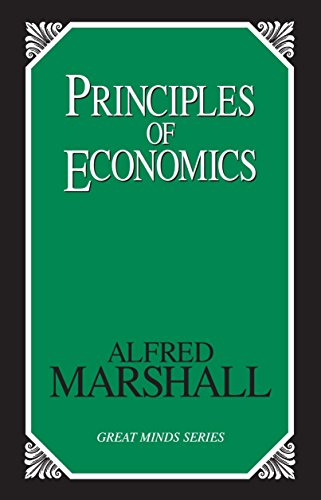
British economist Alfred Marshall (1842-1924) was one of the founders of the "neoclassical" school in which economists studied both wealth and human behavior to understand why we make the choices we do. First published in 1890, Principles of Economics stands as Marshall's most influential work. This abridged edition offers a general introduction to the study of economics, dealing mainly with normal conditions of industry, employment, and wages. It begins by isolating the primary relations of supply, demand, and price in regard to a particular commodity. Following his study of science, history, and philosophy, Marshall argues that, while fragmentary statistical hypotheses are used as temporary aids to dynamic economic concepts, the central idea of economics must be that of a living force and movement, and its main concern must be with human beings who are impelled, for better or worse, to change and progress.
"synopsis" may belong to another edition of this title.
About the Author
ALFRED MARSHALL, distinguished British economist, was born in London on July 26, 1842. His interest in economics arose out of his earlier studies of philosophy and mathematics. Following his tenure as first principal of University College, Bristol (1877-1881), Marshall taught at Cambridge University from 1885 to 1908, and lived in Cambridge for the remainder of his life.
Marshall's chief work is the Principles of Economics (1890; eighth edition 1920). One of the founders of the so-called neo-classical school, Marshall argued that the economy would run best if left on its own, and that the normal functioning of a market econ-omy leads to full employment. Though influenced by the ideas of John Stuart Mill, Marshall substantially altered Mill's frame of ref-erence: instead of analyzing how the production of goods and the distribution of income among different social classes affected, often dramatically, economic well-being, he studied price setting in a static context, focusing on small, gradual changes and the complex interrelations by which market balance, or "equilibrium," is achieved. And while the earlier political economists Adam Smith and David Ricardo had identified labor as the force deter-mining the exchange value of goods, Marshall identified it as sat-isfaction of consumers' desires, or utility. Marshall's orderly Victorian picture of supply, demand, and price, particularly at a time when contemporary socialists and trade unions were challenging the status quo, came under attack by later economists, including John Maynard Keynes, who demon-strated that market forces can be ineffective in promoting full employment and who advocated enlightened government inter-vention over laissez-faire policies. Nonetheless, Marshall's work continues to influence orthodox economics. Alfred Marshall died in Cambridge on July 13, 1924. Marshall's other published works include Industry and Trade (1919) and Money, Credit, and Commerce (1923)."About this title" may belong to another edition of this title.
Search results for Principles of Economics (Great Minds Series)

Stock Image
Principles of Economics Great
Seller: World of Books (was SecondSale), Montgomery, IL, U.S.A.
Seller rating 5 out of 5 stars

Condition: Acceptable. Item in acceptable condition! Textbooks may not include supplemental items i.e. CDs, access codes etc. Seller Inventory # 00106395643
Stock Image
Principles of Economics
Published by
The Globe Pequot Publishing Group, Inc., 1997
ISBN 10: 1573921408
ISBN 13: 9781573921404
Used
Softcover
Seller: Better World Books: West, Reno, NV, U.S.A.
Seller rating 5 out of 5 stars
Condition: Good. Pages intact with minimal writing/highlighting. The binding may be loose and creased. Dust jackets/supplements are not included. Stock photo provided. Product includes identifying sticker. Better World Books: Buy Books. Do Good. Seller Inventory # 5425975-6
Seller Image
Principles of Economics (Great Minds)
Seller: -OnTimeBooks-, Phoenix, AZ, U.S.A.
Seller rating 5 out of 5 stars
Condition: very_good. Gently read. May have name of previous ownership, or ex-library edition. Binding tight; spine straight and smooth, with no creasing; covers clean and crisp. Minimal signs of handling or shelving. 100% GUARANTEE! Shipped with delivery confirmation, if you're not satisfied with purchase please return item! Ships USPS Media Mail. Seller Inventory # OTV.1573921408.VG
Seller Image
Principles of Economics
Seller: GreatBookPrices, Columbia, MD, U.S.A.
Seller rating 5 out of 5 stars
Condition: good. May show signs of wear, highlighting, writing, and previous use. This item may be a former library book with typical markings. No guarantee on products that contain supplements Your satisfaction is 100% guaranteed. Twenty-five year bookseller with shipments to over fifty million happy customers. Seller Inventory # 538320-5
Stock Image
Principles of Economics
Seller: ThriftBooks-Dallas, Dallas, TX, U.S.A.
Seller rating 5 out of 5 stars
Paperback. Condition: Very Good. No Jacket. May have limited writing in cover pages. Pages are unmarked. ~ ThriftBooks: Read More, Spend Less. Seller Inventory # G1573921408I4N00
Stock Image
Principles of Economics
Seller: ThriftBooks-Atlanta, AUSTELL, GA, U.S.A.
Seller rating 5 out of 5 stars
Paperback. Condition: Good. No Jacket. Pages can have notes/highlighting. Spine may show signs of wear. ~ ThriftBooks: Read More, Spend Less. Seller Inventory # G1573921408I3N00
Stock Image
Principles of Economics
Seller: ThriftBooks-Atlanta, AUSTELL, GA, U.S.A.
Seller rating 5 out of 5 stars
Paperback. Condition: Very Good. No Jacket. May have limited writing in cover pages. Pages are unmarked. ~ ThriftBooks: Read More, Spend Less. Seller Inventory # G1573921408I4N00
Stock Image
Principles of Economics
Seller: ThriftBooks-Dallas, Dallas, TX, U.S.A.
Seller rating 5 out of 5 stars
Paperback. Condition: As New. No Jacket. Pages are clean and are not marred by notes or folds of any kind. ~ ThriftBooks: Read More, Spend Less. Seller Inventory # G1573921408I2N00
Stock Image
Principles of Economics (Great Minds)
Seller: Books From California, Simi Valley, CA, U.S.A.
Seller rating 4 out of 5 stars

paperback. Condition: Good. Book shows shelf & handling wear, including edge wear & cover scuffing. Pages are somewhat worn, interiors are intact with unmarked text/pictures. A good reading copy. Seller Inventory # mon0004030172
Stock Image
Principles of Economics (Great Minds)
Seller: Book Alley, Pasadena, CA, U.S.A.
Seller rating 4 out of 5 stars
paperback. Condition: Very Good. Very Good. Used with some reading wear but is still in great reading condition. No markings in text. Seller Inventory # mon0000752791