
Items related to Wild Irish Roses: Tales of Brigits, Kathleens and Warrior...
Synopsis
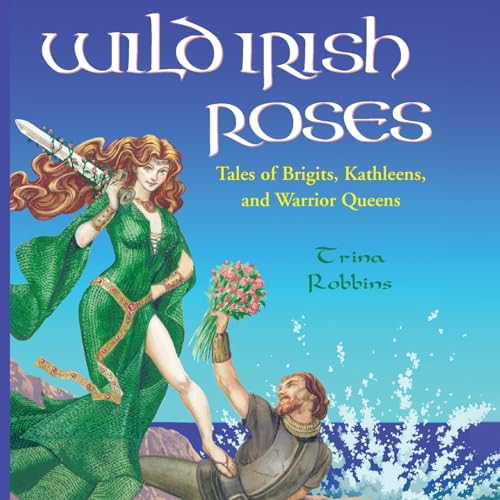
Forget the myth of the sweet Irish Colleen. Real Irish women were no creampuff debs. From the ancient warrior queens Marrigan, Macha, and Badbh to the labormovement maven Mother Jones, Irish women have backbones of steel. Wild Irish Roses is a fascinating look at wild Irish women throughout history/ serious information imparted in Trina Robbins' trademark style, with verve and humor.
The women in Wild Irish Roses are not always nice girls or even good girls, but they are women who know how to get things done, whether on the battlefield or in the bedroom. These are women who preserved and handed down the old stories. They are women who fought in revolutions with either gun or pen, wrote books, starred in books others wrote, and stormed heaven itself.
Author Trina Robbins is an impeccable researcher whose knack for telling stories and embellishing them with engaging illustrations and photos, brings each of these Wild Irish Roses to life, including:
- Maeve and six other warrior queens
- Grania and Deirdre, who ran away from kings for the love of younger men
- Five women who turned themselves into birds to get the job done right
- Saint Brigit and the saintly Kathleen O'Shea
- Cultural revivalist Maude Gonne and friends
- IrishAmerican beauty roses, including Scarlett O'Hara
- And warriors in their own right, such as Mother Jones and company
Wild Irish Roses is a celebration of tough, independent, beautiful Irish women from myth to modernity. It's a book that is sure to entertain, inform, and inspire readers of every background to find the Irish rose in themselvesto discover what they want and have the courage to go out and get it.
"synopsis" may belong to another edition of this title.
About the Author
Trina Robbins has been called Bad by the best of them. More polite people simply refer to her as "outspoken." The author of several books, including From Girls to Grrlz, Tomorrow's Heirlooms, and The Great Women Superheroes, she has been a pagan since 1977. She admittedly can't live without cats, and she considers herself the oldest grrrl in San Francisco.
Excerpt. © Reprinted by permission. All rights reserved.
Wild Irish Roses
Tales of Brigits, Kathleens, and Warrior Queens
By Trina RobbinsRed Wheel/Weiser, LLC
Copyright © 2004 Trina Robbins
All rights reserved.
ISBN: 978-1-57324-952-2All rights reserved.
Contents
| Introduction | |
| PART ONE: BEFORE PATRICK | |
| Warrior Goddesses, Warrior Queens | |
| They Knew What They Wanted | |
| Bird Women | |
| PART TWO: AFTER PATRICK | |
| Saintly Roses and Two Sinners | |
| Two Pirate Queens and a Drama Queen | |
| PART THREE: KATHLEEN NI HOULIHAN | |
| Literary Roses | |
| Muses of the Irish Renaissance | |
| Still Warriors after All These Years | |
| And a Single American Beauty Rose | |
| Further Reading | |
| Index | |
| About the Author |
CHAPTER 1
WARRIOR GODDESSES, WARRIOR QUEENS
The Morrigan, Macha, and Badb
According to Irish mythology, the Tuatha De Danaan, a glamorous, godlike race,lived in Ireland before the Celts arrived. After the Celts landed their ships onIrish soil, there was a battle between the Tuatha De Danaan and the Celts, andthe Celts won. The Tuatha De Danaan retreated to the island of Tir Nan Og, wherethey remained forever young, but they also moved into sidhes, those fairy hillsthat dot the Irish landscape, and the Irish people named them the Sidhe, aftertheir hills. They continued to interact with the new, mortal inhabitants ofIreland for hundreds of years, even after the church demoted them to the statusof fairies.
Like the Irish themselves, the Sidhe loved to fight and loved to love. Amongtheir minions were three warrior-goddess sisters, Macha, Badb, and the Morrigan.The bloodthirsty three would take on the shape of ravens and fly above thescenes of battle, shrieking battle cries and egging their people on to victory.
Badb was the banshee, wailing over the dying. She was also the ominous Washer atthe Ford, who predicted death. Sometimes a warrior who was doomed to fall inbattle would see Badb as a beautiful young woman, weeping while she washed outbloody clothing in a river or stream. Then he would realize with horror that thebloody clothing was his.
All three sisters could morph into ravens, ancient crones, or comely youngwomen. It was in the latter guise that they usually emerged from their hills tohave a fling with whatever strapping young human stud caught their eye.
As did so many human women in those days, the Morrigan found herself attractedto the hero, Cuchulain, who preferred war to love and rebuffed her. Of course,it's bad luck to spurn a goddess, as Cuchulain learned. The angry goddess cameagainst him in battle, and when the dust settled, both of them were the worsefor wear.
Eventually the two became friends. Before Cuchulain's last battle, the Morriganeven tried to keep him from getting himself killed by breaking the shaft of hischariot. Cuchulain, too proud to pay attention, and also a little dim, ignoredthe warning and went to his death. And when he died, the Morrigan, in the shapeof a crow, flew down and perched on his shoulder.
Being a natural troublemaker, maybe because she loved fighting so much, theMorrigan was also a cattle rustler. The ancient Irish held cattle to be soimportant that they counted their wealth in cows, and were forever stealing eachothers' herds. Once the Morrigan stole a cow belonging to a mortal woman namedOdras, and tried to take it into her fairy hill. When Odras tried to get her cowback, the goddess turned the unfortunate woman into a pool of water.
The Morrigan outdid herself when she stole a magical cow of the Sidhe to matewith the great brown bull of Cooley. With this act, she put into motion theevents that caused the great war between Ulster and Connaught known as theCattle Raid of Cooley.
After mating the two animals, the Morrigan returned the cow to its fairy hill,and in due time the cow gave birth to a magical, talking calf. Shortly afterthat, the Sidhe went to war against the king and queen of Connaught, Ailill andMaeve. In the heat of battle, the fairy calf met and fought with Ailill's prizebull, the white bull of Connaught. Young upstart that he was, the calf lost thebattle with the bull, and cried out, "If my father, the great brown bull ofCooley, was here, he'd beat you from Connaught to Ulster!" For the two bulls hadbeen enemies before they were even born; they were reincarnations of two men ofthe Sidhe who had been sworn enemies in life.
When Maeve heard those words from the mouth of the remarkable calf, sheexclaimed, "By the Goddess, I will neither eat, nor drink, nor will I sleep,until I see the great white bull fight the great brown bull!" Whereupon shetried to get the brown bull from its owner, and when he wouldn't give it up, shewent to war with him and with all the people of Ulster.
All of this was the fault of the Morrigan, who, being a goddess, could foreseethe future and knew darn well that she would cause a war.
For the Morrigan, love and war went together like a horse and carriage. OneSamhain eve, before a great battle, the Dagda, king of the Tuatha De Danaan,strolled by the banks of the river Unius and ran into the Morrigan, who wasbathing in the river. Naked and magnificent, with the nine locks of her hairunloosed, she stood with her right leg on one side of the river and her left legon the other side (they were giants in those days).
The sight of her inflamed the Dagda, and as for the Morrigan, she never neededto be asked twice. The two of them went at it, then and there, on the grassybanks of the river, beneath the starry sky of Ireland. The Dagda must have beenreally good in bed, because the Morrigan was so delighted by his performancethat she promised him victory in the next day's battle—and she had the power todo that.
Sure enough, the Tuatha De Danaan won the war. Then the Morrigan committed agruesome act that reminds us just how long ago these tales were first told, andhow savage were the people who told them. She scooped up two handsful of bloodfrom the enemy dead and gave it to her tribe to drink!
No matter how much she lusted after some guy, the Morrigan was never nice. Hersister Macha, on the other hand, who was so nasty that the heads of warriors cutoff in battle were called "Macha's acorn crop," made the mistake of sacrificingher fierce nature when she fell in love with the mortal, Crunden. Crunden was apoor but handsome widower, who lived in a lonely cottage in the Ulster hills. Inher attempt to become the kind of woman he might go for, Macha gentled herselfinto a mortal woman. In the form of a beautiful woman, she marched through theastonished man's door one day, and commenced to make up the fire. She then sweptthe dust bunnies off the messy floor (Crunden, no house-keeper, had let his homego to seed), milked the cow, and whipped up some tasty oat cakes, all withoutsaying a word. He must have thought he had died and gone to heaven, because thatnight she climbed into his bed, too. He awoke the next morning to discover she'dalready chopped the wood, rounded up the cattle, shod his horse, and preparedhim a steaming bowl of porridge.
They lived together happily after that. Crunden was too delighted with his goodluck to ask questions, and anyway, Macha didn't supply any answers, because shenever said a word. She must have eventually started to talk, though, because oneday there was to be a big fair in Ulster, and Crunden announced his intention togo.
"Don't do it," she said.
"And why not?" he whined. "All the other guys are going. If I don't go, they'llsay I'm henpecked."
Macha sighed. Men could be such children! "Go then," she said, "but at leastpromise not to mention me to anyone."
"No problem," said Crunden. And he went to the fair.
The most exciting part of the fair was always the annual chariot race, and thistime it was won by the king's own stallions. While listening to the poets andminstrels praising the royal horses, Crunden couldn't keep his big mouth shut.He'd seen his wife perform some remarkable feats, and though she had told himnothing about her past, he knew that she was no ordinary woman.
So he spoke up. "That's nothing. My wife could outrun those horses."
There was a sudden silence, and everyone turned to stare at him. Already Crundenregretted having spoken. The king ordered, "Seize that man."
When the king's guards arrived at her cottage door, somehow Macha was notsurprised. She knew that she shouldn't have let that handsome lout go anywhereby himself.
"What kind of trouble has he gotten himself into?" she asked.
"You'd best come with us," they replied.
Macha was nine months pregnant, but she gathered up her skirt, threw a shawlover her shoulders, and followed the guards to the fair, where the king and allthe people waited for her.
"This man"—the king pointed to Crunden, cowering wretchedly in chains—"said thatyou could outrun my prize horses. Is this true?"
"And what if I can?" replied Macha.
"Then you must do it now," said the king. "Or your husband dies."
Macha threw off the shawl and displayed her big belly. "How can I run now, andme being nine months with child?" She demanded, "Have pity on me, and at leastwait until my baby is born."
"Then put the man to the sword," ordered the king.
Macha appealed to the watching crowd. "Help me, people of Ulster, for every manof you had a mother."
But the crowd stood silent, waiting for the big show, and there was nothing todo but to race, pregnant as she was. Macha outran the horses, of course—afterall, she was a goddess—but at the finish line she sank to her knees in the dirtand gave birth to twins, a boy and a girl. Goddess or not, she was in greatpain, and screamed in her labor, and as soon as they heard her scream, all themen of Ulster were overcome with labor pains.
Macha cursed them. "For nine generations, you men of Ulster shall pay for whatyou did to me. When you most need your strength, when you're threatened byenemies, you'll be weak as a woman with child, and suffer the pangs ofchildbirth."
Thus the ancient capitol of Ulster, where this story took place, was calledEmain Macha, or "the Twins of Macha." Some sources say that Macha died afterthis, but, as she was a goddess, that's pretty unlikely. No one recorded whathappened to her babies. I think she left them with Crunden and departed in ahuff to her fairy hill, vowing to have nothing more to do with mortal men.
THE OTHER MACHA
If we are to believe the monks who recorded Irish history in the seventhcentury, there was also a flesh-and-blood Macha, who lived in the fourthcentury. She was a warrior queen, and because of her flame-colored hair she wascalled Macha Ruadh, or Macha the Red. Her father, Aedh, was one of threebrothers who took turns at ruling Ireland for seven years each. When all threeking had served their terms, Aedh died, and Macha claimed his turn at the throneas her birthright. Her two uncles, Dithorba and Cimbaoth, refused to let herrule because she was a woman, so Macha solved the problem by marrying Cimbaothand going to war against Dithorba. Defeating Dithorba, she ruled for seven yearsuntil another problem popped up: Dithorba's sons, now grown, wanted the thronefor themselves.
Fiery as her hair, Macha was not one to give in. Disguised as a leper, she wentlooking for the five sons. She found them sitting around a campfire in theforest, after a day of hunting. Macha's beauty must have shone through herdisguise, because leper or not, after sharing their food with her, one by onethe brothers took her into the forest with sex on their minds. What they got wasoverpowered and trussed up like pigs, while Macha went to fetch the nextbrother. Then she dragged the lot of them back to Ulster, where she forced themto build a fort for her.
Macha unfastened the brooch that held her cape, and with its pin, she marked outthe boundaries of the fort she wanted built. Thus, goes the story, her fort wascalled Emain Macha, or "Macha's brooch." You have your choice of etymologies forthe phrase.
Maeve and Findabair
Maeve, the scandalous queen of Connaught in ancient Ireland, was a warriorqueen. In her gilded chariot she led her people to battle against the men ofUlster during that great war called the Cattle Raid of Cooley. Findabair wasMaeve's lovely daughter. Maeve was no slouch in the looks department herself, asher many lovers would have told you, and she was a fierce woman, used to beingin control. She certainly lorded it over her henpecked husband, King Ailill,telling him that no husband of hers could be jealous, because she always had oneman in the shadow of another. Ailill knew full well that he was king onlybecause of Maeve, for she had been married three times before, and each of herhusbands had owed their kingship to her. You couldn't be king in Connaughtunless you were married to Maeve.
It was hard enough for Findabair to have such a domineering mother, because thisbeautiful princess—her name meant Fair Brow—was also a feisty gal. But it wasworse when Maeve tried to meddle in her daughter's love life.
Froech was only half-mortal. His mother was one of the Sidhe, the godlike fairyfolk of Ireland, and she had given her son a gift of twelve red and white cowsfrom the shadow world. In a land where cattle were highly valued and cows wereeven worshipped as goddesses, these cows were very special. They gave thesweetest milk in all of Ireland.
Findabair had heard tales of Froech's beauty, and she fell in love with himwithout ever having seen him. She talked to the right people, who talked to theright people, and word got to Froech that the daughter of Queen Maeve was inlove with him. He loaded his chariots with gifts of gold and silver and preciousstones, and, with his men and horses and hounds and harpers, set out for Maeve'scastle in Connaught.
When the people of Connaught saw Froech and his band coming up over the hill tothe castle, all that gold and silver dazzled their eyes. But Maeve's eyes wereespecially dazzled by the handsome young Froech, and after graciously acceptinghis gifts, she pulled out her golden chessboard with silver chess pieces, andinvited him to play. They played chess without stopping for three days and threenights, and Froech was careful to let Maeve win every game.
Finally, Maeve returned to her senses, and called for meat and drink. Afterthree straight days of chess, she was starving, and, holding a joint of venisonin one hand and a drinking horn brimming with ale in the other, she got aroundto asking the purpose of Froech's visit.
"I've come to ask for the hand of your daughter," replied Froech.
Maeve was disappointed. She had wanted this magnificent specimen for herself, soshe slumped back in her throne, sulked, and said nothing. Finally, Ailill spokeup. "You can have Findabair if you pay the bride price I ask."
"Name your price," said Froech.
Ailill was feeling greedy. After all, he reasoned, this part-fairy suitor shouldbe able to give them anything they wanted. So he said, "Sixty gray horses withgold bridles, and your twelve red and white cows, with a white calf for eachcow, and all your men and musicians to aid us in our battle with Ulster." ForMaeve and Ailill were already preparing for war.
Froech was appalled. "I wouldn't give that much for Maeve herself," heexclaimed, and stomped out of the hall.
Froech walked down to the river to calm himself, and who should be bathing inthe water but fair Findabair? He immediately recognized her, because onlyMaeve's daughter could be so lovely, and she of course knew by his otherworldlybeauty that he must be Froech.
"Your father's giving me a hard time," he told her. "Let's just run awaytogether."
"Run away with you indeed," cried Findabair. "And I a king's daughter? It's aproper wedding we'll have, as befits a princess, the finest Ireland has everseen. Don't worry, Daddy will come around. And meanwhile, here's a token of mylove."
She took a gold ring off her finger and gave it to him. "It was a gift fromDaddy but if he asks, I'll say I lost it."
They didn't know that, watching from the topmost tower of the castle, Ailillcould see his daughter take something shiny off her finger and give it toFroech, who put it into the leather pouch he wore on his belt. He had a prettygood idea as to what it was.
"Our daughter gave that boy my ring," he told Maeve. "She's going to run offwith him, and we'll be disgraced."
"Then we'll simply have to kill him," replied the ever-practical Maeve.
The next day Maeve and Ailill acted like nothing had happened. Along withFindabair, they took Froech hunting. Around noon, they escaped the heat of theday by resting in the cool shadows of a grove of trees that grew around a darklake in the forest. Maeve said, "I hear you're a good swimmer, Froech. I wouldlove a branch of those red berries that are growing there, on the other side ofthe lake. Will you get them for me?"
Maeve knew that a serpent lived in the lake, an Irish version of the Loch NessMonster. Clueless Froech stripped and jumped into the water. Findabair,watching, had never in her life seen anything as beautiful as his perfect body,and she resolved that, no matter what her parents tried, she wouldn't let himcome to harm. As Froech swam to the other side of the lake, Ailill picked up hisleather pouch, shook out the ring, and tossed it into the water. He turned awaythen, and didn't see a big salmon leap from the water and swallow the ring, butFroech did, and he caught the salmon in his hands and hid it under some bushesby the lakeside. Then he swam back with a branch of berries, which he presentedto Maeve.
Disappointed that the monster hadn't shown up, Maeve gave it one more try. Shefinished the berries and exclaimed, "These berries were so delicious! Could youbring me just one more branch?"
Doing his best to make Findabair's mother happy, Froech jumped into the wateragain. This time he was out of luck; the monster surfaced and attacked him.Froech, wrestling with the monster, called out, "A sword! A sword!" but none ofthe king's men dared help him, so they just stood there in silence. Not soFindabair. Quickly she pulled off her clothes, and, sword in her teeth, doveinto the water and swam as close as she dared. She tossed the sword to Froech,who sliced off the monster's head and carried it to shore.
(Continues...)
Excerpted from Wild Irish Roses by Trina Robbins. Copyright © 2004 Trina Robbins. Excerpted by permission of Red Wheel/Weiser, LLC.
All rights reserved. No part of this excerpt may be reproduced or reprinted without permission in writing from the publisher.
Excerpts are provided by Dial-A-Book Inc. solely for the personal use of visitors to this web site.
"About this title" may belong to another edition of this title.
Search results for Wild Irish Roses: Tales of Brigits, Kathleens and Warrior...

Stock Image
Wild Irish Roses: Tales of Brigits, Kathleens, and Warrior Queens
Seller: World of Books Inc, Montgomery, IL, U.S.A.
Seller rating 2 out of 5 stars

Paperback. Condition: Good. Forget the myth of the sweet Irish Colleen. Real Irish women were no creampuff debs. From the ancient warrior queens Marrigan, Macha, and Badbh to the labormovement maven Mother Jones, Irish women have backbones of steel. Wild Irish Roses is a fascinating look at wild Irish women throughout history/ serious information imparted in Trina Robbins' trademark style, with verve and humor.The women in Wild Irish Roses are not always nice girls or even good girls, but they are women who know how to get things done, whether on the battlefield or in the bedroom. These are women who preserved and handed down the old stories. They are women who fought in revolutions with either gun or pen, wrote books, starred in books others wrote, and stormed heaven itself.Author Trina Robbins is an impeccable researcher whose knack for telling stories and embellishing them with engaging illustrations and photos, brings each of these Wild Irish Roses to life, including: Maeve and six other warrior queensGrania and Deirdre, who ran away from kings for the love of younger menFive women who turned themselves into birds to get the job done rightSaint Brigit and the saintly Kathleen O'SheaCultural revivalist Maude Gonne and friendsIrishAmerican beauty roses, including Scarlett O'HaraAnd warriors in their own right, such as Mother Jones and companyWild Irish Roses is a celebration of tough, independent, beautiful Irish women from myth to modernity. It's a book that is sure to entertain, inform, and inspire readers of every background to find the Irish rose in themselvesto discover what they want and have the courage to go out and get it. Seller Inventory # CIN1573249521G
Stock Image
Wild Irish Roses: Tales of Brigits, Kathleens, and Warrior Queens
Seller: HPB Inc., Dallas, TX, U.S.A.
Seller rating 5 out of 5 stars

paperback. Condition: Very Good. Connecting readers with great books since 1972! Used books may not include companion materials, and may have some shelf wear or limited writing. We ship orders daily and Customer Service is our top priority! Seller Inventory # S_411360372
Stock Image
Wild Irish Roses Tales of Brig
Seller: World of Books (was SecondSale), Montgomery, IL, U.S.A.
Seller rating 5 out of 5 stars
Condition: Acceptable. Item in good condition. Textbooks may not include supplemental items i.e. CDs, access codes etc. Seller Inventory # 00048623307
Stock Image
Wild Irish Roses: Tales of Brigits, Kathleens, and Warrior Queens
Seller: Wonder Book, Frederick, MD, U.S.A.
Seller rating 5 out of 5 stars
Condition: Good. Good condition. A copy that has been read but remains intact. May contain markings such as bookplates, stamps, limited notes and highlighting, or a few light stains. Seller Inventory # G01E-00687
Stock Image
Wild Irish Roses: Tales of Brigits, Kathleens, and Warrior Queens
Seller: ThriftBooks-Dallas, Dallas, TX, U.S.A.
Seller rating 5 out of 5 stars
Paperback. Condition: Very Good. No Jacket. May have limited writing in cover pages. Pages are unmarked. ~ ThriftBooks: Read More, Spend Less. Seller Inventory # G1573249521I4N00
Stock Image
Wild Irish Roses: Tales of Brigits, Kathleens, and Warrior Queens
Seller: ThriftBooks-Atlanta, AUSTELL, GA, U.S.A.
Seller rating 5 out of 5 stars
Paperback. Condition: As New. No Jacket. Pages are clean and are not marred by notes or folds of any kind. ~ ThriftBooks: Read More, Spend Less. Seller Inventory # G1573249521I2N00
Stock Image
Wild Irish Roses: Tales of Brigits, Kathleens, and Warrior Queens
Seller: Half Price Books Inc., Dallas, TX, U.S.A.
Seller rating 5 out of 5 stars
paperback. Condition: Very Good. Connecting readers with great books since 1972! Used books may not include companion materials, and may have some shelf wear or limited writing. We ship orders daily and Customer Service is our top priority! Seller Inventory # S_462189207
Stock Image
Wild Irish Roses: Tales of Brigits, Kathleens, and Warrior Queens
Seller: World of Books Inc, Montgomery, IL, U.S.A.
Seller rating 2 out of 5 stars
Paperback. Condition: Fair. Forget the myth of the sweet Irish Colleen. Real Irish women were no creampuff debs. From the ancient warrior queens Marrigan, Macha, and Badbh to the labormovement maven Mother Jones, Irish women have backbones of steel. Wild Irish Roses is a fascinating look at wild Irish women throughout history/ serious information imparted in Trina Robbins' trademark style, with verve and humor.The women in Wild Irish Roses are not always nice girls or even good girls, but they are women who know how to get things done, whether on the battlefield or in the bedroom. These are women who preserved and handed down the old stories. They are women who fought in revolutions with either gun or pen, wrote books, starred in books others wrote, and stormed heaven itself.Author Trina Robbins is an impeccable researcher whose knack for telling stories and embellishing them with engaging illustrations and photos, brings each of these Wild Irish Roses to life, including: Maeve and six other warrior queensGrania and Deirdre, who ran away from kings for the love of younger menFive women who turned themselves into birds to get the job done rightSaint Brigit and the saintly Kathleen O'SheaCultural revivalist Maude Gonne and friendsIrishAmerican beauty roses, including Scarlett O'HaraAnd warriors in their own right, such as Mother Jones and companyWild Irish Roses is a celebration of tough, independent, beautiful Irish women from myth to modernity. It's a book that is sure to entertain, inform, and inspire readers of every background to find the Irish rose in themselvesto discover what they want and have the courage to go out and get it. Seller Inventory # CIN1573249521A
Seller Image
Wild Irish Roses: Tales of Brigits, Kathleens, and Warrior Queens
Seller: Goodwill of Greater Milwaukee and Chicago, Racine, WI, U.S.A.
Seller rating 5 out of 5 stars
Condition: good. Book is considered to be in good or better condition. The actual cover image may not match the stock photo. Hard cover books may show signs of wear on the spine, cover or dust jacket. Paperback book may show signs of wear on spine or cover as well as having a slight bend, curve or creasing to it. Book should have minimal to no writing inside and no highlighting. Pages should be free of tears or creasing. Stickers should not be present on cover or elsewhere, and any CD or DVD expected with the book is included. Book is not a former library copy. Seller Inventory # SEWV.1573249521.G
Stock Image
Wild Irish Roses: Tales of Brigits, Kathleens, and Warrior Queens
Published by
Conari Press, York Beach, ME, 2004
ISBN 10: 1573249521
ISBN 13: 9781573249522
Used
Soft cover
Seller: The Shop Around The Corner, Elgin, IL, U.S.A.
Seller rating 5 out of 5 stars
Soft cover. Condition: Very Good. No Jacket. box33 5½"x6½"; 215 pages; The binding and pages are clean, tight and square. There is no underlining, highlighting or margin notes. A used copy with normal reading wear. If you order multiple titles, I will combine them in order to reduce postage costs. If you have any questions, contact me before ordering for details. Seller Inventory # 003770