
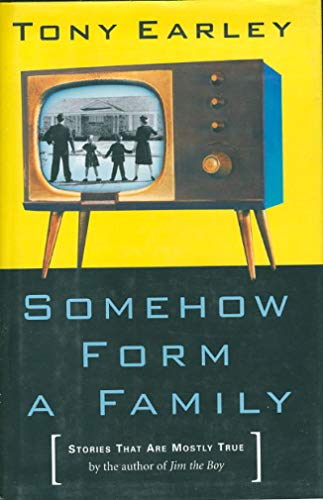
Synopsis
This is the book that in hardcover won unanimous praise from reviewers, who called it "beautiful and transcendent" (The Boston Globe), a book that "measures the arc of a culture's mortality in small, personal increments" (Star Tribune, Minneapolis), is written "in a poker-faced style that always seems on the verge of exploding into manic laughter or howls of pain" (The Atlanta Journal-Constitution).
They're right. Tony Earley is a writer so good at his craft that you don't read his words so much as inhale them. His first book of nonfiction is one of those unexpected classics, like Ann Lamott's Traveling Mercies, in which a great writer rips open his/her heart and takes the reader inside for a no-holds-barred tour.
In a prose style that is deceptively simple, Earley confronts the big things-God, death, civilization, family, his own clinical depression-with wit and grace, without looking away or smirking.
"synopsis" may belong to another edition of this title.
From the Back Cover
The American genius for language lies in understatement...Earley has the courage to return to artistic first principals: clarity, balance, ease. (The New York Times Book Review)
Tony Earley's view of the world is from the edge, at the cusp. Which is what this collection of personal essays is about - about how he stands with one foot in the rural mountains of his birth and upbringing and the other in the Brady Bunch's split-level.
Born thirty-nine years ago, Earley was too late to be a Baby Boomer, too soon to be a Gen Xer. He grew up in the North Carolina mountains but says, "I go around telling anyone who will listen that I am from the country, but deep down I know it's a lie. I grew up on Gilligan's Island, in Mayberry, I'm not sure where."
In a prose style that is deceptively simple (E. B. White comes to mind), Earley confronts the big things - death, civilization, family, his own clinical depression - with wit and grace, without looking away or smirking. He writes about how he's neither an adherent to the fundamentalism of his boyhood nor an unbeliever, and about how hard it is to find your place in the world without letting go of your authenticity.
Clearly having lost patience with irony, Tony Earley is on a journey from faith, through disbelief, and into a new faith.and a new family. And he is a writer so good at his craft that you don't read his words so much as inhale them. His first book of nonfiction is one of those unexpected classics in which a great writer rips open his heart and takes the reader inside for a no-holds-barred tour.
From the Inside Flap
The American genius for language lies in understatement...Earley has the courage to return to artistic first principals: clarity, balance, ease. (The New York Times Book Review)
Tony Earley's view of the world is from the edge, at the cusp. Which is what this collection of personal essays is about - about how he stands with one foot in the rural mountains of his birth and upbringing and the other in the Brady Bunch's split-level.
Born thirty-nine years ago, Earley was too late to be a Baby Boomer, too soon to be a Gen Xer. He grew up in the North Carolina mountains but says, "I go around telling anyone who will listen that I am from the country, but deep down I know it's a lie. I grew up on Gilligan's Island, in Mayberry, I'm not sure where."
In a prose style that is deceptively simple (E. B. White comes to mind), Earley confronts the big things - death, civilization, family, his own clinical depression - with wit and grace, without looking away or smirking. He writes about how he's neither an adherent to the fundamentalism of his boyhood nor an unbeliever, and about how hard it is to find your place in the world without letting go of your authenticity.
Clearly having lost patience with irony, Tony Earley is on a journey from faith, through disbelief, and into a new faith.and a new family. And he is a writer so good at his craft that you don't read his words so much as inhale them. His first book of nonfiction is one of those unexpected classics in which a great writer rips open his heart and takes the reader inside for a no-holds-barred tour.
Excerpt. © Reprinted by permission. All rights reserved.
Excerpt
In July 1969, I looked a lot like Opie in the second or third season of The AndyGriffith Show. I was a small boy with a big head. I wore blue jeans with thecuffs turned up and horizontally striped pullover shirts. I was the brother in afather- mother-brother-sister family. We lived in a four-room house at the edgeof the country, at the foot of the mountains, outside a small town in NorthCarolina, but it could have been anywhere.
On one side of us lived Mr. and Mrs. White. They were old and rich. Theirdriveway was paved. Mrs. White was the president of the town garden club. Whenshe came to visit Mama she brought her own ashtray. Mr. White was almost deaf.When he watched the news on television, it sounded like thunder in the distance.The Whites had an aluminum travel trailer in which you could see yourreflection. One summer they hitched it to their Chrysler and pulled it all theway to Alaska.
On the other side of us lived Mack and Joan. They had just graduated fromcollege. I thought Joan was beautiful, and still do. Mack had a bass boat and athree-tray tackle box in which lurked a bristling school of lures. On the otherside of Mack and Joan lived Mrs. Taylor, who was old, and on the other side ofMrs. Taylor lived Mr. and Mrs. Frady, who had a fierce dog. My sister, Shelly,and I called it the Frady dog. The Frady dog lived a long and bitter life. Itdid not die until well after I had a driver's license.
On the far side of the Whites lived Mr. and Mrs. John Harris; Mr. and Mrs.Burlon Harris lived beyond them. John and Burlon were first cousins. John was ateacher who in the summers fixed lawn mowers, including ours, in a buildingbehind his house. Burlon reminded me of Mr. Greenjeans on Captain Kangaroo. Hekept horses and let us play in his barn. Shelly once commandeered one of hiscats and brought it home to live with us. Burlon did not mind; he asked her ifshe wanted another one. We rode our bicycles toward Mr. Harris's house as ifpulled there by gravity. We did not ride in the other direction; the Frady dogsat in its yard and watched for us.
In July 1969, we did not have much money, but in the hierarchy of southern poor,we were the good kind, the kind you would not mind living on your road. We wereclean. Our clothes were clean. My parents worked. We went to church. Eastermornings, Mama stood us in front of the yellowbell bush and took our picture. Wehad meat at every meal?chicken and cube steak and pork chops and ham?andplenty of milk to drink. We were not trashy. Mrs. White would not sit with herashtray in the kitchen of trashy people. Trashy people lived in the two housesaround the curve past Mr. Harris's. When Daddy drove by those houses we couldsee that the kids in the yard had dirty faces. They were usually jabbing atsomething with a stick. Shelly and I were not allowed to ride our bicyclesaround the curve.
I knew we were poor only because our television was black and white. It was anold Admiral, built in the 1950s, with brass knobs the size of baseballs. Itscabinet was perfectly square, a cube of steel with a painted-on mahogany grain.Hoss on Bonanza could not have picked it up by himself. It was a formidableobject, but its vertical hold was shot. We gathered around it the night NeilArmstrong walked on the moon, but we could not tell what was happening. Thepicture flipped up and down. We turned off the lights in the living room so wecould see better. We listened to Walter Cronkite. In the distance we could hearMr. White's color TV rumbling. We changed the channel and listened to Huntleyand Brinkley. We could hear the scratchy radio transmissions coming down out ofspace, but we could not see anything. Daddy got behind the TV with a flashlight.He said, "Is that better? Is that better?" but it never was. Mama said, "Just bethankful you've got a television."
After the Eagle had landed but before the astronauts opened the door and cameout, Mack knocked on the door and asked us if we wanted to look at the moon. Hewas an engineer for a power company and had set up his surveyor's transit in thebackyard. Daddy and Shelly and I went with him. We left Mama sitting in theliving room in the blue light of the TV. She said she did not want to missanything. The moon, as I remember it, was full, although I have since learnedthat it wasn't. I remember that a galaxy of lightning bugs blinked against theblack pine trees that grew between our yard and that of the Whites. Mack pointedthe transit at the sky. Daddy held me up so I could see. The moon inside theinstrument was startlingly bright; the man in the moon was clearly visible,although the men on the moon weren't. "You can't see them or anything," Macksaid, which I already knew. I said, "I know that." I wasn't stupid and did notlike to be talked to as if I were. Daddy put me down. He and Mack stood for awhile and talked. Daddy smoked a cigarette. In the bright yard Shelly chasedlightning bugs. She did not run, but instead jumped slowly, her feet together. Irealized that she was pretending to walk on the moon, pretending that she wasweightless. The moon was so bright, it cast a shadow at her feet. I rememberthese things for sure. I am tempted to say that she was beautiful in themoonlight, and I'm sure she was, but that isn't something I remember noticingthat night, only a thing I need to say now.
Eight, maybe nine months later, Shelly and I rode the bus home from school. Itwas a Thursday, Mama's day off, Easter time. The cherry tree in the gardenseparating our driveway from that of the Whites was in brilliant, full bloom. Wecould hear it buzzing from the road. One of us checked the mailbox. We looked upthe driveway at our house. Something was wrong with it, but we couldn't tellwhat. Daddy was adding four rooms on to the house, and we were used to itappearing large and unfinished. We stood in the driveway and stared. Black tarpaper was tacked to the outside walls of the new part, but the old part wasstill covered with white asbestos shingles. In the coming summer, Daddy and acrew of brick masons would finish transforming the house into a split-levelranch style, remarkably similar to the one in which the Bradys would live. Iloved the words split-level ranch-style. To me they meant "rich."
Shelly and I spotted what was wrong at the same time. A giant television antennahad attached itself to the roof of our house. It was shiny and tall as a youngtree. It looked dangerous, as if it would bite, like a praying mantis. Theantenna slowly began to turn, as if it had noticed us. Shelly and I lookedquickly at each other, our mouths wide open, and then back at the antenna. Wesprinted up the driveway.
In the living room, on the spot occupied by the Admiral that morning, sat amagnificent new color TV, a Zenith, with a twenty-one-inch screen. Its cabinetwas made of real wood. Gomer Pyle, U.S.M.C. was on. I will never forget that.Gomer Pyle and Sergeant Carter were the first two people I ever saw on a colortelevision. The olive green and khaki of their uniforms was dazzling. Above themwas the blue sky of California. The sky in California seemed bluer than the skyin North Carolina.
We said, "Is that ours?"
We said, "Can we keep it?"
Mama said, "I don't know," but I noticed she had written the numbers of thestations we could get on the dial of the Channel Master, the small box whichcontrolled the direction the antenna pointed. Mama would never have written onanything she planned on taking back to the store.
The dial of the Channel Master was marked like a compass. Channel 3 in Charlottelay to the east; Channel 13 in Asheville lay to the west. Channel 7 inSpartanburg and Channel 4 in Greenville rested side by side below them in thesouth. For years these cities would mark the outside edges of the world as Iknew it. Shelly reached out and turned the dial. Mama smacked her on the hand.Gomer grew fuzzy and disappeared. I said, "Mama, she broke it." When the dialstopped turning, Mama carefully turned it back to the south. Gomer reappeared,resurrected. Jim Nabors probably never looked better to anyone, in his wholelife, than he did to us right then.
Mama sat us down on the couch and laid down the law. Mama always laid down thelaw when she was upset. We were not to touch the TV. We could not turn it on,nor could we change the channel. Under no circumstances were we to touch theChannel Master. The Channel Master was very expensive. And if we so much aslooked at the knobs that controlled the color, she would whip us. It had takenher all afternoon to get the color just right.
Copyright © 2001 Tony Earley. All rights reserved.
ISBN: 1-56512-302-6
"About this title" may belong to another edition of this title.
Other Popular Editions of the Same Title

Search results for Somehow Form a Family: Stories That Are Mostly True

Stock Image
Somehow Form a Family: Stories
Seller: World of Books (was SecondSale), Montgomery, IL, U.S.A.
Seller rating 5 out of 5 stars

Condition: Good. Item in very good condition! Textbooks may not include supplemental items i.e. CDs, access codes etc. Seller Inventory # 00075951807
Seller Image
Somehow Form a Family: Stories That Are Mostly True
Seller: ZBK Books, Carlstadt, NJ, U.S.A.
Seller rating 5 out of 5 stars
Condition: good. Fast & Free Shipping â" Good condition. It may show normal signs of use, such as light writing, highlighting, or library markings, but all pages are intact and the book is fully readable. A solid, complete copy that's ready to enjoy. Seller Inventory # ZWV.1565123026.G
Stock Image
Somehow Form a Family : Stories That Are Mostly True
Published by
Algonquin Books of Chapel Hill, 2001
ISBN 10: 1565123026
ISBN 13: 9781565123021
Used
Hardcover
First Edition
Seller: Better World Books, Mishawaka, IN, U.S.A.
Seller rating 5 out of 5 stars
Condition: Good. 1st ed. Former library copy. Pages intact with minimal writing/highlighting. The binding may be loose and creased. Dust jackets/supplements are not included. Includes library markings. Stock photo provided. Product includes identifying sticker. Better World Books: Buy Books. Do Good. Seller Inventory # 8239433-6
Stock Image
Somehow Form a Family : Stories That Are Mostly True
Published by
Algonquin Books of Chapel Hill, 2001
ISBN 10: 1565123026
ISBN 13: 9781565123021
Used
Hardcover
First Edition
Seller: Better World Books, Mishawaka, IN, U.S.A.
Seller rating 5 out of 5 stars
Condition: Good. 1st ed. Pages intact with minimal writing/highlighting. The binding may be loose and creased. Dust jackets/supplements are not included. Stock photo provided. Product includes identifying sticker. Better World Books: Buy Books. Do Good. Seller Inventory # 18962716-6
Seller Image
Somehow Form a Family: Stories That Are Mostly True
Seller: Goodwill Books, Hillsboro, OR, U.S.A.
Seller rating 5 out of 5 stars
Condition: good. Signs of wear and consistent use. Seller Inventory # GICWV.1565123026.G
Stock Image
Somehow Form a Family: Stories That Are Mostly True
Seller: ThriftBooks-Dallas, Dallas, TX, U.S.A.
Seller rating 5 out of 5 stars
Hardcover. Condition: Very Good. No Jacket. May have limited writing in cover pages. Pages are unmarked. ~ ThriftBooks: Read More, Spend Less. Seller Inventory # G1565123026I4N00
Stock Image
Somehow Form a Family: Stories That Are Mostly True
Seller: ThriftBooks-Phoenix, Phoenix, AZ, U.S.A.
Seller rating 5 out of 5 stars
Hardcover. Condition: Very Good. No Jacket. May have limited writing in cover pages. Pages are unmarked. ~ ThriftBooks: Read More, Spend Less. Seller Inventory # G1565123026I4N00
Stock Image
Somehow Form a Family
Seller: Library House Internet Sales, Grand Rapids, OH, U.S.A.
Seller rating 5 out of 5 stars
Hardcover. Condition: Good. Dust Jacket Condition: Good. The author of Jim the Boy offers eleven essays about growing up in front of the television, fully ensconced in the imaginary world of Mayberry, Gilligan's Island, and the Brady Bunch. Piece(s) of the spine missing. Due to age and/or environmental conditions, the pages of this book have darkened. Please note the image in this listing is a stock photo and may not match the covers of the actual item. Book. Seller Inventory # 123755065
Seller Image
Somehow Form a Family: Stories That Are Mostly True
Published by
Algonquin Books, Chapel Hill, North Carolina, U.S.A., 2001
ISBN 10: 1565123026
ISBN 13: 9781565123021
Used
Hardcover
First Edition
Signed
Seller: Henry E. Lehrich, Bethesda, MD, U.S.A.
Seller rating 5 out of 5 stars
Hardcover. Condition: Fine. Dust Jacket Condition: Fine. 1st Edition. stated First edition. SIGNED by author on bookplate from thePalm beach Florida Literary Society affixed to front free endpage. 172 pp. no writing no tearing . book looks unused see picture on left. Signed by Author(s). Seller Inventory # 91722
Stock Image
Somehow Form a Family: Stories That Are Mostly True
Published by
Algonquin Books Of Chapel Hill, Chapel Hill, North Carolina, U.S.A., 2001
ISBN 10: 1565123026
ISBN 13: 9781565123021
Used
Hardcover
First Edition
Seller: Top Notch Books, Tolar, TX, U.S.A.
Seller rating 5 out of 5 stars
Hard Cover. Condition: Good. Dust Jacket Condition: Good. First Printing. Jacket is in brodart, light wear. Boards have light wear. Usual library/discard markings. Pages are clean, text has no markings, binding is sound. Size: 8vo - over 7¾" - 9¾" tall. Ex-Library. Seller Inventory # 234786A