
Items related to The Emperor's Codes: The Breaking of Japan's...
Synopsis
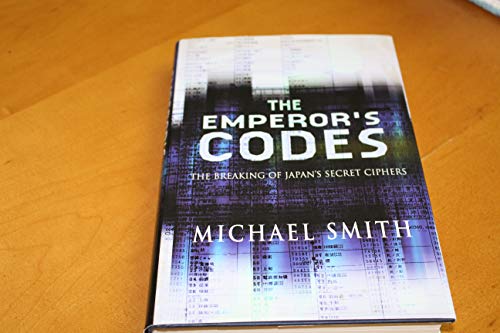
The author of Station X describes how American and Britain's Bletchley Park code-breaking teams worked desperately to break the Japanese codes during World War II, an effort that played a key role in turning the tide of the war in the Pacific theater of World War II. 25,000 first printing.
"synopsis" may belong to another edition of this title.
Review
While Allied Forces understandably pursued a "Europe-first" policy in the Second World War, the Japanese threat in the Far East grew with every month. Popular history credits the Americans with breaking Japanese codes and saving perhaps two years of conflict. This is not Michael Smith's view. Building on the success of Station X, which heralded British success in cracking the German Enigma cipher, The Emperor's Codes uses recently released British archive records to fill in the details of British and Australian involvement in the Far East. In fact, Smith goes further, and controversially concludes that internal bickering in the US military, compounded by a less than open exchange of information with the British, "must have cost many lives, the majority of them American". In addition, he observes that the Allies knew a Japanese "unconditional surrender", dependent on Emperor Hirohito remaining on the throne, was on the cards before the atomic bombs were dropped on Hiroshima and Nagasaki, throwing into considerable doubt the need for such demonstratively horrific tactics.
As well as major players such as John Tiltman, Eric Nave and Joe Rochefort, Smith plays out the controversy, as well as the intricacies of cryptography, through recourse to witness statements from the "ordinary" men and women slavishly dedicated to "stripping"--that is, removing the cipher additive. The urgencies and peculiarities of war saw numerous marriages, Oxbridge linguists learning Japanese in six months (experts had predicted five years), a radio broadcast of a concert from Britain's most secret location and an over-optimistic colour-coded ticket scheme at Bletchley Park for meals; bread and butter, so to speak, for the hungry workers. Charting efforts in Ceylon, Singapore, India, Kenya, Australia and, of course, Bletchley Park, Smith's revisionist reading gives proper due to the grass roots co-operation between Allied intelligence which, though unable to prevent the Japanese attack on Pearl Harbour, helped accelerate Hirohito's surrender. As he makes plain, that it succeeded more in spite of than due to senior US Navy command scathingly undermines the conventional heroic narrative the American military was so quick to proclaim. It's a damning conclusion, but an enthralling read. --David Vincent
Review
Smith provides plenty of technical information, including three appendices, to satisfy even the most ardent lover of cryptography. But less numerate readers are far from short-changed. Some of the book's most fascinating reading lies in the personal testimonies of the many veterans that Smith has interviewed, 'Anything', confesses one, 'was better than learning to march and salute.' --David Stafford, The Literary Review
"About this title" may belong to another edition of this title.
Search results for The Emperor's Codes: The Breaking of Japan's...

Stock Image
The Emperor's Codes: The Breaking of Japan's Secret Ciphers
Seller: HPB-Diamond, Dallas, TX, U.S.A.
Seller rating 5 out of 5 stars

Hardcover. Condition: Very Good. Connecting readers with great books since 1972! Used books may not include companion materials, and may have some shelf wear or limited writing. We ship orders daily and Customer Service is our top priority! Seller Inventory # S_440853810
Stock Image
The Emperor's Codes: The Breaking of Japan's Secret Ciphers
Seller: HPB-Emerald, Dallas, TX, U.S.A.
Seller rating 5 out of 5 stars
Hardcover. Condition: Very Good. Connecting readers with great books since 1972! Used books may not include companion materials, and may have some shelf wear or limited writing. We ship orders daily and Customer Service is our top priority! Seller Inventory # S_463858953
Stock Image
The Emperor's Codes: The Breaking of Japan's Secret Ciphers
Seller: World of Books (was SecondSale), Montgomery, IL, U.S.A.
Seller rating 5 out of 5 stars
Hardback. Condition: Fair. In this gripping, previously untold story from World War I, Michael Smith examines how code breakers cracked Japan's secret codes and won the war in the Pacific. He also takes the reader step by step through the process, explaining exactly how the code breakers went about their daunting task--made even more difficult by the vast linguistic differences between Japanese and English. The Emperor's Codes moves across the world from Bletchley Park to Pearl Harbor, from Singapore to Colombo, and from Mombasa to Melbourne. It tells the stories of John Tiltman, the British soldier turned code breaker who made many of the early breaks in Japanese diplomatic and military codes; Commander Joe Rochedort, the leading expert on Japanese in U.S. naval intelligence; Eric Nave, the Australian sailor who pioneered breakthroughs in deciphering Japanese naval codes; and Oshima Hiroshi, the hard-drinking Japanese ambassador to Berlin whose candid, often verbose reports to Tokyo of his conversations with Hitler and other high-ranking Nazis were a major source of intelligence in the war against Germany. Without the dedication demonstrated by these relatively unsung heroes, the outcome of World War I might have been very different. Seller Inventory # 00108134262
Stock Image
The Emperor's Codes: The Breaking of Japan's Secret Ciphers
Seller: World of Books (was SecondSale), Montgomery, IL, U.S.A.
Seller rating 5 out of 5 stars
Hardback. Condition: Good. In this gripping, previously untold story from World War I, Michael Smith examines how code breakers cracked Japan's secret codes and won the war in the Pacific. He also takes the reader step by step through the process, explaining exactly how the code breakers went about their daunting task--made even more difficult by the vast linguistic differences between Japanese and English. The Emperor's Codes moves across the world from Bletchley Park to Pearl Harbor, from Singapore to Colombo, and from Mombasa to Melbourne. It tells the stories of John Tiltman, the British soldier turned code breaker who made many of the early breaks in Japanese diplomatic and military codes; Commander Joe Rochedort, the leading expert on Japanese in U.S. naval intelligence; Eric Nave, the Australian sailor who pioneered breakthroughs in deciphering Japanese naval codes; and Oshima Hiroshi, the hard-drinking Japanese ambassador to Berlin whose candid, often verbose reports to Tokyo of his conversations with Hitler and other high-ranking Nazis were a major source of intelligence in the war against Germany. Without the dedication demonstrated by these relatively unsung heroes, the outcome of World War I might have been very different. Seller Inventory # 00102081217
Stock Image
The Emperor's Codes: The Breaking of Japan's Secret Ciphers
Published by
Arcade Publishing (edition First Edition), 2001
ISBN 10: 155970568X
ISBN 13: 9781559705684
Used
Hardcover
First Edition
Seller: BooksRun, Philadelphia, PA, U.S.A.
Seller rating 5 out of 5 stars
Hardcover. Condition: Fair. First Edition. The item might be beaten up but readable. May contain markings or highlighting, as well as stains, bent corners, or any other major defect, but the text is not obscured in any way. Seller Inventory # 155970568X-7-1
Stock Image
The Emperor's Codes: The Breaking of Japan's Secret Ciphers
Seller: Wonder Book, Frederick, MD, U.S.A.
Seller rating 5 out of 5 stars
Condition: Good. Good condition. Good dust jacket. A copy that has been read but remains intact. May contain markings such as bookplates, stamps, limited notes and highlighting, or a few light stains. Seller Inventory # V09M-00094
Stock Image
The Emperor's Codes : The Breaking of Japan's Secret Ciphers
Published by
Arcade Publishing, 2001
ISBN 10: 155970568X
ISBN 13: 9781559705684
Used
Hardcover
First Edition
Seller: Better World Books, Mishawaka, IN, U.S.A.
Seller rating 5 out of 5 stars
Condition: Very Good. 1st. Pages intact with possible writing/highlighting. Binding strong with minor wear. Dust jackets/supplements may not be included. Stock photo provided. Product includes identifying sticker. Better World Books: Buy Books. Do Good. Seller Inventory # 11530668-6
Stock Image
The Emperor's Codes: The Breaking of Japan's Secret Ciphers
Seller: HPB-Red, Dallas, TX, U.S.A.
Seller rating 5 out of 5 stars
hardcover. Condition: Good. Connecting readers with great books since 1972! Used textbooks may not include companion materials such as access codes, etc. May have some wear or writing/highlighting. We ship orders daily and Customer Service is our top priority! Seller Inventory # S_435200321
Stock Image
The Emperor's Codes: The Breaking of Japan's Secret Ciphers
Seller: World of Books Inc, Montgomery, IL, U.S.A.
Seller rating 4 out of 5 stars

Hardback. Condition: Fair. In this gripping, previously untold story from World War I, Michael Smith examines how code breakers cracked Japan's secret codes and won the war in the Pacific. He also takes the reader step by step through the process, explaining exactly how the code breakers went about their daunting task--made even more difficult by the vast linguistic differences between Japanese and English. The Emperor's Codes moves across the world from Bletchley Park to Pearl Harbor, from Singapore to Colombo, and from Mombasa to Melbourne. It tells the stories of John Tiltman, the British soldier turned code breaker who made many of the early breaks in Japanese diplomatic and military codes; Commander Joe Rochedort, the leading expert on Japanese in U.S. naval intelligence; Eric Nave, the Australian sailor who pioneered breakthroughs in deciphering Japanese naval codes; and Oshima Hiroshi, the hard-drinking Japanese ambassador to Berlin whose candid, often verbose reports to Tokyo of his conversations with Hitler and other high-ranking Nazis were a major source of intelligence in the war against Germany. Without the dedication demonstrated by these relatively unsung heroes, the outcome of World War I might have been very different. Seller Inventory # CIN155970568XA
Stock Image
The Emperor's Codes: The Breaking of Japan's Secret Ciphers
Seller: World of Books Inc, Montgomery, IL, U.S.A.
Seller rating 4 out of 5 stars
Hardback. Condition: Good. In this gripping, previously untold story from World War I, Michael Smith examines how code breakers cracked Japan's secret codes and won the war in the Pacific. He also takes the reader step by step through the process, explaining exactly how the code breakers went about their daunting task--made even more difficult by the vast linguistic differences between Japanese and English. The Emperor's Codes moves across the world from Bletchley Park to Pearl Harbor, from Singapore to Colombo, and from Mombasa to Melbourne. It tells the stories of John Tiltman, the British soldier turned code breaker who made many of the early breaks in Japanese diplomatic and military codes; Commander Joe Rochedort, the leading expert on Japanese in U.S. naval intelligence; Eric Nave, the Australian sailor who pioneered breakthroughs in deciphering Japanese naval codes; and Oshima Hiroshi, the hard-drinking Japanese ambassador to Berlin whose candid, often verbose reports to Tokyo of his conversations with Hitler and other high-ranking Nazis were a major source of intelligence in the war against Germany. Without the dedication demonstrated by these relatively unsung heroes, the outcome of World War I might have been very different. Seller Inventory # CIN155970568XG