
Items related to A Week on the Concord and Merrimack Rivers: A Classic...
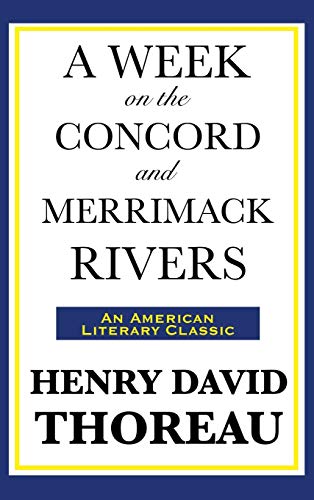
A Week on the Concord and Merrimack Rivers: A Classic Journey through Nature, Memory, and American Transcendental Thought - Hardcover
Synopsis
A Week on the Concord and Merrimack Rivers is both a remembrance of an intensely spiritual moment in Henry David Thoreau's life and a memoriam to his older brother who accompanied him on the trip shortly before his death. Full of fascinating literary musings and philosophical speculations, this book is a true precursor to Walden.
"synopsis" may belong to another edition of this title.
About the Author
Henry David Thoreau (1817-1862) was an American writer, philosopher, naturalist, surveyor, reformer, and one of the central figures of American Transcendentalism. Born in Concord, Massachusetts, he was educated at Harvard College and returned to Concord, where he became closely associated with Ralph Waldo Emerson and the circle of writers and thinkers who helped shape nineteenth-century American intellectual life. Thoreau's work joined literary art, philosophical independence, close natural observation, and moral resistance in a way that made him one of the most enduring American authors.Thoreau is best known for Walden, his account of living deliberately near Walden Pond, and for "Civil Disobedience," his influential essay on conscience, government, slavery, war, and the moral duty to resist unjust authority. His writing also includes journals, lectures, poems, travel narratives, natural history observations, political essays, and works such as A Week on the Concord and Merrimack Rivers, The Maine Woods, and Cape Cod. His journals, in particular, reveal a lifelong commitment to observing seasonal change, plants, animals, weather, and the intimate details of the New England landscape.Although sometimes remembered as a solitary figure, Thoreau was deeply engaged with the social, political, and environmental questions of his time. He opposed slavery, defended John Brown, criticized materialism, and argued for a life guided by conscience rather than conformity. His influence reaches across literature, environmental thought, political protest, nature writing, simple living, and American philosophy. More than a century and a half after his death, Thoreau remains essential to readers interested in freedom, nature, moral courage, and the art of living with attention.
"About this title" may belong to another edition of this title.
Other Popular Editions of the Same Title

Search results for A Week on the Concord and Merrimack Rivers: A Classic...

Seller Image
A Week On The Concord And Merrimack Rivers
Seller: GreatBookPrices, Columbia, MD, U.S.A.
Seller rating 5 out of 5 stars

Condition: New. Seller Inventory # 33167313-n
Seller Image
A Week on the Concord and Merrimack Rivers (Hardback or Cased Book)
Published by
Wilder Publications 4/3/2018, 2018
ISBN 10: 1515436705
ISBN 13: 9781515436706
New
Hardcover
Seller: BargainBookStores, Grand Rapids, MI, U.S.A.
Seller rating 5 out of 5 stars
Hardback or Cased Book. Condition: New. A Week on the Concord and Merrimack Rivers. Book. Seller Inventory # BBS-9781515436706
Seller Image
A Week On The Concord And Merrimack Rivers
Seller: GreatBookPrices, Columbia, MD, U.S.A.
Seller rating 5 out of 5 stars
Condition: As New. Unread book in perfect condition. Seller Inventory # 33167313
Stock Image
A Week on the Concord and Merrimack Rivers
Print on DemandSeller: PBShop.store US, Wood Dale, IL, U.S.A.
Seller rating 5 out of 5 stars
HRD. Condition: New. New Book. Shipped from UK. THIS BOOK IS PRINTED ON DEMAND. Established seller since 2000. Seller Inventory # L1-9781515436706
Stock Image
A Week on the Concord and Merrimack Rivers
Print on DemandSeller: PBShop.store UK, Fairford, GLOS, United Kingdom
Seller rating 5 out of 5 stars
HRD. Condition: New. New Book. Delivered from our UK warehouse in 4 to 14 business days. THIS BOOK IS PRINTED ON DEMAND. Established seller since 2000. Seller Inventory # L1-9781515436706
Buy New
£ 30.48
£ 5.02 shipping
Ships from United Kingdom to U.S.A.
Ships from United Kingdom to U.S.A.
Quantity: Over 20 available
Stock Image
A Week on the Concord and Merrimack Rivers
Print on DemandSeller: Majestic Books, Hounslow, United Kingdom
Seller rating 4 out of 5 stars

Condition: New. Print on Demand. Seller Inventory # 378637571
Buy New
£ 33.13
£ 6.50 shipping
Ships from United Kingdom to U.S.A.
Ships from United Kingdom to U.S.A.
Quantity: 4 available
Stock Image
A Week on the Concord and Merrimack Rivers
Print on DemandSeller: Books Puddle, New York, NY, U.S.A.
Seller rating 4 out of 5 stars
Condition: New. Print on Demand. Seller Inventory # 26384185052
Stock Image
A Week on the Concord and Merrimack Rivers: A Classic Journey through Nature, Memory, and American Transcendental Thought
Seller: Ria Christie Collections, Uxbridge, United Kingdom
Seller rating 5 out of 5 stars
Condition: New. In. Seller Inventory # ria9781515436706_new
Buy New
£ 30.32
£ 11.98 shipping
Ships from United Kingdom to U.S.A.
Ships from United Kingdom to U.S.A.
Quantity: Over 20 available
Stock Image
A Week on the Concord and Merrimack Rivers
Print on DemandSeller: Biblios, Frankfurt am main, HESSE, Germany
Seller rating 4 out of 5 stars
Condition: New. PRINT ON DEMAND. Seller Inventory # 18384185046
Seller Image
A Week On The Concord And Merrimack Rivers
Seller: GreatBookPricesUK, Woodford Green, United Kingdom
Seller rating 5 out of 5 stars
Condition: New. Seller Inventory # 33167313-n
Buy New
£ 30.31
£ 15 shipping
Ships from United Kingdom to U.S.A.
Ships from United Kingdom to U.S.A.
Quantity: Over 20 available