
Items related to Devour Obstacles for Dinner: Tools to Develop a Fearless...
Devour Obstacles for Dinner: Tools to Develop a Fearless Attitude, Discover Joy, and Achieve Goals - Softcover
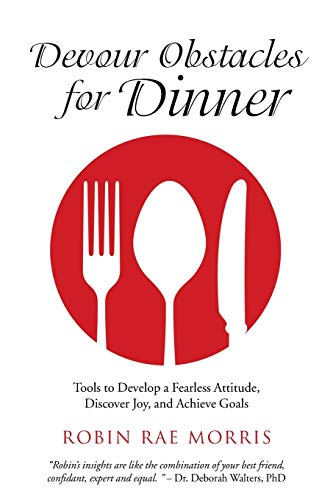
Synopsis
In Devour Obstacles for Dinner, you’ll find inspiration and the tools to put your “aha’s" into practice. You’ll find tools to help you answer should I stay or should I go questions in your relationships and careers, you’ll find tools to help you with overwhelm, anxiety and depression, and you’ll find tools to help you resolve the feeling that you have great life - but maybe something, passion or purpose, is missing. These practical and time tested tools are woven into stories of inspiring life changes, providing you with the attitude and tools to create the life you want to live while allowing you to give your best to others.
This book is for you if you want to:
- Realize it’s not overcoming your problems that will make you happy, confident and fulfilled: it’s about finding the tools to become happy, confident and fulfilled that allows you to overcome your problems
- Experience more joy, passion and compassion in your daily life
- Release worries and fears that hold you back
- Resolve “Should I stay or should I go?” questions
- Approach life with a positive and hopeful mindset
- Launch your biggest dreams
This book is for psychology students, psychotherapists and medical professionals who want to:
- Learn practical tools to propel your clients’ success
- Sharpen your creative counseling skills
- Laugh with clients while resolving issues
- Experience therapy sessions up close and personal
- Connect to clients as the unique helping professional you are, and earn clients’ trust
"synopsis" may belong to another edition of this title.
About the Author
Robin is a licensed mental health counsellor who enjoys private practice in Woodinville, Washington. She loves beauty of the Pacific Northwest and also loves travelling to present at seminars. She has worked in community agencies, private and public schools, and has been a dance teacher and theatre director for kids 5 - 95. In all of her work, she is most concerned with the transformational process for each individual, and providing opportunities for deep connections between individuals. Her varied professional career positions give her a unique, creative and easy to relate to style. She encourages clients to become self-empowered and also to access their innate creativity. Robin has a Masters Degree in Existential Phenomenological Therapeutic Psychology from Seattle University, in Seattle Washington. Don't be afraid of that last sentence, it just means that her therapeutic training focuses on the issues faced by humans throughout our life spans. She loves books, bicycles, being grateful, gardening, hiking and snow-skiing. To learn about counselling, consulting and speaking opportunities, please visit RobinMorrisCounseling.com A long time story teller, both by nature and the family she was born into, Robin has also become a collector of stories. These stories are based in the funny, poignant, determined and passionate accounts collected over thirty years of choosing to work as a dedicated helping professional. She is continuing to be of service to others by offering a series of books and also a series of seminars. The books and seminars are based in getting inspired by others' stories, and assisting clients to create their own magnificent life story.
From the Back Cover
Robin is a licensed mental health counsellor who enjoys private practice in Woodinville, Washington. She loves beauty of the Pacific Northwest and also loves travelling to present at seminars. She has worked in community agencies, private and public schools, and has been a dance teacher and theatre director for kids 5 – 95.
In all of her work, she is most concerned with the transformational process for each individual, and providing opportunities for deep connections between individuals. Her varied professional career positions give her a unique, creative and easy to relate to style. She encourages clients to become self-empowered and also to access their innate creativity.
Robin has a Masters Degree in Existential Phenomenological Therapeutic Psychology from Seattle University, in Seattle Washington. Don’t be afraid of that last sentence, it just means that her therapeutic training focuses on the issues faced by humans throughout our life spans. She loves books, bicycles, being grateful, gardening, hiking and snow-skiing.
To learn about counselling, consulting and speaking opportunities, please visit RobinMorrisCounseling.com
A long time story teller, both by nature and the family she was born into, Robin has also become a collector of stories. These stories are based in the funny, poignant, determined and passionate accounts collected over thirty years of choosing to work as a dedicated helping professional. She is continuing to be of service to others by offering a series of books and also a series of seminars. The books and seminars are based in getting inspired by others’ stories, and assisting clients to create their own magnificent life story.
From the Inside Flap
Robin is a licensed mental health counsellor who enjoys private practice in Woodinville, Washington. She loves beauty of the Pacific Northwest and also loves travelling to present at seminars. She has worked in community agencies, private and public schools, and has been a dance teacher and theatre director for kids 5 – 95.
In all of her work, she is most concerned with the transformational process for each individual, and providing opportunities for deep connections between individuals. Her varied professional career positions give her a unique, creative and easy to relate to style. She encourages clients to become self-empowered and also to access their innate creativity.
Robin has a Masters Degree in Existential Phenomenological Therapeutic Psychology from Seattle University, in Seattle Washington. Don’t be afraid of that last sentence, it just means that her therapeutic training focuses on the issues faced by humans throughout our life spans. She loves books, bicycles, being grateful, gardening, hiking and snow-skiing.
To learn about counselling, consulting and speaking opportunities, please visit RobinMorrisCounseling.com
A long time story teller, both by nature and the family she was born into, Robin has also become a collector of stories. These stories are based in the funny, poignant, determined and passionate accounts collected over thirty years of choosing to work as a dedicated helping professional. She is continuing to be of service to others by offering a series of books and also a series of seminars. The books and seminars are based in getting inspired by others’ stories, and assisting clients to create their own magnificent life story.
Excerpt. © Reprinted by permission. All rights reserved.
Devour Obstacles for Dinner
Tools to Develop a Fearless Attitude, Discover Joy, and Achieve Goals
By Robin Rae MorrisBalboa Press
Copyright © 2016 Robin Rae Morris
All rights reserved.
ISBN: 978-1-5043-4586-6All rights reserved.
Contents
Preface, xi,
Part One: Meet and Greet Ridin' in the Atommobile, 1,
Part Two: Counseling Can Be User Friendly So Many Adventures, So Little Time, 19,
Part Three: Counseling Can Help You Make Important Decisions The Unknown is Faithful, 59,
Part Four: Counseling Can Help You Ask Important Questions The Art of the Pause, 83,
Part Five: Counseling Can Help You Improve Your Relationships The Hallmark Card You'll Never Send, 97,
Part Six: Counseling Can Provide Engaging Metaphors Ride the Best Bus, 131,
Afterword, 157,
CHAPTER 1
Part One: Meet and Greet
Ridin' in the Atommobile
Standing in a line at Disneyland with Mickey Mouse ears atop my head, I stared — equally scared and fascinated — at a ride called Adventures through Inner Space. I instinctively slipped my small, six-year-old hand into my father's large palm as we watched the riders in front of us take their seats in the Atommobile — a converted car that carried visitors down a dark tunnel. We stood at one end of the Mighty Microscope and peered through a glass tube, which showed the Atommobile traveling farther and farther away. Then it was our turn. Once seated in the Atommobile, I clung to my father's arm, and we drove down the tunnel. In the darkness, the voice of an unseen scientist told us we had "passed beyond the limits of normal Mag-ni-fi-ca-tion." In other words, we were shrinking to the size of microscopic molecules!
As we entered through the tunnel, delicate snowflakes fluttered down around us, but as we continued, they grew larger and larger. The scientist said, "Although your body will shrink, your mind will expand." I watched wide-eyed and delighted as the snowflakes progressively grew to two hundred times the size of a little girl — a single snowflake became large enough to fill my entire field of vision. I was surrounded by infinite uniqueness and immeasurable beauty unfolding in every ice crystal. Before we were returned to normal size, a simple knowledge had crystallized within me: we are all infinitely unique and immeasurably beautiful. This inherent beauty is constantly unfolding through our unlimited capacity for joy, love, tolerance, and laughter.
Inevitably, we will all encounter difficulties from which we might prefer to shrink; however, those are precisely the moments in which our hearts and minds can expand. And this book will show you how.
How to Make This Book Work for You
This book is a collection of twenty-two stories, and thirty-nine tools. Each one was written with the goal of helping you resolve a difficult situation, improve your mood, or achieve your next great objective.
Each story describes a client's journey to transforming unhappiness into joy, gratitude, and compassion. Along the way, the reader will see representations of lessons learned along the way in the form of tools. Some tools give an organized "how-to" outline for moving forward. Other tools are a visual representation of a helpful framework, designed to present a new perspective for solving difficult issues and questions. In my counseling practice, I've found that representing frameworks visually on a whiteboard makes them easier to remember. Visual learners love them.
Each tool has been tested and retested to make sure it is helpful in everyday life for a wide range of personalities and presenting problems. Each tool has also proven to be a fundamental element in deeper, transformative experiences for clients. The characters and stories in this book represent composites of several individuals and events, as confidentiality is always my top priority. You can read each story for the full experience, or if you want to cut to the chase, you can go straight to the tools.
I've had the privilege of being a counselor and life coach for over twenty years, and this book is the result of watching client after client change his or her life for the better. Everything starts with the first step: being willing to change. My clients have shown me that once you are willing to manifest the courage and vulnerability necessary to share your story, your story will change. These wonderful people are proof that life works when we're dedicated to creating a life that works for us.
Now is the time! Make this book your own. You have an incredible life story waiting to unfold. In this story, your life works for you and allows you to contribute to your family, community, and society.
A Note to Students of Psychology
Imagine it's your first session as a counselor. You open your mouth to greet your client, and instead of "hello," a gasp comes out. Only then do you realize that you've been holding your breath for who knows how long! You'd like to reach out and shake your client's hand, but you're certain the pools of perspiration seeping out of your shirt and down your arms are a dead giveaway of your uncertainty.
The client looks at you with trusting eyes and innocently inquires, "How does this work?" You feel a scream emerging from your throat. "Hell if I know!" you resist yelling. You also resist calling your mother in the middle of the session and begging her to please come get you and take you home.
Somewhere in your mind, you think about dry cleaning. Yes, dry cleaning — where the clothes come in dirty and go out clean, where a spot is a spot and there is no ambiguity. You know you'd be good at dry cleaning; strange that it is only now as this client, this person, is staring at you and waiting for answers, that you are able to see so clearly that your answer is a different career.
Your mind, scrambling madly, tries to calm you down: Just remember the role plays, the videotaped sessions and feedback, and the endless hours transcribing practice sessions. Your inner cheerleader yells, You got this! But when she sees the stricken, nervous look on your face, even she puts down her pom-poms and heads out to look for a new game.
Practice as we might, nothing can prepare us for those first few sessions when we sit across the room from another human being — someone seeking help, relief from suffering, and perspective on how to make a better life.
My first client was desperate. But he wasn't the only one in the room feeling this way. As he shared his story, he began to sweat, and so did I. I sweat in those weird places that activate when your sweating is anxiety based: the upper lip (attractive and not at all distracting) and behind the knees. Worrying about all the perspiration was not at all conducive to that "being present" thing I had just spent three years of graduate school exploring.
Needless to say, it did not go well.
He did not return.
So I sought feedback. "Relax," my mentor said. "You don't have to solve it all at once. Let your client's life story unfold." I thanked her for this advice. Later, I told her that putting three fingers gently over her mouth and chin had failed to conceal the fact that she was laughing at me and my sweating.
After all these years, I'm now in the position of advising psychology students to relax! But I know it's harder than that, which is why I wrote this book. Here you'll read about the same concepts that are covered in graduate school but with one big difference: now you'll get to "sit in" on sessions and see how all of those concepts are presented in real time, with real human beings.
Make no mistake — it is important go to class, study the material, and understand the history of psychology and how we got to where we are today. However, this book contains the most crucial lesson that you will not learn in any classroom. I've discovered that truly helping my clients heal can only happen when I bring my authentic self to the counseling room. In the following stories, I'll show you how I am me in my sessions so that, should you decide to follow a life dedicated to serving others through psychotherapy and life coaching, you can also learn how to be you in the counseling room. Please be reassured that the greatest gift you have to give to your clients is the one you've already been given — your unique presence.
Family Dysfunction in the Life of a Therapist
Believe it or not, psychotherapists and life coaches are not immune to family dysfunction. If anything, we are more aware of it when it inevitably shows up.
That's why I decided to begin this collection with a story from my own family folklore. This is the only story that uses real names and specific individuals. As mentioned previously, the characters in all the other stories represent composites of several people, in order to protect my clients' privacy.
The Road to Success is Dotted with Many Tempting Parking Spots
The four of us are having a great time in the car — considering we are on our way to a funeral. Our laughter comes to a dead stop when we round a corner and see that the church parking lot is full.
"We should have left earlier," my brother says.
"Who would have thought he had so many friends!" remarks my seventy-eight-year-old Aunt Mary. She was never one to worry much about the unintended subtext of her statements.
"I'm not sure how many friends he had, but part of the problem is that the church parking lot is also a park-and-ride for commuters," I observe.
"It's fine," says my ever-optimistic mom. "There's a great spot right over there."
My brother motors the car to the spot. There are disabled-parking-only signs plastered everywhere.
"Ah ... this isn't ... a good idea," my brother warns.
"It's actually an awful idea!" I add.
"It's fine," Mom repeats, as she deftly pops open the glove box. She slides in her right hand, fishes out a deep-green disabled-parking permit, and loops it onto the rearview mirror, where it swings in happy oblivion.
"Mom!" I scream out in disbelief. "Dad died two years ago! That's expired. And PS: no one in this car is disabled."
"Well, we're certainly glad about that," my aunt responds. She was never one to worry about hijacking a conversation either.
Finally, we park and pile out of the car. I'm grumbling, and my brother is mumbling. We beat feet, since the service begins in five minutes. After songs and speeches, humility and hugs, coffee and cake, we say our goodbyes.
From the steps of the church, we see a man wearing a black vest with the words Volunteer Police written in florescent orange. He is transcribing the license plate number of my mother's car onto a long rectangular form. Mom relives her high school track days with a speedy hundred-yard dash to the officer.
Their conversation starts out all right, but when her sweet talk doesn't deter him from his ticket-writing, things go south. The volunteer police officer faces Mom as he rips the ticket off a neat stack of papers in triplicate and unceremoniously flaps it at her. They look alike in a comic book kind of way — each of them with puffed-up chests, pursed that-tasted-sour lips, and spectacularly furrowed eyebrows.
Mom takes the ticket.
We pile back into the car in silence, except for the sounds of seat belts clicking into place. And the hum of the engine. And the rip of the deep-green disabled-parking permit as mom tears it off the rearview mirror.
"Well!" Mom is indignant. She huffs uncharacteristically, "He certainly was a hardnose!"
"Mom, you broke the law!" I say from the safety of the back seat. "It's his job to write you a ticket."
"How can it be a job when Volunteer is pasted on your back in neon letters?" my brother wonders aloud.
"Okay, I'm just saying, it's not only Mom; we all knew better before the volunteer confirmed it with a punishment," I respond.
"Well," Mom says again, slightly less indignant, "there is that."
"Whether it's death or tickets, there's no use crying over spilt milk," adds my aunt.
"I believe it's 'spilled' milk," I correct her. And then, unable to stop myself from driving the point home, I continue, "There's no use crying over spilled milk."
"Well, la-di-da," replies my aunt, completely carefree.
I look around, thinking maybe I'm in a Woody Allen movie. But no. When I come out of my quick daydream, there's only silence. Then, laughter.
All four of us start belly laughing. Snorting, chortling, giggling, even doing that weird exhale-while-wheezing thing. I love these people — they put the "fun" in family dysfunction. But it's not just family dysfunction or death, tickets, and breaking the law that we're talking about here. It's opportunity. Yes, the opportunity to develop "a humble posture of learning," as my mentor would say.
Later, Mom writes the following letter to City Hall:
Dear Most Honorable Judge,
I have enclosed the ticket I received and marked the box asking me to explain the circumstances. I realize, however, that there is little to explain. I made a mistake. Yes, I am guilty of an error in judgment and of the behavior that accompanied it. I do ask that my fine be reduced, as I have been driving for over fifty years and have had a perfect record up to this point. I would be very grateful if you could reduce the fine.
I am also enclosing half of my deceased husband's disability parking permit. (Did I mention we were married for fifty years and I still miss him every day?)
I am keeping the other half to remind myself that the road to success is dotted with many tempting parking spots.
Very humbly yours, Karin
The most honorable judge deferred the ticket.
"Deferred" is a fancy way of saying that if you've truly understood the error of your ways — which includes deciding to make new, better, healthier, and in this case, legal choices — then we will chalk it up to a learning experience. But if you forget what you've learned or didn't make the effort to humble your ego and pursue change, then we'll give you the ticket and charge you a double fine to boot.
In this case, the most honorable judge seemed to operate a lot like the most honorable universe: encouraging us to recognize that each time we make a decision based on integrity, we manifest our best selves. While attending to the rituals surrounding death, we learned an important lesson about life.
Tool! The Tyranny of Shortcut, Short-Term Thinking and What to Do About It
How to know when you are pulling into a tempting parking space:
You're in a jam because you should have started earlier or had a better plan but you didn't. Your thinking and decision making probably sounds like this: "Oh well, just this once I'll take the short cut, the easy way out. But only this once, and then next time I'll do better." Maybe this means parking illegally in the disabled-parking spot, or cheating off a friend on a test, or getting high before an important presentation at work. Whatever it may be, we humans are experts at creatively rationalizing and excusing unhealthy or irrational behaviors.
What to do about it:
Stop at once! Do not park the car in the tempting parking space. Instead, pull over so you can make the best long-term decision. These are precisely the situations in which we are given the opportunity to assume a humble posture of learning based not in ego or self-flagellation but in genuine self-reflection.
Ask yourself what part you played in creating this situation. Take an honest look at the role fear has played in making those not-so-optimal choices in the past. More often than not, these patterns are rooted in childhood coping or defense mechanisms. However, as we grow older and gain more control and wisdom, it's important to analyze whether these are still healthy ways of being. This process of self-reflection and self-control may entail unexpected inconveniences, expenses, or discomfort. This is the price we pay for growth. It's better to feel a little discomfort in the moment than wait for fate (otherwise known as the "effect" part of cause and effect) to manifest in a more unpleasant way. Owning up to your part in creating the situation will empower you to stay in the driver's seat of your experiences and make it easier to laugh about later.
Ask yourself what you could do differently in the future. Explore the infinite alternatives available to you. Create your own positive destiny by taking action based in integrity instead of fear or convenience. Then recommit as often as necessary.
CHAPTER 2Part Two: Counseling Can Be User Friendly
So Many Adventures, So Little Time
Paul is an intelligent, self-identified geek and space enthusiast who works as a software developer. When he comes in for a session with concerns about feeling anxious and overwhelmed with the myriad responsibilities he has both at work and at home, I don't bother doing therapy.
Instead, I tell him a true story.
An astronaut hovers in space, assigned to remove a panel on the Hubble Telescope. He stares at the panel, knowing he must remove thirty screws in as many minutes. To make matters worse, the gloves he's wearing limit his dexterity. Slowly and deliberately he repeats the phrase, "There is only one screw." This intense focus on the present task proves effective in helping him stay solidly in his space boots, instead of jumping around in time. He avoids jumping ahead, where he will become anxious over how much is left to do. He avoids jumping behind to consider similar situations that he has cataloged as failures. He neither retreats into a lost past nor disappears into an imaginary future. There is only one screw, he thinks again, removing the screw and securing his success.
When I finish the story, Paul starts filling in the details, including the name of the astronaut and the year of his journey. I thank him for the information yet gently let him know that getting more information about the event wasn't why I told him the story.
(Continues...)
Excerpted from Devour Obstacles for Dinner by Robin Rae Morris. Copyright © 2016 Robin Rae Morris. Excerpted by permission of Balboa Press.
All rights reserved. No part of this excerpt may be reproduced or reprinted without permission in writing from the publisher.
Excerpts are provided by Dial-A-Book Inc. solely for the personal use of visitors to this web site.
"About this title" may belong to another edition of this title.
Search results for Devour Obstacles for Dinner: Tools to Develop a Fearless...

Seller Image
Devour Obstacles for Dinner
Seller: Zoom Books Company, Lynden, WA, U.S.A.
Seller rating 5 out of 5 stars

Condition: very_good. Book is in very good condition and may include minimal underlining highlighting. The book can also include "From the library of" labels. May not contain miscellaneous items toys, dvds, etc. . We offer 100% money back guarantee and 24 7 customer service. Seller Inventory # ZBV.150434586X.VG
Stock Image
Devour Obstacles for Dinner
Seller: California Books, Miami, FL, U.S.A.
Seller rating 5 out of 5 stars
Condition: New. Seller Inventory # I-9781504345866
Stock Image
Devour Obstacles for Dinner
Print on DemandSeller: PBShop.store US, Wood Dale, IL, U.S.A.
Seller rating 5 out of 5 stars
PAP. Condition: New. New Book. Shipped from UK. THIS BOOK IS PRINTED ON DEMAND. Established seller since 2000. Seller Inventory # L0-9781504345866
Stock Image
Devour Obstacles for Dinner Tools to Develop a Fearless Attitude, Discover Joy, and Achieve Goals
Print on DemandSeller: PBShop.store UK, Fairford, GLOS, United Kingdom
Seller rating 5 out of 5 stars
PAP. Condition: New. New Book. Delivered from our UK warehouse in 4 to 14 business days. THIS BOOK IS PRINTED ON DEMAND. Established seller since 2000. Seller Inventory # L0-9781504345866
Buy New
£ 11.77
£ 4.16 shipping
Ships from United Kingdom to U.S.A.
Ships from United Kingdom to U.S.A.
Quantity: Over 20 available
Stock Image
Devour Obstacles for Dinner: Tools to Develop a Fearless Attitude, Discover Joy, and Achieve Goals
Print on DemandSeller: Majestic Books, Hounslow, United Kingdom
Seller rating 4 out of 5 stars

Condition: New. Print on Demand pp. 174. Seller Inventory # 371905881
Buy New
£ 13.28
£ 6.50 shipping
Ships from United Kingdom to U.S.A.
Ships from United Kingdom to U.S.A.
Quantity: 4 available
Stock Image
Devour Obstacles for Dinner: Tools to Develop a Fearless Attitude, Discover Joy, and Achieve Goals
Print on DemandSeller: Books Puddle, Woodside, NY, U.S.A.
Seller rating 4 out of 5 stars
Condition: New. Print on Demand pp. 174. Seller Inventory # 26375220870
Stock Image
Devour Obstacles for Dinner: Tools to Develop a Fearless Attitude, Discover Joy, and Achieve Goals
Print on DemandSeller: Biblios, Frankfurt am main, HESSE, Germany
Seller rating 4 out of 5 stars
Condition: New. PRINT ON DEMAND pp. 174. Seller Inventory # 18375220876
Stock Image
Devour Obstacles for Dinner
Seller: Ria Christie Collections, Uxbridge, United Kingdom
Seller rating 5 out of 5 stars
Condition: New. In English. Seller Inventory # ria9781504345866_new
Buy New
£ 13.19
£ 9.37 shipping
Ships from United Kingdom to U.S.A.
Ships from United Kingdom to U.S.A.
Quantity: Over 20 available
Stock Image
Devour Obstacles for Dinner: Tools to Develop a Fearless Attitude, Discover Joy, and Achieve Goals
Seller: Chiron Media, Wallingford, United Kingdom
Seller rating 5 out of 5 stars
PF. Condition: New. Seller Inventory # 6666-IUK-9781504345866
Buy New
£ 8.20
£ 15.49 shipping
Ships from United Kingdom to U.S.A.
Ships from United Kingdom to U.S.A.
Quantity: 10 available
Stock Image
Devour Obstacles for Dinner: Tools to Develop a Fearless Attitude, Discover Joy, and Achieve Goals
Print on DemandSeller: THE SAINT BOOKSTORE, Southport, United Kingdom
Seller rating 5 out of 5 stars
Paperback / softback. Condition: New. This item is printed on demand. New copy - Usually dispatched within 5-9 working days. Seller Inventory # C9781504345866
Buy New
£ 12.63
£ 13.15 shipping
Ships from United Kingdom to U.S.A.
Ships from United Kingdom to U.S.A.
Quantity: Over 20 available