
Items related to Finite Element Methods in CAD: Electrical and Magnetic...
Synopsis
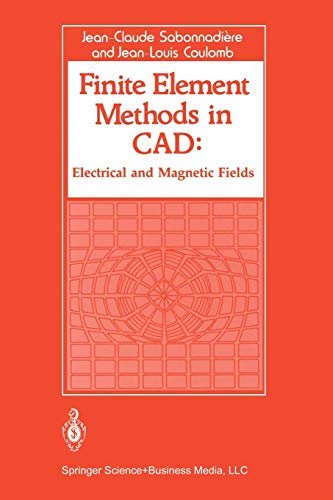
The finite element method (FEM) has been understood, at least in principle, for more than 50 years. The integral formulation on which it is based has been known for a longer time (thanks to the work of Galerkin, Ritz, Courant and Hilbert,1.4 to mention the most important). However, the method could not be applied in a practical way since it involved the solution of a large number of linear or non-linear algebraic equations. Today it is quite common, with the aid of computers, to solve non-linear algebraic problems of several thousand equations. The necessary numerical methods and programming techniques are now an integral part of the teaching curriculum in most engineering schools. Mechanical engineers, confronted with very complicated structural problems, were the first to take advantage of advanced computational methods and high level languages (FORTRAN) to transform the mechanical models into algebraic equations (1956). In recent times (1960), the FEM has been studied by applied mathematicians and, having received rigorous treatment, has become a part of the more general study of partial differential equations, gradually replacing the finite difference method which had been considered the universal tool to solve these types of problems.
"synopsis" may belong to another edition of this title.
Search results for Finite Element Methods in CAD: Electrical and Magnetic...

Stock Image
Finite Element Methods in CAD (eng)
Print on DemandSeller: Brook Bookstore On Demand, Napoli, NA, Italy
Seller rating 5 out of 5 stars

Condition: new. Questo è un articolo print on demand. Seller Inventory # WDGLUHJZAA
Buy New
£ 40.95
£ 4.73 shipping
Ships from Italy to U.S.A.
Ships from Italy to U.S.A.
Quantity: Over 20 available
Stock Image
Finite Element Methods in CAD: Electrical and Magnetic Fields
Seller: Chiron Media, Wallingford, United Kingdom
Seller rating 5 out of 5 stars
PF. Condition: New. Seller Inventory # 6666-IUK-9781468487411
Buy New
£ 47.75
£ 15.49 shipping
Ships from United Kingdom to U.S.A.
Ships from United Kingdom to U.S.A.
Quantity: 10 available
Stock Image
Finite Element Methods in CAD: Electrical and Magnetic Fields
Seller: Ria Christie Collections, Uxbridge, United Kingdom
Seller rating 5 out of 5 stars
Condition: New. In English. Seller Inventory # ria9781468487411_new
Buy New
£ 55.95
£ 9.37 shipping
Ships from United Kingdom to U.S.A.
Ships from United Kingdom to U.S.A.
Quantity: Over 20 available
Seller Image
Finite Element Methods in CAD
Published by
Springer, Chapman And Hall/CRC Okt 2013, 2013
ISBN 10: 1468487418
ISBN 13: 9781468487411
New
Taschenbuch
Seller: BuchWeltWeit Ludwig Meier e.K., Bergisch Gladbach, Germany
Seller rating 5 out of 5 stars
Taschenbuch. Condition: Neu. This item is printed on demand - it takes 3-4 days longer - Neuware -The finite element method (FEM) has been understood, at least in principle, for more than 50 years. The integral formulation on which it is based has been known for a longer time (thanks to the work of Galerkin, Ritz, Courant and Hilbert,1.4 to mention the most important). However, the method could not be applied in a practical way since it involved the solution of a large number of linear or non-linear algebraic equations. Today it is quite common, with the aid of computers, to solve non-linear algebraic problems of several thousand equations. The necessary numerical methods and programming techniques are now an integral part of the teaching curriculum in most engineering schools. Mechanical engineers, confronted with very complicated structural problems, were the first to take advantage of advanced computational methods and high level languages (FORTRAN) to transform the mechanical models into algebraic equations (1956). In recent times (1960), the FEM has been studied by applied mathematicians and, having received rigorous treatment, has become a part of the more general study of partial differential equations, gradually replacing the finite difference method which had been considered the universal tool to solve these types of problems. 208 pp. Englisch. Seller Inventory # 9781468487411
Stock Image
Finite Element Methods in CAD
Seller: Books Puddle, Woodside, NY, U.S.A.
Seller rating 4 out of 5 stars

Condition: New. pp. 208. Seller Inventory # 26128018016
Stock Image
Finite Element Methods in CAD
Print on DemandSeller: Majestic Books, Hounslow, United Kingdom
Seller rating 4 out of 5 stars
Condition: New. Print on Demand pp. 208 49:B&W 6.14 x 9.21 in or 234 x 156 mm (Royal 8vo) Perfect Bound on White w/Gloss Lam. Seller Inventory # 131520959
Buy New
£ 68.37
£ 6.50 shipping
Ships from United Kingdom to U.S.A.
Ships from United Kingdom to U.S.A.
Quantity: 4 available
Stock Image
Finite Element Methods in CAD: Electrical and Magnetic Fields
Seller: Revaluation Books, Exeter, United Kingdom
Seller rating 5 out of 5 stars
Paperback. Condition: Brand New. reprint edition. 202 pages. 9.25x6.10x0.47 inches. In Stock. Seller Inventory # x-1468487418
Buy New
£ 65.85
£ 10 shipping
Ships from United Kingdom to U.S.A.
Ships from United Kingdom to U.S.A.
Quantity: 2 available
Stock Image
Finite Element Methods in CAD
Print on DemandSeller: Biblios, Frankfurt am main, HESSE, Germany
Seller rating 4 out of 5 stars
Condition: New. PRINT ON DEMAND pp. 208. Seller Inventory # 18128018026
Seller Image
Finite Element Methods in CAD : Electrical and Magnetic Fields
Seller: AHA-BUCH GmbH, Einbeck, Germany
Seller rating 5 out of 5 stars
Taschenbuch. Condition: Neu. Druck auf Anfrage Neuware - Printed after ordering - The finite element method (FEM) has been understood, at least in principle, for more than 50 years. The integral formulation on which it is based has been known for a longer time (thanks to the work of Galerkin, Ritz, Courant and Hilbert,1.4 to mention the most important). However, the method could not be applied in a practical way since it involved the solution of a large number of linear or non-linear algebraic equations. Today it is quite common, with the aid of computers, to solve non-linear algebraic problems of several thousand equations. The necessary numerical methods and programming techniques are now an integral part of the teaching curriculum in most engineering schools. Mechanical engineers, confronted with very complicated structural problems, were the first to take advantage of advanced computational methods and high level languages (FORTRAN) to transform the mechanical models into algebraic equations (1956). In recent times (1960), the FEM has been studied by applied mathematicians and, having received rigorous treatment, has become a part of the more general study of partial differential equations, gradually replacing the finite difference method which had been considered the universal tool to solve these types of problems. Seller Inventory # 9781468487411
Seller Image
Finite Element Methods in CAD
Print on DemandSeller: moluna, Greven, Germany
Seller rating 5 out of 5 stars
Condition: New. Dieser Artikel ist ein Print on Demand Artikel und wird nach Ihrer Bestellung fuer Sie gedruckt. The finite element method (FEM) has been understood, at least in principle, for more than 50 years. The integral formulation on which it is based has been known for a longer time (thanks to the work of Galerkin, Ritz, Courant and Hilbert,1.4 to mention the . Seller Inventory # 4205128
Buy New
£ 42.85
£ 42.13 shipping
Ships from Germany to U.S.A.
Ships from Germany to U.S.A.
Quantity: Over 20 available