
Items related to HACCP in Meat, Poultry, and Fish Processing: 10 (Advances...
Synopsis
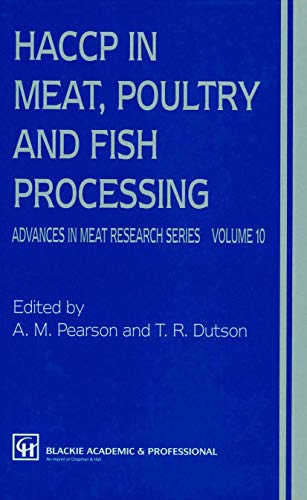
The RACCP (hazard analysis critical control point) concept for food products was an outgrowth of the US space program with the demand for a safe food supply for manned space flights by the National Aeronautics and Space Administration (NASA). The original work was carried out by the Pillsbury Company under the direction of Roward E. Bauman, who as the author of chapter 1 describes the evolution of the RACCP system and its adaptation to foods. The second chapter discusses the adoption of RACCP principles and explains how they fit into the USDA and FDA meat, poultry and seafood inspection systems. The next chapter discusses how RACCP principles can be extended to production of meat, poultry and seafoods, a most important area involved in producing a safe food supply. Chapter 4 deals with the use of RACCP in controlling hazards encountered in slaughtering and distribution of fresh meat and poultry, while chapter 5 discusses the problem - both spoilage and hazards - involved in processing and distribution of meat, poultry and seafood products. Chapter 6 covers the entire area of fish and seafoods, including both fresh and processed products from the standpoints of spoilage and hazards.
"synopsis" may belong to another edition of this title.
About the Author
"Terry and Gerry Audesirk" grew up in New Jersey, where they met as undergraduates. After marrying in 1970, they moved to California, where Terry earned her doctorate in marine ecology at the University of Southern California and Gerry earned his doctorate in neurobiology at the California Institute of Technology. As postdoctoral students at the University of Washington's marine laboratories, they worked together on the neural bases of behavior, using a marine mollusk as a model system. Terry and Gerry are now professors of biology at the University of Colorado at Denver, where they have taught introductory biology and neurobiology since 1982. In their research lab, funded by the National Institutes of Health, they investigate the mechanisms by which neurons are harmed by low levels of environmental pollutants. Terry and Gerry share a deep appreciation of nature and of the outdoors. They enjoy hiking in the Rockies, running near their home in the foothills west of Denver, and attempting to garden at 7000 feet in the presence of hungry deer and elk. They are long-time members of many conservation organizations. Their daughter, Heather, has added another focus to their lives. "Bruce E. Byers," a midwesterner transplanted to the hills of western Massachusetts, is a professor in the biology department at the University of Massachusetts, Amherst. He's been a member of the faculty at UMass (where he also completed his doctoral degree) since 1993. Bruce teaches introductory biology courses for both nonmajors and majors; he also teaches courses in ornithology and animal behavior. A lifelong fascination with birds ultimately led Bruce to scientific exploration of avian biology. His currentresearch focuses on the behavioral ecology of birds, especially on the function and evolution of the vocal signals that birds use to communicate. The pursuit of vocalizations often takes Bruce outdoors, where he can be found before dawn, tape recorder in hand, awaiting the first songs of a new day.
"About this title" may belong to another edition of this title.
Search results for HACCP in Meat, Poultry, and Fish Processing: 10 (Advances...

Stock Image
HACCP in Meat, Poultry, and Fish Proces (eng)
Print on DemandSeller: Brook Bookstore On Demand, Napoli, NA, Italy
Seller rating 5 out of 5 stars

Condition: new. Questo è un articolo print on demand. Seller Inventory # KWV0BC7KBW
Buy New
£ 68.36
£ 5.77 shipping
Ships from Italy to U.S.A.
Ships from Italy to U.S.A.
Quantity: Over 20 available
Stock Image
HACCP in Meat, Poultry, and Fish Processing
Seller: Chiron Media, Wallingford, United Kingdom
Seller rating 5 out of 5 stars
PF. Condition: New. Seller Inventory # 6666-IUK-9781461358985
Buy New
£ 79.17
£ 15.49 shipping
Ships from United Kingdom to U.S.A.
Ships from United Kingdom to U.S.A.
Quantity: 10 available
Stock Image
HACCP in Meat, Poultry, and Fish Processing
Seller: GreatBookPrices, Columbia, MD, U.S.A.
Seller rating 5 out of 5 stars
Condition: New. Seller Inventory # 20181485-n
Stock Image
HACCP in Meat, Poultry, and Fish Processing (Advances in Meat Research, 10)
Seller: Ria Christie Collections, Uxbridge, United Kingdom
Seller rating 5 out of 5 stars
Condition: New. In English. Seller Inventory # ria9781461358985_new
Buy New
£ 89.79
£ 11.29 shipping
Ships from United Kingdom to U.S.A.
Ships from United Kingdom to U.S.A.
Quantity: Over 20 available
Seller Image
HACCP in Meat, Poultry, and Fish Processing
Published by
Springer US, Humana Mär 2013, 2013
ISBN 10: 1461358981
ISBN 13: 9781461358985
New
Taschenbuch
Seller: BuchWeltWeit Ludwig Meier e.K., Bergisch Gladbach, Germany
Seller rating 5 out of 5 stars
Taschenbuch. Condition: Neu. This item is printed on demand - it takes 3-4 days longer - Neuware -The RACCP (hazard analysis critical control point) concept for food products was an outgrowth of the US space program with the demand for a safe food supply for manned space flights by the National Aeronautics and Space Administration (NASA). The original work was carried out by the Pillsbury Company under the direction of Roward E. Bauman, who as the author of chapter 1 describes the evolution of the RACCP system and its adaptation to foods. The second chapter discusses the adoption of RACCP principles and explains how they fit into the USDA and FDA meat, poultry and seafood inspection systems. The next chapter discusses how RACCP principles can be extended to production of meat, poultry and seafoods, a most important area involved in producing a safe food supply. Chapter 4 deals with the use of RACCP in controlling hazards encountered in slaughtering and distribution of fresh meat and poultry, while chapter 5 discusses the problem - both spoilage and hazards - involved in processing and distribution of meat, poultry and seafood products. Chapter 6 covers the entire area of fish and seafoods, including both fresh and processed products from the standpoints of spoilage and hazards. 412 pp. Englisch. Seller Inventory # 9781461358985
Stock Image
HACCP in Meat, Poultry, and Fish Processing
Published by
Springer-Verlag New York Inc., 2013
ISBN 10: 1461358981
ISBN 13: 9781461358985
New
Paperback / softback
Seller: THE SAINT BOOKSTORE, Southport, United Kingdom
Seller rating 5 out of 5 stars
Paperback / softback. Condition: New. This item is printed on demand. New copy - Usually dispatched within 5-9 working days. Seller Inventory # C9781461358985
Buy New
£ 94.70
£ 16.73 shipping
Ships from United Kingdom to U.S.A.
Ships from United Kingdom to U.S.A.
Quantity: Over 20 available
Seller Image
HACCP in Meat, Poultry, and Fish Processing
Print on DemandSeller: moluna, Greven, Germany
Seller rating 5 out of 5 stars
Condition: New. Dieser Artikel ist ein Print on Demand Artikel und wird nach Ihrer Bestellung fuer Sie gedruckt. The RACCP (hazard analysis critical control point) concept for food products was an outgrowth of the US space program with the demand for a safe food supply for manned space flights by the National Aeronautics and Space Administration (NASA). The original w. Seller Inventory # 4194111
Buy New
£ 72.96
£ 41.55 shipping
Ships from Germany to U.S.A.
Ships from Germany to U.S.A.
Quantity: Over 20 available
Seller Image
HACCP in Meat, Poultry, and Fish Processing
Seller: AHA-BUCH GmbH, Einbeck, Germany
Seller rating 5 out of 5 stars
Taschenbuch. Condition: Neu. Druck auf Anfrage Neuware - Printed after ordering - The RACCP (hazard analysis critical control point) concept for food products was an outgrowth of the US space program with the demand for a safe food supply for manned space flights by the National Aeronautics and Space Administration (NASA). The original work was carried out by the Pillsbury Company under the direction of Roward E. Bauman, who as the author of chapter 1 describes the evolution of the RACCP system and its adaptation to foods. The second chapter discusses the adoption of RACCP principles and explains how they fit into the USDA and FDA meat, poultry and seafood inspection systems. The next chapter discusses how RACCP principles can be extended to production of meat, poultry and seafoods, a most important area involved in producing a safe food supply. Chapter 4 deals with the use of RACCP in controlling hazards encountered in slaughtering and distribution of fresh meat and poultry, while chapter 5 discusses the problem - both spoilage and hazards - involved in processing and distribution of meat, poultry and seafood products. Chapter 6 covers the entire area of fish and seafoods, including both fresh and processed products from the standpoints of spoilage and hazards. Seller Inventory # 9781461358985
Stock Image
HACCP in Meat, Poultry, and Fish Processing
Seller: Books Puddle, Woodside, NY, U.S.A.
Seller rating 4 out of 5 stars

Condition: New. pp. 412. Seller Inventory # 2697845337
Stock Image
HACCP in Meat, Poultry, and Fish Processing (Advances in Meat Research)
Seller: Revaluation Books, Exeter, United Kingdom
Seller rating 5 out of 5 stars
Paperback. Condition: Brand New. 393 pages. 8.75x6.00x1.00 inches. In Stock. Seller Inventory # x-1461358981
Buy New
£ 119.53
£ 12.50 shipping
Ships from United Kingdom to U.S.A.
Ships from United Kingdom to U.S.A.
Quantity: 2 available