
Items related to Granular Computing: An Introduction: 717 (The Springer...
Granular Computing: An Introduction: 717 (The Springer International Series in Engineering and Computer Science, 717) - Softcover
Synopsis
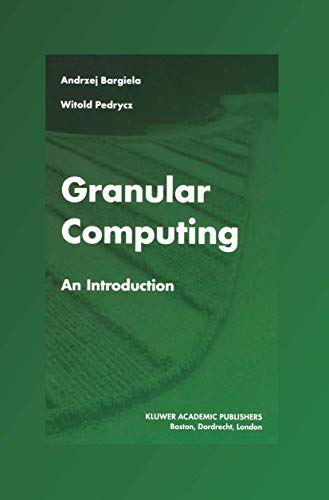
This book is about Granular Computing (GC) - an emerging conceptual and of information processing. As the name suggests, GC concerns computing paradigm processing of complex information entities - information granules. In essence, information granules arise in the process of abstraction of data and derivation of knowledge from information. Information granules are everywhere. We commonly use granules of time (seconds, months, years). We granulate images; millions of pixels manipulated individually by computers appear to us as granules representing physical objects. In natural language, we operate on the basis of word-granules that become crucial entities used to realize interaction and communication between humans. Intuitively, we sense that information granules are at the heart of all our perceptual activities. In the past, several formal frameworks and tools, geared for processing specific information granules, have been proposed. Interval analysis, rough sets, fuzzy sets have all played important role in knowledge representation and processing. Subsequently, information granulation and information granules arose in numerous application domains. Well-known ideas of rule-based systems dwell inherently on information granules. Qualitative modeling, being one of the leading threads of AI, operates on a level of information granules. Multi-tier architectures and hierarchical systems (such as those encountered in control engineering), planning and scheduling systems all exploit information granularity. We also utilize information granules when it comes to functionality granulation, reusability of information and efficient ways of developing underlying information infrastructures.
"synopsis" may belong to another edition of this title.
Search results for Granular Computing: An Introduction: 717 (The Springer...

Stock Image
Granular Computing (eng)
Print on DemandSeller: Brook Bookstore On Demand, Napoli, NA, Italy
Seller rating 5 out of 5 stars

Condition: new. Questo è un articolo print on demand. Seller Inventory # 67e046b46591ab9c18c9bbe097cee2ff
Buy New
£ 144.93
£ 5.75 shipping
Ships from Italy to U.S.A.
Ships from Italy to U.S.A.
Quantity: Over 20 available
Seller Image
Granular Computing : An Introduction
Seller: GreatBookPricesUK, Woodford Green, United Kingdom
Seller rating 5 out of 5 stars
Condition: New. Seller Inventory # 19494347-n
Buy New
£ 177.81
£ 15 shipping
Ships from United Kingdom to U.S.A.
Ships from United Kingdom to U.S.A.
Quantity: Over 20 available
Seller Image
Granular Computing
Print on DemandSeller: moluna, Greven, Germany
Seller rating 5 out of 5 stars
Condition: New. Dieser Artikel ist ein Print on Demand Artikel und wird nach Ihrer Bestellung fuer Sie gedruckt. This book is about Granular Computing (GC) - an emerging conceptual and of information processing. As the name suggests, GC concerns computing paradigm processing of complex information entities - information granules. In essence, information granules arise. Seller Inventory # 4193592
Buy New
£ 156.94
£ 41.45 shipping
Ships from Germany to U.S.A.
Ships from Germany to U.S.A.
Quantity: Over 20 available
Seller Image
Granular Computing : An Introduction
Seller: GreatBookPrices, Columbia, MD, U.S.A.
Seller rating 5 out of 5 stars
Condition: New. Seller Inventory # 19494347-n
Seller Image
Granular Computing
Published by
Springer US, Springer New York Okt 2012, 2012
ISBN 10: 1461353610
ISBN 13: 9781461353614
New
Taschenbuch
Seller: BuchWeltWeit Ludwig Meier e.K., Bergisch Gladbach, Germany
Seller rating 5 out of 5 stars
Taschenbuch. Condition: Neu. This item is printed on demand - it takes 3-4 days longer - Neuware -This book is about Granular Computing (GC) - an emerging conceptual and of information processing. As the name suggests, GC concerns computing paradigm processing of complex information entities - information granules. In essence, information granules arise in the process of abstraction of data and derivation of knowledge from information. Information granules are everywhere. We commonly use granules of time (seconds, months, years). We granulate images; millions of pixels manipulated individually by computers appear to us as granules representing physical objects. In natural language, we operate on the basis of word-granules that become crucial entities used to realize interaction and communication between humans. Intuitively, we sense that information granules are at the heart of all our perceptual activities. In the past, several formal frameworks and tools, geared for processing specific information granules, have been proposed. Interval analysis, rough sets, fuzzy sets have all played important role in knowledge representation and processing. Subsequently, information granulation and information granules arose in numerous application domains. Well-known ideas of rule-based systems dwell inherently on information granules. Qualitative modeling, being one of the leading threads of AI, operates on a level of information granules. Multi-tier architectures and hierarchical systems (such as those encountered in control engineering), planning and scheduling systems all exploit information granularity. We also utilize information granules when it comes to functionality granulation, reusability of information and efficient ways of developing underlying information infrastructures. 480 pp. Englisch. Seller Inventory # 9781461353614
Stock Image
Granular Computing: An Introduction (The Springer International Series in Engineering and Computer Science, 717)
Seller: Ria Christie Collections, Uxbridge, United Kingdom
Seller rating 5 out of 5 stars
Condition: New. In English. Seller Inventory # ria9781461353614_new
Buy New
£ 208.23
£ 11.29 shipping
Ships from United Kingdom to U.S.A.
Ships from United Kingdom to U.S.A.
Quantity: Over 20 available
Seller Image
Granular Computing
Published by
Springer, Springer Okt 2012, 2012
ISBN 10: 1461353610
ISBN 13: 9781461353614
New
Taschenbuch
Seller: buchversandmimpf2000, Emtmannsberg, BAYE, Germany
Seller rating 5 out of 5 stars
Taschenbuch. Condition: Neu. This item is printed on demand - Print on Demand Titel. Neuware -This book is about Granular Computing (GC) - an emerging conceptual and of information processing. As the name suggests, GC concerns computing paradigm processing of complex information entities - information granules. In essence, information granules arise in the process of abstraction of data and derivation of knowledge from information. Information granules are everywhere. We commonly use granules of time (seconds, months, years). We granulate images; millions of pixels manipulated individually by computers appear to us as granules representing physical objects. In natural language, we operate on the basis of word-granules that become crucial entities used to realize interaction and communication between humans. Intuitively, we sense that information granules are at the heart of all our perceptual activities. In the past, several formal frameworks and tools, geared for processing specific information granules, have been proposed. Interval analysis, rough sets, fuzzy sets have all played important role in knowledge representation and processing. Subsequently, information granulation and information granules arose in numerous application domains. Well-known ideas of rule-based systems dwell inherently on information granules. Qualitative modeling, being one of the leading threads of AI, operates on a level of information granules. Multi-tier architectures and hierarchical systems (such as those encountered in control engineering), planning and scheduling systems all exploit information granularity. We also utilize information granules when it comes to functionality granulation, reusability of information and efficient ways of developing underlying information infrastructures.Springer-Verlag KG, Sachsenplatz 4-6, 1201 Wien 480 pp. Englisch. Seller Inventory # 9781461353614
Seller Image
Granular Computing : An Introduction
Seller: AHA-BUCH GmbH, Einbeck, Germany
Seller rating 5 out of 5 stars
Taschenbuch. Condition: Neu. Druck auf Anfrage Neuware - Printed after ordering - This book is about Granular Computing (GC) - an emerging conceptual and of information processing. As the name suggests, GC concerns computing paradigm processing of complex information entities - information granules. In essence, information granules arise in the process of abstraction of data and derivation of knowledge from information. Information granules are everywhere. We commonly use granules of time (seconds, months, years). We granulate images; millions of pixels manipulated individually by computers appear to us as granules representing physical objects. In natural language, we operate on the basis of word-granules that become crucial entities used to realize interaction and communication between humans. Intuitively, we sense that information granules are at the heart of all our perceptual activities. In the past, several formal frameworks and tools, geared for processing specific information granules, have been proposed. Interval analysis, rough sets, fuzzy sets have all played important role in knowledge representation and processing. Subsequently, information granulation and information granules arose in numerous application domains. Well-known ideas of rule-based systems dwell inherently on information granules. Qualitative modeling, being one of the leading threads of AI, operates on a level of information granules. Multi-tier architectures and hierarchical systems (such as those encountered in control engineering), planning and scheduling systems all exploit information granularity. We also utilize information granules when it comes to functionality granulation, reusability of information and efficient ways of developing underlying information infrastructures. Seller Inventory # 9781461353614
Stock Image
Granular Computing
Seller: Books Puddle, Woodside, NY, U.S.A.
Seller rating 4 out of 5 stars

Condition: New. pp. 480. Seller Inventory # 2658582920
Stock Image
Granular Computing
Print on DemandSeller: Majestic Books, Hounslow, United Kingdom
Seller rating 4 out of 5 stars
Condition: New. Print on Demand pp. 480 49:B&W 6.14 x 9.21 in or 234 x 156 mm (Royal 8vo) Perfect Bound on White w/Gloss Lam. Seller Inventory # 51009623
Buy New
£ 276.52
£ 6.50 shipping
Ships from United Kingdom to U.S.A.
Ships from United Kingdom to U.S.A.
Quantity: 4 available