
Targeted Learning: Causal Inference for Observational and Experimental Data (Springer Series in Statistics) - Hardcover
Book 124 of 160: Springer Series in Statistics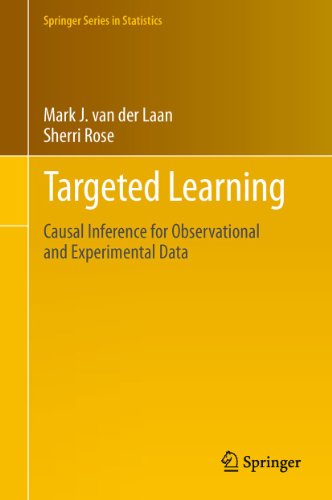
Synopsis
The statistics profession is at a unique point in history. The need for valid statistical tools is greater than ever; data sets are massive, often measuring hundreds of thousands of measurements for a single subject. The field is ready to move towards clear objective benchmarks under which tools can be evaluated. Targeted learning allows (1) the full generalization and utilization of cross-validation as an estimator selection tool so that the subjective choices made by humans are now made by the machine, and (2) targeting the fitting of the probability distribution of the data toward the target parameter representing the scientific question of interest.
This book is aimed at both statisticians and applied researchers interested in causal inference and general effect estimation for observational and experimental data. Part I is an accessible introduction to super learning and the targeted maximum likelihood estimator, including related concepts necessary to understand and apply these methods. Parts II-IX handle complex data structures and topics applied researchers will immediately recognize from their own research, including time-to-event outcomes, direct and indirect effects, positivity violations, case-control studies, censored data, longitudinal data, and genomic studies.
"synopsis" may belong to another edition of this title.
About the Author
Mark J. van der Laan is a Hsu/Peace Professor of Biostatistics and Statistics at the University of California, Berkeley. His research concerns causal inference, prediction, adjusting for missing and censored data, and estimation based on high-dimensional observational and experimental biomedical and genomic data. He is the recipient of the 2005 COPSS Presidents’ and Snedecor Awards, as well as the 2004 Spiegelman Award, and is a Founding Editor for the International Journal of Biostatistics.
Sherri Rose is currently a PhD candidate in the Division of Biostatistics at the University of California, Berkeley. Her research interests include causal inference, prediction, and applications in rare diseases. Upon completion of her doctoral degree, she will begin an NSF Mathematical Sciences Postdoctoral Research Fellowship at Johns Hopkins Bloomberg School of Public Health.
From the Back Cover
The statistics profession is at a unique point in history. The need for valid statistical tools is greater than ever; data sets are massive, often measuring hundreds of thousands of measurements for a single subject. The field is ready to move towards clear objective benchmarks under which tools can be evaluated. Targeted learning allows (1) the full generalization and utilization of cross-validation as an estimator selection tool so that the subjective choices made by humans are now made by the machine, and (2) targeting the fitting of the probability distribution of the data toward the target parameter representing the scientific question of interest.
This book is aimed at both statisticians and applied researchers interested in causal inference and general effect estimation for observational and experimental data. Part I is an accessible introduction to super learning and the targeted maximum likelihood estimator, including related concepts necessary to understand and apply these methods. Parts II-IX handle complex data structures and topics applied researchers will immediately recognize from their own research, including time-to-event outcomes, direct and indirect effects, positivity violations, case-control studies, censored data, longitudinal data, and genomic studies.
"Targeted Learning, by Mark J. van der Laan and Sherri Rose, fills a much needed gap in statistical and causal inference. It protects us from wasting computational, analytical, and data resources on irrelevant aspects of a problem and teaches us how to focus on what is relevant – answering questions that researchers truly care about."
-Judea Pearl, Computer Science Department, University of California, Los Angeles
"In summary, this book should be on the shelf of every investigator who conducts observational research and randomized controlled trials. The concepts and methodology are foundational for causal inference and at the same time staytrue to what the data at hand can say about the questions that motivate their collection."
-Ira B. Tager, Division of Epidemiology, University of California, Berkeley
"About this title" may belong to another edition of this title.
Other Popular Editions of the Same Title

Search results for Targeted Learning: Causal Inference for Observational...

Seller Image
Targeted Learning: Casual Inference for Observational and Experimental Data
Published by
Springer Publishing Company, New York, 2011
ISBN 10: 1441997814
ISBN 13: 9781441997814
Used
Hardcover
Seller: Twice Sold Tales, Capitol Hill, Seattle, WA, U.S.A.
Seller rating 5 out of 5 stars

Hardcover, 626 pages. Condition: Very Good. Light wear to boards, corners bumped. Pages appear free of writing / highlighting. In nice shape. Seller Inventory # 6807
Stock Image
Targeted Learning (eng)
Print on DemandSeller: Brook Bookstore On Demand, Napoli, NA, Italy
Seller rating 3 out of 5 stars

Condition: new. Questo è un articolo print on demand. Seller Inventory # fd67648f90fa91704f3d40f657f271fd
Buy New
£ 148.65
£ 9.55 shipping
Ships from Italy to U.S.A.
Ships from Italy to U.S.A.
Quantity: Over 20 available
Stock Image
Targeted Learning: Causal Inference for Observational and Experimental Data (Springer Series in Statistics)
Seller: Ria Christie Collections, Uxbridge, United Kingdom
Seller rating 5 out of 5 stars
Condition: New. In. Seller Inventory # ria9781441997814_new
Buy New
£ 148.08
£ 11.98 shipping
Ships from United Kingdom to U.S.A.
Ships from United Kingdom to U.S.A.
Quantity: Over 20 available
Seller Image
Targeted Learning : Causal Inference for Observational and Experimental Data
Seller: GreatBookPrices, Columbia, MD, U.S.A.
Seller rating 5 out of 5 stars
Condition: New. Seller Inventory # 12655592-n
Stock Image
Targeted Learning : Causal Inference for Observational and Experimental Data
Seller: GreatBookPricesUK, Woodford Green, United Kingdom
Seller rating 5 out of 5 stars
Condition: New. Seller Inventory # 12655592-n
Buy New
£ 148.07
£ 15 shipping
Ships from United Kingdom to U.S.A.
Ships from United Kingdom to U.S.A.
Quantity: Over 20 available
Seller Image
Targeted Learning
Published by
Springer-Verlag New York Inc., US, 2011
ISBN 10: 1441997814
ISBN 13: 9781441997814
New
Hardcover
Seller: Rarewaves.com USA, London, LONDO, United Kingdom
Seller rating 5 out of 5 stars
Hardback. Condition: New. Seller Inventory # LU-9781441997814
Buy New
£ 197.02
Free Shipping
Ships from United Kingdom to U.S.A.
Ships from United Kingdom to U.S.A.
Quantity: Over 20 available
Stock Image
Targeted Learning: Causal Inference for Observational and Experimental Data (Springer Series in Statistics)
Seller: California Books, Miami, FL, U.S.A.
Seller rating 4 out of 5 stars

Condition: New. Seller Inventory # I-9781441997814
Seller Image
Targeted Learning
Print on DemandSeller: moluna, Greven, Germany
Seller rating 5 out of 5 stars
Condition: New. Dieser Artikel ist ein Print on Demand Artikel und wird nach Ihrer Bestellung fuer Sie gedruckt. Establishes causal inference methodology that incorporates the benefits of machine learning with statistical inferencePresentation combines accessibility with the method s rigorous grounding in statistical theoryDemonstrates targeted learni. Seller Inventory # 4176786
Buy New
£ 160.97
£ 42.52 shipping
Ships from Germany to U.S.A.
Ships from Germany to U.S.A.
Quantity: Over 20 available
Seller Image
Targeted Learning
Published by
Springer, Humana Jun 2011, 2011
ISBN 10: 1441997814
ISBN 13: 9781441997814
New
Hardcover
Seller: BuchWeltWeit Ludwig Meier e.K., Bergisch Gladbach, Germany
Seller rating 5 out of 5 stars
Buch. Condition: Neu. This item is printed on demand - it takes 3-4 days longer - Neuware -The statistics profession is at a unique point in history. The need for valid statistical tools is greater than ever; data sets are massive, often measuring hundreds of thousands of measurements for a single subject. The field is ready to move towards clear objective benchmarks under which tools can be evaluated. Targeted learning allows (1) the full generalization and utilization of cross-validation as an estimator selection tool so that the subjective choices made by humans are now made by the machine, and (2) targeting the fitting of the probability distribution of the data toward the target parameter representing the scientific question of interest. This book is aimed at both statisticians and applied researchers interested in causal inference and general effect estimation for observational and experimental data. Part I is an accessible introduction to super learning and the targeted maximum likelihood estimator, including related concepts necessary to understand and apply these methods. Parts II-IX handle complex data structures and topics applied researchers will immediately recognize from their own research, including time-to-event outcomes, direct and indirect effects, positivity violations, case-control studies, censored data, longitudinal data, and genomic studies. 700 pp. Englisch. Seller Inventory # 9781441997814
Seller Image
Targeted Learning | Causal Inference for Observational and Experimental Data
Print on DemandSeller: preigu, Osnabrück, Germany
Seller rating 5 out of 5 stars
Buch. Condition: Neu. Targeted Learning | Causal Inference for Observational and Experimental Data | Mark J. Van Der Laan (u. a.) | Buch | Springer Series in Statistics | lxxii | Englisch | 2011 | Humana | EAN 9781441997814 | Verantwortliche Person für die EU: Springer Verlag GmbH, Tiergartenstr. 17, 69121 Heidelberg, juergen[dot]hartmann[at]springer[dot]com | Anbieter: preigu Print on Demand. Seller Inventory # 107032626