
Items related to Here I Stand: A Life of Martin Luther
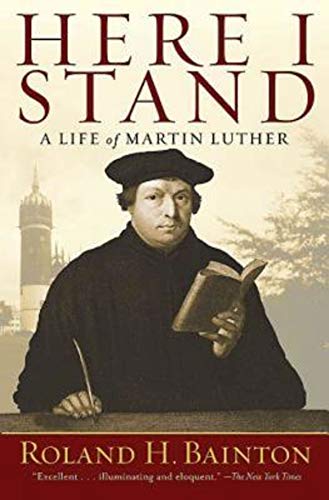
Synopsis
A vivid portrait of Martin Luther, the man of unshakable faith in God who helped bring about the Protestant Reformation The Reformation of the sixteenth century was a vast and complicated movement. It involved kings and peasants, cardinals and country priests, monks and merchants. It spread from one end of Europe to the other and manifested itself in widely differing forms. Yet in spite of its diverse and complex character, to begin to understand the Reformation you need know only one name: Martin Luther. Since it first was published more than fifty years ago, Roland H. Bainton’s Here I Stand: A Life of Martin Luther has sold millions of copies, and it remains the definitive introduction to the great Reformer and is essential reading for anyone seeking to understand this towering historical figure. “The most readable Luther biography in English.” —Time magazine “A sound and well-rounded picture of the man and his role in history.” —Chicago Tribune
"synopsis" may belong to another edition of this title.
About the Author
Roland H. Bainton (1894 1984) was born in England and came to the United States in 1902. A recipient of many degrees, Dr. Bainton was a specialist in Reformation history. For many years he was Titus Street Professor of Ecclesiastical History at Yale University. His other books include The Reformation of the Sixteenth Century, The Travail of Religious Liberty, The Age of Reformation, and Christian Attitudes Toward War and Peace.
Excerpt. © Reprinted by permission. All rights reserved.
HERE I STAND
A Life of Martin Luther
By Roland H. BaintonAbingdon Press
Copyright © 1978 Roland H. Bainton
All rights reserved.
ISBN: 978-1-4267-5443-2All rights reserved.
Contents
| HERE I STAND—After a Quarter of a Century.................................. | 1 |
| I. The Vow................................................................. | 5 |
| II. The Cloister........................................................... | 21 |
| III. The Gospel............................................................ | 37 |
| IV. The Onslaught.......................................................... | 54 |
| V. The Son of Iniquity..................................................... | 71 |
| VI. The Saxon Hus.......................................................... | 91 |
| VII. The German Hercules................................................... | 111 |
| VIII. The Wild Boar in the Vineyard........................................ | 128 |
| IX. The Appeal to Caesar................................................... | 144 |
| X. Here I Stand............................................................ | 162 |
| XI. My Patmos.............................................................. | 187 |
| XII. The Return of the Exile............................................... | 203 |
| XIII. No Other Foundation.................................................. | 214 |
| XIV. Rebuilding the Walls.................................................. | 233 |
| XV. The Middle Way......................................................... | 249 |
| XVI. Behemoth, Leviathan, and the Great Waters............................. | 269 |
| XVII. The School for Character............................................. | 292 |
| XVIII. The Church Territorial.............................................. | 313 |
| XIX. The Church Tutorial................................................... | 336 |
| XX. The Church Ministerial................................................. | 359 |
| XXI. The Struggle for Faith................................................ | 372 |
| XXII. The Measure of the Man............................................... | 387 |
| Bibliography............................................................... | 401 |
| References................................................................. | 415 |
| Sources of Illustrations................................................... | 430 |
| Index...................................................................... | 433 |
CHAPTER 1
The Vow
ON A SULTRY DAY in July of the year 1505a lonely traveler was trudging over a parchedroad on the outskirts of the Saxon village ofStotternheim. He was a young man, shortbut sturdy, and wore the dress of a universitystudent. As he approached the village, thesky became overcast. Suddenly there was a shower, then a crashingstorm. A bolt of lightning rived the gloom and knocked the man tothe ground. Struggling to rise, he cried in terror, "St. Anne help me! Iwill become a monk."
The man who thus called upon a saint was later to repudiate thecult of the saints. He who vowed to become a monk was later torenounce monasticism. A loyal son of the Catholic Church, he waslater to shatter the structure of medieval Catholicism. A devoted servantof the pope, he was later to identify the popes with Antichrist.For this young man was Martin Luther.
His demolition was the more devastating because it reinforceddisintegrations already in progress. Nationalism was in processof breaking the political unities when the Reformation destroyedthe religious. Yet this paradoxical figure revived the Christianconsciousness of Europe. In his day, as Catholic historians all agree,the popes of the Renaissance were secularized, flippant, frivolous,sensual, magnificent, and unscrupulous. The intelligentsia did notrevolt against the Church because the Church was so much of theirmind and mood as scarcely to warrant a revolt. Politics were emancipatedfrom any concern for the faith to such a degree that the MostChristian King of France and His Holiness the Pope did not disdaina military alliance with the Sultan against the Holy Roman Emperor.Luther changed all this. Religion became again a dominant factoreven in politics for another century and a half. Men cared enough forthe faith to die for it and to kill for it. If there is any sense remainingof Christian civilization in the West, this man Luther in no smallmeasure deserves the credit.
Very naturally he is a controversial figure. The multitudinous portrayalsfall into certain broad types already delineated in his own generation.His followers hailed him as the prophet of the Lord and thedeliverer of Germany. His opponents on the Catholic side called himthe son of perdition and the demolisher of Christendom. The agrarianagitators branded him as the sycophant of the princes, and the radicalsectaries compared him to Moses, who led the children of Israel outof Egypt and left them to perish in the wilderness. But such judgmentsbelong to an epilogue rather than a prologue. The first endeavor mustbe to understand the man.
One will not move far in this direction unless one recognizes atthe outset that Luther was above all else a man of religion. The greatoutward crises of his life which bedazzle the eyes of dramatic biographerswere to Luther himself trivial in comparison with the innerupheavals of his questing after God. For that reason this study mayappropriately begin with his first acute religious crisis in 1505 ratherthan with his birth in 1483. Childhood and youth will be drawn upononly to explain the entry into the monastery.
At Home and School
The vow requires interpretation because even at this early point inLuther's career judgments diverge. Those who deplore his subsequentrepudiation of the vow explain his defection on the ground that heought never to have taken it. Had he ever been a true monk, he wouldnot have abandoned the cowl. His critique of monasticism is madeto recoil upon himself in that he ispainted as a monk without vocation,and the vow is interpreted,not as a genuine call, but rather asthe resolution of an inner conflict,an escape from maladjustment athome and at school.
A few sparse items of evidenceare adduced in favor of this explanation.They are not of the highestreliability because they are all takenfrom the conversation of the older Luther as recorded, often inaccurately,by his students; and even if they are genuine, they cannot beaccepted at face value because the Protestant Luther was no longerin a position to recall objectively the motives of his Catholic period.Really there is only one saying which connects the taking of the cowlwith resentment against parental discipline. Luther is reported tohave said, "My mother caned me for stealinga nut, until the blood came. Such strict disciplinedrove me to the monastery, although shemeant it well." This saying is reinforced by twoothers: "My father once whipped me so thatI ran away and felt ugly toward him until hewas at pains to win me back." "[At school] Iwas caned in a single morning fifteen times fornothing at all. I was required to decline and conjugate and hadn'tlearned my lesson."
Unquestionably the young were roughly handled in those days, andLuther may be correctly reported as having cited these instances inorder to bespeak a more humane treatment, but there is no indicationthat such severity produced more than a flash of resentment. Lutherwas highly esteemed at home. His parents looked to him as a lad ofbrilliant parts who should become a jurist, make a prosperous marriage,and support them in their old age. When Luther became a Masterof Arts, his father presented him with a copy of the Corpus Jurisand addressed him no longer with the familiar Du but with the politeSie. Luther always exhibited an extraordinary devotion to his fatherand was grievously disturbed over parental disapproval of his entryinto the monastery. When his father died, Luther was too unnerved towork for several days. The attachment to the mother appears to havebeen less marked; but even of the thrashing he said that it was wellintended, and he recalled affectionately a little ditty she used to sing:
If folk don't like you and me,The fault with us is like to be.
The schools also were not tender, but neither were they brutal. Theobject was to impart a spoken knowledge of the Latin tongue. Theboys did not resent this because Latin was useful—the language ofthe Church, of law, diplomacy, international relations, scholarship,and travel. The teaching was by drill punctuated with the rod. Onescholar, called a lupus or wolf, was appointed to spy on the othersand report lapses into German. The poorest scholar in the class everynoon was given a donkey mask, hence called the asinus, which hewore until he caught another talking German. Demerits were accumulatedand accounted for by birching at the end of the week. Thusone might have fifteen strokes on a single day.
But, despite all the severities, the boys did learn Latin and lovedit Luther, far from being alienated, was devoted to his studies andbecame highly proficient. The teachers were no brutes. One of them,Trebonius, on entering the classroom always bared his head in thepresence of so many future burgomasters, chancellors, doctors, andregents. Luther respected his teachers and was grieved when they didnot approve of his subsequent course.
Nor was he prevailingly depressed, but ordinarily rollicking, fondof music, proficient on the lute, and enamored of the beauty of theGerman landscape. How fair in retrospect was Erfurt! The woodscame down to the fringes of the village to be continued by orchardsand vineyards, and then the fields which supplied the dye industryof Germany with plantings of indigo, blue-flowered flax, and yellowsaffron; and nestling within the brilliant rows lay the walls, thegates, the steeples of many-spired Erfurt. Luther called her a newBethlehem.
Religious Disquiet
Yet Luther was at times severely depressed, and the reason lay notin any personal frictions but in the malaise of existence intensifiedby religion. This man was no son of the Italian Renaissance, but aGerman born in remote Thuringia, where men of piety still rearedchurches with arches and spires straining after the illimitable. Lutherwas himself so much a gothic figure that his faith may be called thelast great flowering of the religion of the Middle Ages. And he camefrom the most religiously conservative element of the population, thepeasants. His father, Hans Luther, and his mother, Margaretta, weresturdy, stocky, swarthy German Bauern. They were not indeed actuallyengaged in the tilling of the soil because as a son without inheritanceHans had moved from the farm to the mines. In the bowels ofthe earth he had prospered with the help of St. Anne, the patronessof miners, until he had come to be the owner of half a dozen foundries;yet he was not unduly affluent, and his wife had still to go to theforest and drag home the wood. The atmosphere of the family wasthat of the peasantry: rugged, rough, at times coarse, credulous, anddevout. Old Hans prayed at the bedside of his son, and Margarettawas a woman of prayer.
Certain elements even of old German paganism were blended withChristian mythology in the beliefs of these untutored folk. For themthe woods and winds and water were peopled by elves, gnomes, fairies,mermen and mermaids, sprites and witches. Sinister spirits wouldrelease storms, floods, and pestilence, and would seduce mankind tosin and melancholia. Luther's mother believed that they played suchminor pranks as stealing eggs, milk, and butter; and Luther himselfwas never emancipated from such beliefs. "Many regions are inhabited,"said he, "by devils. Prussia is full of them, and Lapland ofwitches. In my native country on the top of a high mountain calledthe Pubelsberg is a lake into which if a stone be thrown a tempestwill arise over the whole region because the waters are the abode ofcaptive demons."
The education in the schools brought no emancipation but ratherreinforced the training of the home. In the elementary schools the childrenwere instructed in sacred song. They learned by heart the Sanctus,the Benedictus, the Agnus Dei, and the Confiteor. They were trainedto sing psalms and hymns. How Luther loved the Magnificat! Theyattended masses and vespers, and took part in the colorful processionsof the holy days. Each town in which Luther went to school was full ofchurches and monasteries. Everywhere it was the same: steeples, spires,cloisters, priests, monks of the various orders, collections of relics, ringingof bells, proclaiming of indulgences, religious processions, cures atshrines. Daily at Mansfeld the sick were stationed beside a convent inthe hope of cure at the tolling of the vesper bell. Luther rememberedseeing a devil actually depart from one possessed.
The University of Erfurt brought no change. The institutionat that time had not yet been invaded by Renaissance influences.The classics in the curriculum, such as Vergil, had always beenfavorites in the Middle Ages. Aristotelian physics was regarded as anexercise in thinking God's thoughts after him, and the naturalexplanations of earthquakes and thunderstorms did not precludeoccasional direct divine causation. The studies all impinged on theology,and the Master's degree for which Luther was preparing for thelaw could have equipped him equally for the cloth. The entire trainingof home, school, and university was designed to instill fear of Godand reverence for the Church.
In all this there is nothing whatever to set Luther off from his contemporaries,let alone to explain why later on he should have revoltedagainst so much of medieval religion. There is just one respect in whichLuther appears to have been different from other youths of his time,namely, in that he was extraordinarily sensitive and subject to recurrentperiods of exaltation and depression of spirit. This oscillation ofmood plagued him throughout his life. He testified that it began inhis youth and that the depressions had been acute in the six monthsprior to his entry into the monastery. One cannot dismiss these statesas occasioned merely by adolescence, since he was then twenty-oneand similar experiences continued throughout his adult years. Neithercan one blithely write off the case as an example of manic depression,since the patient exhibited a prodigious and continuous capacity forwork of a high order.
The explanation lies rather in the tensions which medieval religiondeliberately induced, playing alternately upon fear and hope.Hell was stoked, not because men lived in perpetual dread, but preciselybecause they did not, and in order to instill enough fear to drivethem to the sacraments of the Church. If they were petrified withterror, purgatory was introduced by way of mitigation as an intermediateplace where those not bad enough for hell nor good enoughfor heaven might make further expiation. If this alleviation inspiredcomplacency, the temperature was advanced on purgatory, and thenthe pressure was again relaxed through indulgences.
Even more disconcerting than the fluctuation of the temperature ofthe afterlife was the oscillation between wrath and mercy on the partof the members of the divine hierarchy. God was portrayed now asthe Father, now as the wielder of the thunder. He might be softenedby the intercession of his kindlier Son, who again was delineated as animplacable judge unless mollified by his mother, who, being a woman,was not above cheating alike God and the Devil on behalf of her suppliants;and if she were remote, one could enlist her mother, St. Anne.
How these themes were presented is graphically illustrated in themost popular handbooks in thevery age of the Renaissance.The theme was death; and thebest sellers gave instructions,not on how to pay the incometax, but on how to escape hell.Manuals entitled On the Art ofDying depicted in lurid woodcutsthe departing spirit surroundedby fiends who temptedhim to commit the irrevocablesin of abandoning hope in God'smercy. To convince him that hewas already beyond pardon hewas confronted by the womanwith whom he had committed adultery or the beggar he had failed tofeed. A companion woodcut then gave encouragement by presentingthe figures of forgiven sinners: Peter with his cock, Mary Magdalenewith her cruse, the penitent thief, and Saul the persecutor, with theconcluding brief caption, "Never despair."
If this conclusion ministered to complacency, other presentationsinvoked dread. A book strikingly illustrative of the prevailing moodis a history of the world published by Hartmann Schedel in Nürnbergin 1493. The massive folios, after recounting the history of mankindfrom Adam to the Humanist Conrad Celtes, conclude with ameditation on the brevity of human existence accompanied by a woodcutof the dance of death. The final scene displays the day of judgment.A full-page woodcut portrays Christ the Judge sitting upon arainbow. A lily extends from his right ear, signifying the redeemed,who below are being ushered by angels into paradise. From his leftear protrudes a sword, symbolizing the doom of the damned, whomthe devils drag by the hair from the tombs and cast into the flames ofhell. How strange, comments a modern editor, that a chronicle publishedin the year 1493 should end with the judgment day instead ofthe discovery of America! Dr. Schedel had finished his manuscript inJune. Columbus had returned the previous March. The news presumablyhad not yet reached Nürnberg. By so narrow a margin Dr. Schedelmissed this amazing scoop. "What an extraordinary value survivingcopies of the Chronicle would have today if it had recorded the greatevent!"
So writes the modern editor. But old Dr. Schedel, had he known,might not have considered the finding of a new world worthy of record.He could scarcely have failed to know of the discovery of the Cape ofGood Hope in 1488. Yet he never mentioned it. The reason is that hedid not think of history as the record of humanity expanding uponearth and craving as the highest good more earth in which to expand.He thought of history as the sum of countless pilgrimages through a valeof tears to the heavenly Jerusalem. Every one of those now dead wouldsome day rise and stand with the innumerable host of the departedbefore the judgment seat to hear the words, "Well done," or, "Departfrom me into everlasting fire." The Christ upon the rainbow with thelily and the sword was a most familiar figure in the illustrated books ofthe period. Luther had seen pictures such as these and testified that hewas utterly terror-stricken at the sight of Christ the Judge.
The Haven of the Cowl
Like everyone else in the Middle Ages he knew what to do abouthis plight. The Church taught that no sensible person would waituntil his deathbed to make an act of contrition and plead for grace.From beginning to end the only secure course was to lay hold of everyhelp the Church had to offer: sacraments, pilgrimages, indulgences,the intercession of the saints. Yet foolish was the man who reliedsolely on the good offices of the heavenly intercessors if he had donenothing to ensure their favor!
(Continues...)
Excerpted from HERE I STAND by Roland H. Bainton. Copyright © 1978 Roland H. Bainton. Excerpted by permission of Abingdon Press.
All rights reserved. No part of this excerpt may be reproduced or reprinted without permission in writing from the publisher.
Excerpts are provided by Dial-A-Book Inc. solely for the personal use of visitors to this web site.
"About this title" may belong to another edition of this title.
Search results for Here I Stand: A Life of Martin Luther

Stock Image
Here I Stand
Seller: World of Books (was SecondSale), Montgomery, IL, U.S.A.
Seller rating 5 out of 5 stars

Paperback. Condition: Very Good. The Reformation of the sixteenth century was a vast and complicated movement. It involved kings and peasants, cardinals and country priests, monks and merchants. It spread from one end of Europe to the other, and manifested itself in widely differing forms. Yet in spite of its diverse and complex character, to start to understand the Reformation you need know only one name: Martin Luther. Roland Bainton's Here I Stand: A Life of Martin Luther remains the definitive introduction to the great Reformer and is essential reading for anyone seeking to understand this towering historical figure. Seller Inventory # 00107884427
Stock Image
Here I Stand
Seller: World of Books (was SecondSale), Montgomery, IL, U.S.A.
Seller rating 5 out of 5 stars
Paperback. Condition: Good. The Reformation of the sixteenth century was a vast and complicated movement. It involved kings and peasants, cardinals and country priests, monks and merchants. It spread from one end of Europe to the other, and manifested itself in widely differing forms. Yet in spite of its diverse and complex character, to start to understand the Reformation you need know only one name: Martin Luther. Roland Bainton's Here I Stand: A Life of Martin Luther remains the definitive introduction to the great Reformer and is essential reading for anyone seeking to understand this towering historical figure. Seller Inventory # 00108687292
Seller Image
Here I Stand: A Life of Martin Luther
Seller: Bay State Book Company, North Smithfield, RI, U.S.A.
Seller rating 5 out of 5 stars
Condition: good. The book is in good condition with all pages and cover intact, including the dust jacket if originally issued. The spine may show light wear. Pages may contain some notes or highlighting, and there might be a "From the library of" label. Boxed set packaging, shrink wrap, or included media like CDs may be missing. Seller Inventory # BSM.1EP6N
Stock Image
Here I Stand : A Life of Martin Luther
Seller: Better World Books, Mishawaka, IN, U.S.A.
Seller rating 5 out of 5 stars
Condition: Good. Former library copy. Pages intact with minimal writing/highlighting. The binding may be loose and creased. Dust jackets/supplements are not included. Includes library markings. Stock photo provided. Product includes identifying sticker. Better World Books: Buy Books. Do Good. Seller Inventory # 17374049-6
Stock Image
Here I Stand : A Life of Martin Luther
Seller: Better World Books, Mishawaka, IN, U.S.A.
Seller rating 5 out of 5 stars
Condition: Very Good. Former library copy. Pages intact with possible writing/highlighting. Binding strong with minor wear. Dust jackets/supplements may not be included. Includes library markings. Stock photo provided. Product includes identifying sticker. Better World Books: Buy Books. Do Good. Seller Inventory # 11723727-75
Stock Image
Here I Stand : A Life of Martin Luther
Seller: Better World Books, Mishawaka, IN, U.S.A.
Seller rating 5 out of 5 stars
Condition: Good. Pages intact with minimal writing/highlighting. The binding may be loose and creased. Dust jackets/supplements are not included. Stock photo provided. Product includes identifying sticker. Better World Books: Buy Books. Do Good. Seller Inventory # 14746399-6
Stock Image
Here I Stand: A Life of Martin Luther
Seller: ThriftBooks-Dallas, Dallas, TX, U.S.A.
Seller rating 5 out of 5 stars
Paperback. Condition: Fair. No Jacket. Readable copy. Pages may have considerable notes/highlighting. ~ ThriftBooks: Read More, Spend Less. Seller Inventory # G1426754434I5N00
Seller Image
Here I Stand: A Life of Martin Luther
Seller: Blue Vase Books, Interlochen, MI, U.S.A.
Seller rating 5 out of 5 stars
Condition: acceptable. The item is very worn but is perfectly usable. Signs of wear can include aesthetic issues such as scratches, dents, worn and creased covers, folded page corners and minor liquid stains. All pages and the cover are intact, but the dust cover may be missing. Pages may include moderate to heavy amount of notes and highlighting, but the text is not obscured or unreadable. Page edges may have foxing age related spots and browning . May NOT include discs, access code or other supplemental materials. Seller Inventory # BVV.1426754434.A
Stock Image
Here I Stand
Seller: World of Books Inc, Montgomery, IL, U.S.A.
Seller rating 4 out of 5 stars

Paperback. Condition: Good. The Reformation of the sixteenth century was a vast and complicated movement. It involved kings and peasants, cardinals and country priests, monks and merchants. It spread from one end of Europe to the other, and manifested itself in widely differing forms. Yet in spite of its diverse and complex character, to start to understand the Reformation you need know only one name: Martin Luther. Roland Bainton's Here I Stand: A Life of Martin Luther remains the definitive introduction to the great Reformer and is essential reading for anyone seeking to understand this towering historical figure. Seller Inventory # CIN1426754434G
Stock Image
Here I Stand
Seller: World of Books Inc, Montgomery, IL, U.S.A.
Seller rating 4 out of 5 stars
Paperback. Condition: Very Good. The Reformation of the sixteenth century was a vast and complicated movement. It involved kings and peasants, cardinals and country priests, monks and merchants. It spread from one end of Europe to the other, and manifested itself in widely differing forms. Yet in spite of its diverse and complex character, to start to understand the Reformation you need know only one name: Martin Luther. Roland Bainton's Here I Stand: A Life of Martin Luther remains the definitive introduction to the great Reformer and is essential reading for anyone seeking to understand this towering historical figure. Seller Inventory # CIN1426754434VG