
Items related to Running a Bar For Dummies (For Dummies Series)
Synopsis
Get insider details on how to operate a successful bar
Running a Bar For Dummies, 2nd Edition shows established and future bar owners how to establish and maintain a successful business. Using clear, concise language, this For Dummies guide contains all the information you need to start your bar off on the right foot. From grand opening to last call, you'll discover the insider tricks that keep the business end running smoothly and the customers happily engaged. With updated information on marketing and social media, the book walks you step by step through the entire process, revealing the nitty-gritty details most new bar owners only discover after starting.
The bar business continues to grow; however, securing running capital and having knowledge about the business are cited as the two biggest reasons new bars fail. Running a Bar For Dummies, 2nd Edition shines a light on these issues to help bar owners prepare properly. The book helps you find your way through the maze of licensing and permits, developing a business plan, and preparing for your grand opening, plus offers clear, no-nonsense guidance on dealing with tough customers. Every step of the way, Running a Bar For Dummies, 2nd Edition is a reference you can count on.
- Understand the bar business and important legal issues
- Stock the necessities, including equipment and inventory
- Promote your business using marketing and social media
- Manage expenses and control cash flow
When run correctly, a bar can be an extremely profitable business, but the key to success is knowing exactly what you're getting into. By recognizing common problems and teach you how to adapt quickly to changing conditions, Running a Bar For Dummies, 2nd Edition provides the information you need to develop those skills, and get your bar started.
"synopsis" may belong to another edition of this title.
About the Author
Ray Foley, a former Marine with more than 30 years of bartending and restaurant experience, is the founder and publisher of BARTENDER magazine. Heather Dismore is a veteran of both the restaurant and publishing industries. Her published works include Running a Restaurant For Dummies.
From the Back Cover
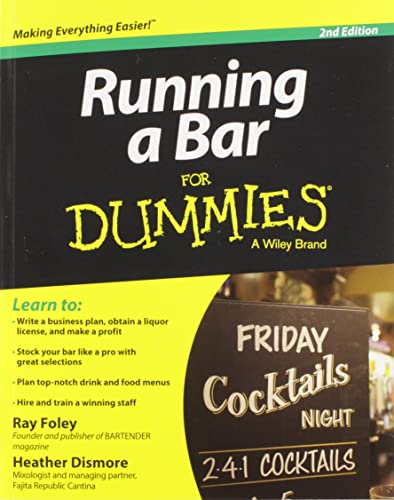
Learn to:
- Write a business plan, obtain a liquor license, and make a profit
- Stock your bar like a pro with great selections
- Plan top-notch drink and food menus
- Hire and train a winning staff
The easy way to break into the bar business
If you want to BYOB (be your own boss) and fulfill your dream of running your own bar, this hands-on, friendly guide has everything you need to get started. You’ll discover how to obtain a liquor license, manage inventory, plan drink and food menus, meet financial and legal requirements, attract customers, make a profit, and more!
- Raise a glass ― get a crash course on the bar business, including tips for getting started, creating your concept, picking your name, and deciding whether you have what it takes to liven your town’s nightlife
- Setting up ― find the best location for your business, make it into your own, and stock your bar, from equipment to appliances, bourbon to beer, and everything in between
- Please your patrons ― discover tips to find, train, manage, and retain employees who will keep customers happy―and your bar stools full―every night of the week
- Money matters ― get trusted guidance on how to buy products the right way to effectively manage your inventory and cash flow, and find out which numbers to watch in the bar business
Open the book and find:
- How to put your business plan together
- Tips on planning and creating your menus
- The scoop on keeping your bar’s bottom line from hitting bottom
- Advice on how to bring in new customers while still keeping your regulars
- Ways to build goodwill in the community and reap the rewards in your business
- How to avoid common problems that plague many a bar owner
From the Inside Flap
Learn to:
- Write a business plan, obtain a liquor license, and make a profit
- Stock your bar like a pro with great selections
- Plan top-notch drink and food menus
- Hire and train a winning staff
The easy way to break into the bar business
If you want to BYOB (be your own boss) and fulfill your dream of running your own bar, this hands-on, friendly guide has everything you need to get started. You’ll discover how to obtain a liquor license, manage inventory, plan drink and food menus, meet financial and legal requirements, attract customers, make a profit, and more!
- Raise a glass — get a crash course on the bar business, including tips for getting started, creating your concept, picking your name, and deciding whether you have what it takes to liven your town’s nightlife
- Setting up — find the best location for your business, make it into your own, and stock your bar, from equipment to appliances, bourbon to beer, and everything in between
- Please your patrons — discover tips to find, train, manage, and retain employees who will keep customers happy—and your bar stools full—every night of the week
- Money matters — get trusted guidance on how to buy products the right way to effectively manage your inventory and cash flow, and find out which numbers to watch in the bar business
Open the book and find:
- How to put your business plan together
- Tips on planning and creating your menus
- The scoop on keeping your bar’s bottom line from hitting bottom
- Advice on how to bring in new customers while still keeping your regulars
- Ways to build goodwill in the community and reap the rewards in your business
- How to avoid common problems that plague many a bar owner
Excerpt. © Reprinted by permission. All rights reserved.
Running a Bar For Dummies
By Ray Foley, Heather DismoreJohn Wiley & Sons
Copyright © 2014 John Wiley & Sons, Ltd
All rights reserved.
ISBN: 978-1-118-88072-2All rights reserved.
CHAPTER 1
Bar Business Basics
In This Chapter
* Understanding the basics of the business
* Deciding whether you have the necessary skills
Think of all the great times people have in bars. They meet for girls' night out, bachelor parties, reunions, birthdays, or just because it's Thursday. They come to celebrate, relax, or have fun. It's a fact: People like bars. So it's not a leap for people to think "Hey, I enjoy hanging out in bars, so I may as well get paid to do what I enjoy — hanging out in bars."
Viewed from the bar stool (on the public side of the bar), it's easy to miss all the hard work that goes on to make hanging out in bars fun for everyone else. When you have to manage every detail — such as hiring the music, choosing the lighting, designing the menu, and picking up trash in the parking lot — the bar business quickly becomes more work than fun, so don't be fooled.
In this chapter, we take you on a quick tour of the business. We explore your reasons for getting into the business and help you check your expectations for your new venture. We introduce you to what you need to know to understand and maximize the true financial performance of your new venture. And finally, we inspire you to keep reaching out to your patrons. Look at the other chapters in this book for more detailed information about these topics and other important points to know about getting your bar going and keeping it running.
Deciding Whether the Bar Business Is Right for You
The bar business world is more than a party every night of the week. It's actually a business. Those owners who look at it as a business ultimately have a much greater chance of succeeding. You can't just give drinks to friends or offer drink specials too deep to turn a profit. You can't order too many bottles of whiskey only to (not) see two of them walk out the door. You have a tremendous opportunity to make a great career out of a fun business if you're willing to put in the effort and use some common sense.
Why do you want to be in the bar business?
The bar business is tough for some people to relate to because you're selling an experience rather than something that's physically packaged that you can hold. Instead, your product is packaged in many layers, from the music you play, to your furniture and lighting choices, to the beers you have on draft. All these things make up your packaging, affect the costs of doing business, and affect your patron's decision to hang out at your place or move on down the street.
Think about these questions when you're contemplating your decision to take the plunge and run your own place:
[check] Do you really like people? An odd question on the surface perhaps, but running a bar doesn't afford you a lot of quiet, contemplative alone-time. Make sure you can stand the onslaught of conversation and complaints.
[check] How do you handle your own liquor? For some people, running a bar is like giving a kid the keys to a candy store. The liquor is always available, and they don't seem to know when to say "when."
[check] Are you a night owl? Think about your own internal clock. When does it turn on and shut off? If you like to be up until 2 or 3 o'clock in the morning, this could be the industry for you.
[check] Are you ready to baby-sit adults? As the owner or manager of the bar, you have many employees, suppliers, and customers who need your attention. Sometimes you're the one who has to cover a missed shift on the fly. Occasionally, you've got to handle a late shipment of liquor that arrives inconveniently at 6 o'clock on a Friday night. Most likely, you'll need to attend to a patron who needs a cab. Whatever the scenario, tag — you're it.
TIP
Make sure you spend some time reading Chapter 2 to get a feel for what the business is really like before you invest serious time and money in developing your ideas.
What do you expect to get out of your place?
Now's the time for you to sit down and create your plan for what your bar should be. Early on, create the pie-in-the-sky version of your ideal place, including a menu (both drink and food), and even draw up mock floor plans. Figure out where you want your stage and TVs to go, how many bars or wells you might have, what your theme is going to be, and so on.
Make sure you figure out what you, as a person, want to get out of the occupation of running a bar. Think about these questions:
[check] How much time do I want to dedicate to work? Running a bar takes a lot of time, just like managing any other business. The key difference though is that the time tends to be during nontraditional work times. So when the rest of the world is out having a good time, you're providing the good time.
[check] How much time do I need to spend with my family? If you like to spend nights and weekends at home, this may not be the business for you. But if you're open to finding other times to enjoy each other, you can make it work.
[check] How do I like to spend my free time? If you enjoy talking with people, listening to music, and playing an occasional game of pool during your free time, you'll probably enjoy this work. But remember to draw a clear line between your business and personal lives.
[check] Do I like having any free time? When you own your own business, you don't have lots of free time in the beginning. If you hire the right staff members (see Chapter 10 for help) and train them right, you can work your way into delegating some of your jobs.
Eventually, you must take certain steps to plan your business to make it a success before you can open the doors and enjoy it. In fact, we recommend you start planning as soon as you can so you can decide whether your plan is a viable one.
TIP
Create a timeline for getting your business up and running (Chapter 13). Decide exactly what kind of bar you want to run (Chapter 4). Choose a name that suits it (Chapter 6). Develop a detailed business plan and use it to find and secure financing (Chapters 5 and 3, respectively). Find the best location for your new bar and get the right licenses and permits as soon as you can (Chapters 6 and 3, respectively).
Starting Fresh or Taking Over an Existing Bar?
The decision to open a bar is a big one. Sometimes people are just sort of considering the idea, and then — out of the blue — they fall in love with an existing location, immediately imagining themselves behind the bar, spit shining glasses. Other people build their dream bar in their mind's eye from the ground up. They have very specific ideas about every physical detail of their place. And naturally, they want to physically build it from the ground up, as well. Depending on your schedule and budget, you can make either scenario a success if you keep certain things in mind, which we explore in this section.
Location, location, location
The bar business is a bit of a different animal. Location definitely matters as it does in any business. But what defines a great location is in the mind of the beholder.
Some people choose to buy or build a bar in an already booming area (and choose to pay higher rent) to get a leg up on getting people in the door. Others think it's better to speculate a bit and get in on the ground floor of an up-and-coming neighborhood, in the hopes that the area will be the next "hot" thing. They save on rent, but usually spend more promoting their business, and have to wait a while to see a return on their investment. The choice is yours.
To help you figure out which way to go, and other specifics about finding the right location for your bar, check out Chapter 6.
TIP
Many small neighborhood bars are not in what people would consider ideal locations, but the people who patronize them love them and wouldn't think of going anywhere else. In most cases, these places have been around a long time. If you're taking over a location like this, it's important to figure out what's working already. People have sought this place out for a reason, so you need to figure out what that reason is and don't mess it up. Don't just come in and change everything; instead, meld your ideas with the existing business to make it work for you.
REMEMBER
Don't alienate your built-in clientele unless you have to, and then make sure you can replace them with another clientele, through marketing, advertising, and other means.
Getting in with the right people
We're not talking about the Celebrity A-List crowd here. Instead, we mean the barrage of people who can help you alter your space to fit your needs. Most people starting a new business want to change a few things at their new location. Maybe you need to add a wall to create a quiet area away from the stage. Maybe you need to upgrade the bathrooms to comply with the Americans With Disabilities Act regulations. Or maybe you need to install a more comprehensive air-filtration system to keep cigarette smoke away from your customers.
A contractor can save you lots of time and trouble. Don't hesitate to ask questions of a couple of different ones and check their references. Chapter 4 has tips on finding and hiring a contractor.
Here's a quick list of a few hired helpers to keep on speed dial, depending on your concept:
[check] A good equipment-repair technician: Very important, especially if you've purchased used equipment that always needs to be in working order.
[check] A plumber who works nights and weekends: Toilets back up even on busy Saturday nights.
[check] A handyman: Someone who has restaurant experience is a huge plus. You never know when you'll need someone to solder a table leg, replace a window, or fix a crack in your sidewalk on the fly.
[check] An electrician: He can help you set up dimmers, hide wires and components in places you didn't know were available, and rig up lighting for your stage.
TIP
Sometimes you get lucky, and someone on your existing staff has some of these skills. Make use of them. The staffer feels good because you recognize his or her talent, and you can save the cost of a service call.
Staying on Top of the Latest Bar Trends
To be successful in this or, really, in any business, you need to take care of your business today, tomorrow, and years from now. One of the best ways to do this is by staying up on trends in the bar and restaurant businesses.
By watching food and beverage trends across all food service outlets, you can
[check] Find great additions to your food and drink menu. Watch what mixologists in larger markets are doing for inspiration to create a new cocktail, for example.
[check] Consider new categories of food service. If you serve traditional pub grub, maybe you want to try serving some small plates, or tapas, that still match your core menu ideas. For more on tapas or other kinds of food menu items, take a gander at Chapter 9.
[check] Meld your core concept with what's hot in the industry. You can keep your concept fresh while still keeping your core identity. Look for different fruits that seem popular with patrons (currently guava and pomegranate top the list) and incorporate them into your signature cocktail, for example.
[check] Get ideas from promotions and marketing ideas that work in other markets, and be the first to bring them to your town.
Ultimately, you're competing directly with all the other bars in your area. You're also competing indirectly with local restaurant bars and even carryout liquor stores nearby. So keeping an eye on what's going on closer to home is essential. You don't want to copy them and adopt a me-too approach to innovation, but you want to know what they're up to. Check out Chapter 16 for details on how to keep up with and stay a step ahead of your local competition.
REMEMBER
Your liquor sales reps can be a great source of information for you in many respects. They also call on restaurants, so they can help keep you in the know about all the goings on around town.
Figuring Out Your Financial and Legal Obligations
Owning a bar is an expensive and potentially risky proposition. As with any new business, you budget your costs, forecast your sales, and hope the sales exceed the expenses. But, to be successful, you have to do more than just hope. You need to do your homework and get your detailed plan together first.
Setting yourself up to succeed
You've probably heard "Failing to plan is planning to fail," and it's as true in this business as it is in any other. Successful businesses don't just happen; people make them happen. Sure, some people do get lucky, but most can only capitalize on that luck if they're watching their business and actively managing it.
Here are some tools that can help you keep an eye on your business, evaluate your successes and failures, and reap the greatest financial rewards:
[check] A business plan: Hands down, a business plan is the best tool for figuring out how much money you need to get started, and why, when, and how you're going to turn a profit. Check out Chapter 5 for the steps to create your own. (It's not that painful, we promise.)
[check] Income statements: An income statement summarizes your expenses and sales and gives you the bottom-line profit for the month (or the quarter, year, and so on). Take a look at the sample in Chapter 5 to see what this looks like. For more details on using it in your business on an ongoing basis, turn to Chapter 15.
[check] Cash flow reports: A cash flow report tells you when money is coming in and going out of your bar. It shows you exactly when, where, and how you're spending (and collecting) all that cold, hard cash. Take a look at Chapter 15 for help on creating your own version of this exceedingly helpful tool.
[check] Inventory counts: Counting your inventory on a regular basis is crucial to your success. You buy ingredients (like liquor, juice, or even French fries), turn them into products (like cocktails and food items), and then sell them to your patrons. Physically counting your inventory and comparing it to what you should have (based on your invoices and sales numbers) tells you how much of your product is actually making it to the tables and bar top in your bar. It helps you see how much you're wasting, or sadly, how much people are stealing from you. Check out Chapter 14 for tips on managing your inventory to maximize your profits.
Hiring other people to help you steer the ship
Hire an accountant early in the process of setting up your business. She can help you get your numbers together for your business plan, which is a must-do if you're trying to get financing for your venture. Chapters 3 and 5 can give you the details. After you're up and running, you will analyze your monthly financial reports and look for ways to improve the numbers. A good accountant, preferably one with restaurant or bar experience, can help. Take a look at Chapters 14 and 15 to know which numbers to watch and why.
An attorney can help smooth the start-up process by getting all your legal paperwork in order quickly. He can help you review contracts with suppliers, establish partnership agreements, file your permits, or maybe incorporate your business. Depending on how you set up your business, you may need to draft a partnership agreement or two. Watch for details in Chapter 3.
Insurance is a financial necessity for any business owner. You need protection in case a water pipe bursts, a fire breaks out, vandals break in, or worst-case scenario, someone sues you. Make sure you get a good insurance agent from the beginning. Chapter 4 can help you get the right one for you.
Bringing In the Crowds and Keeping Them Coming Back
Getting people in the door is important, and frankly, it's not terribly difficult. The hard part is making sure they have a great time, so great, in fact, that they want to tell their friends and come back night after night, week after week.
(Continues...)
Excerpted from Running a Bar For Dummies by Ray Foley, Heather Dismore. Copyright © 2014 John Wiley & Sons, Ltd. Excerpted by permission of John Wiley & Sons.
All rights reserved. No part of this excerpt may be reproduced or reprinted without permission in writing from the publisher.
Excerpts are provided by Dial-A-Book Inc. solely for the personal use of visitors to this web site.
"About this title" may belong to another edition of this title.
Search results for Running a Bar For Dummies (For Dummies Series)

Seller Image
Running a Bar For Dummies (For Dummies Series)
Seller: Goodwill Books, Hillsboro, OR, U.S.A.
Seller rating 5 out of 5 stars

Condition: good. Signs of wear and consistent use. Seller Inventory # GICWV.1118880722.G
Stock Image
Running a Bar For Dummies
Seller: World of Books (was SecondSale), Montgomery, IL, U.S.A.
Seller rating 5 out of 5 stars
Paperback. Condition: Very Good. Get insider details on how to operate a successful bar Running a Bar For Dummies, 2nd Edition shows established and future bar owners how to establish and maintain a successful business. Seller Inventory # 00109304280
Stock Image
Running a Bar For Dummies
Seller: World of Books (was SecondSale), Montgomery, IL, U.S.A.
Seller rating 5 out of 5 stars
Paperback. Condition: Good. Get insider details on how to operate a successful bar Running a Bar For Dummies, 2nd Edition shows established and future bar owners how to establish and maintain a successful business. Seller Inventory # 00104760867
Stock Image
Running a Bar For Dummies
Seller: World of Books (was SecondSale), Montgomery, IL, U.S.A.
Seller rating 5 out of 5 stars
Paperback. Condition: Fair. Get insider details on how to operate a successful bar Running a Bar For Dummies, 2nd Edition shows established and future bar owners how to establish and maintain a successful business. Seller Inventory # 00085195077
Stock Image
Running a Bar for Dummies
Seller: ThriftBooks-Phoenix, Phoenix, AZ, U.S.A.
Seller rating 5 out of 5 stars
Paperback. Condition: Fair. No Jacket. Readable copy. Pages may have considerable notes/highlighting. ~ ThriftBooks: Read More, Spend Less. Seller Inventory # G1118880722I5N00
Stock Image
Running a Bar for Dummies
Seller: ThriftBooks-Reno, Reno, NV, U.S.A.
Seller rating 5 out of 5 stars
Paperback. Condition: Good. No Jacket. Pages can have notes/highlighting. Spine may show signs of wear. ~ ThriftBooks: Read More, Spend Less. Seller Inventory # G1118880722I3N00
Stock Image
Running a Bar for Dummies
Seller: ThriftBooks-Dallas, Dallas, TX, U.S.A.
Seller rating 5 out of 5 stars
Paperback. Condition: Fair. No Jacket. Readable copy. Pages may have considerable notes/highlighting. ~ ThriftBooks: Read More, Spend Less. Seller Inventory # G1118880722I5N00
Stock Image
Running a Bar for Dummies
Seller: ThriftBooks-Phoenix, Phoenix, AZ, U.S.A.
Seller rating 5 out of 5 stars
Paperback. Condition: Good. No Jacket. Pages can have notes/highlighting. Spine may show signs of wear. ~ ThriftBooks: Read More, Spend Less. Seller Inventory # G1118880722I3N00
Stock Image
Running a Bar for Dummies
Seller: ThriftBooks-Reno, Reno, NV, U.S.A.
Seller rating 5 out of 5 stars
Paperback. Condition: Fair. No Jacket. Readable copy. Pages may have considerable notes/highlighting. ~ ThriftBooks: Read More, Spend Less. Seller Inventory # G1118880722I5N00
Stock Image
Running a Bar for Dummies
Seller: ThriftBooks-Dallas, Dallas, TX, U.S.A.
Seller rating 5 out of 5 stars
Paperback. Condition: Good. No Jacket. Pages can have notes/highlighting. Spine may show signs of wear. ~ ThriftBooks: Read More, Spend Less. Seller Inventory # G1118880722I3N00