
Items related to The Art and Science of Sails
Synopsis
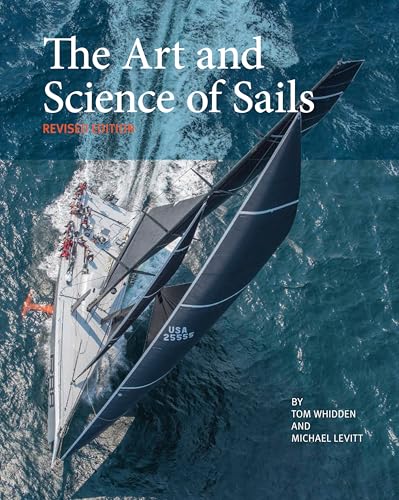
The Art and Science of Sails, Second Edition, is the bible of modern sail handling and selection. Tom Whidden is president of North Sails, the largest sailmaker in the United States and the world. Coauthor Michael Levitt has written more than a dozen books in the nautical field. The previous edition sold more than 20,000 copies. This new edition has an oversize format and beautiful four/colour photographs. This is not your parents Art and Science of Sails, written by Tom Whidden and Michael Levitt and published in 1990 by St. Martin s Press. The first edition sold more than 20,000 copies. The Second Revised Edition 2016 is published by North Sails Group, LLC and written by the same duo. What a difference 25 years makes! Today there are one-piece sails made over a 3D mold in the shape they will assume in the wind. Sail plans have radically evolved to fractional rigs, fat-head mains, and non-overlapping jibs. That is true for racing boats as well as cruising. Thus, ninety percent of the text is new, as are almost all of the more than 100 photographs and technical illustrations. The authors focus on circulation as they did in the first edition, but now come at it from a different direction. And for the first time anywhere, they attempt to quantify its effects. Where the wind speeds up and why as it passes over a sail plan, and where it slows down and why. Circulation theory is familiar to aerodynamicists for at least 100 years and is argued about by sailors at least since 1973, when the late Arvel Gentry loosed his theories on the sailing world. Gentry was an aerodynamicist at Boeing by day and a sailor on the weekends. And the theories used to explain why airplanes fly were at odds with the theories of why sailboats sail to weather and what the slot actually does. Whidden and Levitt utilize explanations like circulation to answer such diverse questions as: Why fractional rigs, fat-head mains, and non-overlapping jibs have come to predominate. Why and how leech twist can be a sail-trimmer s best friend. Why a yacht designer positions the mast, keel, and rudder to create some weather helm. Why the safe-leeward position is advantageous relative to the entire fleet, not just to the boat you tacked beneath and forward of. Why a mainsail s efficiency is improved with added upper roach, beyond the value of the extra area. Why the miracle of upwind sailing is not that there is so much lift but so little drag. Why, when sailing upwind, the main is always trimmed to a tighter angle than the jib. What a polar diagram tells us or why tacking downwind is almost always faster than sailing directly to a mark. There is also an in-depth look at the wonders of material utilization not just materials. Indeed there have been no new fibers accepted into sailmaking for over 20 years. It is how they are used that makes the difference. In the last three chapters, the authors drill down on mainsails, headsails, and downwind asymmetric or symmetric spinnakers. And in this edition for the first time they address downwind aerodynamics. The book celebrates the complexity and beauty of sails and of the whole rarefied sport of sailing.
"synopsis" may belong to another edition of this title.
About the Author
Tom Whidden is President of North Sails, the world's largest sailmaker. He is also one of the world's most experienced sailors and sailboat racers.
"About this title" may belong to another edition of this title.
Search results for The Art and Science of Sails

Seller Image
Art and Science of Sails
Seller: GreatBookPrices, Columbia, MD, U.S.A.
Seller rating 5 out of 5 stars

Condition: As New. Unread book in perfect condition. Seller Inventory # 26432280
Seller Image
Art and Science of Sails
Seller: GreatBookPrices, Columbia, MD, U.S.A.
Seller rating 5 out of 5 stars
Condition: New. Seller Inventory # 26432280-n
Seller Image
The Art and Science of Sails (Hardcover)
Published by
Seapoint Books, Sydney, NSW, 2016
ISBN 10: 0997392002
ISBN 13: 9780997392005
New
Hardcover
Seller: Grand Eagle Retail, Bensenville, IL, U.S.A.
Seller rating 5 out of 5 stars
Hardcover. Condition: new. Hardcover. This is not your parents' Art and Science of Sails, written by Tom Whidden and Michael Levitt and published in 1990 by St. Martin's Press. The first edition sold more than 20,000 copies. The Second Revised Edition 2016 is published by North Sails Group, LLC and written by the same duo. What a difference 25 years makes! Today there are one-piece sails made over a 3D mold in the shape they will assume in the wind. Sail plans have radically evolved to fractional rigs, fat-head mains, and non-overlapping jibs. That is true for racing boats as well as cruising. Thus, ninety percent of the text is new, as are almost all of the more than 100 photographs and technical illustrations. The authors focus on circulation as they did in the first edition, but now come at it from a different direction. And for the first time anywhere, they attempt to quantify its effects. Where the wind speeds up and why as it passes over a sail plan, and where it slows down and why. Circulation theory is familiar to aerodynamicists for at least 100 years and is argued about by sailors at least since 1973, when the late Arvel Gentry loosed his theories on the sailing world. Gentry was an aerodynamicist at Boeing by day and a sailor on the weekends. And the theories used to explain why airplanes fly were at odds with the theories of why sailboats sail to weather and what the slot actually does. Whidden and Levitt utilize explanations like circulation to answer such diverse questions as: * Why fractional rigs, fat-head mains, and non-overlapping jibs have come to predominate. * Why and how leech twist can be a sail-trimmer's best friend. * Why a yacht designer positions the mast, keel, and rudder to create some weather helm. * Why the safe-leeward position is advantageous relative to the entire fleet, not just to the boat you tacked beneath and forward of. * Why a mainsail's efficiency is improved with added upper roach, beyond the value of the extra area. * Why the miracle of upwind sailing is not that there is so much lift but so little drag. * Why, when sailing upwind, the main is always trimmed to a tighter angle than the jib. * What a polar diagram tells us or why tacking downwind is almost always faster than sailing directly to a mark. There is also an in-depth look at the wonders of material utilization-not just materials. Indeed there have been no new fibers accepted into sailmaking for over 20 years. It is how they are used that makes the difference. In the last three chapters, the authors drill down on mainsails, headsails, and downwind asymmetric or symmetric spinnakers. And in this edition for the first time they address downwind aerodynamics. The book celebrates the complexity and beauty of sails and of the whole rarefied sport of sailing. A bible of modern sail handling and selection. It is presented in an oversize format along with four/color photographs. Shipping may be from multiple locations in the US or from the UK, depending on stock availability. Seller Inventory # 9780997392005
Stock Image
The Art and Science of Sails
Seller: INDOO, Avenel, NJ, U.S.A.
Seller rating 5 out of 5 stars
Condition: New. Seller Inventory # 9780997392005
Stock Image
The Art and Science of Sails
Seller: Revaluation Books, Exeter, United Kingdom
Seller rating 5 out of 5 stars
Hardcover. Condition: Brand New. 2nd edition. 182 pages. 11.25x9.25x1.00 inches. In Stock. Seller Inventory # __0997392002
Buy New
£ 29.80
£ 15 shipping
Ships from United Kingdom to U.S.A.
Ships from United Kingdom to U.S.A.
Quantity: 3 available
Stock Image
The Art and Science of Sails
Seller: Russell Books, Victoria, BC, Canada
Seller rating 5 out of 5 stars
Hardcover. Condition: New. Special order direct from the distributor. Seller Inventory # ING9780997392005
Stock Image
The Art and Science of Sails
Seller: Kennys Bookshop and Art Galleries Ltd., Galway, GY, Ireland
Seller rating 5 out of 5 stars
Condition: New. A bible of modern sail handling and selection. It is presented in an oversize format along with four/color photographs. Num Pages: 182 pages, 15 colour illustrations, 200 colour illustrations. BIC Classification: WSD; WSSN3. Category: (G) General (US: Trade). Dimension: 224 x 284 x 2. Weight in Grams: 68. . 2016. 2nd Edition. Hardcover. . . . . Seller Inventory # V9780997392005
Seller Image
Art and Science of Sails
Seller: GreatBookPricesUK, Woodford Green, United Kingdom
Seller rating 5 out of 5 stars
Condition: As New. Unread book in perfect condition. Seller Inventory # 26432280
Buy Used
£ 32.20
£ 15 shipping
Ships from United Kingdom to U.S.A.
Ships from United Kingdom to U.S.A.
Quantity: 3 available
Seller Image
Art and Science of Sails
Seller: GreatBookPricesUK, Woodford Green, United Kingdom
Seller rating 5 out of 5 stars
Condition: New. Seller Inventory # 26432280-n
Buy New
£ 34.78
£ 15 shipping
Ships from United Kingdom to U.S.A.
Ships from United Kingdom to U.S.A.
Quantity: 3 available
Stock Image
The Art and Science of Sails
Seller: Revaluation Books, Exeter, United Kingdom
Seller rating 5 out of 5 stars
Hardcover. Condition: Brand New. 2nd edition. 182 pages. 11.25x9.25x1.00 inches. In Stock. Seller Inventory # xr0997392002
Buy New
£ 35.31
£ 15 shipping
Ships from United Kingdom to U.S.A.
Ships from United Kingdom to U.S.A.
Quantity: 2 available