
Items related to Illustrated Guide to the Mountain Stream Insects of...
Synopsis
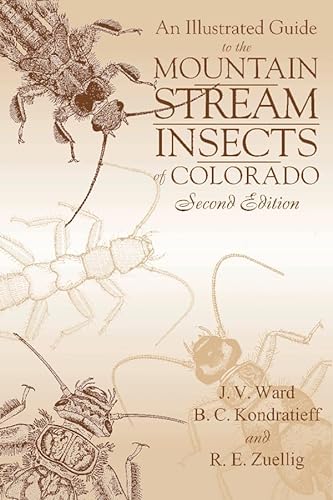
Now available in a revised and updated edition, An Illustrated Guide to the Mountain Stream Insects of Colorado is a comprehensive resource on the biology, ecology, and systematics of aquatic insects found in Rocky Mountain streams. This richly illustrated volume includes descriptions of mountain stream ecosystems and habitats, simplified identification keys, and an extensive bibliography. This second edition is ideal for the naturalist, trout stream anglers interested in entomology, specialists in stream ecology, and students of aquatic entomology and freshwater biology.
"synopsis" may belong to another edition of this title.
About the Author
J.V. Ward is a stream ecologist and professor of biology at Colorado State University. His extensive publication record includes Aquatic Insect Ecology/ He is a former president of the North American Benthological Society and serves as editor of Regulated Rivers, an international journal. B. C. Kondratieff is a professor of entomology and curator of the C. P. Gillette Museum of Arthropod Diversity at Colorado State University. He is the author or co-author of numerous scientific publications on aquatic insect ecology and taxonomy. R. E. Zuellig is studied ecology of aquatic insects and fish at Colorado State University.
Excerpt. © Reprinted by permission. All rights reserved.
An Illustrated Guide to the MOUNTAIN STREAM INSECTS of COLORADO
By J. V. Ward, B. C. Kondratieff, R. E. ZuelligUniversity Press of Colorado
Copyright © 2002 University Press of Colorado
All rights reserved.
ISBN: 978-0-87081-653-6All rights reserved.
Contents
| Preface.................................................................... | ix |
| Introduction............................................................... | 1 |
| The Natural Setting........................................................ | 5 |
| Mountain Stream Ecosystems................................................. | 9 |
| Controlling Factors........................................................ | 19 |
| Insects of Aquatic Habitats................................................ | 27 |
| Impacts of Humans on Mountain Streams...................................... | 35 |
| Evaluating Aquatic Communities............................................. | 43 |
| Insects of Colorado Mountain Streams....................................... | 49 |
| Appendix A: Mayfly Distribution............................................ | 165 |
| Appendix B: Stonefly Distribution.......................................... | 169 |
| Appendix C: Caddisfly Distribution......................................... | 173 |
| Glossary................................................................... | 179 |
| References................................................................. | 187 |
| Subject Index.............................................................. | 211 |
| Taxonomic Index............................................................ | 215 |
Excerpt
<h2>CHAPTER 1</h2><p><b>TheNATURAL SETTING</b></p><br><p>Colorado may be divided into three general physiographic regions: theGreat Plains on the east, the Colorado Plateau on the west, and theRocky Mountains in between (Fig. 1). Numerous mountain peaks exceed14,000 ft. (4,267 m) in elevation. Four major rivers have theirsources in the Colorado Cordillera. The Colorado River flows into thePacific Ocean (Gulf of California); the Rio Grande, South Platte, andArkansas Rivers drain to the Gulf of Mexico.</p><p>The topographic diversity and associated gradients in altitude resultin five major life zones. These life zones are best exemplified alongthe easternmost range of mountains in Colorado.</p><p>In central Colorado, timberline occurs at about 11,500 ft. (3,505m), above which lies the Alpine Zone. Protected cirques may containsmall glaciers, remnants of the neoglaciation about three thousand yearsago. Pristine lakes and clear brooks are set amidst fell-fields and meadowsrich in alpine wildflowers.</p><p>The Subalpine Zone is dominated by the spruce-fir forest (<i>Picea engelmannii–Abieslasiocarpa</i>), which occurs from 10,000 ft. (3,048 m) to timberline.</p><p>In the Montane Zone, from 8,000 to 10,000 ft. (2,438–3,048 m),Douglas fir (<i>Pseudotsuga menziesii</i>) predominates on north slopes andponderosa pine (<i>Pinus ponderosa</i>) occurs in more xeric locations. Largestands of aspen (<i>Populus tremuloides</i>) and lodgepole pine (<i>Pinus contorta</i>)also characterize this zone.</p><p>The Foothills Zone from 6,000 to 8,000 ft. (1,829–2,438 m) istypified by steep slopes and deep canyons. The Pleistocene glaciers thatsoftened the topography of the Montane Zone did not reach the foothills.Open forests of ponderosa pine occupy mesic sites and shrubsdominate dry slopes. Douglas fir occupies north-facing slopes and Coloradoblue spruce occurs in valleys.</p><p>The Plains Zone occupies elevations below 6,000 ft. (1,829 m),where grasses are the dominant vegetation of the Great Plains. Treessuch as cottonwoods, willows, and boxelder occur only along streamcourses.</p><p>There are eleven major drainage basins in Colorado, ten of whichoriginate in mountainous regions (Fig. 2). The Yampa, White, Dolores,and San Juan Rivers are subbasins of the Colorado River. The San LuisValley is a closed basin.</p><br><p><b>MOUNTAIN STREAMECOSYSTEMS</b></p><p>A variety of lotic (running water) habitats occur in the mountainousregions of Colorado. Unless otherwise specified, the term "mountainstream" is used broadly to include any lotic system in the western halfof Colorado, irrespective of size or elevation. More specific designations(e.g., brook or river) are described later in this section. However,there is an emphasis on the insect fauna characterizing relatively high-gradientrocky-bottomed stream reaches. The remainder of this sectionbriefly summarizes some of the attributes of mountain stream ecosystems.</p><p>For more detailed accounts see Leopold, Wolman, and Miller(1964), Hynes (1970a), Whitton (1975), Davies and Walker (1986),Ward (1992a and b), Williams and Feltmate (1992), Allan (1995),Leopold (1997), Waters (2000), and Wohl (2000).</p><br><p>SOME BASIC PRINCIPLES</p><p>Stream Order Analysis</p><p>Stream order (Strahler 1957) is a method of roughly classifyingrunning-water segments by size (Fig. 3). First-order streams are the head-watersources without tributaries. The confluence of two streams of thesame order produces the next highest order. Therefore, the joining oftwo first-order streams produces a second-order segment, two second-orderstreams produce a third-order stream, and so on. The MississippiRiver at its mouth is a twelfth-order stream. The largest rivers in Coloradoare eighth- or ninth-order. Although small in size, the lower-orderstreams are numerous. First- and second-order streams drain about 70percent of the United States.</p><br><p>Longitudinal Profiles</p><p>The longitudinal profile graphically describes a stream's gradient(slope) as a function of distance from the source. Typically, the longitudinalprofile is roughly concave (hyperbolic), with the highest gradient(steepest slope) in the headwaters and the lowest gradient in downstreamreaches (Fig. 4).</p><p>Although the hydrodynamic phenomena responsible for the concaveprofile need not concern us here (see Leopold, Wolman, and Miller1964), the downstream changes in ecological conditions are of interest.For example, the substrate of high-gradient headwater segments ischaracterized by coarse materials (boulders and rubble), whereass low-gradientdownstream reaches may be primarily sand and gravel.</p><br><p>Channel Patterns</p><p>There are three major types of channel patternss (Fig. 5). High-gradientmountain streams often flow in relatively straight channels.Even in straight reaches, however, the deepest portion of the stream(the thalweg) tends to moooove back and forth across the width of thestream. In meandering streams, the entire channel forms S-shaped segmentsthat are continually moving downstream as materials eroded fromthe concave side are deposited on convex bends. Meander formationrequires an erodible substrate and a low gradient. Streams that carrylarge debris loads tend to form a braided pattern in sections of highlyerodible substrate. Such streams are wide and shallow with shiftingsubstrate and numerous islands of various sizes.</p><br><p>Riffles and Pools</p><p>The formation of riffles and pools results from hydrodynamic adjustmentsof heterogeneous substrate materials to the potential energy offlowing water (Yang 1971). Riffles are shallower and have higher gradients,coarser substrate, and higher current velocities than pools. Innatural streams, riffles and pools alternate, with adjacent riffles generallyspaced five to seven stream widths apart. Riffles and pools provide quitedifferent habitat conditions for aquatic insects and other organisms.</p><br><p>MAJOR LOTIC HABITAT TYPES</p><p>A variety of stream classification and zonation schemes have been proposed(reviewed by Hynes 1970a and Hawkes 1975). The zonation systemof Illies and Botosaneanu (1963) and the "River Continuum Concept" ofVannote et al. (1980) are among those most commonly referred to in theliterature.</p><p>The three major zones in the Illies and Botosaneanu system (Table1) are based on changes in the benthic invertebrate faunal compositionover the longitudinal profile. Crenal includes spring sources and springbrooks (Fig. 6), those generally small lotic habitats dominated by groundwaterand often characterized by relatively constant environmental conditions.</p><p>In Colorado, the upper reaches of river systems, especially thoseoriginating at high elevations (Fig. 7), are often fed by surface runoffand snowmelt (rather than groundwater) and may not exhibit many ofthe characteristics of crenal habitats. Whereas aquatic insects normallymake up over 95 percent of the total benthic fauna of high-elevationheadwater streams (Short and Ward 1980a; Ward 1986), crenal habitatstypically contain few species of insects and an enhanced non-insectinvertebrate fauna (Ward and Dufford 1979; Ward, Zimmerman, andCline 1986).</p><p>Rhithral includes the portion of the longitudinal profile from midsizestreams to small rivers (Fig. 8). Before the term "crenal" was addedto incorporate spring-fed headwaters, rhithral was defined as extendingdownstream from the source to the location where summer temperaturesreach, but do not exceed, 20°C. Other rhithral characteristicsinclude high oxygen concentrations, high current velocities, and coarsesubstrate. A large portion of the fauna is composed of cold stenotherms,which do not occur in lower reaches because of their intolerance ofwarm water. The rhithral insect fauna is typified by morphological, behavioral,and physiological adaptations relating to the cold water andrapid current (Hynes 1970a; Ward 1992a).</p><p>In potamal segments (Fig. 9), summer water temperatures exceed20°C, dissolved oxygen may reach low levels during certain periods, thecurrent is slower and less turbulent than in rhithral reaches, and finersubstrate materials predominate. Many of the benthic species occurringin potamal reaches exhibit no special adaptations for running watersand may also inhabit suitable standing-water bodies. Most of the majorrivers in Colorado have potamal characteristics in their lower reaches.</p><p>The River Continuum Concept (Vannote et al. 1980) hypothesizesthat aquatic invertebrates are predictably structured along resource gradientsover the longitudinal stream profile. This concept emphasizesdownstream shifts in the relative importance of functional feeding groupsas the composition of food resources changes along the river continuum.Shredders, which feed on coarse particulate organic matter (CPOM;>1 mm), are hypothesized as being most abundant in headwaters anddeclining downstream as CPOM (primarily terrestrial leaf litter) concomitantlydeclines in importance relative to other food resources.Collectors, which utilize fine particulate organic matter (FPOM; <1mm) in transport (filter feeders) or as sedimentary detritus (gatherers),although also abundant in headwaters, constitute 80–90 percent of thetotal benthic macroinvertebrates in lower reaches where FPOM dominatesthe food resources. Scrapers, which feed primarily by grazing onattached algae, are most abundant in middle reaches where in situphotosynthesis is highest because of the combination of open canopyand relatively shallow water of high clarity. The relative abundance ofinvertebrate predators is similar in all reaches, according to the RiverContinuum Concept.</p><p>Whether or not the River Continuum Concept, based primarily oneastern deciduous forest streams, is applicable to Colorado mountainstreams remains to be fully elucidated. The more xeric conditions, sparseterrestrial vegetation (low inputs of CPOM), less predictable physicalenvironment, and poor detritus-retention characteristics of high-gradientColorado streams will undoubtedly modify resource gradients andbiotic responses (Fig. 10).</p><br><p>SPECIAL LOTIC HABITATS</p><p>In addition to the nonthermal springs (crenal) already mentioned, otherspecial running-water habitats occur in Colorado. The special conditionsand fauna of regulated streams—lotic segments below dams—areconsidered in the section that deals with the impacts of humans onrunning waters. In this section, discussion will be limited to temporarystreams and thermal springs.</p><p>Temporary or intermittent streams exhibit surface flow during onlya portion of each year (Williams 1987). Aquatic species utilize five strategiesto survive the dry phase (Hynes 1970a). Some species survive thedry phase in isolated pools. However, the high temperatures and stagnantconditions in the pools and the vulnerability to predation limitthis strategy to only a few species of aquatic insects. Some aquatic insectsand other invertebrates burrow into the substrate during the dryphase. Survival does not necessarily require migration to depths wherethere is liquid water because the interstitial spaces between substrateparticles may be saturated with water vapor well above the water table.Several species of aquatic insects have dormant stages (resistant eggs,diapausing larvae) that are resistant to desiccation. Other species completethe aquatic stages of their life cycles and emerge as aerial adultsprior to drying of the stream. A few species are highly adapted for temporarywaters and employ special tactics: the caddisfly that seals itselfin its case to avoid desiccation is one example. Knight and Gaufin(1967) list the species of stoneflies collected from temporary streams inthe Gunnison River drainage, but virtually no other research has beenconducted on the intermittent streams of Colorado.</p><p>There are more than a hundred geothermal springs in Colorado(Pearl 1972). Temperatures up to 84°C have been recorded. Most ofthese springs are small: The largest thermal springs discharge less than200 liters of water per second. Some of the hot springs have been developedfor commercial purposes.</p><p>At temperatures of 35–39°C, the fauna consist of a few specieseach from a few groups that generally occur in hot springs worldwide(Winterbourn 1968). This warm-water fauna comprises primarily eurythermalforms living close to their upper temperature limits. Insectinhabitants include members of several families of true flies (Diptera),damselflies (Odonata), water boatmen and back swimmers (Hemiptera),and dytiscid beetles (Coleoptera). In hot springs (>39°C) the insectfauna is generally restricted to one family of true flies (Ephydridae) andone beetle family (Hydrophilidae). Typical inhabitants of Coloradomountain streams (e.g., stoneflies and mayflies) are not found in thermalsprings. Although considerable research has been conducted in thethermal streams in Yellowstone National Park (e.g., Brues 1927;Armitage 1985) and the geyser area of California (e.g., Lamberti andResh 1983), virtually no data are available on aquatic insects of thethermal waters in Colorado.</p><br><p><b>CONTROLLINGFACTORS</b></p><p>A myriad of environmental factors and their interactions determinethe composition and abundance of stream insects. However, in naturalstreams relatively few major controlling factors account for the environmentalvariance of primary importance in structuring lotic communities.The remainder of this section addresses these major controlling factors.For additional reading on this topic see Macan (1961, 1974), Hynes (1970aand b), Resh and Rosenberg (1984), Ward (1992a), and Allan (1995).</p><br><p>TEMPERATURE</p><p>Spatial and temporal patterns of temperature are extremely importantin structuring aquatic insect communities (Ward and Stanford 1982).In addition to latitude and altitude, a variety of hydrological, topographical,and meterological factors are responsible for thermal patternsin streams (Collings 1969; Smith 1972; Smith and Lavis 1975).In natural streams not greatly influenced by groundwater, there is aclose relationship between air temperatures and water temperaturesexcept during periods of ice cover, snowmelt, or spates. The aspect ofthe drainage basin, streamside vegetation, and channel form influencethe relative importance of direct solar radiation on stream temperatures(Ward 1985).</p><p>Natural streams of mid-latitudes have temperatures that generallyvary from around 0° to 25°C or less over an annual cycle. Daily fluctuationof 6°C or more may occur during summer. However, springs oftenexhibit considerable thermal constancy, with annual ranges of only afew degrees and daily fluctuation of less than 1°C (Ward and Dufford1979).</p><p>Other factors being equal, annual and daily ranges of temperaturegenerally increase from high to low elevations. For example, an annualrange of 0–6°C in the headwaters (above timberline) of a Coloradomountain stream contrasted with 0–16°C recorded at a lower foothillslocation (Ward 1986).</p><p>The thermal regime of a lotic system influences distribution patterns,life cycle phenomena, trophic relationships, and behavioral responsesof aquatic insects (Ward and Stanford 1982). There are, inaddition, many other interactions between temperature and stream fauna,including indirect effects such as the relationship between water temperatureand oxygen solubility. Several authors have suggested that altitudinalzonation patterns of stream insects (Fig. 11) result primarilyfrom changes in the temperature regime as a function of elevation (Doddsand Hisaw 1925b; Kamler 1965; Knight and Gaufin 1966; Decamps1967; Ward and Berner 1980; Ward 1981, 1982, 1984a). Many mountainstream insects are cold stenotherms; some species are able to growat or near 0°C.</p><br><p>DISCHARGE AND CURRENT</p><p>Many lotic insects, especially those of mountain streams, are highlyadapted to conditions in running waters, and a large number are restrictedto lotic environments because of inherent current requirementsassociated with their respiratory physiology or feeding mechanisms(Hynes 1970a). Some stream insects cannot survive in still water evenif the water is thermally suitable and saturated with oxygen.</p><p>Discharge (flow) is a measurement of the volume of water (m<sup>3</sup>/sec)moving past a given point, whereas current (velocity) is a measurementof the speed (cm/sec) of the flowing water. A current meter directlymeasures the instantaneous velocity of moving water. Instantaneousdischarge may be estimated by taking a series of current readings acrossa stream of known depth and width (see John 1978).</p><p>Spring-fed streams are characterized by flow constancy, whereasstreams fed primarily by runoff typically exhibit extreme flow variation.Most unregulated Colorado mountain streams exhibit snowmelt runoffpatterns (Poff and Ward 1989), with relatively predictable annualhydrographs. Peak discharge occurs during the spring snowmelt andminimum flow in late autumn and winter. Mountain streams tend to beliable to spates and may exhibit orders-of-magnitude change in dischargeas a result of major storm events.
(Continues...)
Excerpted from An Illustrated Guide to the MOUNTAIN STREAM INSECTS of COLORADO by J. V. Ward. Copyright © 2002 by University Press of Colorado. Excerpted by permission of University Press of Colorado.
All rights reserved. No part of this excerpt may be reproduced or reprinted without permission in writing from the publisher.
Excerpts are provided by Dial-A-Book Inc. solely for the personal use of visitors to this web site.
"About this title" may belong to another edition of this title.
Search results for Illustrated Guide to the Mountain Stream Insects of...

Stock Image
An Illustrated Guide to the Mountain Streams Insects of Colorado, Second Edition
Published by
University Press of Colorado, 2002
ISBN 10: 0870816535
ISBN 13: 9780870816536
Used
paperback
Seller: Midtown Scholar Bookstore, Harrisburg, PA, U.S.A.
Seller rating 5 out of 5 stars

paperback. Condition: Very Good. Very Good - Crisp, clean, unread book with some shelfwear/edgewear, may have a remainder mark - NICE PAPERBACK Standard-sized. Seller Inventory # M0870816535Z2
Stock Image
An Illustrated Guide to the Mountain Streams Insects of Colorado, Second Edition
Published by
University Press of Colorado, 2002
ISBN 10: 0870816535
ISBN 13: 9780870816536
Used
paperback
Seller: Midtown Scholar Bookstore, Harrisburg, PA, U.S.A.
Seller rating 5 out of 5 stars
paperback. Condition: Good. Good - Bumped and creased book with tears to the extremities, but not affecting the text block, may have remainder mark or previous owner's name - GOOD PAPERBACK Standard-sized. Seller Inventory # M0870816535Z3
Seller Image
Illustrated Guide to the Mountain Streams Insects of Colorado
Published by
University Press of Colorado, 2002
ISBN 10: 0870816535
ISBN 13: 9780870816536
New
Softcover
Seller: GreatBookPrices, Columbia, MD, U.S.A.
Seller rating 5 out of 5 stars
Condition: New. Seller Inventory # 158089-n
Stock Image
An Illustrated Guide to the Mountain Stream Insects of Colorado, Second Edition
Seller: PBShop.store US, Wood Dale, IL, U.S.A.
Seller rating 5 out of 5 stars
PAP. Condition: New. New Book. Shipped from UK. Established seller since 2000. Seller Inventory # CX-9780870816536
Stock Image
An Illustrated Guide to the Mountain Stream Insects of Colorado, Second Edition
Published by
Univ of Chicago behalf of UP Colorado, 2002
ISBN 10: 0870816535
ISBN 13: 9780870816536
New
PAP
Seller: PBShop.store UK, Fairford, GLOS, United Kingdom
Seller rating 5 out of 5 stars
PAP. Condition: New. New Book. Shipped from UK. Established seller since 2000. Seller Inventory # CX-9780870816536
Buy New
£ 21.31
£ 4.16 shipping
Ships from United Kingdom to U.S.A.
Ships from United Kingdom to U.S.A.
Quantity: 15 available
Seller Image
An Illustrated Guide to the Mountain Streams Insects of Colorado
Published by
University Press of Colorado, 2002
ISBN 10: 0870816535
ISBN 13: 9780870816536
New
Softcover
Seller: eCampus, Lexington, KY, U.S.A.
Seller rating 4 out of 5 stars

Condition: New. Seller Inventory # N:9780870816536:ONHAND
Seller Image
An Illustrated Guide to the Mountain Stream Insects of Colorado
Published by
University Press of Colorado, US, 2002
ISBN 10: 0870816535
ISBN 13: 9780870816536
New
Paperback
Seller: Rarewaves.com USA, London, LONDO, United Kingdom
Seller rating 5 out of 5 stars
Paperback. Condition: New. Second Edition. Now available in a revised and updated edition, An Illustrated Guide to the Mountain Stream Insects of Colorado is a comprehensive resource on the biology, ecology, and systematics of aquatic insects found in Rocky Mountain streams. This richly illustrated volume includes descriptions of mountain stream ecosystems and habitats, simplified identification keys, and an extensive bibliography. This second edition is ideal for the naturalist, trout stream anglers interested in entomology, specialists in stream ecology, and students of aquatic entomology and freshwater biology. Seller Inventory # LU-9780870816536
Buy New
£ 26.67
Free Shipping
Ships from United Kingdom to U.S.A.
Ships from United Kingdom to U.S.A.
Quantity: Over 20 available
Seller Image
Illustrated Guide to the Mountain Streams Insects of Colorado
Published by
University Press of Colorado, 2002
ISBN 10: 0870816535
ISBN 13: 9780870816536
Used
Softcover
Seller: GreatBookPrices, Columbia, MD, U.S.A.
Seller rating 5 out of 5 stars
Condition: As New. Unread book in perfect condition. Seller Inventory # 158089
Seller Image
An Illustrated Guide to the Mountain Stream Insects of Colorado, Second Edition (Paperback or Softback)
Published by
University Press of Colorado 4/15/2002, 2002
ISBN 10: 0870816535
ISBN 13: 9780870816536
New
Paperback or Softback
Seller: BargainBookStores, Grand Rapids, MI, U.S.A.
Seller rating 5 out of 5 stars
Paperback or Softback. Condition: New. An Illustrated Guide to the Mountain Stream Insects of Colorado, Second Edition. Book. Seller Inventory # BBS-9780870816536
Stock Image
An Illustrated Guide to the Mountain Streams Insects of Colorado, Second Edition
Published by
University Press of Colorado, 2002
ISBN 10: 0870816535
ISBN 13: 9780870816536
New
Softcover
Seller: Ria Christie Collections, Uxbridge, United Kingdom
Seller rating 5 out of 5 stars
Condition: New. In English. Seller Inventory # ria9780870816536_new
Buy New
£ 27.70
£ 9.37 shipping
Ships from United Kingdom to U.S.A.
Ships from United Kingdom to U.S.A.
Quantity: Over 20 available