
Items related to The Theory of Moral Sentiments (Glasgow Edition of...
The Theory of Moral Sentiments (Glasgow Edition of the Works and Correspondence of Adam Smith): 01 - Softcover
Book 33 of 77: Cambridge Texts in the History of Philosophy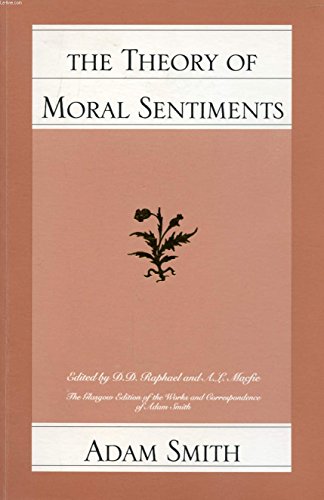
Synopsis
The Theory of Moral Sentiments, Smith's first and in his own mind most important work, outlines his view of proper conduct and the institutions and sentiments that make men virtuous. Here he develops his doctrine of the impartial spectator, whose hypothetical disinterested judgment we must use to distinguish right from wrong in any given situation. We by nature pursue our self-interest, according to Smith. This makes independence or self-command an instinctive good, and neutral rules as difficult to craft as they are necessary. But society is not held together merely by neutral rules; it is held together by sympathy. Smith argues that we naturally share the emotions and to a certain extent the physical sensations we witness in others. Sharing the sensations of our fellows, we seek to maximize their pleasures and minimize their pains so that we may share in their joys and enjoy their expressions of affection and approval.
"synopsis" may belong to another edition of this title.
About the Author
Adam Smith was born in a small village in Kirkcaldy, Scotland in 1723. He entered the University of Glasgow at age fourteen, and later attended Balliol College at Oxford. After lecturing for a period, he held several teaching positions at Glasgow University. His greatest achievement was writing The Wealth of Nations (1776), a five-book series that sought to expose the true causes of prosperity, and installed him as the father of contemporary economic thought. He died in Edinburgh on July 19, 1790.
"About this title" may belong to another edition of this title.
Search results for The Theory of Moral Sentiments (Glasgow Edition of...

Seller Image
The Theory of Moral Sentiments (Glasgow Edition of the Works and Correspondence of Adam Smith, vol.1)
Seller: Zoom Books East, Glendale Heights, IL, U.S.A.
Seller rating 5 out of 5 stars

Condition: good. Book is in good condition and may include underlining highlighting and minimal wear. The book can also include "From the library of" labels. May not contain miscellaneous items toys, dvds, etc. . We offer 100% money back guarantee and 24 7 customer service. Seller Inventory # ZEV.0865970122.G
Stock Image
The Theory of Moral Sentiments (Glasgow Edition of the Works and Correspondence of Adam Smith, vol.1)
Published by
Liberty Classics (edition Reissue), 1982
ISBN 10: 0865970122
ISBN 13: 9780865970120
Used
Paperback
Seller: BooksRun, Philadelphia, PA, U.S.A.
Seller rating 5 out of 5 stars
Paperback. Condition: Fair. Reissue. The item might be beaten up but readable. May contain markings or highlighting, as well as stains, bent corners, or any other major defect, but the text is not obscured in any way. Seller Inventory # 0865970122-7-1
Stock Image
The Theory of Moral Sentiments (Glasgow Edition of the Works and Correspondence of Adam Smith, vol.1)
Seller: Books From California, Simi Valley, CA, U.S.A.
Seller rating 4 out of 5 stars

Paperback. Condition: Good. Ex-library copy with usual markings. Seller Inventory # mon0004271135
Stock Image
The Theory of Moral Sentiments (Glasgow Edition of the Works and Correspondence of Adam Smith, vol.1)
Seller: WorldofBooks, Goring-By-Sea, WS, United Kingdom
Seller rating 5 out of 5 stars
Paperback. Condition: Very Good. The book has been read, but is in excellent condition. Pages are intact and not marred by notes or highlighting. The spine remains undamaged. Seller Inventory # GOR001778179
Buy Used
£ 2.86
£ 5.60 shipping
Ships from United Kingdom to U.S.A.
Ships from United Kingdom to U.S.A.
Quantity: 3 available
Stock Image
Theory of Moral Sentiments
Published by
Liberty Fund, Incorporated, 2009
ISBN 10: 0865970122
ISBN 13: 9780865970120
Used
Softcover
Seller: Better World Books Ltd, Dunfermline, United Kingdom
Seller rating 5 out of 5 stars
Condition: Good. Pages intact with minimal writing/highlighting. The binding may be loose and creased. Dust jackets/supplements are not included. Stock photo provided. Product includes identifying sticker. Better World Books: Buy Books. Do Good. Seller Inventory # 3934374-6
Buy Used
£ 5.18
£ 5 shipping
Ships from United Kingdom to U.S.A.
Ships from United Kingdom to U.S.A.
Quantity: 1 available
Stock Image
The Theory of Moral Sentiments (Glasgow Edition of the Works and Correspondence of Adam Smith, vol.1)
Seller: Unique Books, Lexington, KY, U.S.A.
Seller rating 5 out of 5 stars
Soft cover. Condition: Very Good. No Jacket. b-480. Seller Inventory # b-642-06
Seller Image
The Theory of Moral Sentiments (Glasgow Edition of the Works and Correspondence of Adam Smith, vol.1)
Seller: Avenue Victor Hugo Books, Newmarket, NH, U.S.A.
Seller rating 4 out of 5 stars
paperback. Condition: new. Reprint. This copy is unopened and still in the original publisher's shrinkwrap. Octavo, 9" tall, x + 412 pages, stiff illustrated wraps. A fine, neat soft cover, binding tight, paper white. Seller Inventory # 72181
Stock Image
Theory of Moral Sentiments
Seller: World of Books (was SecondSale), Montgomery, IL, U.S.A.
Seller rating 5 out of 5 stars
Paperback. Condition: Good. The Theory of Moral Sentiments, Smith's first and in his own mind most important work, outlines his view of proper conduct and the institutions and sentiments that make men virtuous. Here he develops his doctrine of the impartial spectator, whose hypothetical disinterested judgment we must use to distinguish right from wrong in any given situation. We by nature pursue our self-interest, according to Smith. This makes independence or self-command an instinctive good and neutral rules as difficult to craft as they are necessary But society is not held together merely by neutral rules; it is held together by sympathy. Smith argues that we naturally share the emotions and to a certain extent the physical sensations we witness in others. Sharing the sensations of our fellows, we seek to maximize their pleasures and minimize their pains so that we may share in their joys and enjoy their expressions of affection and approval. Seller Inventory # 00110084631
Stock Image
The Theory of Moral Sentiments (Glasgow Edition of the Works and Correspondence of Adam Smith, vol.1)
Seller: Cucamonga Books, Rancho Cucamonga, CA, U.S.A.
Seller rating 5 out of 5 stars
Soft cover. Condition: As New. Seller Inventory # ABE-1771351006148
Stock Image
THEORY OF MORAL SENTIMENTS
Seller: Textbook Bookie, Little Rock, AR, U.S.A.
Seller rating 5 out of 5 stars
Paperback. Condition: Fair. Book in Fair condition. Seller Inventory # 9780865970120-acceptable