
Items related to Helen with the High Hand (Pocket classics)
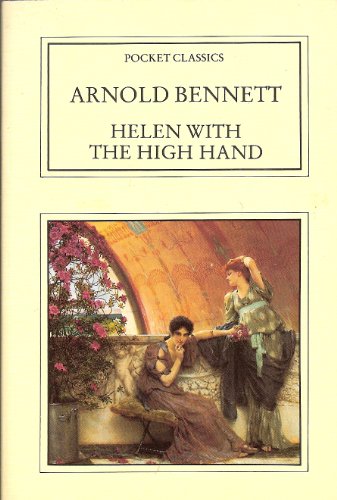
Synopsis
It is difficult to say who is the more delightful in this charming domestic comedy: James Ollerenshaw or high handed Helen who arrives to disturb his miserly, measured existence. When Helen Rathbone met her estranged step-uncle James on a park bench in one of the Five Towns, no citizen of this provincial manufacturing region could have guessed what a turn events would take, least of all the two protagonists. Helen was quite convinced she could change James for the better, whilst he was equally determined that she should not. From that moment their lives were inextricably bound together and would affect many more inside and outside their circle
"synopsis" may belong to another edition of this title.
About the Author
Arnold Bennett is famous for his realistic novels about the Five Towns - the 'Five Towns' being the pottery towns of his youth. His virtuosity as a writer was his manner of depicting simple things and ordinary people in an intriguing way for the readers. He has a warm and kind understanding for his characters, particularly when describing the intricate details of their dreary routine lives. (Enoch) Arnold Bennett was born in Hanley, Staffordshire, in 1867. Arnold followed his father into the legal profession but at the age of 21, he decided to leave his father's firm and moved to London and worked as a solicitor's clerk. He won a literary competition in ""Tit Bits"" magazine in 1889 and in 1893 became assistant editor of the journal, Woman. He published his first essentially autobiographical novel The Man from the North in 1898. His best work is contained in his novels of the 'Five Towns' which include Anna of the Five Towns (1902), The Old Wives' Tale (1908), Clayhanger (1910), The Card (1911), Hilda Lessways (1911) and These Twain (1916). During the First World War, he became Director of Propaganda at the War Ministry. He refused a knighthood in 1918. In 1926, he began writing an influential weekly article on books for the Evening Standard newspaper.
"About this title" may belong to another edition of this title.
Search results for Helen with the High Hand (Pocket classics)

Stock Image
Helen With the High Hand
Seller: ThriftBooks-Atlanta, AUSTELL, GA, U.S.A.
Seller rating 5 out of 5 stars

Paperback. Condition: Good. No Jacket. Pages can have notes/highlighting. Spine may show signs of wear. ~ ThriftBooks: Read More, Spend Less. Seller Inventory # G0862990769I3N00
Stock Image
Helen with the High Hand (Pocket classics)
Seller: AwesomeBooks, Wallingford, United Kingdom
Seller rating 5 out of 5 stars
Paperback. Condition: Very Good. Helen with the High Hand (Pocket classics) This book is in very good condition and will be shipped within 24 hours of ordering. The cover may have some limited signs of wear but the pages are clean, intact and the spine remains undamaged. This book has clearly been well maintained and looked after thus far. Money back guarantee if you are not satisfied. See all our books here, order more than 1 book and get discounted shipping. Seller Inventory # 7719-9780862990763
Buy Used
£ 3.95
£ 4.12 shipping
Ships from United Kingdom to U.S.A.
Ships from United Kingdom to U.S.A.
Quantity: 2 available
Seller Image
Helen with the High Hand
Published by
Alan Sutton, 1983
ISBN 10: 0862990769
ISBN 13: 9780862990763
Used
paperback
First Edition
Seller: Mystery Cove Book Shop, Hulls Cove, ME, U.S.A.
Seller rating 5 out of 5 stars
paperback. New in wraps. 1st printing of this edition. First published in 1910. Seller Inventory # 165282
Stock Image
Helen with the High Hand (Pocket classics)
Seller: Bahamut Media, Reading, United Kingdom
Seller rating 5 out of 5 stars
Paperback. Condition: Very Good. This book is in very good condition and will be shipped within 24 hours of ordering. The cover may have some limited signs of wear but the pages are clean, intact and the spine remains undamaged. This book has clearly been well maintained and looked after thus far. Money back guarantee if you are not satisfied. See all our books here, order more than 1 book and get discounted shipping. Seller Inventory # 6545-9780862990763
Buy Used
£ 2.71
£ 6.98 shipping
Ships from United Kingdom to U.S.A.
Ships from United Kingdom to U.S.A.
Quantity: 2 available
Seller Image
Helen With the High Hand
Seller: Jake's Place Books, Clarksville, TN, U.S.A.
Seller rating 5 out of 5 stars
Soft cover. Condition: Near Fine. Near fine condition. Spine tight, pages clean, cover lovely. Minor sticker schmutz on back. Seller Inventory # ABE-1726260497265
Stock Image
Helen with the High Hand (Pocket classics)
Seller: Reuseabook, Gloucester, GLOS, United Kingdom
Seller rating 5 out of 5 stars
Paperback. Condition: Used; Very Good. Dispatched, from the UK, within 48 hours of ordering. Though second-hand, the book is still in very good shape. Minimal signs of usage may include very minor creasing on the cover or on the spine. Seller Inventory # CHL10876713
Buy Used
£ 2.49
£ 10 shipping
Ships from United Kingdom to U.S.A.
Ships from United Kingdom to U.S.A.
Quantity: 1 available
Stock Image
Helen with the High Hand (Pocket classics)
Seller: Brit Books, Milton Keynes, United Kingdom
Seller rating 4 out of 5 stars

Paperback. Condition: Used; Very Good. ***Simply Brit*** Welcome to our online used book store, where affordability meets great quality. Dive into a world of captivating reads without breaking the bank. We take pride in offering a wide selection of used books, from classics to hidden gems, ensuring there is something for every literary palate. All orders are shipped within 24 hours and our lightning fast-delivery within 48 hours coupled with our prompt customer service ensures a smooth journey from ordering to delivery. Discover the joy of reading with us, your trusted source for affordable books that do not compromise on quality. Seller Inventory # 4459337
Buy Used
£ 3.67
£ 15.99 shipping
Ships from United Kingdom to U.S.A.
Ships from United Kingdom to U.S.A.
Quantity: 1 available
Stock Image
Helen with the High Hand (Pocket classics)
Seller: Greener Books, London, United Kingdom
Seller rating 4 out of 5 stars
Paperback. Condition: Used; Very Good. **SHIPPED FROM UK** We believe you will be completely satisfied with our quick and reliable service. All orders are dispatched as swiftly as possible! Buy with confidence! Greener Books. Seller Inventory # 4911068
Buy Used
£ 3.67
£ 20 shipping
Ships from United Kingdom to U.S.A.
Ships from United Kingdom to U.S.A.
Quantity: 1 available