
Handbook of Recycled Concrete and Demolition Waste (Woodhead Publishing Series in Civil and Structural Engineering): Management, Processing and Environmental Assessment - Hardcover
Book 65 of 149: Woodhead Publishing Series in Civil and Structural Engineering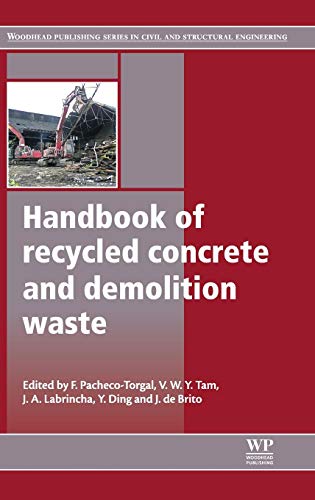
Synopsis
The civil engineering sector accounts for a significant percentage of global material and energy consumption and is a major contributor of waste material. The ability to recycle and reuse concrete and demolition waste is critical to reducing environmental impacts meeting national, regional and global environmental targets. Handbook of recycled and demolition waste summarises key recent research in achieving these goals. Part one considers techniques for managing construction and demolition waste. Part two reviews key steps in handling construction and demolition waste, from comparing conventional demolition and construction techniques to the preparation, refinement and quality control of concrete aggregates produced from waste. The following part includes examples of the use of recycled aggregates in applications such as roads, pavements, high-performance concrete and alkali-activated or geopolymer cements. Finally, the book discusses environmental and safety issues such as the removal of harmful substances from recycled aggregates.
Key Features: summarises key recent research in recycling and reusing concrete and demolition waste to reduce environmental impacts and meet national, regional and global environmental targets; considers techniques for managing construction and demolition waste, including waste management plans, ways of estimating levels of waste, the types and optimal location of waste recycling plants; reviews key steps in handling construction and demolition waste.
Contents: Introduction to the recycling of construction and demolition waste (CDW). Part 1 Managing construction and demolition waste: Improving waste management plans in construction projects; Methods for estimating CDW; Waste management plants and technology for recycling CDW: State-of-the-art and future challenges; Multi-criteria decision-making methods for the optimal location of CDW recycling facilities; The economics of CDW management facilities. Part 2 Processing and properties of recycled aggregates from construction and demolition waste: Conventional demolition versus deconstruction techniques in managing CDW; Demolition techniques and production of CDW for recycling; Preparation of concrete aggregates from CDW; Separation processes to improve the quality of recycled concrete aggregates (RCAs); Quality control of recycled aggregates (Ras) from CDW; Properties of concrete with recycled aggregates; Strength and durability of concrete using recycled aggregates (Ras). Part 3 Applications of recycled aggregates from construction and demolition waste: Recycled aggregates (Ras) for roads; Recycled aggregates (Ras) for asphalt materials; Recycled asphalt (RA) for pavements; The suitability of concrete using recycled aggregates (Ras) for high-performance concrete (HPC); Use of CDW for alkali-activated or geopolymer cements. Part 4 Environmental issues affecting recycled aggregates from construction and demolition waste: Removing gypsum from construction and demolition waste (C&DW); Recycling asbestos-containing material (ACM) from CDW; Remediation processes for wood treated with organic and/or inorganic preservatives; An effective approach to utilize recycled aggregates (Ras) from alkali-silica reaction (ASR) affected portland cement concrete; Life cycle assessment (LCA) of concrete with recycled aggregates (Ras); Assessing the potential environmental hazards of concrete made using recycled aggregates (Ras).
"synopsis" may belong to another edition of this title.
About the Author
Fernando Pacheco-Torgal is an investigator in the C-TAC Research Centre at the University of Minho, Portugal. He is the author or co-author of more than 200 publications and has edited seven books. Vivian Tam is Senior Lecturer in Quality Surveying in the School of Engineering and Construction Management at the University of Western Sydney, Australia. She is the author of over 200 papers. Joao Labrincha is Associate Professor in the Materials and Ceramics Engineering Department of the University of Aveiro, Portugal, and member of the CICECO research unit. He has registered 22 patent applications, and has published over 170 papers. Yining Ding is Professor in the Institute of Structure Engineering at Dalian University of Technology, China. He has published over 100 papers in three languages. Jorge de Brito is Professor in the Department of Civil Engineering, Architecture and Georesources at the Instituto Superior Tecnico, Technical University of Lisbon, Portugal. He was Head of the ICIST Research Centre from 2009 to 2012.
"About this title" may belong to another edition of this title.
Other Popular Editions of the Same Title

Search results for Handbook of Recycled Concrete and Demolition Waste...

Stock Image
Handbook of Recycled Concrete and Demolition Waste
Print on DemandSeller: Brook Bookstore On Demand, Napoli, NA, Italy
Seller rating 4 out of 5 stars

Condition: new. Questo è un articolo print on demand. Seller Inventory # 9f0efaa975180f2ea47fd34632cb9478
Buy New
£ 172.56
£ 9.50 shipping
Ships from Italy to U.S.A.
Ships from Italy to U.S.A.
Quantity: Over 20 available
Stock Image
Handbook of Recycled Concrete and Demolition Waste (Woodhead Publishing Series in Civil and Structural Engineering)
Published by
Woodhead Publishing Ltd 2013-07-30, 2013
ISBN 10: 0857096826
ISBN 13: 9780857096821
New
Hardcover
Seller: Chiron Media, Wallingford, United Kingdom
Seller rating 5 out of 5 stars

Hardcover. Condition: New. Seller Inventory # 6666-ELS-9780857096821
Buy New
£ 171.07
£ 15.49 shipping
Ships from United Kingdom to U.S.A.
Ships from United Kingdom to U.S.A.
Quantity: Over 20 available
Stock Image
Handbook of Recycled Concrete and Demolition Waste
Published by
Woodhead Publishing Limited, 2013
ISBN 10: 0857096826
ISBN 13: 9780857096821
New
Hardcover
Seller: Majestic Books, Hounslow, United Kingdom
Seller rating 4 out of 5 stars
Condition: New. pp. 690. Seller Inventory # 49555075
Buy New
£ 195.11
£ 6.50 shipping
Ships from United Kingdom to U.S.A.
Ships from United Kingdom to U.S.A.
Quantity: 3 available
Stock Image
Handbook of Recycled Concrete and Demolition Waste
Seller: Revaluation Books, Exeter, United Kingdom
Seller rating 5 out of 5 stars
Hardcover. Condition: Brand New. 646 pages. 9.25x6.25x1.50 inches. In Stock. Seller Inventory # __0857096826
Buy New
£ 195.22
£ 15 shipping
Ships from United Kingdom to U.S.A.
Ships from United Kingdom to U.S.A.
Quantity: 2 available
Seller Image
Handbook of Recycled Concrete and Demolition Waste
Published by
Elsevier Science & Technology, Woodhead Publishing, 2013
ISBN 10: 0857096826
ISBN 13: 9780857096821
New
Hardcover
Seller: BuchWeltWeit Ludwig Meier e.K., Bergisch Gladbach, Germany
Seller rating 5 out of 5 stars
Buch. Condition: Neu. This item is printed on demand - it takes 3-4 days longer - Neuware -The civil engineering sector accounts for a significant percentage of global material and energy consumption and is a major contributor of waste material. The ability to recycle and reuse concrete and demolition waste is critical to reducing environmental impacts in meeting national, regional and global environmental targets. Handbook of recycled concrete and demolition waste summarises key recent research in achieving these goals.Part one considers techniques for managing construction and demolition waste, including waste management plans, ways of estimating levels of waste, the types and optimal location of waste recycling plants and the economics of managing construction and demolition waste. Part two reviews key steps in handling construction and demolition waste. It begins with a comparison between conventional demolition and construction techniques before going on to discuss the preparation, refinement and quality control of concrete aggregates produced from waste. It concludes by assessing the mechanical properties, strength and durability of concrete made using recycled aggregates. Part three includes examples of the use of recycled aggregates in applications such as roads, pavements, high-performance concrete and alkali-activated or geopolymer cements. Finally, the book discusses environmental and safety issues such as the removal of gypsum, asbestos and alkali-silica reaction (ASR) concrete, as well as life-cycle analysis of concrete with recycled aggregates.Handbook of recycled concrete and demolition waste is a standard reference for all those involved in the civil engineering sector, as well as academic researchers in the field. Englisch. Seller Inventory # 9780857096821
Stock Image
Handbook of Recycled Concrete and Demolition Waste
Published by
Woodhead Publishing Limited, 2013
ISBN 10: 0857096826
ISBN 13: 9780857096821
New
Hardcover
Seller: Books Puddle, New York, NY, U.S.A.
Seller rating 4 out of 5 stars
Condition: New. pp. 690. Seller Inventory # 2642178908
Stock Image
Handbook of Recycled Concrete and Demolition Waste
Published by
Woodhead Publishing Limited, 2013
ISBN 10: 0857096826
ISBN 13: 9780857096821
New
Hardcover
Seller: Biblios, Frankfurt am main, HESSE, Germany
Seller rating 4 out of 5 stars
Condition: New. pp. 690. Seller Inventory # 1842178902
Seller Image
Handbook of Recycled Concrete and Demolition Waste
Published by
Elsevier Science & Technology, Woodhead Publishing, 2013
ISBN 10: 0857096826
ISBN 13: 9780857096821
New
Hardcover
Seller: AHA-BUCH GmbH, Einbeck, Germany
Seller rating 5 out of 5 stars
Buch. Condition: Neu. nach der Bestellung gedruckt Neuware - Printed after ordering - The civil engineering sector accounts for a significant percentage of global material and energy consumption and is a major contributor of waste material. The ability to recycle and reuse concrete and demolition waste is critical to reducing environmental impacts in meeting national, regional and global environmental targets. Handbook of recycled concrete and demolition waste summarises key recent research in achieving these goals.Part one considers techniques for managing construction and demolition waste, including waste management plans, ways of estimating levels of waste, the types and optimal location of waste recycling plants and the economics of managing construction and demolition waste. Part two reviews key steps in handling construction and demolition waste. It begins with a comparison between conventional demolition and construction techniques before going on to discuss the preparation, refinement and quality control of concrete aggregates produced from waste. It concludes by assessing the mechanical properties, strength and durability of concrete made using recycled aggregates. Part three includes examples of the use of recycled aggregates in applications such as roads, pavements, high-performance concrete and alkali-activated or geopolymer cements. Finally, the book discusses environmental and safety issues such as the removal of gypsum, asbestos and alkali-silica reaction (ASR) concrete, as well as life-cycle analysis of concrete with recycled aggregates.Handbook of recycled concrete and demolition waste is a standard reference for all those involved in the civil engineering sector, as well as academic researchers in the field. Seller Inventory # 9780857096821