
Items related to Our Land, Our Rent, Our Jobs: Uncovering the Explosive...
Our Land, Our Rent, Our Jobs: Uncovering the Explosive Potential for Growth Via Resource Rentals - Softcover
Synopsis
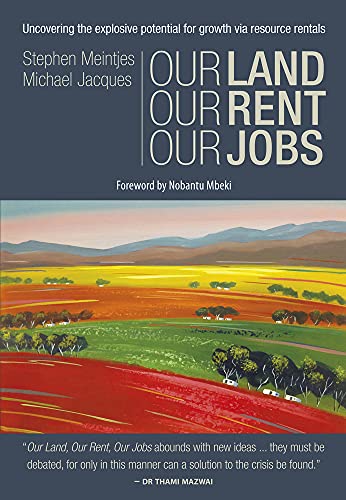
South Africa, like many countries in Africa, is resource rich but the benefits are not shared by the whole population. High levels of unem-ployment are leading to increasing conflict and violence, undermining the brighter future hoped for when apartheid was abolished. The authors set out a proposal to unleash their country's potential for growth in a way that benefits investors and the poorest by reforming taxation - a blueprint for other developing countries. The rapid develop-ment of Taiwan and South Korea in the 1950s and 1960s owed much to a similar, business-friendly tax reform. Governments today tax social ills like tobacco and alcohol to discourage use, but why tax work and investment? The result, the authors reveal, is to make half the country economically unviable, yet economists since Adam Smith have known that a tax on ground rent does not have this adverse effect. As he put it: "Though a part of this revenue should be taken ...in order to defray the expenses of the state, no dis-couragement will thereby be given to any sort of industry." All governments need do is collect the value they create and stop taxing the value created by labour and capital.To achieve this, the authors propose replacing most taxes with land value rentals and, in the case of mining, rolling out the tried and tested gold mine tax formula to the rest of the industry, thus stimulating development and creating more jobs. Such a regime would encourage the owner of land to put it to its best use or sell it for someone else to do so. It would also make viable public investment in new infrastructure projects. These would become self financing, because the uplift in land values, due to the improved amenities, would automatically be captured in higher rentals payable to the government, a kind of virtuous circle.
"synopsis" may belong to another edition of this title.
About the Author
Stephen Meintjes studied law at Stellenbosch and Oxford where he was a Rhodes Scholar. He has spent most of his career in investment research and management and is frequently quoted in the media, including radio and television. He is currently Head of Research for Imara S. P. Reid. The late Michael Jacques, a chartered accountant and then lecturer at the Faculty of Commerce of the University of the Witwatersrand, worked with Stephen Meintjes on the submission to the Treasury of various proposals on windfall taxes, royalties and general tax reform.
"About this title" may belong to another edition of this title.
Search results for Our Land, Our Rent, Our Jobs: Uncovering the Explosive...

Seller Image
Our Land, Our Rent, Our Jobs: Uncovering the Explosive Potential for Growth Via Resource Rentals
Published by
Shepheard-Walwyn (Publishers) Ltd, 2015
ISBN 10: 0856835048
ISBN 13: 9780856835049
Used
paperback
Seller: WeBuyBooks, Rossendale, LANCS, United Kingdom
Seller rating 5 out of 5 stars

paperback. Condition: Very Good. Most items will be dispatched the same or the next working day. A copy that has been read, but is in excellent condition. Pages are intact and not marred by notes or highlighting. The spine remains undamaged. Seller Inventory # rev8203241640
Buy Used
£ 7.52
£ 5.90 shipping
Ships from United Kingdom to U.S.A.
Ships from United Kingdom to U.S.A.
Quantity: 1 available
Seller Image
Our Land, Our Rent, Our Jobs : Uncovering the Explosive Potential for Growth Via Resource Rentals
Seller: GreatBookPrices, Columbia, MD, U.S.A.
Seller rating 5 out of 5 stars
Condition: As New. Unread book in perfect condition. Seller Inventory # 23289054
Seller Image
Our Land, Our Rent, Our Jobs : Uncovering the Explosive Potential for Growth Via Resource Rentals
Seller: GreatBookPrices, Columbia, MD, U.S.A.
Seller rating 5 out of 5 stars
Condition: New. Seller Inventory # 23289054-n
Seller Image
Our Land, Our Rent, Our Jobs
Published by
Shepheard-Walwyn (Publishers) Ltd, GB, 2015
ISBN 10: 0856835048
ISBN 13: 9780856835049
New
Paperback
Seller: Rarewaves.com USA, London, LONDO, United Kingdom
Seller rating 5 out of 5 stars
Paperback. Condition: New. South Africa, like many countries in Africa, is resource rich but the benefits are not shared by the whole population. High levels of unem-ployment are leading to increasing conflict and violence, undermining the brighter future hoped for when apartheid was abolished. The authors set out a proposal to unleash their country's potential for growth in a way that benefits investors and the poorest by reforming taxation - a blueprint for other developing countries. The rapid develop-ment of Taiwan and South Korea in the 1950s and 1960s owed much to a similar, business-friendly tax reform. Governments today tax social ills like tobacco and alcohol to discourage use, but why tax work and investment? The result, the authors reveal, is to make half the country economically unviable, yet economists since Adam Smith have known that a tax on ground rent does not have this adverse effect. As he put it: "Though a part of this revenue should be taken .in order to defray the expenses of the state, no dis-couragement will thereby be given to any sort of industry." All governments need do is collect the value they create and stop taxing the value created by labour and capital.To achieve this, the authors propose replacing most taxes with land value rentals and, in the case of mining, rolling out the tried and tested gold mine tax formula to the rest of the industry, thus stimulating development and creating more jobs.Such a regime would encourage the owner of land to put it to its best use or sell it for someone else to do so. It would also make viable public investment in new infrastructure projects. These would become self financing, because the uplift in land values, due to the improved amenities, would automatically be captured in higher rentals payable to the government, a kind of virtuous circle. Seller Inventory # LU-9780856835049
Buy New
£ 22.39
Free Shipping
Ships from United Kingdom to U.S.A.
Ships from United Kingdom to U.S.A.
Quantity: 20 available
Stock Image
Our Land, Our Rent, Our Jobs
Seller: PBShop.store US, Wood Dale, IL, U.S.A.
Seller rating 5 out of 5 stars
PAP. Condition: New. New Book. Shipped from UK. Established seller since 2000. Seller Inventory # C3-9780856835049
Stock Image
Our Land, Our Rent, Our Jobs (Paperback)
Published by
Shepheard-Walwyn (Publishers) Ltd, London, 2015
ISBN 10: 0856835048
ISBN 13: 9780856835049
New
Paperback
Seller: Grand Eagle Retail, Bensenville, IL, U.S.A.
Seller rating 5 out of 5 stars
Paperback. Condition: new. Paperback. South Africa, like many countries in Africa, is resource rich but the benefits are not shared by the whole population. High levels of unem-ployment are leading to increasing conflict and violence, undermining the brighter future hoped for when apartheid was abolished. The authors set out a proposal to unleash their country's potential for growth in a way that benefits investors and the poorest by reforming taxation - a blueprint for other developing countries. The rapid develop-ment of Taiwan and South Korea in the 1950s and 1960s owed much to a similar, business-friendly tax reform. Governments today tax social ills like tobacco and alcohol to discourage use, but why tax work and investment? The result, the authors reveal, is to make half the country economically unviable, yet economists since Adam Smith have known that a tax on ground rent does not have this adverse effect. As he put it: "Though a part of this revenue should be taken .in order to defray the expenses of the state, no dis-couragement will thereby be given to any sort of industry." All governments need do is collect the value they create and stop taxing the value created by labour and capital.To achieve this, the authors propose replacing most taxes with land value rentals and, in the case of mining, rolling out the tried and tested gold mine tax formula to the rest of the industry, thus stimulating development and creating more jobs.Such a regime would encourage the owner of land to put it to its best use or sell it for someone else to do so. It would also make viable public investment in new infrastructure projects. These would become self financing, because the uplift in land values, due to the improved amenities, would automatically be captured in higher rentals payable to the government, a kind of virtuous circle. South Africa, like many countries in Africa, is resource rich but the benefits are not shared by the whole population. High levels of unem-ployment are leading to increasing conflict and violence, undermining the brighter future hoped for when apartheid was abolished. Shipping may be from multiple locations in the US or from the UK, depending on stock availability. Seller Inventory # 9780856835049
Stock Image
Our Land, Our Rent, Our Jobs
Published by
Shepheard-Walwyn (Publishers) Ltd, 2015
ISBN 10: 0856835048
ISBN 13: 9780856835049
New
PAP
Seller: PBShop.store UK, Fairford, GLOS, United Kingdom
Seller rating 5 out of 5 stars
PAP. Condition: New. New Book. Shipped from UK. Established seller since 2000. Seller Inventory # C3-9780856835049
Buy New
£ 21.64
£ 4.16 shipping
Ships from United Kingdom to U.S.A.
Ships from United Kingdom to U.S.A.
Quantity: 15 available
Stock Image
Our Land, Our Rent, Our Jobs
Seller: Majestic Books, Hounslow, United Kingdom
Seller rating 4 out of 5 stars

Condition: New. pp. 272. Seller Inventory # 373670126
Buy New
£ 20.03
£ 6.50 shipping
Ships from United Kingdom to U.S.A.
Ships from United Kingdom to U.S.A.
Quantity: 3 available
Stock Image
Our Land, Our Rent, Our Jobs: Uncovering the Explosive Potential for Growth Via Resource Rentals
Seller: Revaluation Books, Exeter, United Kingdom
Seller rating 5 out of 5 stars
Paperback. Condition: Brand New. 272 pages. 9.00x6.00x1.00 inches. In Stock. Seller Inventory # __0856835048
Buy New
£ 18.23
£ 10 shipping
Ships from United Kingdom to U.S.A.
Ships from United Kingdom to U.S.A.
Quantity: 2 available
Stock Image
Our Land, Our Rent, Our Jobs: Uncovering the Explosive Potential for Growth Via Resource Rentals
Seller: Kennys Bookshop and Art Galleries Ltd., Galway, GY, Ireland
Seller rating 5 out of 5 stars
Condition: New. South Africa, like many countries in Africa, is resource rich but the benefits are not shared by the whole population. High levels of unem-ployment are leading to increasing conflict and violence, undermining the brighter future hoped for when apartheid was abolished. Num Pages: 272 pages, Graphs & Tables Index. BIC Classification: 1HFMS; JP; KCG. Category: (G) General (US: Trade). Dimension: 160 x 234 x 30. Weight in Grams: 404. . 2015. Paperback. . . . . Seller Inventory # V9780856835049
Buy New
£ 23.92
£ 8.15 shipping
Ships from Ireland to U.S.A.
Ships from Ireland to U.S.A.
Quantity: Over 20 available