
Items related to New Grange
Synopsis
The great prehistoric chambered tomb of New Grange lies in the bend of the Boyne, north of Dublin and west of Drogheda. It is one of a group of prehistoric tombs forming one of the great cemeteries of ancient Europe. Until the end of the seventeenth century it was a huge grass-covered mound and then the chamber tomb was found. Edward Lhwyd, Keeper of the Ashmolean Museum at Oxford, was travelling in Ireland at the time and wrote in a letter dated 15 December 1699, The most remarkable curiosity we saw by the way was a stately Mount at a place called New Grange near Drogheda; having a number of huge stones pitch d on end round about it, and a single one on the top. The gentleman of the village (one Mr. Charles Campbell) observing that under the green turf this mount was wholly composed of stones, and having occasion for some, employ d his servants to carry off a considerable parcel of them; till they came at last to a very broad flat stone, rudely carved, and placed edgewise at the bottom of the mount. This they discovered to be the door of a cave, which had a long entry leading to it. Thus was discovered one of the finest megalithic monuments in the world, and one of the earliest and most remarkable examples of early architecture in western Europe. The last two and a half centuries have seen much speculation about the name and nature of the New Grange chambered mound. Edward Lhwyd himself, percipient and brilliant antiquary that he was, thought the site was pre-Roman: some place of sacrifice or burial of the ancient Irish he wrote. Others thought it Danish, or Phoenician, or Egyptian or Druidic. Sir Richard Colt Hoare, who travelled in Ireland in the early nineteenth century, was inclined to attribute this singular temple to some of the Celtic or Belgic tribes who poured in upon us from the continent of Gaul.
"synopsis" may belong to another edition of this title.
Search results for New Grange

Stock Image
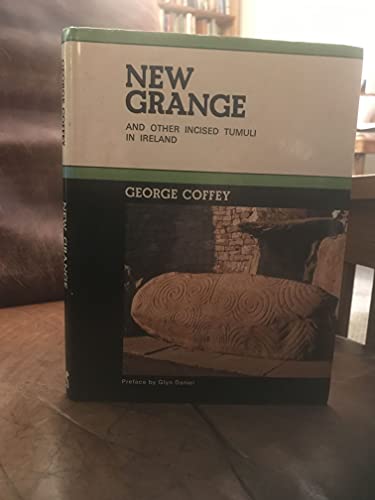
New Grange and Other Incised Tumuli in Ireland
Published by
Sterling Publishing Co., Inc., 1978
ISBN 10: 0856420417
ISBN 13: 9780856420412
Used
Hardcover
Seller: Better World Books Ltd, Dunfermline, United Kingdom
Seller rating 5 out of 5 stars

Condition: Good. Pages intact with minimal writing/highlighting. The binding may be loose and creased. Dust jackets/supplements are not included. Stock photo provided. Product includes identifying sticker. Better World Books: Buy Books. Do Good. Seller Inventory # 51906608-6
Buy Used
£ 5.73
£ 5 shipping
Ships from United Kingdom to U.S.A.
Ships from United Kingdom to U.S.A.
Quantity: 1 available
Seller Image
New Grange and other incised tumuli in Ireland (Dolphin archaeologies)
Published by
Dolphin Press, United Kingdom, 1977
ISBN 10: 0856420417
ISBN 13: 9780856420412
Used
Hardcover
Seller: Carmarthenshire Rare Books, Carmarthen, United Kingdom
Seller rating 5 out of 5 stars
Hardcover. Condition: Very Good. Dust Jacket Condition: Very Good. 2nd Edition. original cloth hardcover, illustrated, 127 pages, names to flyleaf otherwise very good in very good unclipped dustwrapper. We are a real bookshop with real books situated in and shipping from the United Kingdom. Shelf N17. Seller Inventory # 123020
Buy Used
£ 6
£ 17.50 shipping
Ships from United Kingdom to U.S.A.
Ships from United Kingdom to U.S.A.
Quantity: 1 available
Stock Image
New Grange (Dolphin archaeologies)
Seller: Kennys Bookstore, Olney, MD, U.S.A.
Seller rating 5 out of 5 stars
Condition: Very Good. 1977. Hardcover. 8vo.Original cloth with dustwrapper. . . . . Books ship from the US and Ireland. Seller Inventory # KEX0298246
Stock Image
New Grange (Dolphin archaeologies)
Seller: Kennys Bookshop and Art Galleries Ltd., Galway, GY, Ireland
Seller rating 5 out of 5 stars
Condition: Very Good. 1977. Hardcover. 8vo.Original cloth with dustwrapper. . . . . Seller Inventory # KEX0298246
Seller Image
New Grange and Other Incised Tumuli in Ireland
Published by
Dolphin Press, Dorset, England, 1977
ISBN 10: 0856420417
ISBN 13: 9780856420412
Used
Hardcover
First Edition
Seller: Lindenlea Books, Ottawa, ON, Canada
Seller rating 5 out of 5 stars
Hardcover. Condition: Near Fine. Dust Jacket Condition: Near Fine. First Thus. Bumped at head of spine, smudge on rear lower edge, else near fine. DJ lightly wrinkled on ends of spine, rear flap creased on lower corner, else near fine. Seller Inventory # 002146
Stock Image
New Grange and other incised tumuli in Ireland
Published by
Dolphin Press, Poole, Dorset, 1977
ISBN 10: 0856420417
ISBN 13: 9780856420412
Used
Hardcover
Seller: Brillig's Books, Kingston, NY, U.S.A.
Seller rating 5 out of 5 stars
Hardcover. Condition: Good. Dust Jacket Condition: Good. Reprint Edition. 127 pps. Gilt titles: sp. Illust. w/ b/w photos, drawings, designs & plans. Green cloth bds. Interior leaves are clean and tight. First published in 1912. Guide to the magnificent carved megalithic site at New Grange ( Brugh-na- Boine), County Meath, Ireland. Includes: early literary references; art; other megalithic sites. Written by an eminent early 20th century Irish antiquarian. New preface by Glyn Daniel. Includes index. The magnificent ruin has recently been restored to its original grandeur, and I'll tell'ya. Seller Inventory # 004099
Stock Image
New Grange and other incised tumuli in Ireland (Dolphin archaeologies)
Seller: BennettBooksLtd, Los Angeles, CA, U.S.A.
Seller rating 5 out of 5 stars
hardcover. Condition: New. In shrink wrap. Looks like an interesting title! Seller Inventory # Q-0856420417