
Items related to Whose Middle Ages?: Teachable Moments for an Ill-Used...
Whose Middle Ages?: Teachable Moments for an Ill-Used Past (Fordham Series in Medieval Studies) - Softcover
Book 9 of 14: Fordham Series in Medieval Studies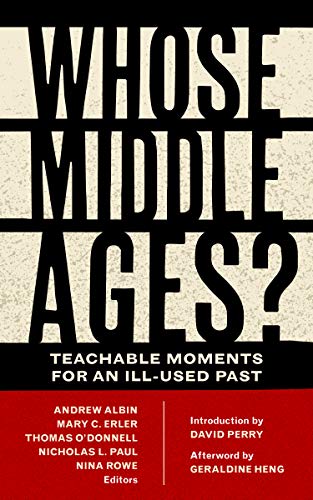
Synopsis
Whose Middle Ages? is an interdisciplinary collection of short, accessible essays intended for the nonspecialist reader and ideal for teaching at an undergraduate level. Each of twenty-two essays takes up an area where digging for meaning in the medieval past has brought something distorted back into the present: in our popular entertainment; in our news, our politics, and our propaganda; and in subtler ways that inform how we think about our histories, our countries, and ourselves. Each author looks to a history that has refused to remain past and uses the tools of the academy to read and re-read familiar stories, objects, symbols, and myths.
Whose Middle Ages? gives nonspecialists access to the richness of our historical knowledge while debunking damaging misconceptions about the medieval past. Myths about the medieval period are especially beloved among the globally resurgent far right, from crusading emblems on the shields borne by alt-right demonstrators to the on-screen image of a purely white European populace defended from actors of color by Internet trolls. This collection attacks these myths directly by insisting that readers encounter the relics of the Middle Ages on their own terms.
Each essay uses its author’s academic research as a point of entry and takes care to explain how the author knows what she or he knows and what kinds of tools, bodies of evidence, and theoretical lenses allow scholars to write with certainty about elements of the past to a level of detail that might seem unattainable. By demystifying the methods of scholarly inquiry, Whose Middle Ages? serves as an antidote not only to the far right’s errors of fact and interpretation but also to its assault on scholarship and expertise as valid means for the acquisition of knowledge.
"synopsis" may belong to another edition of this title.
About the Authors
Andrew Albin is Associate Professor of English and Medieval Studies at Fordham University. His scholarship in the fi eld of historical sound studies examines embodied listening practices, sound’s meaningful contexts, and the lived aural experiences of historical hearers―in a word, the sonorous past―as an object of critical inquiry. His work has been recognized with grants and fellowships from the American Council of Learned Societies, the Medieval Academy of America, the Pontifical Institute of Mediaeval Studies, and the Yale Institute of Sacred Music. He is the author of Richard Rolle’s Melody of Love: A Study and Translation with Manuscript and Musical Contexts (PIMS, 2018).
Mary C. Erler is Distinguished Professor of English at Fordham University and a member of the faculty of Fordham University’s Center for Medieval Studies.
Nicholas L. Paul is Associate Professor of History at Fordham University. He received his MPhil in Medieval History and PhD in History from Cambridge University. His previous publications include To Follow in Their Footsteps: The Crusades and Family Memory in the High Middle Ages (Cornell, 2017) and the coedited collections Remembering the Crusades: Myth, Image, and Identity (Johns Hopkins, 2012), and, with Laura K. Morreale, The French of Outremer: Communities and Communications in the Crusading Mediterranean (Fordham, 2018).
Nina Rowe is Associate Professor of Art History and a member of the faculty of Fordham University’s Center for Medieval Studies.
David M. Perry is Senior Academic Advisor in the History Department at the University of Minnesota.
"About this title" may belong to another edition of this title.
Search results for Whose Middle Ages?: Teachable Moments for an Ill-Used...

Stock Image
Whose Middle Ages?: Teachable Moments for an Ill-Used Past
Published by
Fordham University Press, 2019
ISBN 10: 0823285561
ISBN 13: 9780823285563
Used
Paperback
Seller: ThriftBooks-Dallas, Dallas, TX, U.S.A.
Seller rating 5 out of 5 stars

Paperback. Condition: Very Good. No Jacket. May have limited writing in cover pages. Pages are unmarked. ~ ThriftBooks: Read More, Spend Less. Seller Inventory # G0823285561I4N00
Stock Image
Whose Middle Ages?: Teachable Moments for an Ill-Used Past
Published by
Fordham University Press, 2019
ISBN 10: 0823285561
ISBN 13: 9780823285563
Used
Paperback
Seller: ThriftBooks-Atlanta, AUSTELL, GA, U.S.A.
Seller rating 5 out of 5 stars
Paperback. Condition: Fair. No Jacket. Readable copy. Pages may have considerable notes/highlighting. ~ ThriftBooks: Read More, Spend Less. Seller Inventory # G0823285561I5N00
Stock Image
Whose Middle Ages?: Teachable Moments for an Ill-Used Past
Published by
Fordham University Press, 2019
ISBN 10: 0823285561
ISBN 13: 9780823285563
Used
Paperback
Seller: ThriftBooks-Atlanta, AUSTELL, GA, U.S.A.
Seller rating 5 out of 5 stars
Paperback. Condition: Very Good. No Jacket. May have limited writing in cover pages. Pages are unmarked. ~ ThriftBooks: Read More, Spend Less. Seller Inventory # G0823285561I4N00
Stock Image
Whose Middle Ages?: Teachable Moments for an Ill-Used Past
Published by
Fordham University Press, 2019
ISBN 10: 0823285561
ISBN 13: 9780823285563
Used
Paperback
Seller: World of Books (was SecondSale), Montgomery, IL, U.S.A.
Seller rating 5 out of 5 stars
Paperback. Condition: Good. Whose Middle Ages? is an interdisciplinary collection of short, accessible essays intended for the nonspecialist reader and ideal for teaching at an undergraduate level. Each of twenty-two essays takes up an area where digging for meaning in the medieval past has brought something distorted back into the present: in our popular entertainment; in our news, our politics, and our propaganda; and in subtler ways that inform how we think about our histories, our countries, and ourselves. Each author looks to a history that has refused to remain past and uses the tools of the academy to read and re-read familiar stories, objects, symbols, and myths. Whose Middle Ages? gives nonspecialists access to the richness of our historical knowledge while debunking damaging misconceptions about the medieval past. Myths about the medieval period are especially beloved among the globally resurgent far right, from crusading emblems on the shields borne by alt-right demonstrators to the on-screen image of a purely white European populace defended from actors of color by Internet trolls. This collection attacks these myths directly by insisting that readers encounter the relics of the Middle Ages on their own terms. Each essay uses its author's academic research as a point of entry and takes care to explain how the author knows what she or he knows and what kinds of tools, bodies of evidence, and theoretical lenses allow scholars to write with certainty about elements of the past to a level of detail that might seem unattainable. By demystifying the methods of scholarly inquiry, Whose Middle Ages? serves as an antidote not only to the far right's errors of fact and interpretation but also to its assault on scholarship and expertise as valid means for the acquisition of knowledge. Seller Inventory # CIN0823285561G
Stock Image
Whose Middle Ages?: Teachable Moments for an Ill-Used Past
Published by
Fordham University Press, 2019
ISBN 10: 0823285561
ISBN 13: 9780823285563
Used
Paperback
Seller: World of Books (was SecondSale), Montgomery, IL, U.S.A.
Seller rating 5 out of 5 stars
Paperback. Condition: Very Good. Whose Middle Ages? is an interdisciplinary collection of short, accessible essays intended for the nonspecialist reader and ideal for teaching at an undergraduate level. Each of twenty-two essays takes up an area where digging for meaning in the medieval past has brought something distorted back into the present: in our popular entertainment; in our news, our politics, and our propaganda; and in subtler ways that inform how we think about our histories, our countries, and ourselves. Each author looks to a history that has refused to remain past and uses the tools of the academy to read and re-read familiar stories, objects, symbols, and myths. Whose Middle Ages? gives nonspecialists access to the richness of our historical knowledge while debunking damaging misconceptions about the medieval past. Myths about the medieval period are especially beloved among the globally resurgent far right, from crusading emblems on the shields borne by alt-right demonstrators to the on-screen image of a purely white European populace defended from actors of color by Internet trolls. This collection attacks these myths directly by insisting that readers encounter the relics of the Middle Ages on their own terms. Each essay uses its author's academic research as a point of entry and takes care to explain how the author knows what she or he knows and what kinds of tools, bodies of evidence, and theoretical lenses allow scholars to write with certainty about elements of the past to a level of detail that might seem unattainable. By demystifying the methods of scholarly inquiry, Whose Middle Ages? serves as an antidote not only to the far right's errors of fact and interpretation but also to its assault on scholarship and expertise as valid means for the acquisition of knowledge. Seller Inventory # 00102983947
Stock Image
Whose Middle Ages?: Teachable Moments for an Ill-Used Past (Fordham Series in Medieval Studies)
Published by
Fordham University Press, 2019
ISBN 10: 0823285561
ISBN 13: 9780823285563
Used
Softcover
Seller: Wonder Book, Frederick, MD, U.S.A.
Seller rating 5 out of 5 stars
Condition: Good. Good condition. A copy that has been read but remains intact. May contain markings such as bookplates, stamps, limited notes and highlighting, or a few light stains. Seller Inventory # Q11Q-01440
Stock Image
Whose Middle Ages?: Teachable Moments for an Ill-Used Past (Fordham Series in Medieval Studies)
Published by
Fordham University Press, 2019
ISBN 10: 0823285561
ISBN 13: 9780823285563
Used
paperback
Seller: HPB-Red, Dallas, TX, U.S.A.
Seller rating 5 out of 5 stars
paperback. Condition: Good. Connecting readers with great books since 1972! Used textbooks may not include companion materials such as access codes, etc. May have some wear or writing/highlighting. We ship orders daily and Customer Service is our top priority! Seller Inventory # S_482279951
Seller Image
Whose Middle Ages?: Teachable Moments for an Ill-Used Past (Fordham Series in Medieval Studies)
Published by
Fordham University Press, 2019
ISBN 10: 0823285561
ISBN 13: 9780823285563
Used
Softcover
Seller: Volunteers of America Ohio & Indiana, Columbus, OH, U.S.A.
Seller rating 4 out of 5 stars

Condition: good. Seller Inventory # VOAV.0823285561.G
Stock Image
Whose Middle Ages?: Teachable Moments for an Ill-Used Past
Published by
Fordham University Press, 2019
ISBN 10: 0823285561
ISBN 13: 9780823285563
Used
Paperback
Seller: World of Books Inc, Montgomery, IL, U.S.A.
Seller rating 4 out of 5 stars
Paperback. Condition: Good. Whose Middle Ages? is an interdisciplinary collection of short, accessible essays intended for the nonspecialist reader and ideal for teaching at an undergraduate level. Each of twenty-two essays takes up an area where digging for meaning in the medieval past has brought something distorted back into the present: in our popular entertainment; in our news, our politics, and our propaganda; and in subtler ways that inform how we think about our histories, our countries, and ourselves. Each author looks to a history that has refused to remain past and uses the tools of the academy to read and re-read familiar stories, objects, symbols, and myths. Whose Middle Ages? gives nonspecialists access to the richness of our historical knowledge while debunking damaging misconceptions about the medieval past. Myths about the medieval period are especially beloved among the globally resurgent far right, from crusading emblems on the shields borne by alt-right demonstrators to the on-screen image of a purely white European populace defended from actors of color by Internet trolls. This collection attacks these myths directly by insisting that readers encounter the relics of the Middle Ages on their own terms. Each essay uses its author's academic research as a point of entry and takes care to explain how the author knows what she or he knows and what kinds of tools, bodies of evidence, and theoretical lenses allow scholars to write with certainty about elements of the past to a level of detail that might seem unattainable. By demystifying the methods of scholarly inquiry, Whose Middle Ages? serves as an antidote not only to the far right's errors of fact and interpretation but also to its assault on scholarship and expertise as valid means for the acquisition of knowledge. Seller Inventory # CIN0823285561G
Stock Image
Whose Middle Ages?: Teachable Moments for an Ill-Used Past
Published by
Fordham University Press, 2019
ISBN 10: 0823285561
ISBN 13: 9780823285563
Used
Paperback
Seller: World of Books Inc, Montgomery, IL, U.S.A.
Seller rating 4 out of 5 stars
Paperback. Condition: Very Good. Whose Middle Ages? is an interdisciplinary collection of short, accessible essays intended for the nonspecialist reader and ideal for teaching at an undergraduate level. Each of twenty-two essays takes up an area where digging for meaning in the medieval past has brought something distorted back into the present: in our popular entertainment; in our news, our politics, and our propaganda; and in subtler ways that inform how we think about our histories, our countries, and ourselves. Each author looks to a history that has refused to remain past and uses the tools of the academy to read and re-read familiar stories, objects, symbols, and myths. Whose Middle Ages? gives nonspecialists access to the richness of our historical knowledge while debunking damaging misconceptions about the medieval past. Myths about the medieval period are especially beloved among the globally resurgent far right, from crusading emblems on the shields borne by alt-right demonstrators to the on-screen image of a purely white European populace defended from actors of color by Internet trolls. This collection attacks these myths directly by insisting that readers encounter the relics of the Middle Ages on their own terms. Each essay uses its author's academic research as a point of entry and takes care to explain how the author knows what she or he knows and what kinds of tools, bodies of evidence, and theoretical lenses allow scholars to write with certainty about elements of the past to a level of detail that might seem unattainable. By demystifying the methods of scholarly inquiry, Whose Middle Ages? serves as an antidote not only to the far right's errors of fact and interpretation but also to its assault on scholarship and expertise as valid means for the acquisition of knowledge. Seller Inventory # CIN0823285561VG