
Items related to Entrepreneurial Selves: Neoliberal Respectability and...
Entrepreneurial Selves: Neoliberal Respectability and the Making of a Caribbean Middle Class (Next Wave: New Directions in Women's Studies) - Softcover
Book 28 of 42: Next Wave: New Directions in Women's Studies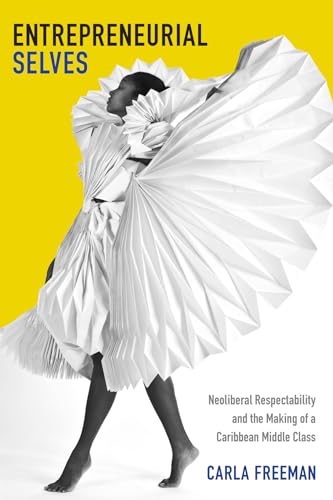
Synopsis
Entrepreneurial Selves is an ethnography of neoliberalism. Bridging political economy and affect studies, Carla Freeman turns a spotlight on the entrepreneur, a figure saluted across the globe as the very embodiment of neoliberalism. Steeped in more than a decade of ethnography on the emergent entrepreneurial middle class of Barbados, she finds dramatic reworkings of selfhood, intimacy, labor, and life amid the rumbling effects of political-economic restructuring. She shows us that the déjà vu of neoliberalism, the global hailing of entrepreneurial flexibility and its concomitant project of self-making, can only be grasped through the thickness of cultural specificity where its costs and pleasures are unevenly felt. Freeman theorizes postcolonial neoliberalism by reimagining the Caribbean cultural model of 'reputation-respectability.' This remarkable book will allow readers to see how the material social practices formerly associated with resistance to capitalism (reputation) are being mobilized in ways that sustain neoliberal precepts and, in so doing, re-map class, race, and gender through a new emotional economy.
"synopsis" may belong to another edition of this title.
About the Author
Carla Freeman is Winship Distinguished Research Professor of Women's, Gender, and Sexuality Studies, and associated faculty in Anthropology and Latin American and Caribbean Studies, at Emory University. She is the author of High Tech and High Heels in the Global Economy: Women, Work, and Pink Collar Identities in the Caribbean, also published by Duke University Press, and a coeditor of Global Middle Classes: Ethnographic Particularities, Theoretical Convergences.
Excerpt. © Reprinted by permission. All rights reserved.
Entrepreneurial Selves
Neoliberal Respectability and the Making of a Caribbean Middle Class
By Carla FreemanDuke University Press
Copyright © 2014 Duke University Press
All rights reserved.
ISBN: 978-0-8223-5803-9All rights reserved.
Contents
Acknowledgments,
Entrepreneurial Selves: An Introduction,
CHAPTER ONE Barbadian Neoliberalism and the Rise of a New Middle-Class Entrepreneurialism,
CHAPTER TWO Entrepreneurial Affects: "Partnership" Marriage and the New Intimacy,
CHAPTER THREE The Upward Mobility of Matrifocality,
CHAPTER FOUR Neoliberal Work and Life,
CHAPTER FIVE The Therapeutic Ethic and the Spirit of Neoliberalism,
Conclusion,
Notes,
References,
Index,
CHAPTER 1
Barbadian Neoliberalism and the Rise of a New Middle-Class Entrepreneurialism
Homo economicus is an entrepreneur, an entrepreneur of himself ... being for himself his own capital ... his own producer ... the source of [his] earnings. —FOUCAULT, THE BIRTH OF BIOPOLITICS, 266
The contemporary entrepreneur represents neoliberalism's heroic actor: supple, flexible, and keenly responsive to market fluctuations, always prepared to retool and retrain to advance in uncharted directions (Bourdieu 1998; Harvey 2005). Entrepreneurship and entrepreneurialism, however, carry neither generic shape nor historical tradition. Likewise, in its traffic between popular and academic settings, the concept of neoliberalism is fraught with conflicting, albeit mostly threatening, associations. From the perspective of political economy, the neoliberal era of capitalism signifies the seemingly limitless advance of a global marketplace, a fully integrated apparatus serving the interests of a global corporate elite via new strategies of capital accumulation, while the protective arm of the state shrinks back from its commitments to regulation and social welfare. Under this agenda, the world market is envisioned as both engine and compass directing human action and new regimes of accumulation: privatization, deregulation, and "the commodification of everything" (Harvey 2005). Neoliberalism, in this sense, operates both as ideology and economic policy, producing unexpected and ironic effects (Comaroff and Comaroff 2000). Bourdieu refers to neoliberalism as "a mode of production that entails a mode of domination based on the institution of insecurity, domination through precariousness" (2003, 29; see also Clarke 2004).
For others, in particular those influenced by Foucault, neoliberalism marks the intensifying techniques of "governmentality" by which the logics of capitalism and the weight of economic rationality become so fully globalized (Hardt and Negri 2000) and so deeply engrained that people are compelled to become self-governing (Rose 1990, 1992). The concept of neoliberalism is most fruitfully conceived not as a specific set of structures or as Ong (2007, 5) aptly put it, an "economic tsunami ... of market-driven forces" decimating all in its wake, or a single abstract "thing that acts in the world" (Kingfisher and Maskovsky 2008), but rather as a logic that can be adapted and melded within specific conditions, through specific cultural forms, in time and space.
I retain the concept of neoliberalism not as a generic gloss for contemporary capitalism but with the hopes of adding greater cultural particularity and precision to its dynamic and multifaceted forms. As a concept, neoliberalism also signals a confounding "slippage" in my fieldwork where the term assumed both popular and analytical usage. In short, describing certain conditions and practices as "neoliberal" or as evidence of neoliberalism was not something confined to academic conference rooms or published papers. A critical discourse about neoliberalism also emanated from my informants in a way that seems to be an ever more common dimension of contemporary fieldwork. This is especially the case when studying the middle classes, whose life styles, modes of consumption, media worlds, and so on may resemble and overlap with those of the ethnographer. Every day I noticed not only convergences between the language and lives of my entrepreneurial informants and my own life and milieu in the United States, but the echoes of "official" neoliberal discourse were also unmistakable. Neoliberalism and its signature elements of flexibility, entrepreneurship and entrepreneurialism have entered the common parlance of state-level officials as well as many of my interlocutors, often with positive value attached. Among academics the concept has become an almost trite gloss for the ills of today's precarious global economy and cultural condition. Discursive blendings such as this one beg for conceptual excavation and close ethnographic exploration. For, familiar as these themes of flexibility and rationality sounded to my American ear, I was equally aware that they were steeped in a different set of cultural understandings and could not be interpreted through a single framework.
THE NEOLIBERAL LOGIC OF FLEXIBILITY
The clarion call for flexibility became a constant refrain resounding from all corners of society, from entrepreneurs' own testimonies and the programmatic charges of the Barbadian state, to the private sector, and NGO establishment. "The essence of neo-liberalism," as Bourdieu summed it up, is an "absolute reign of flexibility" (1998). From one vantage point, these bedfellows—neoliberalism and flexibility—connote the instability of labor and financial markets; ruptures, radical escalations, and the collapse of time and space; an erosion of state-sanctioned social welfare; and according to Lash and Urry (1987), "the end of organized (bureaucratic) capitalism." Across popular and academic discourses, neoliberal flexibility is variously portrayed as "slogan ... ideology ... dream and nightmare" (Marquand 1992, 61). In the terms of some of my Barbadian interviewees, flexibility is fundamentally about "insecurity and risk," while for others "flexibility is the name of the game," a de facto reality they not only embraced but also eagerly sought. Whether a source of anxiety, an external command, a badge of honor, a chimera of promise, or a deeply internalized desire, if a single concept could capture the complex essence of the entrepreneurialism I will try to describe, it would be flexibility.
Few if any spheres of life are exempt from contemporary neoliberal demands for flexibility—from the structures of economic markets to the nuances of individuals' subjectivities as citizens, producers, consumers, migrants, tourists, members of families, and so on. Aihwa Ong (2006) has demonstrated the supple and sometimes unexpected maneuvers made by Asian states as they attempt to position themselves competitively under neoliberalism. She has also highlighted the degree to which flexibility and movement stand in direct challenge to the stability and solidity that were prized under earlier capitalist expansions. Emily Martin (1994) has described how the contemporary emphasis on flexible accumulation extends across domains of life from the immune system to the laboring and managing body within corporate enterprise. The tentacles of neoliberalism reach from on high—whether the corporation, the state, or agglomerations thereof, into the individual, the body, psyche, and cell.
The mandate for flexibility requires not only that individuals retrain for an ever-changing set of job requirements in the new economy but also that they foster a heightened sense of individualism in which, as many have noted, therapeutic culture has come to play a significant role in bolstering and soothing the self (Rieff 2006; Lasch 1991; Rose 1992). The directive to become an "entrepreneur of the self" implies an independence in which the individual is defined as a self-propelled, autonomous economic actor, ever responsive to a dynamic marketplace, and simultaneously encouraged to seek introspection, self-mastery, and personal fulfillment. This edict entails not only retraining and the procurement of new skills, networks, and the imagination and courage to break outside of the established channels of upward mobility but also an interior dimension of selfhood and flexible self making through enterprise in which capital accumulation is not an end in itself but a means to reinvent oneself. The reinvention at stake has many dimensions—that of producer, consumer, and citizen, a social being as well as an individual who cares for her own livelihood and her own body, mind, and soul.
North Americans and Europeans are intimately familiar with the flexibility discourse and the notion that in this era of late capitalism the onus is increasingly placed upon the individual to take charge of his own economic, social, and personal fate. Self-help manuals, life coaches, personal trainers, and counselors of all sorts are all part of an expanding network of services for adapting to the "precarity" of life (Hardt and Negri 2004). Workers are expected to respond quickly and with agility to labor market demands by constantly retraining; businesses are charged with developing special niche markets, customizable services and products, and to restructure, reorganize, and relocate in relation to the global marketplace; academics must anticipate and respond to market pressures by being more strategic and entrepreneurial in publication, utilize new media and digital technologies that expand public outreach, increase university revenues and justify costs; children are coaxed in their consumer habits, their extracurricular activities, and their schooling, to carefully craft their profiles in social media and for college applications. These are just a few illustrations of the ways in which middle-class life today is enmeshed within a culture and economy of neoliberalism and its messianic call for entrepreneurial flexibility.
CARIBBEAN LOGIC OF REPUTATIONAL FLEXIBILITY
The mantra of flexibility is not the sole preserve of neoliberal discourse, however, and its significance for Barbadian entrepreneurs cannot be interpreted as a simple echo of contemporary globalization. Flexibility has also been the keystone of a deeply rooted Caribbean cultural tradition, a value complex that for many analyses signifies what is most culturally authentic about these new world societies. Indeed, what I call the Caribbean logic of reputational flexibility recuperates conceptually one of the region's most powerful (and controversial) gatekeeping concepts—the reputation-respectability model. I argue that this regional idiom of reputation and respectability illustrates what Ong (2007, 5) evocatively describes as "the promiscuous entanglements of global and local logics" of neoliberalism. My larger goal is to highlight that even where landscapes and lives appear to imitate familiar signs of neoliberalism in the United States or Europe, we must not make the mistake of interpreting these forms as the same. This book recasts the reputation-respectability model as a tool with which to interrogate the nuances of global processes.
Polemically proposed by the anthropologist Peter Wilson in the 1960s, the model of reputation and respectability contends that Caribbean societies can be broadly understood as steeped in the structures and ideologies of two competing value systems. On one hand is respectability, the inescapable legacy of colonial dependence through which patterns of social hierarchy are upheld and reproduced, and on the other hand is reputation, a set of oppositional responses to colonial domination and the elusiveness of respectability through which people enact creative individualism and achieve a sort of social leveling or esprit of communitas. Respectability, for Wilson, encoded a set of British colonially defined institutions, values and mores endorsed and practiced largely by the middle class, by women in particular, and by old or married men. Steeped in Victorian tradition, respectability sanctioned the nuclear patriarchal family over the "matrifocal" household, the more fluid "visiting union," and more casual sexual relations. Respectability enshrined the white Christian church over other, syncretic denominations. Ideals of respectable social order, propriety, monogamy, and domesticity are enacted through formal patriarchal marriage, the Anglican Church, the pursuit of higher education, and a secure place in the hierarchy of the civil service or the professions of law or medicine. The essence of reputation, by contrast, is rooted in African culture and expressed through an improvisational adaptability associated primarily with a lower-class and masculine public sphere of performance and sociality. Reputation is performed in the public domain in such venues as street corners, the political platform, the rum shop, the market, and the musical stage, where people flaunt qualities such as sexual prowess, verbal wit, musical flair, and guile.
The qualities most central to reputation can be thought of as the embodiment of an entrepreneurial esprit—adaptive, self-defined, and resistant to the stiff, stultifying conventions of bureaucratic respectability. Whether performed by men or women, the culture of reputation has a distinctively masculine and lower-class aura. For Wilson, most importantly, reputation embodied all that was creative, resilient, and anticolonial in the forging of an independent, creole, or New World Caribbean culture. Where respectability symbolized the false, imitative essence of colonial culture—its preoccupation with the codes of British decorum—reputation, by contrast, could be upheld as the model of authentic Caribbean-ness. If respectability upholds hierarchical order, reputation advances flexibility and communitas.
This emphasis on flexibility and adaptability as a paramount feature of Caribbean experience and culture is widely acknowledged within academic and popular realms. Movement, migration, and change, rather than insularity or stasis, have defined the Caribbean as a social and cultural field. And as Trouillot (2003, 42) reminds us, cultural practice in the Caribbean "takes firmer contours when we consider the provision grounds of slavery." When not under the whip in the cane fields, slaves carved both economic liberties and a robust internal marketing system out of the rigid structure of the plantation; the provisions they grew and traded became the diet of planter and slave alike, and their market acumen anchored a tradition of economic resilience and flexibility. Echoing Mintz (1978), Trouillot noted, "what started as an economic bonus for planters turned out to be a field of opportunities for individual slaves," critical not only materially but also as "symbolic fields for the production of individual selves by way of the production of material goods." Indeed, a proclivity for "strategic flexibility" operates as a general cultural model with which West Indians approach most aspects of life.
This logic of flexibility at the core of Caribbean personhood is rooted in a history of movement and expressed structurally in numerous ways across the life course: in circuits of labor migration, the dispersed regional and transnational networks of kin and child fostering, shifting household constellations, the formally recognized "visiting union," the preponderance of female-headed households, and in the salience of "occupational multiplicity." The fisherman who keeps a rum shop that also rents pirated DVDs, office workers who spend weekends buying fashions and household wares in Miami for resale in their modest living-room markets, and even the successful Cambridge-educated medical doctor who keeps a kitchen garden and raises pigs and chickens in his yard are but a few examples of Barbadian resourcefulness I witnessed. They speak to the well-anchored culture of reputational flexibility that encompasses the wider Caribbean. As Trouillot (1992, 33) has said, "Caribbean peoples seem to have fewer problems than most in recognizing the fuzziness and overlap of categories, and multiplicity is not confined to the economic realm or to the poor."
Historically the tension between cultures of reputation and respectability in the Caribbean fostered a dynamic that Wilson (1978, 58) called "crab antics"—an expression I continued to hear among entrepreneurs today. The saying connotes a barrel full of crabs. Each crab in pursuit of his own freedom yanks the one above back down. A newly defined struggle between reputation and respectability might be said to be especially pronounced today and to embody the entrepreneurial heart of Barbadian neoliberalism. For where entrepreneurship has historically been rooted in the tradition of reputation, it is the middle class—as a group and a set of ideals—that has constituted the axis of respectability. In short the tension between reputation and respectability today is unfolding in a direction that Wilson did not anticipate. Where once the values and practices of reputation stood in stark opposition to the ethic of bureaucratic, capitalist respectability, they now align perfectly within the neoliberal order. For Wilson, the reputation-respectability model offered not a mere academic heuristic but a political agenda. He saw the cultural values of reputation as the way to combat a neocolonial order and beckon a more culturally authentic future for the Caribbean region. This reputational propensity for flexibility, innovation, and self-invention—whether in realms of economy, conjugality, kinship or self-expression—constituted an adaptive, alternative set of economic and cultural responses to capitalist domination, and as such, reputation suggested an alternative, counterhegemonic esprit. Today, however, these values and entrepreneurial practices are precisely the ticket to neoliberal orthodoxy. Entrepreneurial flexibility increasingly represents not simply a survival strategy but also an aspirational and officially mandated path, not only a means of a livelihood but also a lifestyle and way of being. And as reputation becomes upwardly mobile, its new relationship to respectability poses new opportunities as well as challenges along the lines of gender, class, and race. No longer the preserve of lower-class black masculinity, reputational flexibility is attractive to and hailed by more and more people, including and perhaps especially middle-class women, whom Wilson would have seen as the very anchor of traditional, intractable respectability.
(Continues...)
Excerpted from Entrepreneurial Selves by Carla Freeman. Copyright © 2014 Duke University Press. Excerpted by permission of Duke University Press.
All rights reserved. No part of this excerpt may be reproduced or reprinted without permission in writing from the publisher.
Excerpts are provided by Dial-A-Book Inc. solely for the personal use of visitors to this web site.
"About this title" may belong to another edition of this title.
Search results for Entrepreneurial Selves: Neoliberal Respectability and...

Stock Image
Entrepreneurial Selves: Neoliberal Respectability and the Making of a Caribbean Middle Class
Seller: World of Books (was SecondSale), Montgomery, IL, U.S.A.
Seller rating 5 out of 5 stars

Paperback. Condition: Fair. Steeped in more than a decade of ethnography on the emergent middle class of Barbados, this remarkable book turns a spotlight on the entrepreneur, a figure saluted across the globe as the very embodiment of neoliberalism. Seller Inventory # 00099652996
Stock Image
Entrepreneurial Selves: Neoliberal Respectability and the Making of a Caribbean Middle Class (Next Wave: New Directions in Women's Studies)
Published by
Duke University Press (edition ), 2014
ISBN 10: 0822358034
ISBN 13: 9780822358039
Used
Paperback
Seller: BooksRun, Philadelphia, PA, U.S.A.
Seller rating 5 out of 5 stars
Paperback. Condition: Very Good. It's a well-cared-for item that has seen limited use. The item may show minor signs of wear. All the text is legible, with all pages included. It may have slight markings and/or highlighting. Seller Inventory # 0822358034-11-1
Stock Image
Entrepreneurial Selves: Neoliberal Respectability and the Making of a Caribbean Middle Class
Seller: World of Books Inc, Montgomery, IL, U.S.A.
Seller rating 4 out of 5 stars

Paperback. Condition: Fair. Steeped in more than a decade of ethnography on the emergent middle class of Barbados, this remarkable book turns a spotlight on the entrepreneur, a figure saluted across the globe as the very embodiment of neoliberalism. Seller Inventory # CIN0822358034A
Stock Image
Entrepreneurial Selves: Neoliberal Respectability and the Making of a Caribbean Middle Class
Seller: ThriftBooks-Atlanta, AUSTELL, GA, U.S.A.
Seller rating 5 out of 5 stars
Paperback. Condition: Very Good. No Jacket. May have limited writing in cover pages. Pages are unmarked. ~ ThriftBooks: Read More, Spend Less. Seller Inventory # G0822358034I4N00
Stock Image
Entrepreneurial Selves : Neoliberal Respectability and the Making of a Caribbean Middle Class
Seller: Better World Books: West, Reno, NV, U.S.A.
Seller rating 5 out of 5 stars
Condition: Very Good. Pages intact with possible writing/highlighting. Binding strong with minor wear. Dust jackets/supplements may not be included. Stock photo provided. Product includes identifying sticker. Better World Books: Buy Books. Do Good. Seller Inventory # 4961109-6
Stock Image
Entrepreneurial Selves : Neoliberal Respectability and the Making of a Caribbean Middle Class
Seller: Better World Books, Mishawaka, IN, U.S.A.
Seller rating 5 out of 5 stars
Condition: Good. Former library copy. Pages intact with minimal writing/highlighting. The binding may be loose and creased. Dust jackets/supplements are not included. Includes library markings. Stock photo provided. Product includes identifying sticker. Better World Books: Buy Books. Do Good. Seller Inventory # 54283756-6
Stock Image
Entrepreneurial Selves : Neoliberal Respectability and the Making of a Caribbean Middle Class
Seller: Better World Books, Mishawaka, IN, U.S.A.
Seller rating 5 out of 5 stars
Condition: Good. Pages intact with minimal writing/highlighting. The binding may be loose and creased. Dust jackets/supplements are not included. Stock photo provided. Product includes identifying sticker. Better World Books: Buy Books. Do Good. Seller Inventory # 6342546-6
Stock Image
Entrepreneurial Selves: Neoliberal Respectability and the Making of a Caribbean Middle Class (Next Wave: New Directions in Women's Studies)
Published by
Duke University Press Books, 2014
ISBN 10: 0822358034
ISBN 13: 9780822358039
Used
paperback
Seller: HPB-Ruby, Dallas, TX, U.S.A.
Seller rating 5 out of 5 stars
paperback. Condition: Very Good. Connecting readers with great books since 1972! Used books may not include companion materials, and may have some shelf wear or limited writing. We ship orders daily and Customer Service is our top priority! Seller Inventory # S_449086602
Stock Image
Entrepreneurial Selves: Neoliberal Respectability and the Making of a Caribbean Middle Class (Next Wave: New Directions in Women's Studies)
Seller: WorldofBooks, Goring-By-Sea, WS, United Kingdom
Seller rating 5 out of 5 stars
Paperback. Condition: Very Good. The book has been read, but is in excellent condition. Pages are intact and not marred by notes or highlighting. The spine remains undamaged. Seller Inventory # GOR014758764
Buy Used
£ 5.22
£ 5.60 shipping
Ships from United Kingdom to U.S.A.
Ships from United Kingdom to U.S.A.
Quantity: 1 available
Stock Image
Entrepreneurial Selves: Neoliberal Respectability and the Making of a Caribbean Middle Class (Next Wave: New Directions in Women's Studies)
Published by
Duke University Press Books, 2014
ISBN 10: 0822358034
ISBN 13: 9780822358039
Used
paperback
Seller: Textbooks_Source, Columbia, MO, U.S.A.
Seller rating 5 out of 5 stars
paperback. Condition: Good. Ships in a BOX from Central Missouri! May not include working access code. Will not include dust jacket. Has used sticker(s) and some writing or highlighting. UPS shipping for most packages, (Priority Mail for AK/HI/APO/PO Boxes). Seller Inventory # 001805528U