
Items related to Gendering the Recession: Media and Culture in an Age...
Synopsis
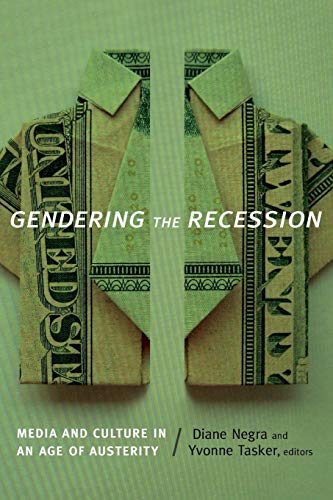
This timely, necessary collection of essays provides feminist analyses of a recession-era media culture characterized by the reemergence and refashioning of familiar gender tropes, including crisis masculinity, coping women, and postfeminist self-renewal. Interpreting media forms as diverse as reality television, financial journalism, novels, lifestyle blogs, popular cinema, and advertising, the contributors reveal gendered narratives that recur across media forms too often considered in isolation from one another. They also show how, with a few notable exceptions, recession-era popular culture promotes affective normalcy and transformative individual enterprise under duress while avoiding meaningful critique of the privileged white male or the destructive aspects of Western capitalism. By acknowledging the contradictions between political rhetoric and popular culture, and between diverse screen fantasies and lived realities, Gendering the Recession helps to make sense of our postboom cultural moment.
Contributors. Sarah Banet-Weiser, Hamilton Carroll, Hannah Hamad, Anikó Imre, Suzanne Leonard, Isabel Molina-Guzmán, Sinéad Molony, Elizabeth Nathanson, Diane Negra, Tim Snelson, Yvonne Tasker, Pamela Thoma
Contributors. Sarah Banet-Weiser, Hamilton Carroll, Hannah Hamad, Anikó Imre, Suzanne Leonard, Isabel Molina-Guzmán, Sinéad Molony, Elizabeth Nathanson, Diane Negra, Tim Snelson, Yvonne Tasker, Pamela Thoma
"synopsis" may belong to another edition of this title.
About the Author
Diane Negra is Professor of Film Studies and Screen Culture and Head of Film Studies at University College Dublin.
Yvonne Tasker is Dean of Arts and Humanities at the University of East Anglia.
Negra and Tasker are the coeditors of Interrogating Postfeminism: Gender and the Politics of Popular Culture, also published by Duke University Press.
Yvonne Tasker is Dean of Arts and Humanities at the University of East Anglia.
Negra and Tasker are the coeditors of Interrogating Postfeminism: Gender and the Politics of Popular Culture, also published by Duke University Press.
Excerpt. © Reprinted by permission. All rights reserved.
GENDERING THE RECESSION
Media and Culture in an Age of Austerity
By Diane Negra, Yvonne TaskerDuke University Press
Copyright © 2014 Duke University Press
All rights reserved.
ISBN: 978-0-8223-5696-7All rights reserved.
Contents
ACKNOWLEDGMENTS, vii,
INTRODUCTION. Gender and Recessionary Culture Diane Negra and Yvonne Tasker, 1,
ONE. Escaping the Recession? The New Vitality of the Woman Worker Suzanne Leonard, 31,
TWO. "Latina Wisdom" in "Postrace" Recession Media Isabel Molina-Guzmán, 59,
THREE. "We Are All Workers": Economic Crisis, Masculinity, and the American Working Class Sarah Banet-Weiser, 81,
FOUR. What Julia Knew: Domestic Labor in the Recession-Era Chick Flick Pamela Thoma, 107,
FIVE. Dressed for Economic Distress: Blogging and the "New" Pleasures of Fashion Elizabeth Nathanson, 136,
SIX. The (Re)possession of the American Home: Negative Equity, Gender Inequality, and the Housing Crisis Horror Story Tim Snelson, 161,
SEVEN. House and Home: Structuring Absences in Post–Celtic Tiger Documentary Sinéad Molony, 181,
EIGHT. "Stuck between Meanings": Recession-Era Print Fictions of Crisis Masculinity Hamilton Carroll, 203,
NINE. Fairy Jobmother to the Rescue: Postfeminism and the Recessionary Cultures of Reality TV Hannah Hamad, 223,
TEN. How Long Can the Party Last? Gendering the European Crisis on Reality TV Anikó Imre, 246,
BIBLIOGRAPHY, 273,
CONTRIBUTORS, 299,
INDEX, 303,
CHAPTER 1
SUZANNE LEONARD
Escaping the Recession?
THE NEW VITALITY OF THE WOMAN WORKER
In February 2011, a plucky American five-year-old became an overnight YouTube sensation with her adamant, direct address declaration, "I don't want to marry somebody if I don't have a job first.... I don't care if I marry you. I don't care if I marry another man. I care if I do something that's special." In emphatic terms, the unnamed speaker designates her job rather than her relational prospects as her chance to do something special, a mind-set also reflected in demographic research over the last forty years, which finds marriage to be of diminished significance in the eyes of multiple constituencies of Americans. As with other videos that feature precocious young white girls parroting feminist logics, this one stars a small child voicing a very adult observation. Yet, despite her young age, the speaker is also perfectly in sync with a postfeminist moment wherein securing work—and particularly the lucrative and self-actualizing kind—has begun to supplant marriage as the aspirational event of mediatized female lives.
Feminism has long supported the prospect of female labor as a route to financial empowerment while at the same time drawing attention to structural obstacles that thwart economic achievement, such as the wage gap, lack of adequate day care support and family-friendly work policies, and women's concentration in low-paying service industries. Such histories are largely papered over in the little girl's monologue, however, for her stated devotion to her career more obviously confirms an ideological and economic dynamic that Angela McRobbie identified in 2009 as the "visibility of the well-educated working girl" around whom terms like "capacity, success, attainment, enjoyment, entitlement, social mobility, and participation" swirl. Girls' claims to citizenship rest on these presumed attributes, and McRobbie observes that "the ability to earn a living is also the single most important feature of the social and cultural changes of which young women find themselves to be the privileged subjects." The successful girl exists, in turn, as proof that even during one of the worst economic crises of recent history, postfeminist thought regimes continue to emphasize and inculcate notions of equality and choice, messages that resonate particularly with those who enjoy race and class privilege, evidenced in this case by the speaker's whiteness, the upper-middleclass milieu she apparently inhabits, and the fact that the video was allegedly posted and edited by her eleven-year-old sister, a singer-songwriter.
More than a mere affirmation of hegemonic notions of postfeminist femininity, this video establishes a commensurability between discourses of gender, labor, and marriage, an equation that has been particularly salient in organizing life cycle temporalities in a recession economy. The blithe association this video makes between women, work, and upward mobility, and its seeming disinterest in anything men have to offer in that respect, resonates with a predominant emphasis on females triumphing in a recessionary moment more aptly described as one in which the majority of Americans are suffering. The false assumption that assertiveness equals ascendance, and that career success represents an option available to women at all points in the life cycle likewise reflects a common discursive positioning of women as impervious to a financial crisis that has nevertheless devastated men. Such thought paradigms paradoxically position women's professional aspirations as taken for granted, and yet at the same time legible only in light of their relational prospects with men or male partners. In this essay, I untangle these various recessionary discourses, highlighting how myths of male potency are fractured and disrupted by narratives of economically independent women. Such regimes latently emphasize not only the differing prospects of employment and marriage for the sexes, but also establish hierarchies based on what it means to be employable and marriageable, categorizations that are inevitably raced and classed. As I identify, increasing polarization between men and women in the professional and marital economies refracts through contemporary recessionary rhetorics and foments multiple social divisions.
Masculinity in Crisis—Again
From its inception, the post-2007 economic crisis has been understood in gendered terms. While the crisis undeniably brought issues of financial instability and hence class to the forefront of the collective consciousness in ways that they had not been for quite some time, the perception that the recession affected males and females differently, and to different degrees, quickly gained prominence. The crisis featured a collision of events originating with the subprime mortgage crisis and housing market collapse, catastrophes that led in turn to the sudden bankruptcy of a number of Wall Street investment banks. These failures precipitated multiple government bailouts (Aig, Ford, and Chrysler), and ricochet effects were felt in the global economy (particularly apparent in the European debt crisis). This downfall was vertiginous, and in many ways incomprehensible, a confusion stemming from the fact that average citizens are largely bereft of a theoretical framework through which to understand the workings of financial capital. Like the concepts and practices they describe, lexical terms like "speculation," "securities," "credit-default swaps," and "derivatives" are untethered from any sort of concrete material reality. To combat such abstractions, media outlets increasingly humanized the crisis, recounting numbers of job losses, vigilantly monitoring unemployment statistics, and reporting on average citizens whose homes had been foreclosed upon. In such scenarios, if the market collapse was precipitated by forces often too nebulous to visualize, the effects of it were all too easy to behold. In particular, mapping the recession onto actual job and home losses helped to order an otherwise unintelligible set of events, and thanks to the fact that one of the first conspicuous signs of the financial meltdown occurred in the male-dominated housing industry, the observation that the recession disproportionately disadvantaged male workers quickly became a structuring narrative.
If the housing boom in the United States was long taken (erroneously so, we now know) as an indicator of widespread national prosperity, one of the first signs that economies were amiss was the bust. New home and condominium construction in the United States ground to a halt around 2008–9, and hence so too did the mostly male-staffed jobs associated with this industry. The Bureau of Labor Statistics reports that residential construction created and accounted for nearly 3 million jobs that would not have existed otherwise, an observation that bespeaks one way in which the workings of global capital trade in hallucinatory effects, mirages of affluence that dispersed once the bubble burst. These losses in the construction industry were conflated, in turn, in the cultural imaginary with the decline in manufacturing—the other sector most visibly associated with contemporary masculinities—and focalized through the sharply diminishing stature of the automobile industry. The evisceration of manufacturing has been occurring in the postindustrial United States since at least the 1970s, with its pummeling taken up explicitly by documentaries such as Michael Moore's Roger and Me (1989) and Susan Faludi's book Stiffed: The Betrayal of the American Man (1999), wherein she linked a crisis in masculinity to the decline in American manufacturing. Recession-era anxiety nevertheless provided an opening for renewed attention to this downward spiral. A March 2012 report from the Information Technology and Innovation Foundation observes that from 2000 to 2010, 33.1 percent of U.S. manufacturing jobs were lost. Though these numbers are devastating, it is perhaps important to note that manufacturing today represents about 11 percent of all jobs, but nearly one-third of the jobs lost during the recession, a reality that underscores the slightly disingenuous quality of the strong emphasis placed on manufacturing in recent cultural narratives.
Afforded new legitimacy and exigency during the recession, nostalgic notions of both construction and manufacturing can be found in cultural products such as The Company Men (2010), which, though ostensibly concerned with redundancy and corporate downsizing, includes an elegiac sequence set in a now-vacated shipyard where an aging white male (Tommy Lee Jones) laments the fact that nothing gets made anymore. As if to further underscore the targeted losses that the recession economy has precipitated in men, in this film, the now-unemployed corporate worker's reembodiment occurs via carpentry, so that the act of fixing up houses serves as a nod to construction job losses in the wider economy, and provides a fairly transparent vehicle by which to remake his embattled masculinity, attenuated by the corporate and hence nonembodied labor market in which he had previously been participating.
The twinning of the construction and manufacturing industries in the cultural imagination fueled the perception that the recession hit men harder than women, as evidenced by the straightforward title of a March 2009 New York Times article by Floyd Norris, "In This Recession, More Men Are Losing Jobs." Stories about the "he-cession" or "man-cession" routinely compare male and female job losses and almost invariably invoke the specter of both the manufacturing and construction industries when they seek to explain the disproportionate effects of the recession on men. To name one of many representative examples, in her 2010 essay in the Atlantic, "The End of Men," Hanna Rosin writes, "In the wreckage of the Great Recession ... three quarters of the 8 million jobs lost were lost by men. The worst hit industries were overwhelmingly male and deeply identified with macho: construction, manufacturing, high finance." Such perceptions have been abetted by popular culture representations that extrapolate from these observations to suggest that all men are being hit harder by the recession, and impose the attendant fear that as a result of declines in traditionally masculine industries, men will have to accept more feminizing jobs—"He-Cession Has More Men Looking at Once 'Female' Jobs" claimed the Baltimore Sun in 2009, a story that was repeated in May 2012 in a New York Times article, "More Men Enter Fields Dominated by Women."
Relatedly, because the financial downfall has been narrated predominantly though the lens of the heterosexual family, losses in the employment sphere are assumed to alter men's position in the familial sphere as well, an observation that structures Liza Mundy's widely publicized The Richer Sex: How the New Majority of Female Breadwinners Is Transforming Sex, Love and Family (2012). Her book, which predicted that in the future more families will be supported by women than by men, garnered a Time cover story featuring a female figure made of cash (figure 1.1). According to Mundy, this new order in which women outpace men financially will necessitate a different set of calculations on the domestic front; she predicts that "for the first time, men will start thinking of marriage as a bet on the economic potential of a spouse, exactly as women have done for generations." While Mundy is rather cheerful about this prospect, Diane Negra and Yvonne Tasker note the preponderance of recession images that mournfully suggest that men are being left out, or left behind, as their female partners surge ahead. Reading a visual image wherein a man is left at home, cleaning and holding a baby, while his female partner goes to work, Negra and Tasker observe that "the usurped male breadwinner serves as a handy visual reference point."
The wrapping together in this way of the economic and the domestic, and particularly the perception that men's professional woes concomitantly cripple them in the private sphere, has provided a structuring narrative of the recession, informing, for instance, the creation and release of a bevy of man-centric sitcoms in the 2011–12 network season such as How to Be a Gentleman, Last Man Standing, Man Up!, and Work It. As their almost cloned titles attest, all used fears of emasculation to pander to recession-era anxieties. Perhaps the most egregious of these was Abc's Work It; as the network explained, "With unemployment an ongoing issue and women now outnumbering men in the workforce, the new comedy series Work It follows two alpha males who realize that the only way to beat the current 'mancession' and land a job in pharmaceutical sales is to pass themselves off as women." Thanks to widespread disinterest in the show's regressive gender stereotyping and protests from LGBT groups who objected to its ignorance of transgender issues, Work It lasted for only two episodes. (How to Be a Gentleman and Man Up! eventually succumbed to cancellation as well.) These shows' collective sense that men's professional futures turn on their ability to function in a women's world has, however, lingered, as has a tendency to reify retrograde models of masculinity in order to proclaim their embattled status. This observation underpins Last Man Standing, an ABC sitcom starring Tim Allen as Mike, a married father of three daughters and marketing manager of Outdoor Man, a sporting goods store, where he mentors a cookie-baking, romantic-comedy-loving, younger male employee. With a wink to his previous role as the "tool man," and a secure family breadwinner in the sitcom Home Improvement (1991–99), the series depicts Mike as repeatedly at sea in a world infused with newly feminine values, such as when his boss's daughter, a Wharton graduate, offers a presentation about how Outdoor Man should consider tapping into what she views as a burgeoning market: young women. The show gently pokes fun at Mike's attempts to navigate the new girl order, but nevertheless reinforces the idea that new masculinities and empowered femininities both collude to nudge out traditional forms of manhood.
By so overtly framing female gains as occurring in relation to male losses, the recession also offered a convenient opportunity to recirculate and revalidate misogynist tropes about how feminist ideals have hurt boys and men, attitudes that have held sway in conservative circles for some time. Christina Hoff Sommers's The War against Boys: How Misguided Feminism Is Harming Our Young Men (2001) represented an origin text with respect to such attitudes in the postfeminist era, serving as the first in a long line of reports that promulgate hand-wringing over the diminishing status of boys. The focus on proliferating rates of autism, an affliction that tends to affect more boys than girls, is but one discursive site that has contributed to the cultural perception of declining boys and flourishing girls. Related is the virtual cottage industry of alarmist accounts that proclaim boys to be losing ground on the educational front, as indicated by book titles such as The Minds of Boys: Saving Our Sons from Falling Behind in School and Life (2005); Boys Adrift: The Five Factors Driving the Growing Epidemic of Unmotivated Boys and Underachieving Young Men (2007); The Trouble with Boys: A Surprising Report Card on Our Sons, Their Problems at School, and What Parents and Educators Must Do (2008); Why Boys Fail: Saving Our Sons from an Educational System That's Leaving Them Behind (2010); and The Demise of Guys: Why Boys Are Struggling and What We Can Do about It (2012). These books ostensibly share a corrective sensibility, asking that we pay attention to boys because the spotlight has been turned away from them, and provide an implicit rejoinder to educators and parents who centralized girl students in previous eras. In a section titled "Rethinking Ophelia," the author of The Trouble with Boys writes, "In the 1990s the struggles of girls were so vividly documented and widely reported that in the minds of most people, girls remain a vulnerable and disadvantaged group." In histrionic tones, this series of texts enjoins readers to wake up to the fact that a focus on girls hogs attention from the real problem: boys.
(Continues...)
Excerpted from GENDERING THE RECESSION by Diane Negra, Yvonne Tasker. Copyright © 2014 Duke University Press. Excerpted by permission of Duke University Press.
All rights reserved. No part of this excerpt may be reproduced or reprinted without permission in writing from the publisher.
Excerpts are provided by Dial-A-Book Inc. solely for the personal use of visitors to this web site.
"About this title" may belong to another edition of this title.
Search results for Gendering the Recession: Media and Culture in an Age...

Seller Image
Gendering the Recession: Media and Culture in an Age of Austerity
Published by
Duke University Press Books, 2014
ISBN 10: 0822356961
ISBN 13: 9780822356967
Used
paperback
Seller: WeBuyBooks, Rossendale, LANCS, United Kingdom
Seller rating 5 out of 5 stars

paperback. Condition: Good. Most items will be dispatched the same or the next working day. A copy that has been read but remains in clean condition. All of the pages are intact and the cover is intact and the spine may show signs of wear. The book may have minor markings which are not specifically mentioned. Seller Inventory # rev9683266460
Buy Used
£ 2.74
£ 6.58 shipping
Ships from United Kingdom to U.S.A.
Ships from United Kingdom to U.S.A.
Quantity: 1 available
Seller Image
Gendering the Recession: Media and Culture in an Age of Austerity
Published by
Duke University Press Books, 2014
ISBN 10: 0822356961
ISBN 13: 9780822356967
Used
paperback
Seller: WeBuyBooks, Rossendale, LANCS, United Kingdom
Seller rating 5 out of 5 stars
paperback. Condition: Very Good. Most items will be dispatched the same or the next working day. A copy that has been read, but is in excellent condition. Pages are intact and not marred by notes or highlighting. The spine remains undamaged. Seller Inventory # rev7498156931
Buy Used
£ 2.75
£ 6.58 shipping
Ships from United Kingdom to U.S.A.
Ships from United Kingdom to U.S.A.
Quantity: 1 available
Stock Image
Gendering the Recession : Media and Culture in an Age of Austerity
Seller: Better World Books Ltd, Dunfermline, United Kingdom
Seller rating 5 out of 5 stars
Condition: Very Good. Former library copy. Pages intact with possible writing/highlighting. Binding strong with minor wear. Dust jackets/supplements may not be included. Includes library markings. Stock photo provided. Product includes identifying sticker. Better World Books: Buy Books. Do Good. Seller Inventory # 38799870-20
Buy Used
£ 4.99
£ 5 shipping
Ships from United Kingdom to U.S.A.
Ships from United Kingdom to U.S.A.
Quantity: 1 available
Stock Image
Gendering the Recession : Media and Culture in an Age of Austerity
Seller: Better World Books Ltd, Dunfermline, United Kingdom
Seller rating 5 out of 5 stars
Condition: Good. Former library copy. Pages intact with minimal writing/highlighting. The binding may be loose and creased. Dust jackets/supplements are not included. Includes library markings. Stock photo provided. Product includes identifying sticker. Better World Books: Buy Books. Do Good. Seller Inventory # 45907300-6
Buy Used
£ 4.99
£ 5 shipping
Ships from United Kingdom to U.S.A.
Ships from United Kingdom to U.S.A.
Quantity: 1 available
Stock Image
Gendering the Recession: Media and Culture in an Age of Austerity
Seller: Wonder Book, Frederick, MD, U.S.A.
Seller rating 5 out of 5 stars
Condition: As New. Like New condition. A near perfect copy that may have very minor cosmetic defects. Seller Inventory # C05C-02040
Stock Image
Gendering the Recession: Media and Culture in an Age of Austerity
Seller: ThriftBooks-Dallas, Dallas, TX, U.S.A.
Seller rating 5 out of 5 stars
Paperback. Condition: Fair. No Jacket. Former library book; Readable copy. Pages may have considerable notes/highlighting. ~ ThriftBooks: Read More, Spend Less. Seller Inventory # G0822356961I5N10
Stock Image
Gendering the Recession : Media and Culture in an Age of Austerity
Seller: Better World Books, Mishawaka, IN, U.S.A.
Seller rating 5 out of 5 stars
Condition: Very Good. Former library copy. Pages intact with possible writing/highlighting. Binding strong with minor wear. Dust jackets/supplements may not be included. Includes library markings. Stock photo provided. Product includes identifying sticker. Better World Books: Buy Books. Do Good. Seller Inventory # 38799870-20
Stock Image
Gendering the Recession: Media and Culture in an Age of Austerity
Seller: GoldBooks, Denver, CO, U.S.A.
Seller rating 5 out of 5 stars
Paperback. Condition: new. New Copy. Customer Service Guaranteed. Seller Inventory # 9F38_36_0822356961
Seller Image
Gendering the Recession : Media and Culture in an Age of Austerity
Seller: GreatBookPrices, Columbia, MD, U.S.A.
Seller rating 5 out of 5 stars
Condition: New. Seller Inventory # 20898551-n
Stock Image
Gendering the Recession
Seller: PBShop.store UK, Fairford, GLOS, United Kingdom
Seller rating 5 out of 5 stars
PAP. Condition: New. New Book. Shipped from UK. Established seller since 2000. Seller Inventory # FW-9780822356967
Buy New
£ 31.38
£ 4.16 shipping
Ships from United Kingdom to U.S.A.
Ships from United Kingdom to U.S.A.
Quantity: 1 available