
Items related to Codes and Curves (Student Mathematical Library)
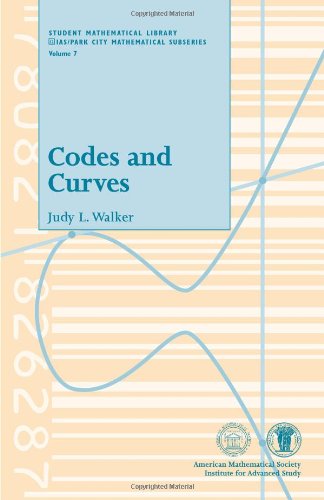
Synopsis
When information is transmitted, errors are likely to occur. This problem has become increasingly important as tremendous amounts of information are transferred electronically every day. Coding theory examines efficient ways of packaging data so that these errors can be detected, or even corrected. The traditional tools of coding theory have come from combinatorics and group theory. Since the work of Goppa in the late 1970s, however, coding theorists have added techniques from algebraic geometry to their toolboxes. In particular, by re-interpreting the Reed-Solomon codes as coming from evaluating functions associated to divisors on the projective line, one can see how to define new codes based on other divisors or on other algebraic curves. For instance, using modular curves over finite fields, Tsfasman, Vladut, and Zink showed that one can define a sequence of codes with asymptotically better parameters than any previously known codes. This monograph is based on a series of lectures the author gave as part of the IAS/PCMI program on arithmetic algebraic geometry. Here, the reader is introduced to the exciting field of algebraic geometric coding theory. Presenting the material in the same conversational tone of the lectures, the author covers linear codes, including cyclic codes, and both bounds and asymptotic bounds on the parameters of codes. Algebraic geometry is introduced, with particular attention given to projective curves, rational functions and divisors. The construction of algebraic geometric codes is given, and the Tsfasman-Vladut-Zink result mentioned above is discussed. No previous experience in coding theory or algebraic geometry is required. Some familiarity with abstract algebra, in particular finite fields, is assumed. However, this material is reviewed in two appendices. There is also an appendix containing projects that explore other codes not covered in the main text.
"synopsis" may belong to another edition of this title.
Search results for Codes and Curves (Student Mathematical Library)

Stock Image
Codes and Curves (Student Mathematical Library)
Published by
Amer Mathematical Society, 2000
ISBN 10: 082182628X
ISBN 13: 9780821826287
Used
Paperback
Seller: WorldofBooks, Goring-By-Sea, WS, United Kingdom
Seller rating 5 out of 5 stars

Paperback. Condition: Very Good. The book has been read, but is in excellent condition. Pages are intact and not marred by notes or highlighting. The spine remains undamaged. Seller Inventory # GOR007474628
Buy Used
£ 3.64
£ 5.60 shipping
Ships from United Kingdom to U.S.A.
Ships from United Kingdom to U.S.A.
Quantity: 1 available
Stock Image
Codes and Curves
Published by
American Mathematical Society, 2000
ISBN 10: 082182628X
ISBN 13: 9780821826287
Used
Softcover
Seller: Better World Books, Mishawaka, IN, U.S.A.
Seller rating 5 out of 5 stars
Condition: Good. Former library copy. Pages intact with minimal writing/highlighting. The binding may be loose and creased. Dust jackets/supplements are not included. Includes library markings. Stock photo provided. Product includes identifying sticker. Better World Books: Buy Books. Do Good. Seller Inventory # 10167916-6
Stock Image
Codes and Curves (Student Mathematical Library, Vol. 7)
Published by
Amer Mathematical Society, 2000
ISBN 10: 082182628X
ISBN 13: 9780821826287
Used
paperback
Seller: HPB-Red, Dallas, TX, U.S.A.
Seller rating 5 out of 5 stars
paperback. Condition: Good. Connecting readers with great books since 1972! Used textbooks may not include companion materials such as access codes, etc. May have some wear or writing/highlighting. We ship orders daily and Customer Service is our top priority! Seller Inventory # S_404485565
Stock Image
Codes and Curves (Student Mathematical Library, Vol. 7)
Published by
Amer Mathematical Society, 2000
ISBN 10: 082182628X
ISBN 13: 9780821826287
Used
Softcover
Seller: Phatpocket Limited, Waltham Abbey, HERTS, United Kingdom
Seller rating 5 out of 5 stars
Condition: Good. Your purchase helps support Sri Lankan Children's Charity 'The Rainbow Centre'. Ex-library, so some stamps and wear, but in good overall condition. Our donations to The Rainbow Centre have helped provide an education and a safe haven to hundreds of children who live in appalling conditions. Seller Inventory # Z1-S-019-03021
Buy Used
£ 2.44
£ 10.64 shipping
Ships from United Kingdom to U.S.A.
Ships from United Kingdom to U.S.A.
Quantity: 1 available
Seller Image
Codes and Curves (Student Mathematical Library, Vol. 7)
Published by
Amer Mathematical Society, 2000
ISBN 10: 082182628X
ISBN 13: 9780821826287
Used
Paperback
First Edition
Seller: Southampton Books, Sag Harbor, NY, U.S.A.
Seller rating 5 out of 5 stars
Paperback. Condition: Like New. First Edition. First Edition, First Printing. Published by Amer Mathematical Society, 2000. Octavo. Paperback. Book is like new. Previous owner name on Inside cover. Seller Inventory # 545740
Stock Image
Student Mathematical Library: Codes and Curves (Volume 7)
Published by
American Mathematical Society, 2000
ISBN 10: 082182628X
ISBN 13: 9780821826287
Used
Softcover
Seller: Anybook.com, Lincoln, United Kingdom
Seller rating 5 out of 5 stars
Condition: Good. Volume 7. This is an ex-library book and may have the usual library/used-book markings inside.This book has soft covers. In good all round condition. Please note the Image in this listing is a stock photo and may not match the covers of the actual item,200grams, ISBN:9780821826287. Seller Inventory # 3898015
Buy Used
£ 12.80
£ 13.60 shipping
Ships from United Kingdom to U.S.A.
Ships from United Kingdom to U.S.A.
Quantity: 1 available
Stock Image
Codes and Curves (Student Mathematical Library, Vol. 7) (Student Mathematical Library, V. 7.)
Published by
Amer Mathematical Society, 2000
ISBN 10: 082182628X
ISBN 13: 9780821826287
New
Paperback
Seller: Revaluation Books, Exeter, United Kingdom
Seller rating 5 out of 5 stars
Paperback. Condition: Brand New. 66 pages. 8.00x5.50x0.25 inches. In Stock. Seller Inventory # 082182628X
Buy New
£ 24.21
£ 10 shipping
Ships from United Kingdom to U.S.A.
Ships from United Kingdom to U.S.A.
Quantity: 1 available
Stock Image
Codes and Curves (Student Mathematical Library, Vol. 7)
Published by
Amer Mathematical Society, 2000
ISBN 10: 082182628X
ISBN 13: 9780821826287
Used
Soft cover
Seller: MostlyAcademic, Berrima, NSW, Australia
Seller rating 5 out of 5 stars
Soft cover. Condition: As New. Seller Inventory # ABE-1764467790532
Buy Used
£ 10.98
£ 26.19 shipping
Ships from Australia to U.S.A.
Ships from Australia to U.S.A.
Quantity: 1 available
Seller Image
Codes and Curves
Published by
American Mathematical Society, US, 2000
ISBN 10: 082182628X
ISBN 13: 9780821826287
New
Paperback
Seller: Rarewaves.com USA, London, LONDO, United Kingdom
Seller rating 5 out of 5 stars
Paperback. Condition: New. When information is transmitted, errors are likely to occur. This problem has become increasingly important as tremendous amounts of information are transferred electronically every day. Coding theory examines efficient ways of packaging data so that these errors can be detected, or even corrected. The traditional tools of coding theory have come from combinatorics and group theory. Since the work of Goppa in the late 1970s, however, coding theorists have added techniques from algebraic geometry to their toolboxes. In particular, by re-interpreting the Reed-Solomon codes as coming from evaluating functions associated to divisors on the projective line, one can see how to define new codes based on other divisors or on other algebraic curves. For instance, using modular curves over finite fields, Tsfasman, Vladut, and Zink showed that one can define a sequence of codes with asymptotically better parameters than any previously known codes. This monograph is based on a series of lectures the author gave as part of the IAS/PCMI program on arithmetic algebraic geometry. Here, the reader is introduced to the exciting field of algebraic geometric coding theory. Presenting the material in the same conversational tone of the lectures, the author covers linear codes, including cyclic codes, and both bounds and asymptotic bounds on the parameters of codes. Algebraic geometry is introduced, with particular attention given to projective curves, rational functions and divisors. The construction of algebraic geometric codes is given, and the Tsfasman-Vladut-Zink result mentioned above is discussed. No previous experience in coding theory or algebraic geometry is required. Some familiarity with abstract algebra, in particular finite fields, is assumed. However, this material is reviewed in two appendices. There is also an appendix containing projects that explore other codes not covered in the main text. Seller Inventory # LU-9780821826287
Buy New
£ 43.57
Free Shipping
Ships from United Kingdom to U.S.A.
Ships from United Kingdom to U.S.A.
Quantity: 1 available
Stock Image
Codes and Curves (Student Mathematical Library)
Published by
American Mathematical Society, 2000
ISBN 10: 082182628X
ISBN 13: 9780821826287
New
Softcover
Seller: Kennys Bookshop and Art Galleries Ltd., Galway, GY, Ireland
Seller rating 5 out of 5 stars
Condition: New. Introduces algebraic geometric coding theory. This book covers linear codes, including cyclic codes, and both bounds and asymptotic bounds on the parameters of codes. Algebraic geometry is introduced, with particular attention given to projective curves, rational functions and divisors. Series: Student Mathematical Library. Num Pages: 66 pages, Illustrations. BIC Classification: GPF; PBG; PBMW; PBV. Category: (P) Professional & Vocational. Dimension: 215 x 151 x 5. Weight in Grams: 108. . 2000. Paperback. . . . . Seller Inventory # V9780821826287