
Items related to The Rapture Exposed: The Message of Hope in the Book...
Synopsis
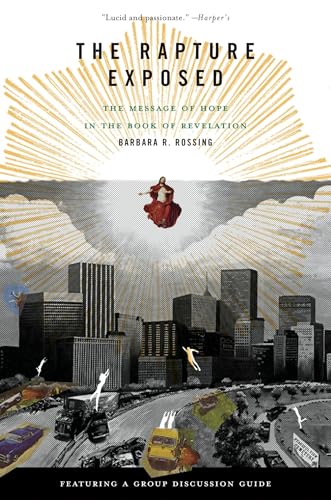
The idea of “The Rapture”—the return of Christ to rescue and deliver Christians off the earth—is an extremely popular interpretation of the Bible’s Book of Revelation and a jumping-off point for the best-selling “Left Behind” series of books. This interpretation, based on a psychology of fear and destruction, guides the daily acts of thousands if not millions of people worldwide. In The Rapture Exposed, Barbara Rossing argues that this script for the world’s future is nothing more than a disingenuous distortion of the Bible. The truth, Rossing argues, is that Revelation offers a vision of God’s healing love for the world. The Rapture Exposed reclaims Christianity from fundamentalists’ destructive reading of the biblical story and back into God’s beloved community.
"synopsis" may belong to another edition of this title.
About the Author
Barbara R. Rossing teaches New Testament at the Lutheran School of Theology at Chicago. She holds a doctorate from Harvard University Divinity School and a Masters of Divinity degree from Yale University Divinity School. An ordained minister in the Evangelical Lutheran Church in America, she lives in Chicago.
Excerpt. © Reprinted by permission. All rights reserved.
The Rapture Exposed
The Message of Hope in the Book of RevelationBy Barbara R. RossingWestview Press
Copyright © 2005 Barbara R. RossingAll right reserved.
ISBN: 9780813343143
Chapter One
The Destructive Racket of RaptureIf I knew the world were going to end tomorrow I would plant a tree. MARTIN LUTHER I need a new car. Something tells me it's going to be our only chance to survive. "BUCK" WILLIAMS (TIM LAHAYE AND JERRY JENKINS, NICOLAE, 12) We need a shelter ... I'm talking about getting an earthmover in here and digging out a place we can escape to. REV. BRUCE BARNES (LAHAYE AND JENKINS, TRIBULATION FORCE, 32)
The rapture is a racket. Whether prescribing a violentscript for Israel or survivalism in the United States, this theologydistorts God's vision for the world. In place of healing, theRapture proclaims escape. In place of Jesus' blessing of peacemakers,the Rapture voyeuristically glorifies violence and war. In place ofRevelation's vision of the Lamb's vulnerable self-giving love, theRapture celebrates the lion-like wrath of the Lamb. This theology isnot biblical. We are not Raptured off the earth, nor is God. No, Godhas come to live in the world through Jesus. God created the world,God loves the world, and God will never leave the world behind!
Rapture theology is disastrous for the Middle East and it is evenmore dangerous for planet earth. Proponents love to use the imageof a countdown, reminiscent of a missile launch or space travel. Godhas a clock that is counting down, its hands drawing ever closer tomidnight. Never mind that clocks and stopwatches were not inventeduntil long after the Bible was written, it is their favorite image.God's prophetic stopwatch is ticking down to the end of the world.
John Hagee, pastor of the 15,000-member Cornerstone Churchin San Antonio, borrows his particular doomsday clock from theBulletin of the Atomic Scientists, an effort on the part of nuclear scientiststo alert the world to the danger of nuclear annihilation. In1947, these scientists initially set the hands of the clock at sevenminutes to midnight. They periodically moved the hands closer orfurther from midnight depending on their evaluation of the globalnuclear arms risk.
"God has a similar clock, my friend, and its hands never movebackward," writes Hagee in the introduction to his book Daniel toDoomsday: The Countdown Has Begun. "Doomsday-the stroke ofmidnight-is coming." But note the crucial difference betweenHagee's prophetic doomsday clock and that of the scientists. Thenuclear scientists developed their clock to alert the world to ourperilous situation so that the hands will never reach midnight. The scientistsare trying to keep us from destroying the world.
Not Hagee. For him and other Rapture proponents the stroke ofmidnight on the doomsday clock is inevitable and even welcome.God plans to destroy the earth and there is nothing we can do tostop it. The countdown to the end is already under way. Each chapter of Hagee's book advances the clock one minute closer to midnight,culminating in the final chapter, entitled "Midnight: Doomsdayat the Great White Throne," when the world comes to an end.
The Rapture is the reason Hagee and so many others revel in theprospect of destruction for the earth; the Rapture will be their"great escape" from earth. As Hagee boasts about the Rapture,"Believers in Christ will escape doomsday! Mark it down, take it toheart, and comfort one another with these words. Doomsday iscoming for the earth, for nations, and for individuals, but thosewho have trusted in Jesus will not be present on earth to witnessthe dire time of tribulation."
Similarly, Hal Lindsey writes, "Although I grieve over the lostworld that is headed toward catastrophe, the hope of the Rapturekeeps me from despair in the midst of ever-worsening world conditions."He and other proponents of the Rapture are confident thatJesus will come to snatch or "Rapture" them up to heaven beforeunleashing a seven-year period of global tribulation and terribledestruction on the earth. Lindsey interprets Revelation's referenceto "those who dwell in heaven" in chapter 12 of Revelation as proofthat he and other Christians will not be found on earth during thewoes and tribulation but rather will be part of "another specialgroup called 'those who dwell in heaven.'" Only non-Christianswill suffer the fate of being "left behind" on earth.
In the summer of 2003 Ted Turner and Public Broadcasting Systemsponsored an eight-hour special "Avoiding Armageddon,"warning of nuclear and chemical weapons proliferation and urgingthe world's leaders to take steps to curb the danger. The next week,in reviewing the week's news through her end-times lenses, abreathless Rexella Van Impe asked her husband on their fundamentalistChristian cable television show, "Jack, Ted Turner thinksArmageddon can be avoided. Is he right?" No, Armageddon cannotbe avoided, was Jack Van Impe's enthusiastic reply to viewers. VanImpe is the author of The Great Escape: Preparing for the Rapture, theNext Event on God's Prophetic Clock and other books on the Raptureand the Middle East. Like Hagee and Lindsey, he is confident thatGod will destroy the earth and also that he and Rexella will be rapturedup to heaven before it all happens.
Rapture and Armageddon scenarios tap into Americans' love fordisaster films and survivalist plot lines. Readers of end-times novelsreadily envision themselves among the select few who will escapeplanetary disaster. Like the remnant who survive an attack on theplanet by alien creatures in the 1996 film Independence Day, or thecouple who survey the devastation of New York City after the tidalwave caused by the impact from a comet in the movie Deep Impact,or survivors in the 1998 thriller Armageddon, readers of these scriptsplace themselves in the role of the elite individual heroes who willsurvive Armageddon or other disasters while the rest of the planetperishes. Even once-jailed televangelist Jim Bakker has now disavowedhis previous pre-Tribulation Rapture theology as escapist,calling it a racket that preached a false gospel of prosperity-combinedwith the promise of escape from any consequences.
Christ will return, on that the Rapture proponents and I agree. Ipray for it each time I pray "Thy kingdom come" in the Lord'sPrayer-a prayer that is never once prayed in the twelve Left Behindnovels. Jesus taught an urgency about his kingdom in this prayerthat is still very much alive for Christians today.
But we completely disagree on what that urgency means for theworld and for our life today. We differ, first of all, on our views ofGod-whether our God is a God whose will is to destroy theworld. Second, we differ on whether Christians are to embrace anescapist ethics, as Rapture proponents argue, or are to urgentlylove and care for the world in anticipation of Christ's return, as Iadvocate. These differences in ethics will be crucial for our future.
GOD STILL LOVES THE WORLD-GOD DOES NOT DESTROY THE EARTH
Jesus is coming back at a moment we cannot know. But that doesnot mean that God is getting ready to destroy the earth and takeChristians away to another planet. A Presbyterian pastor taught mea Rapture song he learned as a child: "Somewhere in outer spaceGod has prepared a place for all those who trust him and obey ...The countdown's getting closer every day." This song reflects a keypoint on which the Rapture teaching is false and dangerous. Thereis no place in outer space to which God will take us to escape theearth. This is not the biblical message. We cannot trash this planetand assume there is another.
Space imagery is frequent in Hal Lindsey's Late Great PlanetEarth. Published in 1970, just one year after astronaut Neil Armstrongwalked on the moon, Lindsey's book appealed to people'sdesire for the adventure of space travel in describing the Rapture asthe "ultimate" space trip.
Astounding as man's trip to the moon is, there is another trip which many men, women, and children will take someday which will leave the rest of the world gasping ... Without benefit of science, space suits, or interplanetary rockets, there will be those who will be transported into a glorious place more beautiful, more awesome, than we can possibly comprehend ... It will be the living end. The ultimate trip. (Hal Lindsey, The Late Great Planet Earth [Grand Rapids, Mich.: Zondervan, 1970], 135-137)
Left Behind author Tim LaHaye also engages in planetary speculationregarding earth's destruction and the creation of the "newearth" of Revelation 21. He explains how God's future timetable"does away with this planet as we know it" in two events ofdestruction. Earth's first destruction will be by fire while the seconddestruction will be more severe, and will include even theatmosphere. Here LaHaye fabricates a distinction between threedifferent heavens in the Bible-the atmospheric heaven around theearth, which he says is the "abode of Satan"; a second, stellar heaventhat contains the stars; and the third heaven, the heaven of thethrone of God in the visions of Revelation 4 and 5, which will notbe destroyed. The atmospheric heaven is what God plans todestroy in Revelation 21:1, according to LaHaye. "God will destroythis earth that is so marred and cursed by Satan's evil. He willinclude the atmospheric heaven to guarantee that all semblance ofevil has been cleared away."
Only after those two destructions will God create a new heavenand a new earth, says LaHaye. He fantasizes that the new earthmay not be "limited to the twenty-five thousand miles in circumferenceand eight thousand miles in diameter of the present earth.It may be much larger; the Bible does not say." In addition to a larger-sizeearth, LaHaye speculates about how the new planet won'twaste any space with oceans or mountains or deserts, since suchlandscapes are uninhabitable for humans and are therefore "worthless."
This kind of speculation would be amusing if it were not so dangerous.God created the earth's mountains and deserts and calledthem "good"-they are not worthless to their Creator. Earth'satmosphere, too, was created by God, and God laments over itwhen we destroy it. The atmosphere is under assault today fromozone depletion, increasing concentrations of carbon dioxide thatcause global warming, and other wounds-but these are woundscaused by humans. The atmosphere is not the abode of Satan. Theview that total planetary and atmospheric destruction must takeplace on earth before God's renewing vision of "New Jerusalem"can come into the world is not biblical. It leads to appalling ethics.
To be sure, Revelation proclaims a "new heaven and a newearth," but that does not mean that God gives us a replacement forthis current earth when we damage it beyond recovery. A newearth is not something we go out and get as born-again hero BuckWilliams gets a new car in the Left Behind novels. Rather the earthbecomes "new" in the sense of resurrection or renewal-just asour bodies will be resurrected, brought to new life, but they are stillour bodies. The whole creation is longing for redemption, theapostle Paul writes-this is the sense in which there will be a newcreation. It, too, will be redeemed, made new. The Greek wordused for the "new" earth in Revelation 21:1 can mean either"renewed" or "new"-but it certainly does not mean a "different"earth. There is no justification for using up the earth on thegrounds that we get to trade this one in for a new and bigger onein seven years.
Reagan-era Secretary of the Interior James Watt told U. S. senatorsthat we are living at the brink of the end-times and impliedthat this justifies clearcutting the nation's forests and other unsustainableenvironmental policies. When he was asked about preservingthe environment for future generations, Watt told his Senateconfirmation hearing, "I do not know how many futuregenerations we can count on before the Lord returns." Watt's "useit or lose it" view of the world's resources is a perspective shared bymany Rapture proponents, whose chief preoccupation is countingdown to earth's violent end.
Even more extreme is a recent remark by right-wing punditAnne Coulter: "God gave us the earth. We have dominion over theplants, the animals, the trees. God said, 'Earth is yours. Take it.Rape it. It's yours.'"
Raping the earth and justifying such behavior on the groundsthat this earth is ours and it will be finished in seven years is likesaying we might as well use drugs and abuse our bodies because weknow we will soon be resurrected with new bodies. Our bodies areGod's temple, the apostle Paul tells us in his letter to the Romans.They are not to be abused but rather reverenced. God dwells inthese earthen vessels. Similarly with the body of the earth: It, too,is a body God created and still calls good. It is a temple in whichGod dwells. We do not leave this earth behind. God does not leaveit behind and neither can we.
The British author C. S. Lewis's Chronicles Of Narnia, a popularseries of Christian novels from the mid-twentieth century, depictssalvation in a much more earth-affirming way than the Left Behindstory. When Lucy and her companions finally come into the "NewNarnia" at the end of their journey in Lewis's The Last Battle, it isnot an escape from their homeland but rather a going through adoor more deeply into God's picture, into the world. The travelersslowly come to realize that the place is the very same place as theworld they left behind: the same hills as those in their hometown,the same house, but everything is more radiant. The color blue isbluer. It is "more like the real thing." New Narnia is different fromold Narnia in being a "deeper country: every rock and flower andblade of grass looked as if it meant more."
New Narnia is "world within world," Lucy realizes. The FaunTumnus explains the within-ness of God's vision for our world: "Youare now looking at the England within England, the real England."Most importantly, in Lewis's vision-contrary to the destructiveRapture script-"no good thing is destroyed." This is the wondrousland Lucy and her companions have been looking for all of theirlives. A donkey named Puzzle, a Mouse, an Owl, the Good Badger,and "all the dear creatures" go with them into the new landscape.
The Narnia story's ending gives a much truer reading of the finalvision of the book of Revelation than the Left Behind story.
Continues...
Excerpted from The Rapture Exposedby Barbara R. Rossing Copyright © 2005 by Barbara R. Rossing. Excerpted by permission.
All rights reserved. No part of this excerpt may be reproduced or reprinted without permission in writing from the publisher.
Excerpts are provided by Dial-A-Book Inc. solely for the personal use of visitors to this web site.
"About this title" may belong to another edition of this title.
Search results for The Rapture Exposed: The Message of Hope in the Book...

Seller Image
The Rapture Exposed: The Message of Hope in the Book of Revelation
Seller: Dream Books Co., Denver, CO, U.S.A.
Seller rating 5 out of 5 stars

Condition: very_good. Pages are clean with no markings. May show minor signs of wear or cosmetic defects marks, cuts, bends, or scuffs on the cover, spine, pages, or dust jacket. May have remainder marks on edges. Seller Inventory # DBV.0813343143.VG
Seller Image
The Rapture Exposed: The Message of Hope in the Book of Revelation
Seller: MERS Goodwill-Kansas City, Blue Springs, MO, U.S.A.
Seller rating 5 out of 5 stars
Condition: good. The book has been read but is in good condition. It has very minimal damage to the cover, including scuff marks, but no holes or tears. The dust jacket for hard covers may not be included. The binding has minimal wear. The majority of pages are undamaged with minimal creasing or tearing, minimal pencil underlining of text, no highlighting of text, and no writing in the margins. There are no missing pages. See the seller's listing for full details and a description of any imperfections. Seller Inventory # WMEKV.0813343143.G
Stock Image
The Rapture Exposed: The Message of Hope in the Book of Revelation
Seller: ThriftBooks-Phoenix, Phoenix, AZ, U.S.A.
Seller rating 5 out of 5 stars
Paperback. Condition: Good. No Jacket. Pages can have notes/highlighting. Spine may show signs of wear. ~ ThriftBooks: Read More, Spend Less. Seller Inventory # G0813343143I3N00
Stock Image
The Rapture Exposed: The Message of Hope in the Book of Revelation
Seller: ThriftBooks-Reno, Reno, NV, U.S.A.
Seller rating 5 out of 5 stars
Paperback. Condition: Fair. No Jacket. Readable copy. Pages may have considerable notes/highlighting. ~ ThriftBooks: Read More, Spend Less. Seller Inventory # G0813343143I5N00
Stock Image
The Rapture Exposed: The Message of Hope in the Book of Revelation
Seller: ThriftBooks-Reno, Reno, NV, U.S.A.
Seller rating 5 out of 5 stars
Paperback. Condition: Good. No Jacket. Pages can have notes/highlighting. Spine may show signs of wear. ~ ThriftBooks: Read More, Spend Less. Seller Inventory # G0813343143I3N00
Stock Image
The Rapture Exposed: The Message of Hope in the Book of Revelation
Seller: ThriftBooks-Phoenix, Phoenix, AZ, U.S.A.
Seller rating 5 out of 5 stars
Paperback. Condition: Fair. No Jacket. Readable copy. Pages may have considerable notes/highlighting. ~ ThriftBooks: Read More, Spend Less. Seller Inventory # G0813343143I5N00
Stock Image
The Rapture Exposed: The Message of Hope in the Book of Revelation
Seller: ThriftBooks-Reno, Reno, NV, U.S.A.
Seller rating 5 out of 5 stars
Paperback. Condition: Very Good. No Jacket. May have limited writing in cover pages. Pages are unmarked. ~ ThriftBooks: Read More, Spend Less. Seller Inventory # G0813343143I4N00
Stock Image
The Rapture Exposed: The Message of Hope in the Book of Revelation
Seller: ThriftBooks-Atlanta, AUSTELL, GA, U.S.A.
Seller rating 5 out of 5 stars
Paperback. Condition: Very Good. No Jacket. May have limited writing in cover pages. Pages are unmarked. ~ ThriftBooks: Read More, Spend Less. Seller Inventory # G0813343143I4N00
Stock Image
The Rapture Exposed: The Message of Hope in the Book of Revelation
Seller: ThriftBooks-Dallas, Dallas, TX, U.S.A.
Seller rating 5 out of 5 stars
Paperback. Condition: Good. No Jacket. Pages can have notes/highlighting. Spine may show signs of wear. ~ ThriftBooks: Read More, Spend Less. Seller Inventory # G0813343143I3N00
Stock Image
The Rapture Exposed: The Message of Hope in the Book of Revelation
Seller: ThriftBooks-Dallas, Dallas, TX, U.S.A.
Seller rating 5 out of 5 stars
Paperback. Condition: Fair. No Jacket. Readable copy. Pages may have considerable notes/highlighting. ~ ThriftBooks: Read More, Spend Less. Seller Inventory # G0813343143I5N00