
Items related to Vagabonding: An Uncommon Guide to the Art of Long-Term...
Synopsis
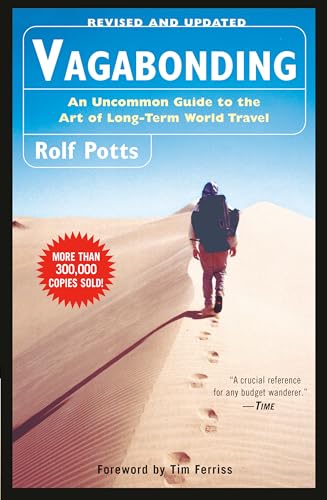
Vagabonding is about taking time off from your normal life—from six weeks to four months to two years—to discover and experience the world on your own terms. Veteran shoestring traveler Rolf Potts shows how anyone armed with an independent spirit can achieve the dream of extended overseas travel. Potts gives the necessary information on:
• financing your travel time
• determining your destination
• adjusting to life on the road
• working and volunteering overseas
• handling travel adversity
• re-assimilating back into ordinary life
Not just a plan of action, vagabonding is an outlook on life that emphasizes creativity, discovery, and the growth of the spirit.
"synopsis" may belong to another edition of this title.
About the Author
Rolf Potts funded his earliest vagabonding experiences by working as a landscaper and an ESL teacher. He now writes about independent travel for National Geographic Adventure, and his travel essays have appeared in Salon, Condé Nast Traveler, National Geographic Traveler, and Best American Travel Writing 2000, and on National Public Radio.
From the Back Cover
“Potts wants us to wander, to explore, to embrace the unknown, and, finally, to take our own damn
time about it. I think this is the most sensible book of travel-related advice ever written.”
—Tim Cahill, author of Hold the Enlightenment
“Rolf Potts has produced an engaging book that does what few, if any, other travel guides do: make readers aware of how many possibilities vagabonding offers them to enhance their lives, and how accessible the experience of long-term travel really is.”
—Jeffrey Tayler, author of Glory in the Camel’s Eye, Facing the Congo, and Siberian Dawn
“Vagabonding brings to inspiring life both the hows and the whys of life on the road.”
—Don George, global travel editor, Lonely Planet Publications
“Digging into Rolf Potts, one encounters real issues about travel, issues that most other travel writers overlook, while still having a good time.”
—Joe Cummings, author of Lonely Planet Thailand, Lonely Planet Bangkok,
Moon Handbooks: Mexico, and Moon Handbooks: Texas
Excerpt. © Reprinted by permission. All rights reserved.
Chapter 1
From this hour I ordain myself loos'd of limits and imaginary lines, Going where I list, my own master total and absolute, Listening to others, considering well what they say, Pausing, searching, receiving, contemplating, Gently, but with undeniable will divesting myself of the holds that would hold me.
-Walt Whitman, "Song of the Open Road"
Declare Your Independence
Of all the outrageous throwaway lines one hears in movies, there is one that stands out for me. It doesn't come from a madcap comedy, an esoteric science-fiction flick, or a special-effects-laden action thriller. It comes from Oliver Stone's Wall Street, when the Charlie Sheen character - a promising big shot in the stock market - is telling his girlfriend about his dreams.
"I think if I can make a bundle of cash before I'm thirty and get out of this racket," he says, "I'll be able to ride my motorcycle across China."
When I first saw this scene on video a few years ago, I nearly fell out of my seat in astonishment. After all, Charlie Sheen or anyone else could work for eight months as a toilet cleaner and have enough money to ride a motorcycle across China. Even if they didn't yet have their own motorcycle, another couple months of scrubbing toilets would earn them enough to buy one when they got to China.
The thing is, most Americans probably wouldn't find this movie scene odd. For some reason, we see long-term travel to faraway lands as a recurring dream or an exotic temptation, but not something that applies to the here and now. Instead?out of our insane duty to fear, fashion, and monthly payments on things we don't really need - we quarantine our travels to short, frenzied bursts. In this way, as we throw our wealth at an abstract notion called "lifestyle," travel becomes just another accessory -a smooth-edged, encapsulated experience that we purchase the same way we buy clothing and furniture.
Not long ago, I read that nearly a quarter of a million short-term monastery- and convent-based vacations had been booked and sold by tour agents in the year 2000. Spiritual enclaves from Greece to Tibet were turning into hot tourist draws, and travel pundits attributed this "solace boom" to the fact that "busy overachievers are seeking a simpler life."
What nobody bothered to point out, of course, is that purchasing a package vacation to find a simpler life is kind of like using a mirror to see what you look like when you aren't looking into the mirror. All that is really sold is the romantic notion of a simpler life, and - just as no amount of turning your head or flicking your eyes will allow you to unselfconsciously see yourself in the looking glass - no combination of one-week or ten-day vacations will truly take you away from the life you lead at home.
Ultimately, this shotgun wedding of time and money has a way of keeping us in a holding pattern. The more we associate experience with cash value, the more we think that money is what we need to live. And the more we associate money with life, the more we convince ourselves that we're too poor to buy our freedom. With this kind of mind-set, it's no wonder so many Americans think extended overseas travel is the exclusive realm of students, counterculture dropouts, and the idle rich.
In reality, long-term travel has nothing to do with demographics - age, ideology, income - and everything to do with personal outlook. Long-term travel isn't about being a college student; it's about being a student of daily life. Long-term travel isn't an act of rebellion against society; it's an act of common sense within society. Long-term travel doesn't require a massive "bundle of cash"; it requires only that we walk through the world in a more deliberate way.
This deliberate way of walking through the world has always been intrinsic to the time-honored, quietly available travel tradition known as "vagabonding."
Vagabonding involves taking an extended time-out from your normal life?six weeks, four months, two years?to travel the world on your own terms.
But beyond travel, vagabonding is an outlook on life. Vagabonding is about using the prosperity and possibility of the information age to increase your personal options instead of your personal possessions. Vagabonding is about looking for adventure in normal life, and normal life within adventure. Vagabonding is an attitude?a friendly interest in people, places, and things that makes a person an explorer in the truest, most vivid sense of the word.
Vagabonding is not a lifestyle, nor is it a trend. It's just an uncommon way of looking at life - a value adjustment from which action naturally follows. And, as much as anything, vagabonding is about time - our only real commodity - and how we choose to use it.
Sierra Club founder John Muir (an ur-vagabonder if there ever was one) used to express amazement at the well-heeled travelers who would visit Yosemite only to rush away after a few hours of sightseeing. Muir called these folks the "time-poor" - people who were so obsessed with tending their material wealth and social standing that they couldn't spare the time to truly experience the splendor of California's Sierra wilderness. One of Muir's Yosemite visitors in the summer of 1871 was Ralph Waldo Emerson, who gushed upon seeing the sequoias, "It's a wonder that we can see these trees and not wonder more." When Emerson scurried off a couple hours later, however, Muir speculated wryly about whether the famous transcendentalist had really seen the trees in the first place.
Nearly a century later, naturalist Edwin Way Teale used Muir's example to lament the frenetic pace of modern society. "Freedom as John Muir knew it," he wrote in his 1956 book Autumn Across America, "with its wealth of time, its unregimented days, its latitude of choice . . . such freedom seems more rare, more difficult to attain, more remote with each new generation."
But Teale's lament for the deterioration of personal freedom was just as hollow a generalization in 1956 as it is now. As John Muir was well aware, vagabonding has never been regulated by the fickle public definition of lifestyle. Rather, it has always been a private choice within a society that is constantly urging us to do otherwise.
This is a book about living that choice.
"About this title" may belong to another edition of this title.
Search results for Vagabonding: An Uncommon Guide to the Art of Long-Term...

Seller Image
Vagabonding: An Uncommon Guide to the Art of Long-Term World Travel
Seller: Dream Books Co., Denver, CO, U.S.A.
Seller rating 5 out of 5 stars

Condition: acceptable. This copy has clearly been enjoyedâ"expect noticeable shelf wear and some minor creases to the cover. Binding is strong, and all pages are legible. May contain previous library markings or stamps. Seller Inventory # DBV.0812992180.A
Stock Image
Vagabonding: An Uncommon Guide to the Art of Long-Term World Travel
Seller: World of Books (was SecondSale), Montgomery, IL, U.S.A.
Seller rating 5 out of 5 stars
Paperback. Condition: Fair. INTERNATIONAL BESTSELLER . With a new foreword by Tim Ferriss . "Vagabonding easily remains in my top-10 list of life-changing books. Why? Because one incredible trip, especially a long-term trip, can change your life forever. And Vagabonding teaches you how to travel (and think), not just for one trip, but for the rest of your life."-Tim Ferriss, from the foreword There's nothing like vagabonding: taking time off from your normal life-from six weeks to four months to two years-to discover and experience the world on your own terms. In this one-of-a-kind handbook, veteran travel writer Rolf Potts explains how anyone armed with an independent spirit can achieve the dream of extended overseas travel. Now completely revised and updated, Vagabonding is an accessible and inspiring guide to . financing your travel time . determining your destination . adjusting to life on the road . working and volunteering overseas . handling travel adversity . re-assimilating back into ordinary life Updated for our ever-changing world, Vagabonding is an indispensable guide for the modern traveler. Seller Inventory # 00103368010
Stock Image
Vagabonding: An Uncommon Guide to the Art of Long-Term World Travel
Seller: World of Books (was SecondSale), Montgomery, IL, U.S.A.
Seller rating 5 out of 5 stars
Paperback. Condition: Good. INTERNATIONAL BESTSELLER . With a new foreword by Tim Ferriss . "Vagabonding easily remains in my top-10 list of life-changing books. Why? Because one incredible trip, especially a long-term trip, can change your life forever. And Vagabonding teaches you how to travel (and think), not just for one trip, but for the rest of your life."-Tim Ferriss, from the foreword There's nothing like vagabonding: taking time off from your normal life-from six weeks to four months to two years-to discover and experience the world on your own terms. In this one-of-a-kind handbook, veteran travel writer Rolf Potts explains how anyone armed with an independent spirit can achieve the dream of extended overseas travel. Now completely revised and updated, Vagabonding is an accessible and inspiring guide to . financing your travel time . determining your destination . adjusting to life on the road . working and volunteering overseas . handling travel adversity . re-assimilating back into ordinary life Updated for our ever-changing world, Vagabonding is an indispensable guide for the modern traveler. Seller Inventory # 00104271939
Seller Image
Vagabonding: An Uncommon Guide to the Art of Long-Term World Travel
Seller: Dream Books Co., Denver, CO, U.S.A.
Seller rating 5 out of 5 stars
Condition: good. Gently used with minimal wear on the corners and cover. A few pages may contain light highlighting or writing, but the text remains fully legible. Dust jacket may be missing, and supplemental materials like CDs or codes may not be included. May be ex-library with library markings. Ships promptly! Seller Inventory # DBV.0812992180.G
Seller Image
Vagabonding: An Uncommon Guide to the Art of Long-Term World Travel
Seller: Zoom Books East, Glendale Heights, IL, U.S.A.
Seller rating 5 out of 5 stars
Condition: good. Book is in good condition and may include underlining highlighting and minimal wear. The book can also include "From the library of" labels. May not contain miscellaneous items toys, dvds, etc. . We offer 100% money back guarantee and 24 7 customer service. Seller Inventory # ZEV.0812992180.G
Stock Image
Vagabonding: An Uncommon Guide to the Art of Long-Term World Travel
Published by
Villard Books (edition First Edition), 2002
ISBN 10: 0812992180
ISBN 13: 9780812992182
Used
Paperback
First Edition
Seller: BooksRun, Philadelphia, PA, U.S.A.
Seller rating 5 out of 5 stars
Paperback. Condition: Fair. First Edition. The item might be beaten up but readable. May contain markings or highlighting, as well as stains, bent corners, or any other major defect, but the text is not obscured in any way. Seller Inventory # 0812992180-7-1
Stock Image
Vagabonding: An Uncommon Guide to the Art of Long-Term World Travel
Published by
Villard Books (edition First Edition), 2002
ISBN 10: 0812992180
ISBN 13: 9780812992182
Used
Paperback
First Edition
Seller: BooksRun, Philadelphia, PA, U.S.A.
Seller rating 5 out of 5 stars
Paperback. Condition: Very Good. First Edition. It's a well-cared-for item that has seen limited use. The item may show minor signs of wear. All the text is legible, with all pages included. It may have slight markings and/or highlighting. Seller Inventory # 0812992180-11-1
Seller Image
Vagabonding: An Uncommon Guide to the Art of Long-Term World Travel
Seller: The Happy Book Stack, Murfreesboro, TN, U.S.A.
Seller rating 5 out of 5 stars
Condition: good. Book may have little to no writing and or underlining inside, and is in overall good condition. Cover may have some cosmetic wear. Book has dust jacket if applicable. Seller Inventory # 5ALWH0000A71_ns
Seller Image
Vagabonding: An Uncommon Guide to the Art of Long-Term World Travel
Seller: Greenworld Books, Arlington, TX, U.S.A.
Seller rating 5 out of 5 stars
Condition: good. Fast Free Shipping â" Good condition. It may show normal signs of use, such as light writing, highlighting, or library markings, but all pages are intact and the book is fully readable. A solid, complete copy that's ready to enjoy. Seller Inventory # GWV.0812992180.G
Seller Image
Vagabonding: An Uncommon Guide to the Art of Long-Term World Travel
Seller: Zoom Books Company, Lynden, WA, U.S.A.
Seller rating 5 out of 5 stars
Condition: very_good. Book is in very good condition and may include minimal underlining highlighting. The book can also include "From the library of" labels. May not contain miscellaneous items toys, dvds, etc. . We offer 100% money back guarantee and 24 7 customer service. Seller Inventory # ZBV.0812992180.VG