
Items related to The Essential Writings of Machiavelli (Modern Library...
Synopsis
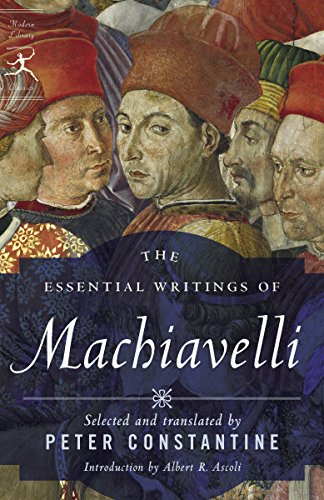
FINALIST--2008 PEN TRANSLATION PRIZE In ''The Essential Writings of Machiavelli'', Peter Constantine has assembled a comprehensive collection that shows the true depth and breadth of a great Renaissance thinker. Refreshingly accessible, these superb new translations are faithful to Machiavelli s original, beautifully crafted writings. The volume features essays that appear in English for the first time, such as ''A Caution to the Medici'' and ''The Persecution of Africa.'' Also included are complete versions of the political treatise, ''The Prince'', the comic satire ''The Mandrake'', ''The Life of Castruccio Castracani'', and the classic story ''Belfagor'', along with selections from ''The Discourses'', ''The Art of War'', and ''Florentine Histories''. Augmented with useful features vital and concise annotations and cross-references this unique compendium is certain to become the standard one-volume reference to this influential, versatile, and ever timely writer. -- Since 1917 The Modern Library prides itself as ''The modern Library of the world s Best Book''. Its paperback series feature treasured classics, major translations of great works, and rediscoveries of keen literary and historical merit.Featuring introductions by leading writers, stunning translations, scholarly endnotes and reading group guides. Production values emphasize superior quality and readability. Competitive prices, coupled with exciting cover design make these an ideal gift to be cherished by the avid reader.
"synopsis" may belong to another edition of this title.
About the Author
Niccolò Machiavelli (1469-1527) was born in Florence. He served the Florentine republic as secretary and second chancellor, but was expelled from public life when the Medici family returned to power in 1512. His most famous work, The Prince, was a written attempt to reingratiate himself with the Medicis and return to politics.
Excerpt. © Reprinted by permission. All rights reserved.
Chapter One
Of the kinds of principalities that exist, and how they can be acquired
All states, all dominions that rule or have ruled over men, are or have been either republics or principalities. Principalities are either hereditary, with a long-established bloodline, or new. And the new principalities are either entirely new, as Milan was to Francesco Sforza,2 or are like limbs added to the hereditary state of the prince who acquires them, as the Kingdom of Naples was to the King of Spain.3 States obtained in this way are accustomed either to living under a prince, or to being free. They are acquired either with the arms of others, or with one's own, either by chance or by skill.
2. Francesco Sforza (1401'66) was a soldier of fortune who became Duke of Milan in 1450.
3. Ferdinand the Catholic (1452'1516), King of Aragon, also became Ferdinand III of Naples in 1504.
chapter two
Of hereditary principalities
I will not discuss republics, as I have already done so at some length elsewhere. I shall only concentrate on principalities, and shall weave together the threads I have already laid out. I will show how these principalities can be governed and maintained.
First, states that are hereditary and tied to the bloodline of their prince are easier to maintain than new ones. It is enough not to diverge from the practices of one's forebears, and to handle unforeseen issues as they arise. If such a prince is of at least average ability he can retain his position of power, so long as no extraordinary or excessive force deprive him of it. If this prince is deprived of his state, he will find he can reacquire it if any misfortune befalls the usurper.
In Italy we have the example of the Duke of Ferrara, who resisted the assaults of the Venetians in 1484 and of Pope Julius II in 1510, for the simple reason that he had inherited an ancient principality.4 A hereditary prince has less cause to mistreat his subjects, and so is more loved by them. If unusual vices do not make him hated, it is to be expected that he will be loved by his people.
The long continuum of the dominion obliterates the memories and issues that make men yearn for innovation, for one change will inevitably forge a link to another.
4. In fact, Duke Ercole d'Este of Ferrara managed to end the war with Venetians in 1484, while his son Duke Alfonso managed to stay in power despite excommunication and an ongoing war with the papal forces.
chapter three
Of mixed principalities
It is in the new principality that the difficulties lie. First, if the principality is not completely new, but is like a limb or extension added to another principality (in which case we could almost call the whole state a mixed principality), its volatility stems mainly from a difficulty inherent in all new principalities. This is that men will willingly change their ruler in the hope that they will fare better, a hope that leads them to take up arms against their old ruler. But in this they are deceived, because, as they invariably discover, their lot under a new ruler is inevitably worse. This is the result of another natural and basic inevitability: that you cannot avoid offending those whose new ruler you are, both with your armed soldiers and with innumerable other provocations that come in the wake of a conquest. You end up making enemies of all those you have offended during your conquest of the principality, and you find that you cannot keep the friendship of those who helped you to power, since you cannot satisfy them in the way they had envisioned. Furthermore, you cannot take strong measures against them, as you are indebted to them. Even with the most powerful army, if you want to invade a state, you need the support of the people. It was for these reasons that King Louis XII of France was quick to occupy Milan, and just as quick to lose it. Duke Ludovico's own forces were enough to win Milan back the first time, because the same masses that had opened the gates for Louis, finding themselves misled in their hopes for a better future, could not endure the new prince's offenses.5
It is a fact that once a prince acquires a rebellious state for the second time, it also proves harder to lose that state a second time.6 This is because the prince who seizes the opportunity of the rebellion has fewer scruples about securing his position by punishing offenders, flushing out suspects, and strengthening all the places where he is weakest. In this sense, it was enough for a Duke Ludovico to make a little noise along the borders for Louis XII to lose Milan the first time. But for him to lose Milan a second time the whole world had to unite against him, defeat his army, and chase it out of Italy.7 This followed from the causes I have already laid out. Nonetheless, both the first and second time, Milan was taken from him.
The general reasons for the first loss have been discussed. It now remains to discuss the second, and to see what recourse someone in Louis's position could have taken to maintain himself more securely in his new acquisition. I must stress that the states a prince acquires and adds to his own are either of the same country and language, or are not. If they are it is much easier to retain them, particularly if they are not used to freedom. To hold them securely, it is enough to extinguish the line of the previous prince who ruled them. As for the rest, if the new acquisition's former state of affairs is kept and there is no difference in customs, men will live quite peacefully, as we have seen in Burgundy, Brittany, Gascony, and Normandy, which for a long time now have all belonged to France. Although there is some difference in language, their customs are similar, and their people get along with one another quite easily. He who acquires such states and wishes to retain them has to make sure of two things: that the bloodline of their former princes is extinguished, and that their laws and taxes remain the same. This way, the prince's new state merges with the old, quickly becoming a single body.
"About this title" may belong to another edition of this title.
Search results for The Essential Writings of Machiavelli (Modern Library...

Stock Image
The Essential Writings of Machiavelli
Seller: ThriftBooks-Atlanta, AUSTELL, GA, U.S.A.
Seller rating 5 out of 5 stars

Paperback. Condition: Good. No Jacket. Pages can have notes/highlighting. Spine may show signs of wear. ~ ThriftBooks: Read More, Spend Less. Seller Inventory # G0812974239I3N00
Stock Image
The Essential Writings of Machiavelli
Seller: ThriftBooks-Atlanta, AUSTELL, GA, U.S.A.
Seller rating 5 out of 5 stars
Paperback. Condition: Fair. No Jacket. Readable copy. Pages may have considerable notes/highlighting. ~ ThriftBooks: Read More, Spend Less. Seller Inventory # G0812974239I5N00
Stock Image
The Essential Writings of Machiavelli (Modern Library Classics)
Seller: HPB-Ruby, Dallas, TX, U.S.A.
Seller rating 5 out of 5 stars
Paperback. Condition: Very Good. Connecting readers with great books since 1972! Used books may not include companion materials, and may have some shelf wear or limited writing. We ship orders daily and Customer Service is our top priority! Seller Inventory # S_481131482
Stock Image
The Essential Writings of Machiavelli
Seller: World of Books (was SecondSale), Montgomery, IL, U.S.A.
Seller rating 5 out of 5 stars
Paperback. Condition: Good. FINALIST--2008 PEN TRANSLATION PRIZEPlt;brPgt;In Plt;iPgt;The Essential Writings of Machiavelli,Plt;/iPgt; Peter Constantine has assembled a comprehensive collection that shows the true depth and breadth of a great Renaissance thinker. Refreshingly accessible, these superb new translations are faithful to MachiavelliP#8217;s original, beautifully crafted writings.Plt;brPgt;Plt;brPgt;The volume features essays that appear in English for the first time, such as P#8220;A Caution to the MediciP#8221; and P#8220;The Persecution of Africa.P#8221; Also included are complete versions of the political treatise, Plt;iPgt;The PrincePlt;/iPgt;, the comic satire Plt;iPgt;The MandrakePlt;/iPgt;, Plt;iPgt;The Life of Castruccio CastracaniPlt;/iPgt;, and the classic story P#8220;BelfagorP#8221;, along with selections from Plt;iPgt;The Discourses, The Art of War,Plt;/iPgt; and Plt;iPgt;Florentine HistoriesPlt;/iPgt; Augmented with useful featuresP#8211;vital and concise annotations and cross-referencesP#8211;this unique compendium is certain to become the standard one-volume reference to this influential, versatile, and ever timely writer.Plt;brPgt;Plt;brPgt;P#8220;MachiavelliP#39;s stress on political necessityP#160;rather thanP#160;moral perfection helped inspire the Renaissance by renewing links with Thucydides and other classical thinkers. This new collection providesP#160;deeper insight into MachiavelliP#8217;s personality as a writer, thus broadening our understanding of him.P#8221;Plt;brPgt;P#8211;Robert D. Kaplan, author of WPlt;iPgt;arrior Politics: Why Leadership Demands a Pagan EthosP#160;Plt;/iPgt;Plt;brPgt;Plt;brPgt;P#8220;ConstantineP#8217;s selection is not only intelligent; his translations are astonishingly good. Thoughtfully introduced by Albert Russell Ascoli, this edition belongs in everyoneP#8217;s library.P#8221;Plt;brPgt;P#8211;John Jeffries Martin, professor and chair, department of history, Trinity UniversityPlt;brPgt;Plt;brPgt;P#8220;If one were to assign a single edition of MachiavelliP#39;s works, this most certainly would be it.P#8221;Plt;brPgt;P#8211;John P. McCormick, professor, department of political science, University of Chicago. Seller Inventory # 00110051757
Stock Image
The Essential Writings of Machiavelli (Modern Library Classics)
Seller: HPB-Diamond, Dallas, TX, U.S.A.
Seller rating 5 out of 5 stars
Paperback. Condition: Very Good. Connecting readers with great books since 1972! Used books may not include companion materials, and may have some shelf wear or limited writing. We ship orders daily and Customer Service is our top priority! Seller Inventory # S_483568463
Stock Image
The Essential Writings of Machiavelli
Seller: World of Books Inc, Montgomery, IL, U.S.A.
Seller rating 4 out of 5 stars

Paperback. Condition: Good. FINALIST--2008 PEN TRANSLATION PRIZEPlt;brPgt;In Plt;iPgt;The Essential Writings of Machiavelli,Plt;/iPgt; Peter Constantine has assembled a comprehensive collection that shows the true depth and breadth of a great Renaissance thinker. Refreshingly accessible, these superb new translations are faithful to MachiavelliP#8217;s original, beautifully crafted writings.Plt;brPgt;Plt;brPgt;The volume features essays that appear in English for the first time, such as P#8220;A Caution to the MediciP#8221; and P#8220;The Persecution of Africa.P#8221; Also included are complete versions of the political treatise, Plt;iPgt;The PrincePlt;/iPgt;, the comic satire Plt;iPgt;The MandrakePlt;/iPgt;, Plt;iPgt;The Life of Castruccio CastracaniPlt;/iPgt;, and the classic story P#8220;BelfagorP#8221;, along with selections from Plt;iPgt;The Discourses, The Art of War,Plt;/iPgt; and Plt;iPgt;Florentine HistoriesPlt;/iPgt; Augmented with useful featuresP#8211;vital and concise annotations and cross-referencesP#8211;this unique compendium is certain to become the standard one-volume reference to this influential, versatile, and ever timely writer.Plt;brPgt;Plt;brPgt;P#8220;MachiavelliP#39;s stress on political necessityP#160;rather thanP#160;moral perfection helped inspire the Renaissance by renewing links with Thucydides and other classical thinkers. This new collection providesP#160;deeper insight into MachiavelliP#8217;s personality as a writer, thus broadening our understanding of him.P#8221;Plt;brPgt;P#8211;Robert D. Kaplan, author of WPlt;iPgt;arrior Politics: Why Leadership Demands a Pagan EthosP#160;Plt;/iPgt;Plt;brPgt;Plt;brPgt;P#8220;ConstantineP#8217;s selection is not only intelligent; his translations are astonishingly good. Thoughtfully introduced by Albert Russell Ascoli, this edition belongs in everyoneP#8217;s library.P#8221;Plt;brPgt;P#8211;John Jeffries Martin, professor and chair, department of history, Trinity UniversityPlt;brPgt;Plt;brPgt;P#8220;If one were to assign a single edition of MachiavelliP#39;s works, this most certainly would be it.P#8221;Plt;brPgt;P#8211;John P. McCormick, professor, department of political science, University of Chicago. Seller Inventory # CIN0812974239G
Seller Image
Essential Writings of Machiavelli
Seller: GreatBookPrices, Columbia, MD, U.S.A.
Seller rating 5 out of 5 stars
Condition: New. Seller Inventory # 4862704-n
Stock Image
The Essential Writings of Machiavelli (Modern Library Classics)
Seller: Lakeside Books, Benton Harbor, MI, U.S.A.
Seller rating 5 out of 5 stars
Condition: New. Brand New! Not Overstocks or Low Quality Book Club Editions! Direct From the Publisher! We're not a giant, faceless warehouse organization! We're a small town bookstore that loves books and loves it's customers! Buy from Lakeside Books! Seller Inventory # OTF-S-9780812974232
Stock Image
The Essential Writings of Machiavelli (Modern Library Classics) Format: Paperback
Seller: INDOO, Avenel, NJ, U.S.A.
Seller rating 5 out of 5 stars
Condition: New. Seller Inventory # 9780812974232
Seller Image
Essential Writings of Machiavelli
Seller: GreatBookPrices, Columbia, MD, U.S.A.
Seller rating 5 out of 5 stars
Condition: As New. Unread book in perfect condition. Seller Inventory # 4862704