
Items related to Colonial Botany: Science, Commerce, and Politics in...
Synopsis
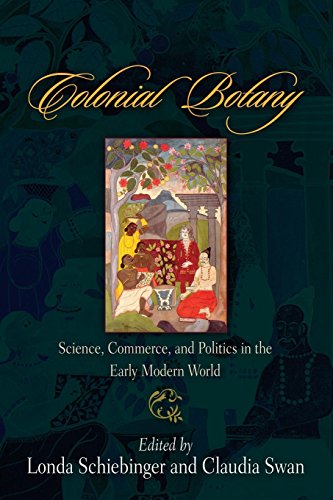
In the early modern world, botany was big science and big business, critical to Europe's national and trade ambitions. Tracing the dynamic relationships among plants, peoples, states, and economies over the course of three centuries, this collection of essays offers a lively challenge to a historiography that has emphasized the rise of modern botany as a story of taxonomies and "pure" systems of classification. Charting a new map of botany along colonial coordinates, reaching from Europe to the New World, India, Asia, and other points on the globe, Colonial Botany explores how the study, naming, cultivation, and marketing of rare and beautiful plants resulted from and shaped European voyages, conquests, global trade, and scientific exploration. From the earliest voyages of discovery, naturalists sought profitable plants for king and country, personal and corporate gain. Costly spices and valuable medicinal plants such as nutmeg, tobacco, sugar, Peruvian bark, peppers, cloves, cinnamon, and tea ranked prominently among the motivations for European voyages of discovery. At the same time, colonial profits depended largely on natural historical exploration and the precise identification and effective cultivation of profitable plants. This volume breaks new ground by treating the development of the science of botany in its colonial context and situating the early modern exploration of the plant world at the volatile nexus of science, commerce, and state politics. Written by scholars as international as their subjects, Colonial Botany uncovers an emerging cultural history of plants and botanical practices in Europe and its possessions.
"synopsis" may belong to another edition of this title.
About the Author
Londa Schiebinger is John L. Hinds Professor of History of Science and Barbara D. Finberg Director of the Institute for Research on Women and Gender, Stanford University. She is the author of The Mind Has No Sex? Women in the Origins of Modern Science; Has Feminism Changed Science?; Nature's Body: Gender in the Making of Modern Science; and Plants and Empire: Colonial Bioprospecting in the Atlantic World. Claudia Swan is Associate Professor in the Department of Art History at Northwestern University and founding Director of the Program in the Study of Imagination. She is the author of The Clutius Botanical Watercolor: Plants and Flowers of the Renaissance and Art, Science, and Witchcraft in Early Modern Holland: Jacques de Gheyn II (1565-1629).
"About this title" may belong to another edition of this title.
Other Popular Editions of the Same Title

Search results for Colonial Botany: Science, Commerce, and Politics in...

Seller Image
Colonial Botany: Science, Commerce, and Politics in the Early Modern World
Published by
University of Pennsylvania Press, 2005
ISBN 10: 0812238273
ISBN 13: 9780812238273
Used
Hardcover
First Edition
Seller: Summerfield Books BA, Penrith, United Kingdom
Seller rating 5 out of 5 stars

Hard Back. Condition: Very Good+. Dust Jacket Condition: Near Fine. 1st Edition. Three dog-eared corners and a sprinkling to the top edge of the textblock, otherwise very crisp, clean and bright throughout, including DJ which has been protected inside a removable clear protective cover. Seller Inventory # 1021079024352
Buy Used
£ 34.29
£ 14 shipping
Ships from United Kingdom to U.S.A.
Ships from United Kingdom to U.S.A.
Quantity: 1 available