
Items related to Is It Righteous to Be?: Interviews with Emmanuel Levinas...
Is It Righteous to Be?: Interviews with Emmanuel Levinas (Meridian: Crossing Aesthetics) - Softcover
Synopsis
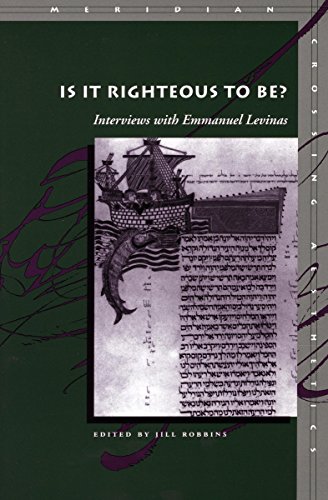
Recent debates within Continental philosophy have decisively renewed the question of the ethical, with the French philosopher Emmanuel Levinas (1905-1995) as its center. Coming from yet in contestation with the phenomenological traditions of Husserl and Heidegger, Levinas defines ethics as an originary response to the face of the other. For him, language is an exception to a habitual economy that represses alterity and maintains the asymmetry and distance constitutive of the nontotalizing relation to the other. Ethics occurs in the interlocutionary relation to the other, and interpellation―a kind of interruption by speaking―is the essential feature of ethical language.
Between 1982 and 1992, Levinas gave numerous interviews, closing a distinguished sixty-year career. Of the twenty interviews collected in this volume, seventeen appear in English for the first time. In the interviews Levinas sets forth the central features of his ethical philosophy, previously enunciated in Totality and Infinity (1961), in a language that bridges to the idiom of his later work. He underlines his dedication to the phenomenological search for the concrete and the nonformal signification of alterity. He also elaborates issues that do not receive extensive treatment in his formal philosophical works, including the question of prephilosophical experiences and the ethical signification of money, justice, and the State.
The informality of the interviews prompts Levinas to address matters about which he is reticent in his published works, notably the relation of his ethical philosophy to theological questions, the intrication of the Hebrew Bible in Greek philosophy, his substantial corpus of "nonphilosophical" or "confessional" writings on the Talmud, and recollections of his extraordinary talmudic teacher, Shoshani.
The centerpiece of the volume is a previously untranslated 1986 interview with François Poirié. Containing Levinas's sole extended discussion of biographical matters with an interviewer, this text helps to situate Levinas in his contemporary intellectual world and to clarify his place in French thought.
"synopsis" may belong to another edition of this title.
About the Author
Jill Robbins is Professor of Comparative Literature and English at the State University of New York, Buffalo
From the Back Cover
Recent debates within Continental philosophy have decisively renewed the question of the ethical, with the French philosopher Emmanuel Levinas (1905-1995) as its center. Coming from yet in contestation with the phenomenological traditions of Husserl and Heidegger, Levinas defines ethics as an originary response to the face of the other. For him, language is an exception to a habitual economy that represses alterity and maintains the asymmetry and distance constitutive of the nontotalizing relation to the other. Ethics occurs in the interlocutionary relation to the other, and interpellation--a kind of interruption by speaking--is the essential feature of ethical language.
Between 1982 and 1992, Levinas gave numerous interviews, closing a distinguished sixty-year career. Of the twenty interviews collected in this volume, seventeen appear in English for the first time. In the interviews Levinas sets forth the central features of his ethical philosophy, previously enunciated in Totality and Infinity (1961), in a language that bridges to the idiom of his later work. He underlines his dedication to the phenomenological search for the concrete and the nonformal signification of alterity. He also elaborates issues that do not receive extensive treatment in his formal philosophical works, including the question of prephilosophical experiences and the ethical signification of money, justice, and the State.
The informality of the interviews prompts Levinas to address matters about which he is reticent in his published works, notably the relation of his ethical philosophy to theological questions, the intrication of the Hebrew Bible in Greek philosophy, his substantial corpus of "nonphilosophical" or "confessional" writings on the Talmud, and recollections of his extraordinary talmudic teacher, Shoshani.
The centerpiece of the volume is a previously untranslated 1986 interview with François Poirié. Containing Levinas's sole extended discussion of biographical matters with an interviewer, this text helps to situate Levinas in his contemporary intellectual world and to clarify his place in French thought.
From the Inside Flap
Recent debates within Continental philosophy have decisively renewed the question of the ethical, with the French philosopher Emmanuel Levinas (1905-1995) as its center. Coming from yet in contestation with the phenomenological traditions of Husserl and Heidegger, Levinas defines ethics as an originary response to the face of the other. For him, language is an exception to a habitual economy that represses alterity and maintains the asymmetry and distance constitutive of the nontotalizing relation to the other. Ethics occurs in the interlocutionary relation to the other, and interpellation--a kind of interruption by speaking--is the essential feature of ethical language.
Between 1982 and 1992, Levinas gave numerous interviews, closing a distinguished sixty-year career. Of the twenty interviews collected in this volume, seventeen appear in English for the first time. In the interviews Levinas sets forth the central features of his ethical philosophy, previously enunciated in Totality and Infinity (1961), in a language that bridges to the idiom of his later work. He underlines his dedication to the phenomenological search for the concrete and the nonformal signification of alterity. He also elaborates issues that do not receive extensive treatment in his formal philosophical works, including the question of prephilosophical experiences and the ethical signification of money, justice, and the State.
The informality of the interviews prompts Levinas to address matters about which he is reticent in his published works, notably the relation of his ethical philosophy to theological questions, the intrication of the Hebrew Bible in Greek philosophy, his substantial corpus of "nonphilosophical" or "confessional" writings on the Talmud, and recollections of his extraordinary talmudic teacher, Shoshani.
The centerpiece of the volume is a previously untranslated 1986 interview with Francois Poirie. Containing Levinas's sole extended discussion of biographical matters with an interviewer, this text helps to situate Levinas in his contemporary intellectual world and to clarify his place in French thought.
"About this title" may belong to another edition of this title.
Search results for Is It Righteous to Be?: Interviews with Emmanuel Levinas...

Stock Image
Is It Righteous to Be?: Interviews with Emmanuel Levinas
Published by
Stanford University Press, 2002
ISBN 10: 0804743096
ISBN 13: 9780804743099
Used
Paperback
Seller: World of Books (was SecondSale), Montgomery, IL, U.S.A.
Seller rating 5 out of 5 stars

Paperback. Condition: Good. In the twenty interviews collected in this volume, seventeen of which appear in English for the first time, Levinas sets forth the central features of his ethical philosophy and discusses biographical matters not available elsewhere. Seller Inventory # CIN0804743096G
Seller Image
Is It Righteous to Be? Interviews with Emmanuel Levinas
Published by
Stanford University Press, 2002
ISBN 10: 0804743096
ISBN 13: 9780804743099
Used
Softcover
Seller: Dream Books Co., Denver, CO, U.S.A.
Seller rating 5 out of 5 stars
Condition: acceptable. This copy has clearly been enjoyedâ"expect noticeable shelf wear and some minor creases to the cover. Binding is strong, and all pages are legible. May contain previous library markings or stamps. Seller Inventory # DBV.0804743096.A
Stock Image
Is It Righteous to Be?: Interviews with Emmanuel Levinas
Published by
Stanford University Press, 2002
ISBN 10: 0804743096
ISBN 13: 9780804743099
Used
Paperback
Seller: World of Books Inc, Montgomery, IL, U.S.A.
Seller rating 4 out of 5 stars

Paperback. Condition: Good. In the twenty interviews collected in this volume, seventeen of which appear in English for the first time, Levinas sets forth the central features of his ethical philosophy and discusses biographical matters not available elsewhere. Seller Inventory # CIN0804743096G
Stock Image
Is It Righteous to Be? Interviews with Emmanuel Levinas
Published by
Stanford University Press, 2002
ISBN 10: 0804743096
ISBN 13: 9780804743099
Used
paperback
Seller: HPB-Red, Dallas, TX, U.S.A.
Seller rating 5 out of 5 stars
paperback. Condition: Good. Connecting readers with great books since 1972! Used textbooks may not include companion materials such as access codes, etc. May have some wear or writing/highlighting. We ship orders daily and Customer Service is our top priority! Seller Inventory # S_428409502
Stock Image
Is It Righteous to Be? Interviews with Emmanuel Levinas
Published by
Stanford University Press, 2002
ISBN 10: 0804743096
ISBN 13: 9780804743099
Used
paperback
Seller: HPB-Red, Dallas, TX, U.S.A.
Seller rating 5 out of 5 stars
paperback. Condition: Acceptable. Connecting readers with great books since 1972. Used textbooks may not include companion materials such as access codes, etc. May have condition issues including wear and notes/highlighting. We ship orders daily and Customer Service is our top priority! Seller Inventory # S_433525927
Stock Image
Is It Righteous to Be? Interviews with Emmanuel Levinas
Published by
Stanford University Press, 2002
ISBN 10: 0804743096
ISBN 13: 9780804743099
Used
Paperback
Seller: HPB-Ruby, Dallas, TX, U.S.A.
Seller rating 5 out of 5 stars
Paperback. Condition: Very Good. Connecting readers with great books since 1972! Used books may not include companion materials, and may have some shelf wear or limited writing. We ship orders daily and Customer Service is our top priority! Seller Inventory # S_449212101
Stock Image
Is It Righteous to Be? Interviews with Emmanuel Levinas
Published by
Stanford University Press, 2002
ISBN 10: 0804743096
ISBN 13: 9780804743099
Used
Paperback
Seller: HPB Inc., Dallas, TX, U.S.A.
Seller rating 5 out of 5 stars
Paperback. Condition: Very Good. Connecting readers with great books since 1972! Used books may not include companion materials, and may have some shelf wear or limited writing. We ship orders daily and Customer Service is our top priority! Seller Inventory # S_473322116
Stock Image
Is It Righteous to Be?: Interviews with Emmanuel Levinas
Published by
Stanford University Press, 2002
ISBN 10: 0804743096
ISBN 13: 9780804743099
Used
Paperback
Seller: ThriftBooks-Dallas, Dallas, TX, U.S.A.
Seller rating 5 out of 5 stars
Paperback. Condition: Fair. No Jacket. Readable copy. Pages may have considerable notes/highlighting. ~ ThriftBooks: Read More, Spend Less. Seller Inventory # G0804743096I5N00
Stock Image
Is It Righteous To Be? Interviews with Emmanual Levinas.
Published by
Stanford University Press, Stanford, California, 2001
ISBN 10: 0804743096
ISBN 13: 9780804743099
Used
Softbound
Seller: Henry Hollander, Bookseller, Los Angeles, CA, U.S.A.
Seller rating 4 out of 5 stars
Softbound. Condition: Very Good. Octavo, glossy paper covers, xii, 309 pp., notes, index Edited by Jill Robbns. Werner Hamacher & David E. Wellbery, editors. Seller Inventory # 93409
Stock Image
Is It Righteous to Be? Interviews with Emmanuel Levinas
Published by
Stanford University Press, 2002
ISBN 10: 0804743096
ISBN 13: 9780804743099
Used
paperback
Seller: Midtown Scholar Bookstore, Harrisburg, PA, U.S.A.
Seller rating 5 out of 5 stars
paperback. Condition: Acceptable. Acceptable, Reading copy only, with writing/markings, bumps/creasing, and heavy wear. Standard-sized. Seller Inventory # mon0000354330