
Items related to Deconstruction as Analytic Philosophy (Cultural Memory...
Deconstruction as Analytic Philosophy (Cultural Memory in the Present) - Softcover
Book 17 of 213: Cultural Memory in the Present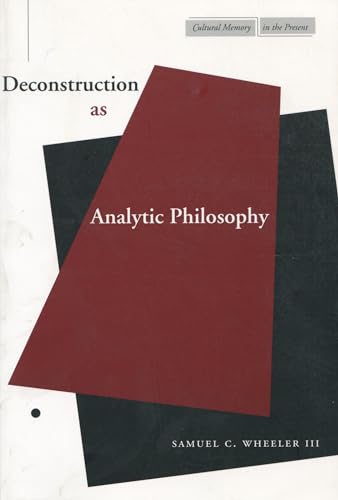
Synopsis
In this collection of essays Samuel Wheeler discusses Derrida and other “deconstructive” thinkers from the perspective of an analytic philosopher willing to treat deconstruction as philosophy, taking it seriously enough to look for and analyze its arguments. The essays focus on the theory of meaning, truth, interpretation, metaphor, and the relationship of language to the world. Wheeler links the thought of Derrida to that of Davidson and argues for close affinities among Derrida, Quine, de Man, and Wittgenstein. He also demonstrates the propinquity of Plato and Derrida and shows that New Criticism shares deconstruction’s conception of language. Of the twelve essays in the collection, four are published here for the first time.
The fundamental resemblance between Derrida and such analytic thinkers as Quine, Wittgenstein, and Davidson, the author argues, is that they deny the possibility of meanings as self-interpreting media constituting thoughts and intentions. Derrida argues that some form of magic language has determined the very project of philosophy, and his arguments work out the consequences of denying that there are such self-interpreting mental contents. In addition, Derrida and Davidson agree in denying any “given.” Without a given, questions about realism and idealism cease to have a point. Derrida and Davidson are both committed to the textuality of all significant marks, whether in neurons or on paper. They argue that there is no mode of representation more direct than language.
"synopsis" may belong to another edition of this title.
About the Author
Samuel C. Wheeler III is Professor of Philosophy at the University of Connecticut.
From the Back Cover
"Wheeler not only builds a bridge between continental and analytic philosophy; he also traces a useful tow path between philosophy and literary theory."--The Comparatist
"This is the best job of analytic-Continental bridgebuilding I have come across. Wheeler presents Davidson and Derrida, very convincingly, as two philosophers who have common enemies and are aiming at the same targets. His lucid and carefully argued book is full of original thinking, ingenious analogies, and spirited polemic." --Richard Rorty, Stanford University
From the Inside Flap
In this collection of essays Samuel Wheeler discusses Derrida and other "deconstructive" thinkers from the perspective of an analytic philosopher willing to treat deconstruction as philosophy, taking it seriously enough to look for and analyze its arguments. The essays focus on the theory of meaning, truth, interpretation, metaphor, and the relationship of language to the world. Wheeler links the thought of Derrida to that of Davidson and argues for close affinities among Derrida, Quine, de Man, and Wittgenstein. He also demonstrates the propinquity of Plato and Derrida and shows that New Criticism shares deconstruction's conception of language. Of the twelve essays in the collection, four are published here for the first time.
The fundamental resemblance between Derrida and such analytic thinkers as Quine, Wittgenstein, and Davidson, the author argues, is that they deny the possibility of meanings as self-interpreting media constituting thoughts and intentions. Derrida argues that some form of magic language has determined the very project of philosophy, and his arguments work out the consequences of denying that there are such self-interpreting mental contents. In addition, Derrida and Davidson agree in denying any "given." Without a given, questions about realism and idealism cease to have a point. Derrida and Davidson are both committed to the textuality of all significant marks, whether in neurons or on paper. They argue that there is no mode of representation more direct than language.
"About this title" may belong to another edition of this title.
Search results for Deconstruction as Analytic Philosophy (Cultural Memory...

Seller Image
Deconstruction as Analytic Philosophy (Cultural Memory in the Present)
Published by
Stanford University Press, 2000
ISBN 10: 0804737533
ISBN 13: 9780804737531
Used
Softcover
Seller: Bay State Book Company, North Smithfield, RI, U.S.A.
Seller rating 5 out of 5 stars

Condition: very_good. Seller Inventory # BSM.19JQ0
Seller Image
Deconstruction as Analytic Philosophy (Cultural Memory in the Present)
Published by
Stanford University Press, 2000
ISBN 10: 0804737533
ISBN 13: 9780804737531
Used
Softcover
Seller: Scissortail, Oklahoma City, OK, U.S.A.
Seller rating 5 out of 5 stars
Condition: good. This is a pre-loved book that shows moderate signs of wear from previous reading. You may notice creases, edge wear, or a cracked spine, but it remains in solid, readable condition. Please note: -May include library or rental stickers, stamps, or markings. -Supplemental materials e.g., CDs, access codes, inserts are not guaranteed. -Box sets may not come with the original outer box. If it does, the box will not be in perfect condition. Your satisfaction is our top priority! If you have any questions or concerns about your order, please don't hesitate to reach out. Thank you for shopping with us and supporting small businessâ"happy reading! Seller Inventory # STM.ILZ
Seller Image
Deconstruction as Analytic Philosophy (Cultural Memory in the Present)
Published by
Stanford University Press, 2000
ISBN 10: 0804737533
ISBN 13: 9780804737531
Used
Softcover
Seller: Goodwill of Central and Coastal Virginia, Richmond, VA, U.S.A.
Seller rating 4 out of 5 stars

Condition: acceptable. Seller Inventory # CCVV.0804737533.A
Stock Image
Deconstruction As Analytic Philosophy
Published by
Stanford University Press, 2000
ISBN 10: 0804737533
ISBN 13: 9780804737531
New
Softcover
Seller: GreatBookPrices, Columbia, MD, U.S.A.
Seller rating 5 out of 5 stars
Condition: New. Seller Inventory # 252103-n
Stock Image
Deconstruction as Analytic Philosophy (Cultural Memory in the Present)
Published by
Stanford University Press, 2000
ISBN 10: 0804737533
ISBN 13: 9780804737531
New
Softcover
Seller: California Books, Miami, FL, U.S.A.
Seller rating 5 out of 5 stars
Condition: New. Seller Inventory # I-9780804737531
Seller Image
Deconstruction As Analytic Philosophy
Published by
Stanford University Press, US, 2000
ISBN 10: 0804737533
ISBN 13: 9780804737531
New
Paperback
Seller: Rarewaves USA, HEBRON, KY, U.S.A.
Seller rating 5 out of 5 stars
Paperback. Condition: New. In this collection of essays Samuel Wheeler discusses Derrida and other "deconstructive" thinkers from the perspective of an analytic philosopher willing to treat deconstruction as philosophy, taking it seriously enough to look for and analyze its arguments. The essays focus on the theory of meaning, truth, interpretation, metaphor, and the relationship of language to the world. Wheeler links the thought of Derrida to that of Davidson and argues for close affinities among Derrida, Quine, de Man, and Wittgenstein. He also demonstrates the propinquity of Plato and Derrida and shows that New Criticism shares deconstruction's conception of language. Of the twelve essays in the collection, four are published here for the first time. The fundamental resemblance between Derrida and such analytic thinkers as Quine, Wittgenstein, and Davidson, the author argues, is that they deny the possibility of meanings as self-interpreting media constituting thoughts and intentions. Derrida argues that some form of magic language has determined the very project of philosophy, and his arguments work out the consequences of denying that there are such self-interpreting mental contents. In addition, Derrida and Davidson agree in denying any "given." Without a given, questions about realism and idealism cease to have a point. Derrida and Davidson are both committed to the textuality of all significant marks, whether in neurons or on paper. They argue that there is no mode of representation more direct than language. Seller Inventory # LU-9780804737531
Seller Image
Deconstruction As Analytic Philosophy
Published by
Stanford University Press, 2000
ISBN 10: 0804737533
ISBN 13: 9780804737531
Used
Softcover
Seller: GreatBookPrices, Columbia, MD, U.S.A.
Seller rating 5 out of 5 stars
Condition: As New. Unread book in perfect condition. Seller Inventory # 252103
Stock Image
Deconstruction As Analytic Philosophy
Seller: PBShop.store UK, Fairford, GLOS, United Kingdom
Seller rating 5 out of 5 stars
PAP. Condition: New. New Book. Shipped from UK. Established seller since 2000. Seller Inventory # FW-9780804737531
Buy New
£ 28.47
£ 4.16 shipping
Ships from United Kingdom to U.S.A.
Ships from United Kingdom to U.S.A.
Quantity: 15 available
Stock Image
Deconstruction As Analytic Philosophy (eng)
Published by
Stanford University Press, 2000
ISBN 10: 0804737533
ISBN 13: 9780804737531
New
Softcover
Seller: Brook Bookstore On Demand, Napoli, NA, Italy
Seller rating 5 out of 5 stars
Condition: new. Seller Inventory # bd0fdc3e36088153df2d13028b98de50
Buy New
£ 30.84
£ 4.63 shipping
Ships from Italy to U.S.A.
Ships from Italy to U.S.A.
Quantity: Over 20 available
Stock Image
Deconstruction As Analytic Philosophy (Cultural Memory in the Present)
Print on DemandSeller: Revaluation Books, Exeter, United Kingdom
Seller rating 5 out of 5 stars
Paperback. Condition: Brand New. 1st edition. 294 pages. 9.00x6.00x0.75 inches. In Stock. This item is printed on demand. Seller Inventory # __0804737533
Buy New
£ 29.08
£ 10 shipping
Ships from United Kingdom to U.S.A.
Ships from United Kingdom to U.S.A.
Quantity: 2 available