
Items related to The Practice of Cultural Analysis: Exposing Interdisciplinar...
The Practice of Cultural Analysis: Exposing Interdisciplinary Interpretation (Cultural Memory in the Present) - Hardcover
Book 9 of 213: Cultural Memory in the Present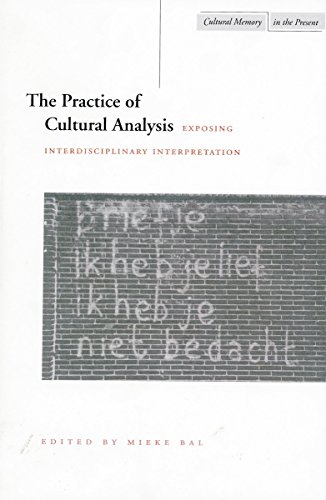
Synopsis
This volume presents an interdisciplinary approach to humanistic scholarship, one that can be situated somewhere between cultural studies and cultural history while being more specific than either. Cultural analysis as a critical practice is based on a keen awareness of the critic's situatedness in the present―the social and cultural present from which we look, and look back, at objects that are already of the past, objects that we take to define our present culture. Thus it can be summarized by the phrase "cultural memory in the present." Far from being indifferent to history, cultural analysis is devoted to understanding the past as part of the present, as what we have around us.
The essays gathered here represent the current state of an emerging field of inquiry. At the same time, they suggest to the larger academic world what cultural analysis can and should do, or be, as an interdisciplinary practice. The challenge for this volume is to counter the common assumption that interdisciplinarity makes the object of inquiry vague and the methodology muddled. In meeting that challenge, it offers close textual and visual readings of subjects ranging from Vermeer to abstract expressionism, from the Book of Ruth to Djuna Barnes's Nightwood, from the history of cinema to popular culture in Zaire.
The essays in Part I, "Don't Look Now: Visual Memory in the Present," explore in detailed case studies centered on the theme of visuality or looking, the tricky consequences of the uncertainties regarding history that the presentness of the past entails. Part II, "Close-ups and Mirrors: The Return of Close Reading, with a Difference," demonstrates and advocates "listening" to the object without the New Critical naïveté that claims the text speaks for itself. Instead, the essays create the kind of dialogical situation that is a major characteristic of cultural analysis; the text does not speak for itself, but it does speak back. The essays in Part III, "Method Matters: Reflections on the Identity of Cultural Analysis," do not propose any "directions for use" or authoritative statements on how to do cultural analysis. Arranged in pairs of opposites, the essays represent the kind of fruitful tension that stimulates debate. Though no definite answers are proposed, and conflicting views are left in conflict, the essays stimulate a (self-)reflection on cultural analysis, its practices, and its understandings.
"synopsis" may belong to another edition of this title.
About the Author
Mieke Bal is Professor of Literary Theory at the University of Amsterdam and co-founder of the Amsterdam School for Cultural Analysis, Theory, and Interpretation. The most recent of her many books is The Mottled Screen: Reading Proust Visually (Stanford, 1997).
From the Back Cover
This volume presents an interdisciplinary approach to humanistic scholarship, one that can be situated somewhere between cultural studies and cultural history while being more specific than either. Cultural analysis as a critical practice is based on a keen awareness of the critic's situatedness in the present--the social and cultural present from which we look, and look back, at objects that are already of the past, objects that we take to define our present culture. Thus it can be summarized by the phrase "cultural memory in the present." Far from being indifferent to history, cultural analysis is devoted to understanding the past as part of the present, as what we have around us.
The essays gathered here represent the current state of an emerging field of inquiry. At the same time, they suggest to the larger academic world what cultural analysis can and should do, or be, as an interdisciplinary practice. The challenge for this volume is to counter the common assumption that interdisciplinarity makes the object of inquiry vague and the methodology muddled. In meeting that challenge, it offers close textual and visual readings of subjects ranging from Vermeer to abstract expressionism, from the Book of Ruth to Djuna Barnes's Nightwood, from the history of cinema to popular culture in Zaire.
The essays in Part I, "Don't Look Now: Visual Memory in the Present," explore in detailed case studies centered on the theme of visuality or looking, the tricky consequences of the uncertainties regarding history that the presentness of the past entails. Part II, "Close-ups and Mirrors: The Return of Close Reading, with a Difference," demonstrates and advocates "listening" to the object without the New Critical naïveté that claims the text speaks for itself. Instead, the essays create the kind of dialogical situation that is a major characteristic of cultural analysis; the text does not speak for itself, but it does speak back. The essays in Part III, "Method Matters: Reflections on the Identity of Cultural Analysis," do not propose any "directions for use" or authoritative statements on how to do cultural analysis. Arranged in pairs of opposites, the essays represent the kind of fruitful tension that stimulates debate. Though no definite answers are proposed, and conflicting views are left in conflict, the essays stimulate a (self-)reflection on cultural analysis, its practices, and its understandings.
From the Inside Flap
This volume presents an interdisciplinary approach to humanistic scholarship, one that can be situated somewhere between cultural studies and cultural history while being more specific than either. Cultural analysis as a critical practice is based on a keen awareness of the critic's situatedness in the present--the social and cultural present from which we look, and look back, at objects that are already of the past, objects that we take to define our present culture. Thus it can be summarized by the phrase "cultural memory in the present." Far from being indifferent to history, cultural analysis is devoted to understanding the past as part of the present, as what we have around us.
The essays gathered here represent the current state of an emerging field of inquiry. At the same time, they suggest to the larger academic world what cultural analysis can and should do, or be, as an interdisciplinary practice. The challenge for this volume is to counter the common assumption that interdisciplinarity makes the object of inquiry vague and the methodology muddled. In meeting that challenge, it offers close textual and visual readings of subjects ranging from Vermeer to abstract expressionism, from the Book of Ruth to Djuna Barnes's Nightwood, from the history of cinema to popular culture in Zaire.
The essays in Part I, "Don't Look Now: Visual Memory in the Present," explore in detailed case studies centered on the theme of visuality or looking, the tricky consequences of the uncertainties regarding history that the presentness of the past entails. Part II, "Close-ups and Mirrors: The Return of Close Reading, with a Difference," demonstrates and advocates "listening" to the object without the New Critical naivete that claims the text speaks for itself. Instead, the essays create the kind of dialogical situation that is a major characteristic of cultural analysis; the text does not speak for itself, but it does speak back. The essays in Part III, "Method Matters: Reflections on the Identity of Cultural Analysis," do not propose any "directions for use" or authoritative statements on how to do cultural analysis. Arranged in pairs of opposites, the essays represent the kind of fruitful tension that stimulates debate. Though no definite answers are proposed, and conflicting views are left in conflict, the essays stimulate a (self-)reflection on cultural analysis, its practices, and its understandings.
"About this title" may belong to another edition of this title.
Search results for The Practice of Cultural Analysis: Exposing Interdisciplinar...

Stock Image
The Practice of Cultural Analysis: Exposing Interdisciplinary Interpretation (Cultural Memory in the Present)
Published by
Stanford University Press, 1999
ISBN 10: 0804730660
ISBN 13: 9780804730662
Used
Hardcover
Seller: Midtown Scholar Bookstore, Harrisburg, PA, U.S.A.
Seller rating 5 out of 5 stars

Hardcover. Condition: Very Good. HARDCOVER Very Good - Crisp, clean, unread book with some shelfwear/edgewear, may have a remainder mark - NICE Standard-sized. Seller Inventory # M0804730660Z2
Seller Image
The Practice of Cultural Analysis: Exposing Interdisciplinary Interpretation (Cultural Memory in the Present)
Published by
Stanford University Press, 1999
ISBN 10: 0804730660
ISBN 13: 9780804730662
Used
Hardcover
First Edition
Seller: Snowden's Books, Santa Fe, NM, U.S.A.
Seller rating 5 out of 5 stars
Hardcover. Condition: Very Good. Dust Jacket Condition: Very Good. 1st Edition. Original hardcover in jacket, 392 pages, index. Book is solid and bright with minimal reading wear. There is a translucent damp stain at top outer page edges with related sliver translucent stain along top page edges. Light soiling, wear to jacket. Mostly cosmetic wear to book, about good to good plus. r2b2. Seller Inventory # ABE-1766381170552
Stock Image
The Practice of Cultural Analysis: Exposing Interd
Published by
Stanford University Press, 1999
ISBN 10: 0804730660
ISBN 13: 9780804730662
Used
Hardcover
Seller: N. Fagin Books, Chicago, IL, U.S.A.
Seller rating 5 out of 5 stars
1999. Anthropological theory and method. Stanford University Press. 392p. Ex-library otherwise tight and clean cloth, no dust jacket. Seller Inventory # 1799297039
Stock Image
The Practice of Cultural Analysis: Exposing Interdisciplinary Interpretation (Cultural Memory in the Present)
Published by
Stanford University Press, 1999
ISBN 10: 0804730660
ISBN 13: 9780804730662
Used
Hardcover
Seller: Midtown Scholar Bookstore, Harrisburg, PA, U.S.A.
Seller rating 5 out of 5 stars
Hardcover. Condition: Good. HARDCOVER Good - Bumped and creased book with tears to the extremities, but not affecting the text block, may have remainder mark or previous owner's name - GOOD Standard-sized. Seller Inventory # M0804730660Z3
Stock Image
The Practice of Cultural Analysis: Exposing Interdisciplinary Interpretation (Cultural Memory in the Present)
Published by
Stanford University Press, 1999
ISBN 10: 0804730660
ISBN 13: 9780804730662
Used
Hardcover
Seller: Sequitur Books, Boonsboro, MD, U.S.A.
Seller rating 5 out of 5 stars
Hardcover. Condition: As New. [From the library of noted scholar Richard A. Macksey.] Hardcover and dust jacket. Good binding and cover. Light edge wear. Clean, unmarked pages. xix, 392 pages, ill., 23 cm. This volume presents an interdisciplinary approach to humanistic scholarship situated somewhere between cultural studies and cultural history. "Richard A. Macksey was a celebrated Johns Hopkins University professor whose affiliation with the university spanned six and a half decades. A legendary figure not only in his own fields of critical theory, comparative literature, and film studies but across all the humanities, Macksey possessed enormous intellectual capacity and a deeply insightful human nature. He was a man who read and wrote in six languages, was instrumental in launching a new era in structuralist thought in America, maintained a personal library containing a staggering collection of books and manuscripts, inspired generations of students to follow him to the thorniest heights of the human intellect, and penned or edited dozens of volumes of scholarly works, fiction, poetry, and translation." - Johns Hopkins University. Seller Inventory # 2402290007
Stock Image
The Practice of Cultural Analysis: Exposing Interdisciplinary Interpretation (Cultural Memory in the Present)
Published by
Stanford University Press, 1999
ISBN 10: 0804730660
ISBN 13: 9780804730662
Used
Hardcover
Seller: Phatpocket Limited, Waltham Abbey, HERTS, United Kingdom
Seller rating 5 out of 5 stars
Condition: Good. Your purchase helps support Sri Lankan Children's Charity 'The Rainbow Centre'. Ex-library, so some stamps and wear, but in good overall condition. Our donations to The Rainbow Centre have helped provide an education and a safe haven to hundreds of children who live in appalling conditions. Seller Inventory # Z1-F-011-02052
Buy Used
£ 28.69
£ 10.64 shipping
Ships from United Kingdom to U.S.A.
Ships from United Kingdom to U.S.A.
Quantity: 1 available
Stock Image
The Practice of Cultural Analysis: Exposing Interdisciplinary Interpretation (Cultural Memory in the Present)
Published by
Stanford University Press, 1999
ISBN 10: 0804730660
ISBN 13: 9780804730662
New
Hardcover
Seller: Poverty Hill Books, Mt. Prospect, IL, U.S.A.
Seller rating 4 out of 5 stars

Hardcover. Condition: New. HARDCOVER, BRAND NEW COPY, Perfect Shape, No Black Remainder Mark,Fast Shipping With Online Tracking, International Orders shipped Global Priority Air Mail, All orders handled with care and shipped promptly in secure packaging, we ship Mon-Sat and send shipment confirmation emails. Our customer service is friendly, we answer emails fast, accept returns and work hard to deliver 100% Customer Satisfaction! Seller Inventory # 9017622
Stock Image
The Practice of Cultural Analysis
Published by
Stanford University Press, 1999
ISBN 10: 0804730660
ISBN 13: 9780804730662
New
Hardcover
Seller: PBShop.store UK, Fairford, GLOS, United Kingdom
Seller rating 5 out of 5 stars
HRD. Condition: New. New Book. Shipped from UK. Established seller since 2000. Seller Inventory # FW-9780804730662
Buy New
£ 140.27
£ 5.87 shipping
Ships from United Kingdom to U.S.A.
Ships from United Kingdom to U.S.A.
Quantity: 3 available
Seller Image
Practice of Cultural Analysis : Exposing Interdisciplinary Interpretation
Published by
Stanford University Press, 1999
ISBN 10: 0804730660
ISBN 13: 9780804730662
New
Hardcover
Seller: GreatBookPrices, Columbia, MD, U.S.A.
Seller rating 5 out of 5 stars
Condition: New. Seller Inventory # 15820732-n
Stock Image
The Practice of Cultural Analysis: Exposing Interdisciplinary Interpretation
Published by
Stanford University Press, 1999
ISBN 10: 0804730660
ISBN 13: 9780804730662
New
Hardcover
Seller: THE SAINT BOOKSTORE, Southport, United Kingdom
Seller rating 5 out of 5 stars
Hardback. Condition: New. New copy - Usually dispatched within 4 working days. Seller Inventory # B9780804730662
Buy New
£ 140.06
£ 18.07 shipping
Ships from United Kingdom to U.S.A.
Ships from United Kingdom to U.S.A.
Quantity: 3 available