
Items related to Making Majorities: Constituting the Nation in Japan,...
Making Majorities: Constituting the Nation in Japan, Korea, China, Malaysia, Fiji, Turkey, and the United States (Contemporary Issues in Asia and the Pacific) - Softcover
Synopsis
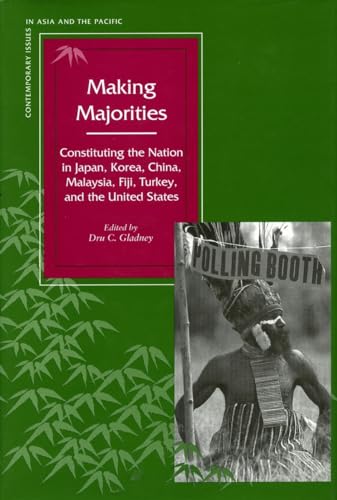
Majorities are made, not born. This book argues that there are no pure majorities in the Asia-Pacific region, broadly defined, nor in the West. Numerically, ethnically, politically, and culturally, societies make and mark their majorities under specific historical, political, and social circumstances. This position challenges Samuel Huntington’s influential thesis that civilizations are composed of more or less homogeneous cultures, suggesting instead that culture is as malleable as the politics that informs it.
The fourteen contributors to this volume argue that emphasis on minority/majority rights is based on uncritically accepted ideas of purity, numerical superiority, and social consensus. Emphases upon multiculturalism can become ways of masking serious political, ethnic, and class differences merely in terms of cultural difference, and affirmative-action policies can isolate, identify, and stigmatize minorities as often as they homogenize, unify, and naturalize majorities.
This book analyzes how minorities are made and marked across cultural, regional, and national boundaries from Hawai‘i to Turkey, a region that encompasses extraordinarily diverse populations and political developments and that is often regarded as composed of relatively homogeneous majorities.
This volume details discourses of majority and minority, allowing exploration of a number of questions of more general concern in the humanities and social sciences, including: How does one become officially “ethnic” in many states in Asia? How are understandings of majority and minority cultures created and shaped in specific political and historical contexts? How does the state shape the way people think of themselves? How do people resist, transform, and appropriate these official representations?
"synopsis" may belong to another edition of this title.
From the Back Cover
Majorities are made, not born. This book argues that there are no pure majorities in the Asia-Pacific region, broadly defined, nor in the West. Numerically, ethnically, politically, and culturally, societies make and mark their majorities under specific historical, political, and social circumstances. This position challenges Samuel Huntington's influential thesis that civilizations are composed of more or less homogeneous cultures, suggesting instead that culture is as malleable as the politics that informs it.
The fourteen contributors to this volume argue that emphasis on minority/majority rights is based on uncritically accepted ideas of purity, numerical superiority, and social consensus. Emphases upon multiculturalism can become ways of masking serious political, ethnic, and class differences merely in terms of cultural difference, and affirmative-action policies can isolate, identify, and stigmatize minorities as often as they homogenize, unify, and naturalize majorities.
This book analyzes how minorities are made and marked across cultural, regional, and national boundaries from Hawai'i to Turkey, a region that encompasses extraordinarily diverse populations and political developments and that is often regarded as composed of relatively homogeneous majorities.
This volume details discourses of majority and minority, allowing exploration of a number of questions of more general concern in the humanities and social sciences, including: How does one become officially "ethnic" in many states in Asia? How are understandings of majority and minority cultures created and shaped in specific political and historical contexts? How does the state shape the way people think of themselves? How do people resist, transform, and appropriate these official representations?
From the Inside Flap
Majorities are made, not born. This book argues that there are no pure majorities in the Asia-Pacific region, broadly defined, nor in the West. Numerically, ethnically, politically, and culturally, societies make and mark their majorities under specific historical, political, and social circumstances. This position challenges Samuel Huntington's influential thesis that civilizations are composed of more or less homogeneous cultures, suggesting instead that culture is as malleable as the politics that informs it.
The fourteen contributors to this volume argue that emphasis on minority/majority rights is based on uncritically accepted ideas of purity, numerical superiority, and social consensus. Emphases upon multiculturalism can become ways of masking serious political, ethnic, and class differences merely in terms of cultural difference, and affirmative-action policies can isolate, identify, and stigmatize minorities as often as they homogenize, unify, and naturalize majorities.
This book analyzes how minorities are made and marked across cultural, regional, and national boundaries from Hawai'i to Turkey, a region that encompasses extraordinarily diverse populations and political developments and that is often regarded as composed of relatively homogeneous majorities.
This volume details discourses of majority and minority, allowing exploration of a number of questions of more general concern in the humanities and social sciences, including: How does one become officially "ethnic" in many states in Asia? How are understandings of majority and minority cultures created and shaped in specific political and historical contexts? How does the state shape the way people think of themselves? How do people resist, transform, and appropriate these official representations?
"About this title" may belong to another edition of this title.
Search results for Making Majorities: Constituting the Nation in Japan,...

Stock Image
MAKING MAJORITIES; CONSTITUTING THE NATION IN JAPAN, KOREA, CHINA, MALAYSIA, FIJJI, TURKEY, AND THE UNITED STATES
Published by
Stanford University Press, 1998
ISBN 10: 0804730482
ISBN 13: 9780804730488
Used
Trade paperback
Seller: Columbia Books, ABAA/ILAB, MWABA, Columbia, MO, U.S.A.
Seller rating 5 out of 5 stars

Trade paperback. Condition: Fine. Stanford University Press, 1998.350pp, index, bibliography, notes. 8vo. Upper corner tip clipped; uncreased spine, fine bright unread softcover. Seller Inventory # 54958
Stock Image
Making Majorities: Constituting the Nation in Japan, Korea, China, Malaysia, Fiji, Turkey, and the United States
Published by
Stanford University Press, Stanford, CA, U.S.A., 1998
ISBN 10: 0804730482
ISBN 13: 9780804730488
Used
Soft cover
Seller: Book Dispensary, Concord, ON, Canada
Seller rating 5 out of 5 stars
Soft cover. Condition: Very Good. VERY GOOD softcover, no marks in text, uncreased spine, clean exterior. Book. Seller Inventory # 082178
Stock Image
Making Majorities : Constituting the Nation in Japan, Korea, China, Malaysia, Fiji, Turkey, and the United States
Published by
Stanford University Press, 1998
ISBN 10: 0804730482
ISBN 13: 9780804730488
Used
Softcover
First Edition
Seller: Better World Books: West, Reno, NV, U.S.A.
Seller rating 5 out of 5 stars
Condition: Good. 1st Edition. Former library copy. Pages intact with minimal writing/highlighting. The binding may be loose and creased. Dust jackets/supplements are not included. Includes library markings. Stock photo provided. Product includes identifying sticker. Better World Books: Buy Books. Do Good. Seller Inventory # 9339544-75
Seller Image
Making Majorities : Constituting the Nation in Japan, Korea, China, Malaysia, Fiji, Turkey, and the United States
Published by
Stanford University Press, 1998
ISBN 10: 0804730482
ISBN 13: 9780804730488
New
Softcover
Seller: GreatBookPrices, Columbia, MD, U.S.A.
Seller rating 5 out of 5 stars
Condition: New. Seller Inventory # 252434-n
Stock Image
Making Majorities: Constituting the Nation in Japan, Korea, China, Malaysia, Fiji, Turkey, and the United States (Contemporary Issues in Asia and the Pacific)
Published by
Stanford University Press, 1998
ISBN 10: 0804730482
ISBN 13: 9780804730488
New
Softcover
Seller: California Books, Miami, FL, U.S.A.
Seller rating 5 out of 5 stars
Condition: New. Seller Inventory # I-9780804730488
Seller Image
Making Majorities : Constituting the Nation in Japan, Korea, China, Malaysia, Fiji, Turkey, and the United States
Published by
Stanford University Press, 1998
ISBN 10: 0804730482
ISBN 13: 9780804730488
Used
Softcover
Seller: GreatBookPrices, Columbia, MD, U.S.A.
Seller rating 5 out of 5 stars
Condition: As New. Unread book in perfect condition. Seller Inventory # 252434
Stock Image
Making Majorities: Constituting the Nation in Japan, Korea, China, Malaysia, Fiji, Turkey, and the United States (Contemporary Issues in Asia and the Pacific)
Published by
Stanford University Press, 1998
ISBN 10: 0804730482
ISBN 13: 9780804730488
New
Paperback
Seller: GoldBooks, Denver, CO, U.S.A.
Seller rating 5 out of 5 stars
Paperback. Condition: new. New Copy. Customer Service Guaranteed. Seller Inventory # 8H31_56_0804730482
Stock Image
Making Majorities
Seller: PBShop.store UK, Fairford, GLOS, United Kingdom
Seller rating 5 out of 5 stars
PAP. Condition: New. New Book. Shipped from UK. Established seller since 2000. Seller Inventory # FW-9780804730488
Buy New
£ 32.52
£ 5.02 shipping
Ships from United Kingdom to U.S.A.
Ships from United Kingdom to U.S.A.
Quantity: 15 available
Stock Image
Making Majorities - Constituting the Nation in Japan, Korea, China, Malaysia, Fiji, Turkey, and the United States (eng)
Published by
Stanford University Press, 1998
ISBN 10: 0804730482
ISBN 13: 9780804730488
New
Softcover
Seller: Brook Bookstore On Demand, Napoli, NA, Italy
Seller rating 5 out of 5 stars
Condition: new. Seller Inventory # 49d9a1af6dfbbfe44423f5f1b8b35e49
Buy New
£ 34.81
£ 5.75 shipping
Ships from Italy to U.S.A.
Ships from Italy to U.S.A.
Quantity: Over 20 available
Stock Image
Making Majorities: Constituting the Nation in Japan, Korea, China, Malaysia, Fiji, Turkey, and the United States
Published by
Stanford University Press, 1998
ISBN 10: 0804730482
ISBN 13: 9780804730488
New
Softcover
First Edition
Seller: Kennys Bookshop and Art Galleries Ltd., Galway, GY, Ireland
Seller rating 5 out of 5 stars
Condition: New. Majorities are made, not born. This book argues that there are no majorities in the Asia-Pacific region, broadly defined, nor in the West. Numerically, ethnically, politically, and culturally, societies make and mark their majorities under specific historical, political, and social circumstance. Editor(s): Gladney, Dru C. Series: Contemporary Issues in Asia and Pacific. Num Pages: 364 pages. BIC Classification: 1DVT; 1FMM; 1FPC; 1FPJ; 1FPK; 1KBB; 1MKLF; JHMC; JHMP. Category: (P) Professional & Vocational; (UP) Postgraduate, Research & Scholarly; (UU) Undergraduate. Dimension: 5817 x 3887 x 21. Weight in Grams: 505. . 1998. 1st Edition. Paperback. . . . . Seller Inventory # V9780804730488
Buy New
£ 37.54
£ 8.04 shipping
Ships from Ireland to U.S.A.
Ships from Ireland to U.S.A.
Quantity: Over 20 available