
Items related to The Natural History of Religion (Library of Modern...
Synopsis
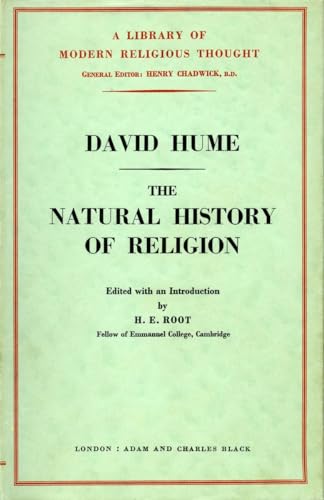
Hume's Natural History of Religion may, with his Dialogues Concerning Natural Religion be held to mark the beginning of the Philosophy of Religion. Not so clearly a text illustrating modern technology-indeed in its own day it was regarded as skeptical and subversive-the Natural History is remarkably illustrative of the development of religious thought and is a brilliant philosophical contribution to the interpretation of religion. The editor of this reprint discusses Hume's purpose in writing the Natural History and assesses its influence at the present day.
"synopsis" may belong to another edition of this title.
Review
"A minor classic . . . The essay has all the celebrated clarity and incisiveness of Hume, and it provides us, in a short and readable form, with the substance of the beliefs about the origins of religion which dominated the first attempts of later and more scientific writers to account for the rise and development of religion."
Philosophy
"A philosophical classic that caused considerable stir in its time. It is good to have a new editions of this brief work completely edited for the use of modern students."
Peabody Journal of Education
"Hume's view of religion was one-side and his anthropology out of date, but his blows were shrewd. In the historical development of modern theology his challenge has a point of departure; and even today, as the editor says, unless we have an answer to him our faith is unreal."
The Times Literary Supplement
About the Author
David Hume was an eighteenth-century Scottish philosopher, historian, and essayist, and the author of A Treatise of Human Nature, considered by many to be one of the most important philosophical works ever published.
Hume attended the University of Edinburgh at an early age and considered a career in law before deciding that the pursuit of knowledge was his true calling. Hume s writings on rationalism and empiricism, free will, determinism, and the existence of God would be enormously influential on contemporaries such as Adam Smith, as well as the philosophers like Schopenhauer, John Stuart Mill, and Karl Popper, who succeeded him. Hume died in 1776.
"About this title" may belong to another edition of this title.
Search results for The Natural History of Religion (Library of Modern...

Stock Image
The Natural History of Religion (Library of Modern Religious Thought)
Published by
Stanford University Press, 1957
ISBN 10: 0804703337
ISBN 13: 9780804703338
Used
Softcover
Seller: Wonder Book, Frederick, MD, U.S.A.
Seller rating 5 out of 5 stars

Condition: Good. Good condition. A copy that has been read but remains intact. May contain markings such as bookplates, stamps, limited notes and highlighting, or a few light stains. Seller Inventory # E02O-00293
Stock Image
Natural History of Religion
Published by
Stanford University Press, 1957
ISBN 10: 0804703337
ISBN 13: 9780804703338
Used
Paperback
Seller: ThriftBooks-Dallas, Dallas, TX, U.S.A.
Seller rating 5 out of 5 stars
Paperback. Condition: Very Good. No Jacket. May have limited writing in cover pages. Pages are unmarked. ~ ThriftBooks: Read More, Spend Less. Seller Inventory # G0804703337I4N00
Stock Image
The Natural History of Religion
Published by
Stanford University Press, 1957
ISBN 10: 0804703337
ISBN 13: 9780804703338
Used
Softcover
Seller: Better World Books, Mishawaka, IN, U.S.A.
Seller rating 5 out of 5 stars
Condition: Good. Former library copy. Pages intact with minimal writing/highlighting. The binding may be loose and creased. Dust jackets/supplements are not included. Includes library markings. Stock photo provided. Product includes identifying sticker. Better World Books: Buy Books. Do Good. Seller Inventory # GRP97724586
Stock Image
The Natural History of Religion
Published by
Stanford University Press, 1957
ISBN 10: 0804703337
ISBN 13: 9780804703338
Used
Softcover
Seller: Better World Books, Mishawaka, IN, U.S.A.
Seller rating 5 out of 5 stars
Condition: Very Good. Pages intact with possible writing/highlighting. Binding strong with minor wear. Dust jackets/supplements may not be included. Stock photo provided. Product includes identifying sticker. Better World Books: Buy Books. Do Good. Seller Inventory # 6473457-6
Stock Image
The Natural History of Religion (Library of Modern Religious Thought)
Published by
Stanford University Press, 1957
ISBN 10: 0804703337
ISBN 13: 9780804703338
Used
Paperback
Seller: HPB Inc., Dallas, TX, U.S.A.
Seller rating 5 out of 5 stars
Paperback. Condition: Very Good. Connecting readers with great books since 1972! Used books may not include companion materials, and may have some shelf wear or limited writing. We ship orders daily and Customer Service is our top priority! Seller Inventory # S_306589227
Stock Image
The Natural History of Religion (Library of Modern Religious Thought)
Published by
Stanford University Press, 1957
ISBN 10: 0804703337
ISBN 13: 9780804703338
Used
Paperback
Seller: Midtown Scholar Bookstore, Harrisburg, PA, U.S.A.
Seller rating 5 out of 5 stars
Paperback. Condition: Good. Good - Bumped and creased book with tears to the extremities, but not affecting the text block, may have remainder mark or previous owner's name - GOOD Standard-sized. Seller Inventory # M0804703337Z3
Stock Image
The Natural History of Religion (Library of Modern Religious Thought)
Published by
Stanford University Press, 1957
ISBN 10: 0804703337
ISBN 13: 9780804703338
Used
Paperback
Seller: Midtown Scholar Bookstore, Harrisburg, PA, U.S.A.
Seller rating 5 out of 5 stars
Paperback. Condition: Very Good. Very Good - Crisp, clean, unread book with some shelfwear/edgewear, may have a remainder mark - NICE Standard-sized. Seller Inventory # M0804703337Z2
Stock Image
The Natural History of Religion (Library of Modern Religious Thought)
Published by
Stanford University Press, 1957
ISBN 10: 0804703337
ISBN 13: 9780804703338
Used
Paperback
Seller: Midtown Scholar Bookstore, Harrisburg, PA, U.S.A.
Seller rating 5 out of 5 stars
Paperback. Condition: Acceptable. Acceptable - This is a significantly damaged book. It should be considered a reading copy only. Please order this book only if you are interested in the content and not the condition. May be ex-library. PAPERBACK Standard-sized. Seller Inventory # M0804703337Z4
Stock Image
The Natural History of Religion
Published by
Stanford University Press, 1957
ISBN 10: 0804703337
ISBN 13: 9780804703338
Used
Softcover
Seller: Better World Books Ltd, Dunfermline, United Kingdom
Seller rating 5 out of 5 stars
Condition: Very Good. Former library copy. Pages intact with possible writing/highlighting. Binding strong with minor wear. Dust jackets/supplements may not be included. Includes library markings. Stock photo provided. Product includes identifying sticker. Better World Books: Buy Books. Do Good. Seller Inventory # GRP98932202
Buy Used
£ 6.26
£ 5 shipping
Ships from United Kingdom to U.S.A.
Ships from United Kingdom to U.S.A.
Quantity: 1 available
Stock Image
The Natural History of Religion (Library of Modern Religious Thought)
Published by
Stanford University Press, Stanford, CA, 1957
ISBN 10: 0804703337
ISBN 13: 9780804703338
Used
Soft cover
First Edition
Seller: Theoria Books, Andover, MA, U.S.A.
Seller rating 5 out of 5 stars
Soft cover. Condition: Fine. 1st Edition. 76pp. First published in 1956 in UK by A. and C. Black Ltd.; First published in USA in 1957 by Stanford University; this copy published in 2007. Editor's Introduction, pp. 7-20; Hume's Introduction, p. 21. Glossy brown wraps with gray bands across top and bottom front cover; title lettering in white over brown across middle front cover, below author name lettering in white over brown. Some pencil point dimples variously over lower half front cover, as if some one "drumming" with their pencil point over another sheet of paper lying on book cover (NO discoloration to brown, except in one very short (1/8") indent; indents, very shallow, barely detectable to touch: describes so much worse than it is but there you have it. Tight binding; corners with very slightest of hints of curls; NO rubbing wear; NO remainder marks; NO previous owner names. Clean text. Apart from surface peccadilloes, Looks New. Unread. Seller Inventory # 001524