
Items related to Meta-Ethnography: Synthesizing Qualitative Studies...
Meta-Ethnography: Synthesizing Qualitative Studies (Qualitative Research Methods): 11 - Softcover
Book 23 of 33: Qualitative Research Methods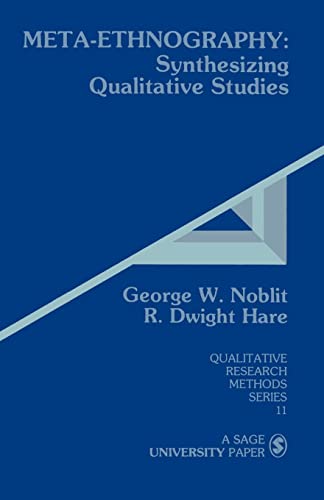
Synopsis
How can ethnographic studies be generalized, in contrast to concentrating on the individual case? Noblit and Hare propose a new method for synthesizing from qualitative studies: meta-ethnography. After citing the criteria to be used in comparing qualitative research projects, the authors define the ways these can then be aggregated to create more cogent syntheses of research. Using examples from numerous studies ranging from ethnographic work in educational settings to the Mead-Freeman controversy over Samoan youth, Meta-Ethnography offers useful procedural advice from both comparative and cumulative analyses of qualitative data. This provocative volume will be read with interest by researchers and students in qualitative research methods, ethnography, education, sociology, and anthropology. "After defining metaphor and synthesis, these authors provide a step-by-step program that will allow the researcher to show similarity (reciprocal translation), difference (refutation), or similarity at a higher level (lines or argument synthesis) among sample studies....Contain(s) valuable strategies at a seldom-used level of analysis." --Contemporary Sociology "The authors made an important contribution by reframing how we think of ethnography comparison in a way that is compatible with the new developments in interpretive ethnography. Meta-Ethnography is well worth consulting for the problem definition it offers." --The Journal of Nervous and Mental Disease "This book had to be written and I am pleased it was. Someone needed to break the ice and offer a strategy for summarizing multiple ethnographic studies. Noblit and Hare have done a commendable job of giving the research community one approach for doing so. Further, no one else can now venture into this area of synthesizing qualitative studies without making references to and positioning themselves vis-a-vis this volume." -Educational Studies
"synopsis" may belong to another edition of this title.
About the Author
George W. Noblit became a sociologist in the 1970s, a time of turbulent social change. Research on crime, delinquency and deviance led to a focus on schooling in the lives and futures of youth. Through a study of school desegregation, he began a program of research on the social construction of race, using ethnographic research to study schools and other educational scenes. Noblit is intrigued with how knowledge―often taken as good in its own right―is implicated in creating the very problems it is asked to solve. Noblit studies the various ways knowledge is constructed and how the competition over which knowledge counts construct powers and difference. This process means exploring both the highest reaches of theory and the everyday lives of people as they struggle to make sense of the world. To Noblit, “there is not a theory-practice gap, only a failure of imagination.” Noblit conducts funded evaluation projects, most recently on A+ (arts-enhanced) schools (the subject of his 2009 book), charter schools and prison education for youth adult offenders in North Carolina. “For me, evaluation and policy studies are a way to be part of larger political processes in our society,” he says, “and to help shape the agendas of important innovations.”
From the Back Cover
How can ethnographic studies be generalized, in contrast to concentrating on the individual case? Noblit and Hare propose a new method for synthesizing from qualitative studies: meta-ethnography. After citing the criteria to be used in comparing qualitative research projects, the authors define the ways these can then be aggregated to create more cogent syntheses of research. Using examples from numerous studies ranging from ethnographic work in educational settings to the Mead-Freeman controversy over Samoan youth, Meta-Ethnography offers useful procedural advice from both comparative and cumulative analyses of qualitative data. This provocative volume will be read with interest by researchers and students in qualitative research methods, ethnography, education, sociology, and anthropology. "After defining metaphor and synthesis, these authors provide a step-by-step program that will allow the researcher to show similarity (reciprocal translation), difference (refutation), or similarity at a higher level (lines or argument synthesis) among sample studies....Contain(s) valuable strategies at a seldom-used level of analysis." --Contemporary Sociology "The authors made an important contribution by reframing how we think of ethnography comparison in a way that is compatible with the new developments in interpretive ethnography. Meta-Ethnography is well worth consulting for the problem definition it offers." --The Journal of Nervous and Mental Disease "This book had to be written and I am pleased it was. Someone needed to break the ice and offer a strategy for summarizing multiple ethnographic studies. Noblit and Hare have done a commendable job of giving the research community one approach for doing so. Further, no one else can now venture into this area of synthesizing qualitative studies without making references to and positioning themselves vis-a-vis this volume." -Educational Studies
"About this title" may belong to another edition of this title.
Search results for Meta-Ethnography: Synthesizing Qualitative Studies...

Stock Image
Meta-Ethnography: Synthesizing Qualitative Studies (Qualitative Research Methods)
Seller: HPB-Red, Dallas, TX, U.S.A.
Seller rating 5 out of 5 stars

paperback. Condition: Good. Connecting readers with great books since 1972! Used textbooks may not include companion materials such as access codes, etc. May have some wear or writing/highlighting. We ship orders daily and Customer Service is our top priority! Seller Inventory # S_443380555
Stock Image
Meta-Ethnography: Synthesizing Qualitative Studies
Seller: ThriftBooks-Atlanta, AUSTELL, GA, U.S.A.
Seller rating 5 out of 5 stars
Paperback. Condition: Good. No Jacket. Pages can have notes/highlighting. Spine may show signs of wear. ~ ThriftBooks: Read More, Spend Less. Seller Inventory # G0803930232I3N00
Stock Image
Meta-Ethnography : Synthesizing Qualitative Studies
Published by
SAGE Publications, Incorporated, 1988
ISBN 10: 0803930232
ISBN 13: 9780803930230
Used
Softcover
Seller: Better World Books, Mishawaka, IN, U.S.A.
Seller rating 5 out of 5 stars
Condition: Good. Pages intact with minimal writing/highlighting. The binding may be loose and creased. Dust jackets/supplements are not included. Stock photo provided. Product includes identifying sticker. Better World Books: Buy Books. Do Good. Seller Inventory # GRP75247625
Stock Image
Meta-Ethnography : Synthesizing Qualitative Studies
Published by
SAGE Publications, Incorporated, 1988
ISBN 10: 0803930232
ISBN 13: 9780803930230
Used
Softcover
Seller: Better World Books, Mishawaka, IN, U.S.A.
Seller rating 5 out of 5 stars
Condition: Very Good. Former library copy. Pages intact with possible writing/highlighting. Binding strong with minor wear. Dust jackets/supplements may not be included. Includes library markings. Stock photo provided. Product includes identifying sticker. Better World Books: Buy Books. Do Good. Seller Inventory # GRP97060412
Stock Image
Meta-Ethnography: Synthesizing Qualitative Studies (Qualitative Research Methods): 11
Seller: WorldofBooks, Goring-By-Sea, WS, United Kingdom
Seller rating 5 out of 5 stars
Paperback. Condition: Very Good. The book has been read, but is in excellent condition. Pages are intact and not marred by notes or highlighting. The spine remains undamaged. Seller Inventory # GOR008313702
Buy Used
£ 20
£ 5.60 shipping
Ships from United Kingdom to U.S.A.
Ships from United Kingdom to U.S.A.
Quantity: 1 available
Stock Image
Meta-Ethnography : Synthesizing Qualitative Studies
Published by
SAGE Publications, Incorporated, 1988
ISBN 10: 0803930232
ISBN 13: 9780803930230
Used
Softcover
Seller: Better World Books Ltd, Dunfermline, United Kingdom
Seller rating 5 out of 5 stars
Condition: Good. Former library copy. Pages intact with minimal writing/highlighting. The binding may be loose and creased. Dust jackets/supplements are not included. Includes library markings. Stock photo provided. Product includes identifying sticker. Better World Books: Buy Books. Do Good. Seller Inventory # 45821380-20
Buy Used
£ 23.43
£ 5 shipping
Ships from United Kingdom to U.S.A.
Ships from United Kingdom to U.S.A.
Quantity: 1 available
Seller Image
Meta-Ethnography; Synthesizing Qualitative Studies (Publisher series: Qualitative Research Methods Series.)
Published by
Sage Publications, Newbury Park
ISBN 10: 0803930232
ISBN 13: 9780803930230
Used
Softcover
Seller: Burton Lysecki Books, ABAC/ILAB, Winnipeg, MB, Canada
Seller rating 5 out of 5 stars
[0-8039-3023-2] 1988. (Trade paperback) Near fine. 88pp. Tables, bibliography. Publisher series: Qualitative Research Methods Series 11. (Anthropology, Ethnography). Seller Inventory # 158684
Seller Image
Meta-Ethnography : Synthesizing Qualitative Studies
Seller: GreatBookPrices, Columbia, MD, U.S.A.
Seller rating 5 out of 5 stars
Condition: New. Seller Inventory # 254075-n
Seller Image
Meta-Ethnography: Synthesizing Qualitative Studies (Paperback or Softback)
Published by
Sage Publications (CA) 2/1/1988, 1988
ISBN 10: 0803930232
ISBN 13: 9780803930230
New
Paperback or Softback
Seller: BargainBookStores, Grand Rapids, MI, U.S.A.
Seller rating 5 out of 5 stars
Paperback or Softback. Condition: New. Meta-Ethnography: Synthesizing Qualitative Studies. Book. Seller Inventory # BBS-9780803930230
Seller Image
Meta-Ethnography : Synthesizing Qualitative Studies
Seller: GreatBookPrices, Columbia, MD, U.S.A.
Seller rating 5 out of 5 stars
Condition: As New. Unread book in perfect condition. Seller Inventory # 254075