
Items related to Wins, Losses, and Empty Seats: How Baseball Outlasted...
Synopsis
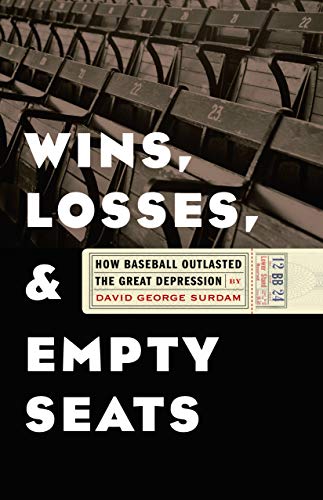
Organized baseball has survived its share of difficult times, and never was the state of the game more imperiled than during the Great Depression. Or was it? Remarkably, during the economic upheavals of the Depression none of the sixteen Major League Baseball teams folded or moved. In this economist’s look at the sport as a business between 1929 and 1941, David George Surdam argues that although it was a very tough decade for baseball, the downturn didn’t happen immediately. The 1930 season, after the stock market crash, had record attendance. But by 1931 attendance began to fall rapidly, plummeting 40 percent by 1933. To adjust, teams reduced expenses by cutting coaches and hiring player-managers. While even the best players, such as Babe Ruth, were forced to take pay cuts, most players continued to earn the same pay in terms of purchasing power. Baseball remained a great way to make a living. Revenue sharing helped the teams in small markets but not necessarily at the expense of big-city teams. Off the field, owners devised innovative solutions to keep the game afloat, including the development of the Minor League farm system, night baseball, and the first radio broadcasts to diversify teams’ income sources. Using research from primary documents, Surdam analyzes how the economic structure and operations side of Major League Baseball during the Depression took a beating but managed to endure, albeit changed by the societal forces of its time.
"synopsis" may belong to another edition of this title.
About the Author
David George Surdam is an associate professor of economics at the University of Northern Iowa. He is the author of The Postwar Yankees: Baseball’s Golden Age Revisited (Nebraska 2008) and Northern Naval Superiority and the Economics of the American Civil War.
"About this title" may belong to another edition of this title.
Search results for Wins, Losses, and Empty Seats: How Baseball Outlasted...

Stock Image
Wins Losses and Empty Seats Ho
Published by
University of Nebraska Press, 2011
ISBN 10: 0803234821
ISBN 13: 9780803234826
Used
Hardcover
Seller: World of Books (was SecondSale), Montgomery, IL, U.S.A.
Seller rating 5 out of 5 stars

Condition: Very Good. Item in very good condition! Textbooks may not include supplemental items i.e. CDs, access codes etc. Seller Inventory # 00106695616
Stock Image
Wins, Losses, and Empty Seats: How Baseball Outlasted the Great Depression
Published by
University of Nebraska Press, 2011
ISBN 10: 0803234821
ISBN 13: 9780803234826
Used
Hardcover
Seller: ThriftBooks-Dallas, Dallas, TX, U.S.A.
Seller rating 5 out of 5 stars
Hardcover. Condition: As New. No Jacket. Pages are clean and are not marred by notes or folds of any kind. ~ ThriftBooks: Read More, Spend Less. Seller Inventory # G0803234821I2N00
Stock Image
Wins, Losses, and Empty Seats: How Baseball Outlasted the Great Depression
Published by
University of Nebraska Press, 2011
ISBN 10: 0803234821
ISBN 13: 9780803234826
Used
Hardcover
Seller: Midtown Scholar Bookstore, Harrisburg, PA, U.S.A.
Seller rating 5 out of 5 stars
Hardcover. Condition: Good. Good - Bumped and creased book with tears to the extremities, but not affecting the text block, may have remainder mark or previous owner's name - GOOD Standard-sized. Seller Inventory # M0803234821Z3
Stock Image
Wins, Losses, and Empty Seats: How Baseball Outlasted the Great Depression
Published by
University of Nebraska Press, 2011
ISBN 10: 0803234821
ISBN 13: 9780803234826
Used
Hardcover
Seller: Sharehousegoods, Colgate, WI, U.S.A.
Seller rating 5 out of 5 stars
Condition: Good. This is an ex-library book with library stickers and customary markings.hardcoverUsed - Good. Seller Inventory # MO-44-01-00039
Stock Image
Wins, Losses, and Empty Seats: How Baseball Outlasted the Great Depression
Published by
University of Nebraska Press, 2011
ISBN 10: 0803234821
ISBN 13: 9780803234826
Used
Hardcover
Seller: Omaha Library Friends, Omaha, NE, U.S.A.
Seller rating 5 out of 5 stars
hardcover. Condition: Used; good. Dust Jacket Condition: Used; good. Ex-library, with expected library markings. Binding is tight and square. Contents are crisp, clean, complete and undamaged. Book was donated to Friends of Omaha Public Library. Seller Inventory # 240118025
Stock Image
Wins, Losses, and Empty Seats Format: Hardcover
Published by
University of Nebraska Press, 2011
ISBN 10: 0803234821
ISBN 13: 9780803234826
New
Hardcover
Seller: INDOO, Avenel, NJ, U.S.A.
Seller rating 5 out of 5 stars
Condition: New. Brand New. Seller Inventory # 9780803234826
Stock Image
Wins, Losses, and Empty Seats: How Baseball Outlasted the Great Depression
Published by
University of Nebraska Press, 2011
ISBN 10: 0803234821
ISBN 13: 9780803234826
New
Hardcover
Seller: California Books, Miami, FL, U.S.A.
Seller rating 5 out of 5 stars
Condition: New. Seller Inventory # I-9780803234826
Stock Image
Wins, Losses, and Empty Seats (Hardcover)
Published by
University of Nebraska Press, Lincoln, 2011
ISBN 10: 0803234821
ISBN 13: 9780803234826
New
Hardcover
Seller: Grand Eagle Retail, Bensenville, IL, U.S.A.
Seller rating 5 out of 5 stars
Hardcover. Condition: new. Hardcover. Organized baseball has survived its share of difficult times, and never was the state of the game more imperiled than during the Great Depression. Or was it? Remarkably, during the economic upheavals of the Depression none of the sixteen Major League Baseball teams folded or moved. In this economists look at the sport as a business between 1929 and 1941, David George Surdam argues that although it was a very tough decade for baseball, the downturn didnt happen immediately. The 1930 season, after the stock market crash, had record attendance. But by 1931 attendance began to fall rapidly, plummeting 40 percent by 1933. To adjust, teams reduced expenses by cutting coaches and hiring player-managers. While even the best players, such as Babe Ruth, were forced to take pay cuts, most players continued to earn the same pay in terms of purchasing power. Baseball remained a great way to make a living. Revenue sharing helped the teams in small markets but not necessarily at the expense of big-city teams. Off the field, owners devised innovative solutions to keep the game afloat, including the development of the Minor League farm system, night baseball, and the first radio broadcasts to diversify teams income sources. Using research from primary documents, Surdam analyzes how the economic structure and operations side of Major League Baseball during the Depression took a beating but managed to endure, albeit changed by the societal forces of its time. Organised baseball has survived its share of difficult times, and never was the state of the game more imperiled than during the Great Depression. Or was it? In this economist's look at the sport as a business between 1929 and 1941, David George Surdam argues that although it was a very tough decade for baseball, the downturn didn't happen immediately. Shipping may be from multiple locations in the US or from the UK, depending on stock availability. Seller Inventory # 9780803234826
Stock Image
Wins, Losses, and Empty Seats: How Baseball Outlasted the Great Depression
Published by
University of Nebraska Press, 2011
ISBN 10: 0803234821
ISBN 13: 9780803234826
New
Hardcover
Seller: Kennys Bookshop and Art Galleries Ltd., Galway, GY, Ireland
Seller rating 5 out of 5 stars
Condition: New. An economic history of baseball in America during the Great Depression. Num Pages: 448 pages, 38 tables. BIC Classification: 1KBB; 3JJG; WSJT. Category: (P) Professional & Vocational. Dimension: 5487 x 3556 x 38. Weight in Grams: 703. . 2011. Illustrated. hardcover. . . . . Seller Inventory # V9780803234826
Stock Image
Wins, Losses, and Empty Seats How Baseball Outlasted the Great Depression
Seller: Revaluation Books, Exeter, United Kingdom
Seller rating 5 out of 5 stars
Hardcover. Condition: Brand New. 472 pages. 8.75x6.00x1.50 inches. In Stock. Seller Inventory # x-0803234821
Buy New
£ 58.42
£ 12.50 shipping
Ships from United Kingdom to U.S.A.
Ships from United Kingdom to U.S.A.
Quantity: 2 available