
Items related to Splitting Heirs: Giving Your Money and Things to Your...
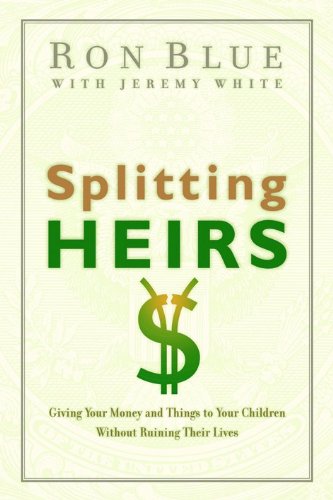
Splitting Heirs: Giving Your Money and Things to Your Children Without Ruining Their Lives - Softcover
Synopsis
Many financial resources are confusing to the average person. Leading Christian financial expert Larry Burkett answers the call for a simplified, yet comprehensive guide to financial management with The World's Easiest Guide to Finances. It is a comprehensive reference work that makes complicated terms and concepts easy to grasp with a touch of humor, and builds the confidence of a person of any experience level that they can understand and implement the information. Features helpful CD-ROM with the following contents:
- Interactive Budgeting Guide: Users simply enter their current expenses and this handy guide provides a visual representation of their budgets.
- The Debt Eliminator: Users enter debts amounts, payment information, and interest rates, and this helpful tool gives prioritized plans to pay off their debts.
"synopsis" may belong to another edition of this title.
About the Author
RON BLUE is a successful entrepreneur in the financial services industry and an admired leader and speaker on the topic of Biblical financial management. In 1970, he founded an Indianapolis-based CPA firm which has grown to be one of the 50 largest CPA firms in the United States. In 1979, he founded Ronald Blue & Co., a fee-only financial planning firm, convinced that Christians would better handle their personal finances if they were counseled objectively with the highest technical expertise and from a Biblical perspective. Ron is the author of twelve books on personal finance from a Biblical perspective, including the best-seller, Master Your Money, and his most recent book, Wealth to Last, co-authored with Larry Burkett. He is currently the President of Kingdom Advisors and lives in Atlanta, Georgia.
Excerpt. © Reprinted by permission. All rights reserved.
Splitting Heirs
Giving Your Money and Things to Your Children Without Ruining Their LivesBy Ron BlueNorthfield Publishers
Copyright © 2008 Ron BlueAll right reserved.
ISBN: 9780802413765
Chapter One
CONFESSIONS OF PROCRASTINATION* * *
I need to make a confession. Well, maybe two.
Over the years, I had returned to my hometown of Lafayette,Indiana, for reunions and holiday visits to my parents. Like a NormanRockwell print come to life, Lafayette has a town square atthe heart of its business district, a railroad at the heart of its midsection,and a local high school basketball team at the heart ofits entertainment.
I had bored my children on previous visits talking about myold stomping grounds. They heard the usual reflective stories,with very little exaggeration, about how I dominated the sportsscene at school, how I walked miles to school uphill both ways,and how I often shoveled three feet of snow off the widows' sidewalkson the way for no pay.
But in 1991, I returned to Lafayette for the funeral of mymother. Heart disease ended her life journey from an immigrant'sdaughter and a faithful spouse of fifty years to a devoted motherof three boys. My mind was flooded with many fond memoriesof my mom and my childhood. The first important woman inmy life was gone.
My two younger brothers and I had never experienced death inour immediate family. Dad was facing the loss of the woman withwhom he'd spent a lifetime. He'd gone through so much with her-theups and downs of life in small town America. The sense of lossweighed mightily. We all knew that a big part of our lives was gone.
But we were men. We could handle this. It's life, part of God'splan. She's in a better place. It would be okay. Time would healthe hurt. You know, I realized clichis are clichis for good reason-though they ring true, they ring hollow. They had no healingpower for my heartache or sadness, no relief for my loss.
We four men stood at the funeral, shoulder to shoulder. Emotionssuppressed and faces stoic. Sweaty hands folded and claspedbehind us. We hardly spoke. It was a beautiful funeral service withtender words sincerely expressed by loved ones and well-wishers.Now it was over.
As we were driving home my wife, Judy, said, "I was wonderinghow you men would handle this. It fascinated me to seehow you four men were so nonemotional and unsentimental."It was an understandable observation. Dad, my brothers Davidand Wendel, and I were not expressive types. Having emotionsis one thing, but expressing them is another. What's a grown, professionalman supposed to do at his mother's funeral? Cry? Be atower of strength? Look solemn and controlled? This was a newexperience for all of us.
I know I was sad though. I also know that I never said all thethings I would have liked to say while Mom was alive. The dayMom died at the hospital, I happened to be alone in their housebefore the rest of the family returned. As I was quietly walkingthrough the house, I saw a yellow note on the kitchen table in herhandwriting: "Call Ron." A phone call that I wish had happenedbut didn't.
I wanted to do better with Dad, but that meant man-to-mantalk. Son to father. That was not going to be easy. Dad had graduatedfrom high school and worked in a factory; he was a self-made,hard-working man. Well respected in the community, heeventually became mayor of Lafayette. He was a part of that generationthat lived with a lot of privacy. I never remember him saying,"I love you." In my forties I finally told him I loved him, andthen he told me he loved me. It was a bit like getting an eight-year-old boy to say "sorry" to his little sister-the words didn't comeout easily. That was the first time we hugged each other as adults.
Time passed without my bringing up such difficult conversations.Life was moving along like swift rapids. My business in Atlantawas demanding, challenging, and rewarding during theboom years of the 1990s. Our children were growing up, finishingcollege, and getting married. We were becoming grandparents.
As for my dad? Like any widower or widow, he moped alittle and coped a lot. He remarried a couple of years after Mom'sdeath. His new wife, Edna, was a wonderful companion for him.Things seemed back to normal. And "normal" included we mennot talking to each other about matters much beyond news,sports, business, and weather.
Several years later, Dad began to have lung trouble. In 2001I got "the call" to go back to Lafayette because Dad's lung diseasehad advanced dramatically. He was in the hospital again.We knew he had an incurable, fatal illness, but none of us knewwhen it would take him. All of a sudden it seemed the momentwas upon us. The end-of-game buzzer was about to sound. I realizedany discussion of his final plans must start with me.
Driving to the hospital on a drab, gray day, I turned on familiarstreets that hadn't changed much in nearly fifty years. Once thiswas my world, but since leaving home I'd lived in New York,San Francisco, Dallas, and Atlanta. I was privileged to travel toTokyo, London, Nairobi, Johannesburg, and Hong Kong. Lafayetteseemed rather small and ordinary. I was struck by the reality thatthe world I'd grown up in and the world I now lived in might aswell be on different continents. And the same was true for Dadand me. We seemed to be in different worlds.
Dad was in the same community hospital in which I was born.It's curious how birth and death stand side by side. Odd neighborsindeed. I'd been at this unspectacular brick box of a buildingover the years to visit various friends and relatives, but todaywas different. It was beckoning me to a final meeting with my dad.What would he say? An even more unnerving thought: Whatwould I say?
I knew I'd not done well with my desire to communicate betterwith him following Mom's death. My rationalization? If anyonehad permission to communicate poorly with his family, asan accountant I did! Being a "numbers guy," I wasn't supposedto be the world's best communicator.
So, here's my confession. My father was eighty-three years oldand within forty-eight hours of death. I was headed to his bedsidewithout ever having had a single conversation with him abouthow to handle things after his death.
I had worked on estate plans for hundreds of clients, writtenbooks about family financial matters, spoken to many conferencesand charitable organizations about estate planning. But I knewvery little of Dad's finances, was unsure what was in his will, andhad no idea how he wanted to dispose of assets. During all thosevisits and phone calls over the years, we'd never talked about whatto do upon his death. I knew the biblical principles of finance andwealth transfer yet hadn't talked to Dad about his final affairs.
I pulled up at the hospital and slowly walked inside. It smelledof cleaning solution and didn't look like any interior decoratorhad ever worked it over. Some nurses bustled by, while othersbent over desks cluttered with papers and computers. I found myway along the corridors to his room.
Surprisingly, Dad didn't look like a man who was dying. Hismind was in great shape, and he was talkative. But his breathingwas labored like a man with a heavy weight on his chest. Dadknew he would never return home, and I did too. This wouldprobably be our last time to talk.
I was relieved when Dad brought up the matter of his lastwishes. Most of his desires were pretty straightforward-dividehis stuff equally among the three sons. But there was one pointwhere Dad got emotional. He wanted my middle brother, David,to have his car. He had not put this in his will. But with anxietyin his voice, he was urgently telling me, his oldest son, to takecare of it.
Many years earlier Dad had helped Wendel and me each geta good car at a crucial point in our lives, but not David. He wantedto make that right. He knew David needed the car more thanWendel or I did. A simple yet loving last gesture from a father whowanted his sons treated fairly.
Dad talked about a few funeral matters and some issues relatedto the care of his wife. His lucid discussion and heartfeltdesire to help my brother were bright spots in a dreary day. Wefinished, I told him I loved him, and I left. It was my last conversationalone with my father.
I'm sure scenes like I've described occur all over the countryevery day. Working with thousands of clients over the years, I'veseen it regularly. In fact I've seen it at both ends-older folkswho haven't prepared their heirs and younger folks who haven'tasked if they can be of assistance in any way as their parents preparefor their aging years.
It's common for parents to leave these matters to the last daysor last minutes of life. But we don't always know when those lastdays will be. Judy and I were dating when her father, a promisingyoung doctor, learned he had cancer. After all the years ofschool and residency and getting his practice established, he andhis family were beginning to enjoy the high income of a physician.
Judy and I accelerated our wedding date so her dad could walkher down the aisle. Tragically, he didn't make it. Our weddingwas filled with mixed emotions-we had just seen many of ourwedding guests a few weeks earlier at a funeral.
Despite my father-in-law's education and sophistication, hehadn't prepared his family for his death. One of his best friendssold life insurance, but he hadn't bought any. Within months ofhis death, Judy's mom had to return to work as a nurse at ageforty-three. Judy's youngest brother, about twelve at the time, hadlost not only his father to death, but also his mother to the workforce.Later they sold their house and moved to an apartment.Judy's mom struggled financially for many years because her husbanddid not prepare properly. It didn't have to be that way.
Beginning a Burden, Igniting a Passion
When Dad died, he was the last of Judy's and my parents topass away. After his memorial service, I realized that I was kindof the head of the clan now. As oldest son and already a grandfather,I knew I had a position of responsibility in the family. Iwanted to do a better job planning and discussing my estate withmy children than I had done with my father. We needed to breakthe silence on matters of death, asset transfer, charitable giving,and preparing our children for what they might or might notreceive.
Analysts project that $41 trillion (that's right, this number hasa "t" on it) of wealth will transfer in the United States over the nextfifty years. A trillion is a million of one millions. Do you knowhow long it would take to count to a trillion? If you countednonstop with no bathroom breaks, without eating or sleeping, itwould take 31,710 years to count to one trillion. It would be aboring 1.3 million years to count to $41 trillion. As big andunimaginable as the U.S. government debt is, it is only one-sixthof the amount that will move out of the hands of one generationinto another.
Dad and I didn't do it right. Judy's dad didn't do it right. Isee others doing it wrong every day. I have a burden to see allthis change-starting with you. You don't have to make the samemistakes. Some adult children are about to inherit a sum thathas the capacity to change their lives-for better or worse. Somecharities may-or may not-receive bequests that could helpthem make lasting spiritual, cultural, or medical changes.
One would think that this issue of wealth transfer involvingtrillions and trillions would be big news. Surely, people wouldbe talking about this, acting upon it, seizing opportunities, makingplans. But seeing the same problem on both sides of my familyacross forty years and with many others time after time, I findthat most people have done nothing.
Oh, they may have a will-but it is often out of date. Andthey almost certainly have not had those important conversationswith children and family members that prepare them for what theywill face after parents die. Most of us feel quite unprepared for thattype of family discussion. We are intimidated by the emotions itmight bring out. That's why I've written this book to help people-richand not-so-rich, men and women, young and old-successfullycomplete a difficult and complex process.
I think there is a better way. And I've found that there are biblicalprinciples that can guide us through this process of preparingfor "when," not "if," something happens. From a straightforwardfinancial man, here are the straightforward realities:
(1) We will all die.
(2) We will take nothing with us.
(3) We will probably die at a time other than when we would like.
(4) Someone else will get our stuff.
(5) We can decide only before we die who gets our stuff after we die.
Why Keep Reading a Book Reminding Me of Death-Especially Mine?
Necessarily, this book will discuss death. But it does so inthe context of helping you live life to the fullest. In the Bible, Paultells Timothy of the goal to "take hold of the life that is truly life"(1 Timothy 6: 19). I want you to be one of the few, the proud,the ones who finish well. We can still laugh at ourselves in themidst of a serious topic. That's why I have included cartoons at thebeginning of each chapter. We might as well smile as we grapplewith the challenges of death.
Some estate planning books focus on the challenges of thesuper-rich and their desire to reduce estate taxes. Such booksare usually written on a technical level and focus on complicatedtrusts, foundations, and techniques. Rather than focus solely onthe legal, financial, and technical aspects of estate planning andinheritances, I think readers can benefit from the relational andspiritual dimensions of wealth transfer. So, much of this bookdeals with family relations (and conflicts), the importance of giving,and God's principles and promises.
News articles and popular culture often focus on high-profilefamily feuds. Their typical case study is Dad the Entrepreneur andControl Freak who founded a successful company and is worthhundreds of millions.
Dad the Entrepreneur and Control Freak spends a modest fortuneon complicated schemes with Good Ol' Boy Lawyer to keepthe Old Wife and her New Husband from getting the riches. Or,the so-called estate planning gets messier when there is a remarriage.Dad the Control Freak doesn't want the Old Wife to takeall the money away from his New Young Greedy Wife. The Oldand Resentful Kids try to influence Dad the Control Freak to excludethe Young Spoiled Kids of New Young Greedy Wife from anequal inheritance. Some of the Old and Resentful Kids haveworked for years in the company to get Dad's approval; othershave rebellious lifestyles.
Continues...
Excerpted from Splitting Heirsby Ron Blue Copyright © 2008 by Ron Blue. Excerpted by permission.
All rights reserved. No part of this excerpt may be reproduced or reprinted without permission in writing from the publisher.
Excerpts are provided by Dial-A-Book Inc. solely for the personal use of visitors to this web site.
"About this title" may belong to another edition of this title.
Search results for Splitting Heirs: Giving Your Money and Things to Your...

Stock Image
Splitting Heirs
Seller: World of Books (was SecondSale), Montgomery, IL, U.S.A.
Seller rating 5 out of 5 stars

Paperback. Condition: Fair. The financial wealth you leave behind could be the best thing that ever happened to your loved ones--or the worst. By approaching these important topics with clarity, conviction, and a little bit of humor, financial advisor Ron Blue explains why it is important to make these decisions now, instead of forcing your heirs to do it later. Even if your nest egg is small, it can have a huge impact on the next generation. With practical tips, tools, charts, and worksheets, this book will foster a real appreciation for the precious resources that God has entrusted to your care. Seller Inventory # CIN0802413765A
Stock Image
Splitting Heirs
Seller: World of Books (was SecondSale), Montgomery, IL, U.S.A.
Seller rating 5 out of 5 stars
Paperback. Condition: Good. The financial wealth you leave behind could be the best thing that ever happened to your loved ones--or the worst. By approaching these important topics with clarity, conviction, and a little bit of humor, financial advisor Ron Blue explains why it is important to make these decisions now, instead of forcing your heirs to do it later. Even if your nest egg is small, it can have a huge impact on the next generation. With practical tips, tools, charts, and worksheets, this book will foster a real appreciation for the precious resources that God has entrusted to your care. Seller Inventory # 00108495041
Stock Image
Splitting Heirs
Seller: World of Books (was SecondSale), Montgomery, IL, U.S.A.
Seller rating 5 out of 5 stars
Paperback. Condition: Very Good. The financial wealth you leave behind could be the best thing that ever happened to your loved ones--or the worst. By approaching these important topics with clarity, conviction, and a little bit of humor, financial advisor Ron Blue explains why it is important to make these decisions now, instead of forcing your heirs to do it later. Even if your nest egg is small, it can have a huge impact on the next generation. With practical tips, tools, charts, and worksheets, this book will foster a real appreciation for the precious resources that God has entrusted to your care. Seller Inventory # 00101891061
Stock Image
Splitting Heirs : Giving Your Money and Things to Your Children Without Ruining Their Lives
Seller: Better World Books, Mishawaka, IN, U.S.A.
Seller rating 5 out of 5 stars
Condition: Good. Pages intact with minimal writing/highlighting. The binding may be loose and creased. Dust jackets/supplements are not included. Stock photo provided. Product includes identifying sticker. Better World Books: Buy Books. Do Good. Seller Inventory # 3495465-6
Stock Image
Splitting Heirs : Giving Your Money and Things to Your Children Without Ruining Their Lives
Seller: Better World Books, Mishawaka, IN, U.S.A.
Seller rating 5 out of 5 stars
Condition: Good. Former library copy. Pages intact with minimal writing/highlighting. The binding may be loose and creased. Dust jackets/supplements are not included. Includes library markings. Stock photo provided. Product includes identifying sticker. Better World Books: Buy Books. Do Good. Seller Inventory # 45878968-6
Seller Image
Splitting Heirs: Giving Your Money and Things to Your Children Without Ruining Their Lives
Seller: The Happy Book Stack, Murfreesboro, TN, U.S.A.
Seller rating 5 out of 5 stars
Condition: good. Book is in good condition and has some writing, underlining, and or highlighting inside. Cover may have some cosmetic wear. Seller Inventory # HBSV.0802413765.G
Stock Image
Splitting Heirs
Seller: World of Books Inc, Montgomery, IL, U.S.A.
Seller rating 4 out of 5 stars

Paperback. Condition: Good. The financial wealth you leave behind could be the best thing that ever happened to your loved ones--or the worst. By approaching these important topics with clarity, conviction, and a little bit of humor, financial advisor Ron Blue explains why it is important to make these decisions now, instead of forcing your heirs to do it later. Even if your nest egg is small, it can have a huge impact on the next generation. With practical tips, tools, charts, and worksheets, this book will foster a real appreciation for the precious resources that God has entrusted to your care. Seller Inventory # CIN0802413765G
Stock Image
Splitting Heirs
Seller: World of Books Inc, Montgomery, IL, U.S.A.
Seller rating 4 out of 5 stars
Paperback. Condition: Very Good. The financial wealth you leave behind could be the best thing that ever happened to your loved ones--or the worst. By approaching these important topics with clarity, conviction, and a little bit of humor, financial advisor Ron Blue explains why it is important to make these decisions now, instead of forcing your heirs to do it later. Even if your nest egg is small, it can have a huge impact on the next generation. With practical tips, tools, charts, and worksheets, this book will foster a real appreciation for the precious resources that God has entrusted to your care. Seller Inventory # CIN0802413765VG
Stock Image
Splitting Heirs
Seller: World of Books Inc, Montgomery, IL, U.S.A.
Seller rating 4 out of 5 stars
Paperback. Condition: Fair. The financial wealth you leave behind could be the best thing that ever happened to your loved ones--or the worst. By approaching these important topics with clarity, conviction, and a little bit of humor, financial advisor Ron Blue explains why it is important to make these decisions now, instead of forcing your heirs to do it later. Even if your nest egg is small, it can have a huge impact on the next generation. With practical tips, tools, charts, and worksheets, this book will foster a real appreciation for the precious resources that God has entrusted to your care. Seller Inventory # CIN0802413765A
Stock Image
Splitting Heirs: Giving Your Money and Things to Your Children Without Ruining Their Lives
Seller: HPB-Diamond, Dallas, TX, U.S.A.
Seller rating 5 out of 5 stars
Paperback. Condition: Very Good. Connecting readers with great books since 1972! Used books may not include companion materials, and may have some shelf wear or limited writing. We ship orders daily and Customer Service is our top priority! Seller Inventory # S_487419355