
Items related to Conceiving Risk, Bearing Responsibility: Fetal Alcohol...
Conceiving Risk, Bearing Responsibility: Fetal Alcohol Syndrome and the Diagnosis of Moral Disorder - Softcover
Synopsis
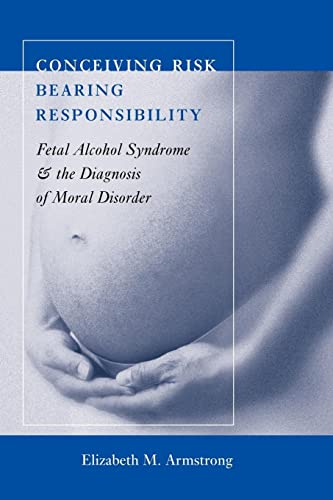
In American society, the consumption of alcohol during pregnancy is considered dangerous, irresponsible, and in some cases illegal. Pregnant women who have even a single drink routinely face openly voiced reproach. Yet fetal alcohol syndrome (FAS) in infants and children is notoriously difficult to diagnose, and the relationship between alcohol and adverse birth outcomes is riddled with puzzles and paradoxes. Sociologist Elizabeth M. Armstrong uses fetal alcohol syndrome and the problem of drinking during pregnancy to examine the assumed relationship between somatic and social disorder, the ways in which social problems are individualized, and the intertwining of health and morality that characterizes American society. She traces the evolution of medical knowledge about the effects of alcohol on fetal development, from nineteenth-century debates about drinking and heredity to the modern diagnosis of FAS and its kindred syndromes. She argues that issues of race, class, and gender have influenced medical findings about alcohol and reproduction and that these findings have always reflected broader social and moral preoccupations and, in particular, concerns about women's roles and place in society, as well as the fitness of future generations. Medical beliefs about drinking during pregnancy have often ignored the poverty, chaos, and insufficiency of some women's livesÑfactors that may be more responsible than alcohol for adverse outcomes in babies and children. Using primary sources and interviews to explore relationships between doctors and patients and women and their unborn children, Armstrong offers a provocative and detailed analysis of how drinking during pregnancy came to be considered a pervasive social problem, despite the uncertainties surrounding the epidemiology and etiology of fetal alcohol syndrome.
"synopsis" may belong to another edition of this title.
About the Author
Elizabeth M. Armstrong is an assistant professor of sociology and public affairs at Princeton University.
From the Back Cover
Finalist, C. Wright Mills Award, Society for the Study of Social Problems
Drinking during pregnancy has come to be considered a pervasive social problem, despite the uncertainties surrounding the epidemiology and etiology of fetal alcohol syndrome (FAS).
Sociologist Elizabeth M. Armstrong traces the evolution of medical knowledge about the effects of alcohol on fetal development from nineteenth-century debates about drinking and heredity to the modern diagnosis of FAS and its kindred syndromes. She argues that issues of race, class, and gender have influenced medical findings about alcohol and reproduction and that these findings have always reflected broader social and moral preoccupations--in particular, concerns about a woman's role and place in society. Medical beliefs about drinking during pregnancy have often ignored the poverty, chaos, and insufficiency of some women's lives--factors that may be more responsible than alcohol for adverse outcomes in babies and children.
"Armstrong draws attention to some important questions about our perceptions of responsibility for alcohol-related harm sustained during pregnancy . . . I hope that her book will lead to a healthy debate and a more objective ethical, medical, and scientific approach to this field in the future."--Addiction
"There is much to admire in Armstrong's account: her clever deconstruction of the advocates' invented history of FAS, her sure-handed discussion of the politics of reproduction, and her often fascinating interview material."--Perspectives in Biology and Medicine
"In this well-written book, Armstrong provides an in-depth analysis of fetal alcohol syndrome as a social problem."--American Journal of Sociology
"A well-researched, highly readable, and convincing example of the ways in which modern medicine continues to create myths, stigmatize the poor, and pathologize gender."--Social History of Medicine
Elizabeth M. Armstrong is an associate professor of sociology and public affairs at Princeton University.
From the Inside Flap
Finalist, C. Wright Mills Award, Society for the Study of Social Problems
Drinking during pregnancy has come to be considered a pervasive social problem, despite the uncertainties surrounding the epidemiology and etiology of fetal alcohol syndrome (FAS).
Sociologist Elizabeth M. Armstrong traces the evolution of medical knowledge about the effects of alcohol on fetal development from nineteenth-century debates about drinking and heredity to the modern diagnosis of FAS and its kindred syndromes. She argues that issues of race, class, and gender have influenced medical findings about alcohol and reproduction and that these findings have always reflected broader social and moral preoccupations--in particular, concerns about a woman's role and place in society. Medical beliefs about drinking during pregnancy have often ignored the poverty, chaos, and insufficiency of some women's lives--factors that may be more responsible than alcohol for adverse outcomes in babies and children.
Armstrong draws attention to some important questions about our perceptions of responsibility for alcohol-related harm sustained during pregnancy . . . I hope that her book will lead to a healthy debate and a more objective ethical, medical, and scientific approach to this field in the future.--Addiction
There is much to admire in Armstrong's account: her clever deconstruction of the advocates' invented history of FAS, her sure-handed discussion of the politics of reproduction, and her often fascinating interview material.--Perspectives in Biology and Medicine
In this well-written book, Armstrong provides an in-depth analysis of fetal alcohol syndrome as a social problem.--American Journal of Sociology
A well-researched, highly readable, and convincing example of the ways in which modern medicine continues to create myths, stigmatize the poor, and pathologize gender.--Social History of Medicine
Elizabeth M. Armstrong is an associate professor of sociology and public affairs at Princeton University.
--Charles E. Rosenberg, Harvard University "Perspectives in Biology and Medicine""About this title" may belong to another edition of this title.
Search results for Conceiving Risk, Bearing Responsibility: Fetal Alcohol...

Stock Image
Conceiving Risk, Bearing Responsibility: Fetal Alcohol Syndrome and the Diagnosis of Moral Disorder
Published by
Johns Hopkins University Press, 2008
ISBN 10: 0801891086
ISBN 13: 9780801891083
Used
paperback
Seller: Your Online Bookstore, Houston, TX, U.S.A.
Seller rating 5 out of 5 stars

paperback. Condition: Fair. Seller Inventory # 0801891086-4-35355638
Stock Image
Conceiving Risk, Bearing Responsibility: Fetal Alcohol Syndrome and the Diagnosis of Moral Disorder
Published by
Johns Hopkins University Press (edition 1), 2008
ISBN 10: 0801891086
ISBN 13: 9780801891083
Used
Paperback
Seller: BooksRun, Philadelphia, PA, U.S.A.
Seller rating 5 out of 5 stars
Paperback. Condition: Fair. 1. The item might be beaten up but readable. May contain markings or highlighting, as well as stains, bent corners, or any other major defect, but the text is not obscured in any way. Seller Inventory # 0801891086-7-1
Stock Image
Conceiving Risk, Bearing Responsibility: Fetal Alcohol Syndrome and the Diagnosis of Moral Disorder
Published by
Johns Hopkins University Press, 2008
ISBN 10: 0801891086
ISBN 13: 9780801891083
Used
Paperback
Seller: ThriftBooks-Atlanta, AUSTELL, GA, U.S.A.
Seller rating 5 out of 5 stars
Paperback. Condition: Good. No Jacket. Pages can have notes/highlighting. Spine may show signs of wear. ~ ThriftBooks: Read More, Spend Less. Seller Inventory # G0801891086I3N00
Stock Image
Conceiving Risk, Bearing Responsibility: Fetal Alcohol Syndrome and the Diagnosis of Moral Disorder
Published by
Johns Hopkins University Press, 2008
ISBN 10: 0801891086
ISBN 13: 9780801891083
Used
Paperback
Seller: ThriftBooks-Atlanta, AUSTELL, GA, U.S.A.
Seller rating 5 out of 5 stars
Paperback. Condition: Very Good. No Jacket. May have limited writing in cover pages. Pages are unmarked. ~ ThriftBooks: Read More, Spend Less. Seller Inventory # G0801891086I4N00
Stock Image
Conceiving Risk, Bearing Responsibility: Fetal Alcohol Syndrome and the Diagnosis of Moral Disorder
Published by
Johns Hopkins University Press, 2008
ISBN 10: 0801891086
ISBN 13: 9780801891083
Used
Paperback
Seller: ThriftBooks-Dallas, Dallas, TX, U.S.A.
Seller rating 5 out of 5 stars
Paperback. Condition: Good. No Jacket. Pages can have notes/highlighting. Spine may show signs of wear. ~ ThriftBooks: Read More, Spend Less. Seller Inventory # G0801891086I3N00
Stock Image
Conceiving Risk, Bearing Responsibility : Fetal Alcohol Syndrome and the Diagnosis of Moral Disorder
Published by
Johns Hopkins University Press, 2008
ISBN 10: 0801891086
ISBN 13: 9780801891083
Used
Softcover
Seller: Better World Books, Mishawaka, IN, U.S.A.
Seller rating 5 out of 5 stars
Condition: Good. Former library copy. Pages intact with minimal writing/highlighting. The binding may be loose and creased. Dust jackets/supplements are not included. Includes library markings. Stock photo provided. Product includes identifying sticker. Better World Books: Buy Books. Do Good. Seller Inventory # 17901404-75
Stock Image
Conceiving Risk, Bearing Responsibility: Fetal Alcohol Syndrome and the Diagnosis of Moral Disorder
Published by
Johns Hopkins University Press, 2008
ISBN 10: 0801891086
ISBN 13: 9780801891083
Used
paperback
Seller: HPB-Red, Dallas, TX, U.S.A.
Seller rating 5 out of 5 stars
paperback. Condition: Good. Connecting readers with great books since 1972! Used textbooks may not include companion materials such as access codes, etc. May have some wear or writing/highlighting. We ship orders daily and Customer Service is our top priority! Seller Inventory # S_454031029
Stock Image
Conceiving Risk, Bearing Responsibility: Fetal Alcohol Syndrome and the Diagnosis of Moral Disorder
Published by
Johns Hopkins University Press, 2008
ISBN 10: 0801891086
ISBN 13: 9780801891083
Used
Paperback
Seller: Textbook Bookie, Little Rock, AR, U.S.A.
Seller rating 5 out of 5 stars
Paperback. Condition: Good. Book in Good condition. Seller Inventory # 9780801891083-good
Stock Image
Conceiving Risk, Bearing Responsibility: Fetal Alcohol Syndrome and the Diagnosis of Moral Disorder
Published by
Johns Hopkins University Press, 2008
ISBN 10: 0801891086
ISBN 13: 9780801891083
Used
paperback
First Edition
Seller: Textbooks_Source, Columbia, MO, U.S.A.
Seller rating 5 out of 5 stars
paperback. Condition: Good. 1st Edition. Ships in a BOX from Central Missouri! May not include working access code. Will not include dust jacket. Has used sticker(s) and some writing or highlighting. UPS shipping for most packages, (Priority Mail for AK/HI/APO/PO Boxes). Seller Inventory # 000966610U
Seller Image
Conceiving Risk, Bearing Responsibility : Fetal Alcohol Syndrome & the Diagnosis of Moral Disorder
Published by
Johns Hopkins University Press, 2008
ISBN 10: 0801891086
ISBN 13: 9780801891083
Used
Softcover
Seller: GreatBookPrices, Columbia, MD, U.S.A.
Seller rating 5 out of 5 stars
Condition: good. May show signs of wear, highlighting, writing, and previous use. This item may be a former library book with typical markings. No guarantee on products that contain supplements Your satisfaction is 100% guaranteed. Twenty-five year bookseller with shipments to over fifty million happy customers. Seller Inventory # 5658621-5