
Items related to A Fine Balance
Synopsis
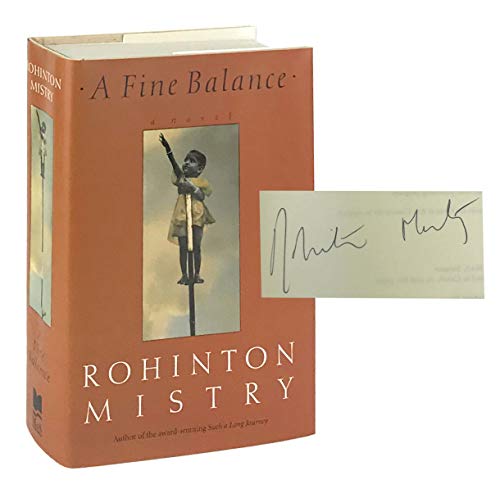
A Fine Balance, Rohinton Mistry’s stunning internationally acclaimed bestseller, is set in mid-1970s India. It tells the story of four unlikely people whose lives come together during a time of political turmoil soon after the government declares a “State of Internal Emergency.” Through days of bleakness and hope, their circumstances – and their fates – become inextricably linked in ways no one could have foreseen. Mistry’s prose is alive with enduring images and a cast of unforgettable characters. Written with compassion, humour, and insight, A Fine Balance is a vivid, richly textured, and powerful novel written by one of the most gifted writers of our time.
"synopsis" may belong to another edition of this title.
About the Author
Rohinton Mistry is the author of a collection of short stories, Tales from Firozsha Baag (1987), and three internationally acclaimed novels, Such a Long Journey (1991), A Fine Balance (1995), and Family Matters (2002). His fiction has won many prestigious international awards, including The Giller Prize, the Commonwealth Writers Prize for Best Book, the Governor General’s Award, the Canada-Australia Literary Prize, the Los Angeles Times Book Prize for Fiction, The Royal Society of Literature’s Winifred Holtby Award, and the Kiriyama Pacific Rim Book Prize for Fiction. A Fine Balance was also an Oprah’s Book Club® selection.
Born in Bombay in 1952, Rohinton Mistry came to Canada in 1975.
Excerpt. © Reprinted by permission. All rights reserved.
One: City By the Sea
Dina Dalal seldom indulged in looking back at her life with regret or bitterness, or questioning why things had turned out the way they had, cheating her of the bright future everyone had predicted for her when she was in school, when her name was still Dina Shroff. And if she did sink into one of these rare moods, she quickly swam out of it. What was the point of repeating the story over and over and over, she asked herself--it always ended the same way; whichever corridor she took, she wound up in the same room.
Dina's father had been a doctor, a GP with a modest practice who followed the Hippocratic oath somewhat more passionately than others of his profession. During the early years of Dr. Shroff's career, his devotion to his work was diagnosed, by peers, family members, and senior physicians, as typical of youthful zeal and vigour. "How refreshing, this enthusiasm of the young," they smiled, nodding sagely, confident that time would douse the fires of idealism with a healthy dose of cynicism and family responsibilities.
But marriage, and the arrival of a son, followed eleven years later by a daughter, changed nothing for Dr. Shroff. Time only sharpened the imbalance between his fervour to ease suffering and his desire to earn a comfortable income.
"How disappointing," said friends and relatives, shaking their heads. "Such high hopes we had for him. And he keeps slaving like a clerk, like a fanatic, refusing to enjoy life. Poor Mrs. Shroff. Never a vacation, never a party--no fun at all in her existence."
At fifty-one, when Most GPS would have begun considering options like working half-time, hiring an inexpensive junior, or even selling the practice in favour of early retirement, Dr. Shroff had neither the bank balance nor the temperament to permit such indulgences. Instead, he volunteered to lead a campaign of medical graduates bound for districts in the interior. There, where typhoid and cholera, unchallenged by science or technology, were still reaping their routine harvest of villagers, Dr. Shroff would try to seize the deadly sickles or, at the very least, to blunt them.
But Mrs. Shroff undertook a different sort of campaign: to dissuade her husband from going into what she felt were the jaws of certain death. She attempted to coach Dina with words to sway her father. After all, Dina, at twelve, was Daddy's darling. Mrs. Shroff knew that her son, Nusswan, could be of no help in this enterprise. Enlisting him would have ruined any chance of changing her husband's mind.
The turning point in the father-and-son relationship had come seven years ago, on Nusswan's sixteenth birthday. Uncles and aunts had been invited to dinner, and someone said, "Well, Nusswan, you will soon be studying to become a doctor, just like your father."
"I don't want to be a doctor," Nusswan answered. "I'll be going into business-import and export."
Some of the uncles and aunts nodded approvingly. Others recoiled in mock horror, turning to Dr. Shroff. "Is this true? No father-son partnership?"
"Of course it's true," he said. "My children are free to do whatever they please."
But five-year-old Dina had seen the hurt on her father's face before he could hide it. She ran to him and clambered onto his lap. "Daddy, I want to be a doctor, just like you, when I grow up."
Everyone laughed and applauded, and said, Smart little girl, knows how to get what she wants. Later, they whispered that the son was obviously not made of the same solid stuff as the father-no ambition, wouldn't amount to much.
Dina had repeated her wish in the years to come, continuing to regard her father as some kind of god who gave people good health, who struggled against illness, and who, sometimes, succeeded in temporarily thwarting death. And Dr. Shroff was delighted with his bright child. On parents' night at the convent school, the principal and teachers always had the highest praise for her. She would succeed if she wanted to, Dr. Shroff knew it for certain.
Mrs. Shroff also knew, for certain, that her daughter was the one to recruit in the campaign against Dr. Shroff's foolish philanthropic plan of working in remote, Godforsaken villages. But Dina refused to cooperate; she did not approve of devious means to keep her beloved father home.
Then Mrs. Shroff resorted to other methods, using not money or his personal safety or his family to persuade him, for she knew these would fail hopelessly. Instead, she invoked his patients, claiming he was abandoning them, old and frail and helpless. "What will they do if you go so far away? They trust you and rely on you. How can you be so cruel? You have no idea how much you mean to them."
"No, that is not the point," said Dr. Shroff. He was familiar with the anfractuous arguments that her love for him could prompt her to wield. Patiently he explained there were GPS galore in the city who could take care of the assorted aches and pains-where he was going, the people had no one. He comforted her that it was only a temporary assignment, hugging and kissing her much more than was usual for him. "I promise to be back soon," he said. "Before you even grow used to my absence."
But Dr. Shroff could not keep his promise. Three weeks into the medical campaign he was dead, not from typhoid or cholera, but from a cobra's bite, far from the lifesaving reach of antivenins.
Mrs. Shroff received the news calmly. People said it was because she was a doctor's wife, more familiar with death than other mortals. They reasoned that Dr. Shroff must have often carried such tidings to her regarding his own patients, thus preparing her for the inevitable.
When she took brisk charge of the funeral arrangements, managing everything with superb efficiency, people wondered if there was not something a little abnormal about her behaviour. Between disbursing funds from her handbag for the various expenses, she accepted condolences, comforted grieving relatives, tended the oil lamp at the head of Dr. Shroff's bed, washed and ironed her white sari, and made sure there was a supply of incense and sandalwood in the house. She personally instructed the cook about the special vegetarian meal for the next day.
After the full four days of death ceremonies, Dina was still crying. Mrs. Shroff, who was busy tallying the prayer-bungalow charges from the Towers of Silence, said briskly, "Come, my daughter, be sensible now. Daddy would not like this." So Dina did her best to control herself.
Then Mrs. Shroff continued absentmindedly, writing out the cheque. "You could have stopped him if you wanted. He would have listened to you," she said.
Dina's sobs burst out with renewed intensity. In addition to the grief for her father, her tears now included anger towards her mother, even hatred. It would take her a few months to understand that there was no malice or accusation contained in what had been said, just a sad and simple statement of fact as seen by her mother.
Six months after Dr. Shroff's death, after being the pillar that everyone could lean on, Mrs. Shroff gradually began to crumble. Retreating from daily life, she took very little interest in the running of her household or in her own person.
It made little difference to Nusswan, who was twenty-three and busy planning his own future. But Dina, at twelve, could have done with a parent for a few more years. She missed her father dreadfully. Her mother's withdrawal made it much worse.
Nusswan Shroff had earned his own living as a businessman for two years prior to his father's death. He was still single, living at home, saving his money while searching for a suitable flat and a suitable wife. With his father's passing and his mother's reclusion, he realized that the pursuit of a flat was unnecessary, and a wife, urgent.
He now assumed the role of head of the family, and legal guardian to Dina. All their relatives agreed this was as it should be. They praised his selfless decision, admitting they had been wrong about his capabilities. He also took over the family finances, promising that his mother and sister would want for nothing; he would look after them out of his own salary. But, even as he spoke, he knew there was no need for this. The money from the sale of Dr. Shroff's dispensary was sufficient.
Nusswan's first decision as head of the family was to cut back on the hired help. The cook, who came for half the day and prepared the two main meals, was kept on; Lily, the live-in servant, was let go. "We cannot continue in the same luxury as before," he declared. "I just can't afford the wages."
Mrs. Shroff expressed some doubt about the change. "Who will do the cleaning? My hands and feet don't work like before."
"Don't worry, Mamma, we will all share it. You can do easy things, like dusting the furniture. We can wash our own cups and saucers, surely. And Dina is a young girl, full of energy. It will be good for her, teach her how to look after a home."
"Yes, maybe you are right," said Mrs. Shroff, vaguely convinced of the need for money-saving measures.
But Dina knew there was more to it. The week before, while passing the kitchen on her way to the wc well past midnight, she had noticed her brother with the ayah: Lily sitting on one end of the kitchen table, her feet resting on the edge; Nusswan, his pyjamas around his ankles, stood between Lily's thighs, clasping her hips to him. Dina watched his bare buttocks with sleepy curiosity, then crept back to bed without using the toilet, her cheeks flushed. But she must have lingered a moment too long, for Nusswan had seen her.
Not a word was spoken about it. Lily departed (with a modest bonus, unbeknownst to Mrs. Shroff), tearfully declaring that she would never find as nice a family to work for ever again. Dina felt sorry for her, and also ...
"About this title" may belong to another edition of this title.
Search results for A Fine Balance

Stock Image
A Fine Balance
Published by
McClelland & Stewart (edition 1st), 1995
ISBN 10: 0771060521
ISBN 13: 9780771060526
Used
Hardcover
First Edition
Seller: BooksRun, Philadelphia, PA, U.S.A.
Seller rating 5 out of 5 stars

Hardcover. Condition: Fair. 1st. With dust jacket. The item might be beaten up but readable. May contain markings or highlighting, as well as stains, bent corners, or any other major defect, but the text is not obscured in any way. Seller Inventory # 0771060521-7-1-29
Stock Image
A Fine Balance
Seller: Greener Books, London, United Kingdom
Seller rating 4 out of 5 stars

Hardcover. Condition: Used; Very Good. **SHIPPED FROM UK** We believe you will be completely satisfied with our quick and reliable service. All orders are dispatched as swiftly as possible! Buy with confidence! Greener Books. Seller Inventory # 5043609
Buy Used
£ 7.52
£ 20 shipping
Ships from United Kingdom to U.S.A.
Ships from United Kingdom to U.S.A.
Quantity: 1 available
Stock Image
A Fine Balance
Seller: Greener Books, London, United Kingdom
Seller rating 4 out of 5 stars
Hardcover. Condition: Used; Good. **SHIPPED FROM UK** We believe you will be completely satisfied with our quick and reliable service. All orders are dispatched as swiftly as possible! Buy with confidence! Greener Books. Seller Inventory # 1645645
Buy Used
£ 7.52
£ 20 shipping
Ships from United Kingdom to U.S.A.
Ships from United Kingdom to U.S.A.
Quantity: 1 available
Stock Image
A Fine Balance
Published by
McClelland & Stewart, 1995
ISBN 10: 0771060521
ISBN 13: 9780771060526
Used
Hardcover
First Edition
Seller: A Good Read, Toronto, ON, Canada
Seller rating 4 out of 5 stars
Hardcover. Condition: Very Good. Dust Jacket Condition: Near Fine. First Edition; First Printing. Faint bruising to d/j at top spine. PO name in ink on ffep, ex-libris sticker inside front board. A Good Read ships from Toronto and Niagara Falls, NY - customers outside of North America please allow two to three weeks for delivery.; 9.30 X 6 X 2.40 inches; 768 pages. Seller Inventory # 79707
Stock Image
A Fine Balance
Seller: Chapter 1, Johannesburg, GAU, South Africa
Seller rating 5 out of 5 stars
Hardcover. Condition: Very Good. Dust Jacket Condition: Very Good. 2nd Edition. The jacket is a bit shelf rubbed.Previous owner's inscriptions.Well bound.EK. Our orders are shipped using tracked courier delivery services. Seller Inventory # ls77
Buy Used
£ 10.78
£ 20.94 shipping
Ships from South Africa to U.S.A.
Ships from South Africa to U.S.A.
Quantity: 1 available
Seller Image
A Fine Balance
Published by
McClelland & Stewart Limited, Toronto, Canada, 1995
ISBN 10: 0771060521
ISBN 13: 9780771060526
Used
Hardcover
First Edition
Seller: Lindenlea Books, Ottawa, ON, Canada
Seller rating 5 out of 5 stars
Hardcover. Condition: Very Good Plus. Dust Jacket Condition: Near Fine. First Edition. First printing. Lightly bumped on ends of spine, backstrip pulled away at head of spine, glue showing through along gutter on pastedowns, faint smudge (1/4 inch) on bottom edge, else very good plus. Pages clean and binding firm. DJ wrinkled along top and bottom edge, else near fine. Winner of the 1995 Giller Prize, short-listed for the 1996 Booker. Also winner of Britain's 1996 Winifred Holtby Memorial Prize for the best regional work by a Commonwealth writer. Note: heavy, oversized book - 748 pages. Seller Inventory # 004500
Seller Image
A Fine Balance
Published by
Mcclelland & Stewart, Toronto, Ontario, Canada, 1995
ISBN 10: 0771060521
ISBN 13: 9780771060526
Used
Hardcover
First Edition
Seller: Black's Fine Books & Manuscripts, Toronto, ON, Canada
Seller rating 5 out of 5 stars
Hardcover. First Edition, First Printing. pp. 748. Thick 8vo. Bright, clean, and unmarked with firm, sound binding; near fine and housed in very good+, very lightly rubbed, dustjacket. Seller Inventory # 4864
Seller Image
A Fine Balance : A Novel
Published by
McClelland & Stewart M & S, Toronto, Ontario, Canada, 1995
ISBN 10: 0771060521
ISBN 13: 9780771060526
Used
Hardcover
First Edition
Seller: Alex Simpson, Carrying Place, ON, Canada
Seller rating 5 out of 5 stars
Hard Cover. Condition: G. Dust Jacket Condition: VG. First Edition. First Canadian printing. Previous owner's Xmas gift note on the front free endpaper, light staining in the gutter of the front/rear endpapers believed to be a production glueing error as we have seen a number of copies with the same stain (view picture), soiling to outer edges and light creasing from page handling. DJ (with original printed price) has edge/rub wear and creasing. Actual book for sale pictured. 16 x 24.5 x 5.8cm, wt1.5Kg Please note the book is oversized and it may require extra postage. Size: 8vo - over 7¾" - 9¾" tall. Seller Inventory # 016781
Stock Image
A Fine Balance
Published by
McClelland & Stewart, 1995
ISBN 10: 0771060521
ISBN 13: 9780771060526
Used
Hardcover
First Edition
Seller: A Good Read, Toronto, ON, Canada
Seller rating 4 out of 5 stars
Hardcover. Condition: Near Fine. Dust Jacket Condition: Near Fine. First Edition; First Printing. A Good Read ships from Toronto and Niagara Falls, NY - customers outside of North America please allow two to three weeks for delivery. Rubbing to edges of d/j.; 9.30 X 6 X 2.40 inches; 768 pages. Seller Inventory # 73303
Seller Image
A Fine Balance : A Novel
Published by
McClelland & Stewart M & S, Toronto, Ontario, Canada, 1995
ISBN 10: 0771060521
ISBN 13: 9780771060526
Used
Hardcover
First Edition
Seller: Alex Simpson, Carrying Place, ON, Canada
Seller rating 5 out of 5 stars
Hard Cover. Condition: VG. Dust Jacket Condition: VG. First Edition. First Canadian printing. Light staining in the gutter of the front/rear endpapers believed to be a production gluing error as we have seen a number of copies with the same glue stain - view picture. Soil to outer edges, corner creasing and light creasing from page handling. DJ (with original printed price) has edge/rub wear, light soiling, a Giller Prize winner sticker on the front panel, small chips at flap folds and creasing. Actual book for sale pictured. 16 x 24.5 x 5.8cm, wt1.5Kg Please note the book is oversized and it may require extra postage. Size: 8vo - over 7¾" - 9¾" tall. Seller Inventory # 018938