
Items related to Anthropology and Modern Life (Routledge Revivals)
Synopsis
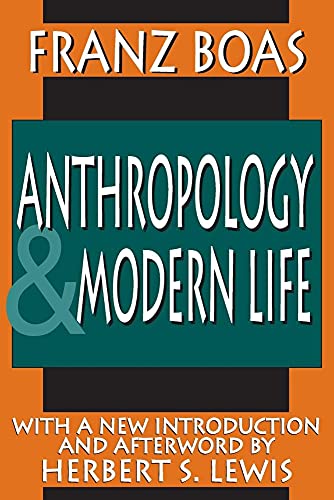
Anthropologist Franz Boas was a stalwart fighter for human rights and against racism. He was passionately concerned about individual liberty, freedom of inquiry and speech, equality of opportunity, and the defeat of prejudice and chauvinism. His Anthropology and Modern Life shows how Boas uses science in the service of humanity, hoping to break down racial and cultural barriers.
From the book's very opening, Boas shatters the myth that anthropology is simply a collection of curious facts about exotic peoples and their customs and belief systems. He asserts that a clear understanding of the principles of anthropology illuminates the social processes of our own times and may show us the book's what to do and what to avoid. Boas proceeds to discuss issues that have had resounding significance in our own time: the problem of defining race; the subjective view of racial types; heredity versus environment; alleged physiological and mental differences between races; the significance of intelligence tests; the importance of one's cultural experience; open versus closed societies; nationality and nationalism; the mixed descent of European nations; eugenics; social conditions versus heredity in the committing of crimes; intolerance; and the influence of race and sex on a successful education. While he outwardly acknowledges that his book runs contrary to popular prejudices, Boas was an optimist, and hoped that dissenters, in reading Anthropology and Modern Life, would come to reexamine their own viewpoints dispassionately and critically.
This new edition of Anthropology and Modern Life is enhanced by an extended introduction by Herbert S. Lewis, who details Franz Boas' life, influence, and ideals. This volume will be a welcome contribution to the libraries of anthropologists, sociologists, and those concerned with human rights.
"synopsis" may belong to another edition of this title.
Review
"In the compass of this short volume Franz Boas accomplishes the annihilation of the bases of almost all the prejudices and passions on which modern society rests, and arrives by the least spectacular kind of reasoning at revolutionary and yet strangely hopeful conclusions."-Nation
?In the compass of this short volume Franz Boas accomplishes the annihilation of the bases of almost all the prejudices and passions on which modern society rests, and arrives by the least spectacular kind of reasoning at revolutionary and yet strangely hopeful conclusions.?-Nation
Synopsis
This work discusses the problem of defining race, the subjective view of racial types, heredity versus environment, alleged physiological and mental differences between races, the significance of intelligence tests, the importance of one's cultural experience, and open versus closed societies.
"About this title" may belong to another edition of this title.
Search results for Anthropology and Modern Life (Routledge Revivals)

Stock Image
Anthropology and Modern Life (Routledge Revivals)
Seller: HPB-Red, Dallas, TX, U.S.A.
Seller rating 5 out of 5 stars

Paperback. Condition: Good. Connecting readers with great books since 1972! Used textbooks may not include companion materials such as access codes, etc. May have some wear or writing/highlighting. We ship orders daily and Customer Service is our top priority! Seller Inventory # S_442050076
Stock Image
Anthropology & Modern Life
Seller: ThriftBooks-Atlanta, AUSTELL, GA, U.S.A.
Seller rating 5 out of 5 stars
Paperback. Condition: Fair. No Jacket. Readable copy. Pages may have considerable notes/highlighting. ~ ThriftBooks: Read More, Spend Less. Seller Inventory # G0765805359I5N00
Stock Image
Anthropology and Modern Life
Seller: Better World Books: West, Reno, NV, U.S.A.
Seller rating 5 out of 5 stars
Condition: Good. Former library copy. Pages intact with minimal writing/highlighting. The binding may be loose and creased. Dust jackets/supplements are not included. Includes library markings. Stock photo provided. Product includes identifying sticker. Better World Books: Buy Books. Do Good. Seller Inventory # 39950915-6
Stock Image
Anthropology and Modern Life (Routledge Revivals)
Seller: Textbook Bookie, Little Rock, AR, U.S.A.
Seller rating 4 out of 5 stars

Paperback. Condition: Fair. Book in Fair condition. Seller Inventory # 9780765805355-acceptable
Stock Image
Anthropology and Modern Life (Routledge Revivals)
Seller: Textbook Bookie, Little Rock, AR, U.S.A.
Seller rating 4 out of 5 stars
Paperback. Condition: Good. Book in Good condition. Seller Inventory # 9780765805355-good
Stock Image
Anthropology and Modern Life (Routledge Revivals)
Seller: HPB Inc., Dallas, TX, U.S.A.
Seller rating 5 out of 5 stars
paperback. Condition: Very Good. Connecting readers with great books since 1972! Used books may not include companion materials, and may have some shelf wear or limited writing. We ship orders daily and Customer Service is our top priority! Seller Inventory # S_469715778
Stock Image
Anthropology and Modern Life (Routledge Revivals)
Seller: GridFreed, San Diego, CA, U.S.A.
Seller rating 5 out of 5 stars
paperback. Condition: New. In shrink wrap. Looks like an interesting title! Seller Inventory # 100-36354