
Items related to Kill the Messenger: The War on Standardized Testing
Synopsis
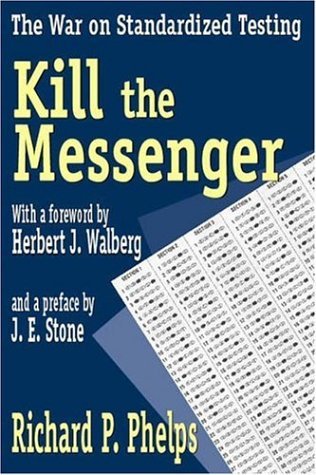
In response to public demand, new federal legislation requires testing of most students in the United States in reading and mathematics, for grades three through eight. In much of the country, this new order promotes an increase in the amount of standardized testing. Many educators, parents, and policymakers who have paid little attention to testing policy issues in the past will now do so. They deserve to have better information on the topic than has generally been available, and Kill the Messenger is intended to fill this gap. Kill the Messenger is perhaps the most thorough and authoritative work in defense of educational testing ever written. Phelps points out that much research conducted by education insiders on the topic is based on ideological preference or profound self-interest. It is not surprising that they arrive at emphatically anti-testing conclusions. He notes that "external" and "high stakes" testing in particular attracts a cornucopia of invective. Much, if not most, of this hostile research is passed on to the public by journalists as if it were neutral, objective, and independent. Kill the Messenger describes the current debate, the players, their interests, and their positions. It explains and refutes many of the common criticisms of testing. It describes testing opponents' strategies, through case studies of Texas and the SAT. It illustrates the profound media bias against testing. It acknowledges testing's limitations, and suggests how it can be improved. It defends testing by comparing it with its alternatives. And finally, it outlines the consequences for America of losing the "war on standardized testing."
"synopsis" may belong to another edition of this title.
About the Author
Richard P. Phelps has devoted most of his working life to the world of education. His research work on testing has been published in Evaluation Review, The Industrial-Organizational Psychologist, Educational and Psychological Measurement, among others. Herbert J. Walberg, a distinguished visiting fellow at the Hoover Institution and a member of the Koret Task Force on K-12 Education, is a University Scholar at the University of Illinois at Chicago and chairman of the board of directors of the Heartland Institute in Chicago. J. E. Stone is the founder and moderator of the Education Consumers ClearingHouse, and a professor of education at East Tennessee State University.
"About this title" may belong to another edition of this title.
Search results for Kill the Messenger: The War on Standardized Testing

Seller Image
Kill the Messenger: The War on Standardized Testing
Seller: ZBK Books, Carlstadt, NJ, U.S.A.
Seller rating 5 out of 5 stars

Condition: very_good. Fast & Free Shipping â" Very Good condition book with a firm cover and clean pages. Shows normal use and some light wear or limited notes markings. A solid, nice copy to enjoy. Seller Inventory # ZWV.0765801787.VG
Stock Image
Kill the Messenger: The War on Standardized Testing
Seller: ThriftBooks-Dallas, Dallas, TX, U.S.A.
Seller rating 5 out of 5 stars
Hardcover. Condition: Very Good. No Jacket. May have limited writing in cover pages. Pages are unmarked. ~ ThriftBooks: Read More, Spend Less. Seller Inventory # G0765801787I4N00
Stock Image
Kill the Messenger : The War on Standardized Testing
Seller: Better World Books, Mishawaka, IN, U.S.A.
Seller rating 5 out of 5 stars
Condition: Very Good. illustrated edition. Former library copy. Pages intact with possible writing/highlighting. Binding strong with minor wear. Dust jackets/supplements may not be included. Includes library markings. Stock photo provided. Product includes identifying sticker. Better World Books: Buy Books. Do Good. Seller Inventory # GRP23689705
Stock Image
Kill the Messenger : The War on Standardized Testing
Seller: Better World Books, Mishawaka, IN, U.S.A.
Seller rating 5 out of 5 stars
Condition: Good. illustrated edition. Former library copy. Pages intact with minimal writing/highlighting. The binding may be loose and creased. Dust jackets/supplements are not included. Includes library markings. Stock photo provided. Product includes identifying sticker. Better World Books: Buy Books. Do Good. Seller Inventory # GRP29647593
Stock Image
Kill the Messenger: The War on Standardized Testing Phelps, Richard P.; Stone, J. E. and Walberg, Herbert J.
Seller: Broad Street Books, Branchville, NJ, U.S.A.
Seller rating 5 out of 5 stars
Hardcover. Condition: New. Brand New Hardcover Book, sealed in factory shrink wrap. Seller Inventory # 7666
Stock Image
Kill the Messenger: The War on Standardized Testing
Seller: The Book Spot, Sioux Falls, MN, U.S.A.
Seller rating 4 out of 5 stars

Hardcover. Condition: New. Seller Inventory # Abebooks97983