
Items related to Spacecraft Formation Flying: Dynamics, Control and...
Synopsis
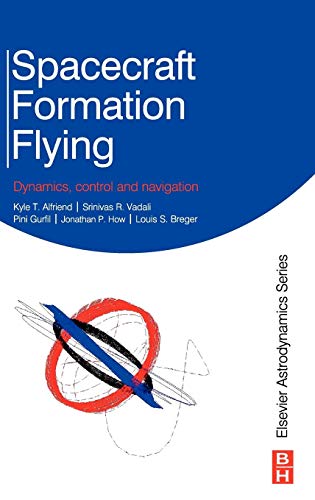
Space agencies are now realizing that much of what has previously been achieved using hugely complex and costly single platform projects―large unmanned and manned satellites (including the present International Space Station)―can be replaced by a number of smaller satellites networked together. The key challenge of this approach, namely ensuring the proper formation flying of multiple craft, is the topic of this second volume in Elsevier’s Astrodynamics Series, Spacecraft Formation Flying: Dynamics, control and navigation.
In this unique text, authors Alfriend et al. provide a coherent discussion of spacecraft relative motion, both in the unperturbed and perturbed settings, explain the main control approaches for regulating relative satellite dynamics, using both impulsive and continuous maneuvers, and present the main constituents required for relative navigation. The early chapters provide a foundation upon which later discussions are built, making this a complete, standalone offering.
Intended for graduate students, professors and academic researchers in the fields of aerospace and mechanical engineering, mathematics, astronomy and astrophysics, Spacecraft Formation Flying is a technical yet accessible, forward-thinking guide to this critical area of astrodynamics.
- The first book dedicated to spacecraft formation flying, written by leading researchers and professors in the field
- Develops the theory from an astrodynamical viewpoint, emphasizing modeling, control and navigation of formation flying satellites on Earth orbits
- Examples used to illustrate the main developments, with a sample simulation of a formation flying mission included to illustrate high fidelity modeling, control and relative navigation
"synopsis" may belong to another edition of this title.
Review
Spacecraft formation flying is being pursued vigorously by NASA and the European Space Agency
Synopsis
Spacecraft formation flying (SFF) is of huge importance to the aerospace and space community. Not the stuff of science-fiction, SFF involves flying multiple small satellites together, to deliver benefits which far outweigh a single larger craft or space station. The first autonomous formation flying earth science mission was in 196 and NASA now has 35 SFF mission sets. By networking several smaller and cheaper craft, scientists can make simultaneous measurements that enable higher resolution astronomical imagery, provide robust and fault-tolerant spacecraft system architectures, and enable complex earth science and space science networks dispersed over clusters of satellites in space.This is the first book to introduce and explore SFF. It is a topic of enormous importance to aerospace engineers, astrodynamicists, satellite engineers, astronomers, physicists, and applied mathematicions. This book provides a complete introduction to the subject and is supported by graduate level student exercises plus Matlab and Maple code sets for running SFF simulations. This is the first book dedicated to spacecraft formation flying which is the enabling element of distributed spacecraft systems.
It is written by the leading researchers and teachers in the field; perfect for research and graduate students. It is accompanied by Matlab and Maple code sets and exercises for graduate level students of aerospace science, astrodynamics and orbital mechanics."About this title" may belong to another edition of this title.
Search results for Spacecraft Formation Flying: Dynamics, Control and...

Stock Image
SPACECRAFT FORMATION FLYING
Print on DemandSeller: Brook Bookstore On Demand, Napoli, NA, Italy
Seller rating 5 out of 5 stars

Condition: new. Questo è un articolo print on demand. Seller Inventory # 2a4862b3b684a2c1f7d0b1e7a6f16b7e
Buy New
£ 85.54
£ 6.87 shipping
Ships from Italy to U.S.A.
Ships from Italy to U.S.A.
Quantity: Over 20 available
Stock Image
Spacecraft Formation Flying: Dynamics, Control and Navigation (Elsevier Astrodynamics)
Published by
Butterworth Heinemann 2007-12-01, 2007
ISBN 10: 0750685336
ISBN 13: 9780750685337
New
Hardcover
Seller: Chiron Media, Wallingford, United Kingdom
Seller rating 5 out of 5 stars
Hardcover. Condition: New. Seller Inventory # 6666-ELS-9780750685337
Buy New
£ 84.20
£ 15.49 shipping
Ships from United Kingdom to U.S.A.
Ships from United Kingdom to U.S.A.
Quantity: Over 20 available
Stock Image
Spacecraft Formation Flying
Seller: Majestic Books, Hounslow, United Kingdom
Seller rating 4 out of 5 stars

Condition: New. pp. 404 52:B&W 6.14 x 9.21in or 234 x 156mm (Royal 8vo) Case Laminate on White w/Gloss Lam. Seller Inventory # 8347521
Buy New
£ 99.25
£ 6.50 shipping
Ships from United Kingdom to U.S.A.
Ships from United Kingdom to U.S.A.
Quantity: 3 available
Stock Image
Spacecraft Formation Flying: Dynamics, Control, and Navigation
Seller: Revaluation Books, Exeter, United Kingdom
Seller rating 5 out of 5 stars
Hardcover. Condition: Brand New. 1st edition. 382 pages. 9.50x6.25x1.00 inches. In Stock. Seller Inventory # __0750685336
Buy New
£ 95.82
£ 12.50 shipping
Ships from United Kingdom to U.S.A.
Ships from United Kingdom to U.S.A.
Quantity: 2 available
Seller Image
Spacecraft Formation Flying
Published by
Butterworth-Heinemann Nov 2009, 2009
ISBN 10: 0750685336
ISBN 13: 9780750685337
New
Hardcover
Seller: BuchWeltWeit Ludwig Meier e.K., Bergisch Gladbach, Germany
Seller rating 5 out of 5 stars
Buch. Condition: Neu. This item is printed on demand - it takes 3-4 days longer - Neuware -Space agencies are now realizing that much of what has previously been achieved using hugely complex and costly single platform projects-large unmanned and manned satellites (including the present International Space Station)-can be replaced by a number of smaller satellites networked together. The key challenge of this approach, namely ensuring the proper formation flying of multiple craft, is the topic of this second volume in Elsevier's Astrodynamics Series, Spacecraft Formation Flying: Dynamics, control and navigation. In this unique text, authors Alfriend et al. provide a coherent discussion of spacecraft relative motion, both in the unperturbed and perturbed settings, explain the main control approaches for regulating relative satellite dynamics, using both impulsive and continuous maneuvers, and present the main constituents required for relative navigation. The early chapters provide a foundation upon which later discussions are built, making this a complete, standalone offering. Intended for graduate students, professors and academic researchers in the fields of aerospace and mechanical engineering, mathematics, astronomy and astrophysics, Spacecraft Formation Flying is a technical yet accessible, forward-thinking guide to this critical area of astrodynamics. Englisch. Seller Inventory # 9780750685337
Stock Image
Spacecraft Formation Flying
Seller: Books Puddle, New York, NY, U.S.A.
Seller rating 4 out of 5 stars
Condition: New. pp. 404. Seller Inventory # 26581726
Stock Image
Spacecraft Formation Flying: Dynamics, Control and Navigation
Published by
Elsevier Science & Technology, 2009
ISBN 10: 0750685336
ISBN 13: 9780750685337
New
Hardcover
Seller: THE SAINT BOOKSTORE, Southport, United Kingdom
Seller rating 5 out of 5 stars
Hardback. Condition: New. New copy - Usually dispatched within 4 working days. Seller Inventory # B9780750685337
Buy New
£ 105.51
£ 18.47 shipping
Ships from United Kingdom to U.S.A.
Ships from United Kingdom to U.S.A.
Quantity: Over 20 available
Stock Image
Spacecraft Formation Flying
Seller: Biblios, Frankfurt am main, HESSE, Germany
Seller rating 4 out of 5 stars
Condition: New. pp. 404. Seller Inventory # 18581716
Seller Image
Spacecraft Formation Flying : Dynamics, Control, and Navigation
Print on DemandSeller: AHA-BUCH GmbH, Einbeck, Germany
Seller rating 5 out of 5 stars
Buch. Condition: Neu. nach der Bestellung gedruckt Neuware - Printed after ordering - Space agencies are now realizing that much of what has previously been achieved using hugely complex and costly single platform projects-large unmanned and manned satellites (including the present International Space Station)-can be replaced by a number of smaller satellites networked together. The key challenge of this approach, namely ensuring the proper formation flying of multiple craft, is the topic of this second volume in Elsevier's Astrodynamics Series, Spacecraft Formation Flying: Dynamics, control and navigation. In this unique text, authors Alfriend et al. provide a coherent discussion of spacecraft relative motion, both in the unperturbed and perturbed settings, explain the main control approaches for regulating relative satellite dynamics, using both impulsive and continuous maneuvers, and present the main constituents required for relative navigation. The early chapters provide a foundation upon which later discussions are built, making this a complete, standalone offering. Intended for graduate students, professors and academic researchers in the fields of aerospace and mechanical engineering, mathematics, astronomy and astrophysics, Spacecraft Formation Flying is a technical yet accessible, forward-thinking guide to this critical area of astrodynamics. Seller Inventory # 9780750685337