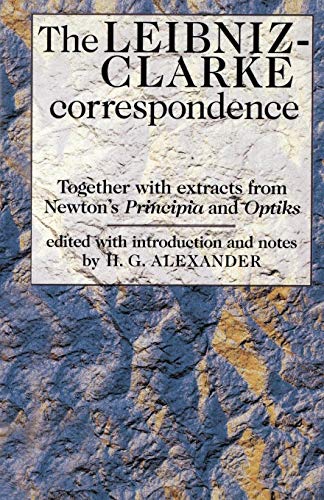
The Leibniz-Clarke Correspondence: With Extracts from Newton's 'Principia' and 'Optiks' (Philosophy Classics) - Softcover
Synopsis
n 1715 Leibniz wrote to his friend the Princess of Wales to warn her of the dangers Newton's philosophy posed for natural religion. Seizing this chance of initiating an exchange between the two greatest minds in Europe, the princess showed his letter to the eminent Newtonian scientist and natural theologian, Samuel Clarke. From his reply developed an exchange of papers which was published in 1717. The correspondence was immediately seen as a crucial discussion of the significance of the new science, and it became one of the most widely read philosophical works of its time.In this edition, an introduction outlines the historical background, and there is a valuable survey of the subsequent discussions of the problem of space and time in the philosophy of science. Significant references to the controversy in Leibniz's other correspondence have also been collected, and the relevant passages from Newton's Principia and Opticks are appended. In 1715 Leibniz wrote to his friend the Princess of Wales to warn her of the dangers Newton's philosophy posed for natural religion. Seizing this chance of initiating an exchange between two of the greatest minds in Europe, the princess showed his letter to the eminent Newtonian scientist and natural theologian, Samuel Clarke. From his reply developed an exchange of papers which was published in 1717. The correspondence was immediately seen as a crucial discussion of the significance of the new science, and it became one of the most widely read philosophical works of its time. Kant developed his theory of space and time from the problems at issue, and the post-Newtonian physics of the twentieth century has brought a revival of interest in Leibniz's objections: some of the problems are still not finally resolved. In this edition an introduction outlines the historical background, and there is a valuable survey of the subsequent discussions of the problem of space and time in the philosophy of science. Significant references to the controversy in Leibniz's other correspondence have also been collected, and the relevant passages from Newton's "Principia" and "Opticks" are appended. -- .
"synopsis" may belong to another edition of this title.
From the Back Cover
n 1715 Leibniz wrote to his friend the Princess of Wales to warn her of the dangers Newton's philosophy posed for natural religion. Seizing this chance of initiating an exchange between the two greatest minds in Europe, the princess showed his letter to the eminent Newtonian scientist and natural theologian, Samuel Clarke. From his reply developed an exchange of papers which was published in 1717. The correspondence was immediately seen as a crucial discussion of the significance of the new science, and it became one of the most widely read philosophical works of its time.In this edition, an introduction outlines the historical background, and there is a valuable survey of the subsequent discussions of the problem of space and time in the philosophy of science. Significant references to the controversy in Leibniz's other correspondence have also been collected, and the relevant passages from Newton's Principia and Opticks are appended. In 1715 Leibniz wrote to his friend the Princess of Wales to warn her of the dangers Newton's philosophy posed for natural religion. Seizing this chance of initiating an exchange between two of the greatest minds in Europe, the princess showed his letter to the eminent Newtonian scientist and natural theologian, Samuel Clarke. From his reply developed an exchange of papers which was published in 1717. The correspondence was immediately seen as a crucial discussion of the significance of the new science, and it became one of the most widely read philosophical works of its time. Kant developed his theory of space and time from the problems at issue, and the post-Newtonian physics of the twentieth century has brought a revival of interest in Leibniz's objections: some of the problems are still not finally resolved. In this edition an introduction outlines the historical background, and there is a valuable survey of the subsequent discussions of the problem of space and time in the philosophy of science. Significant references to the controversy in Leibniz's other correspondence have also been collected, and the relevant passages from Newton's "Principia" and "Opticks" are appended.
From the Inside Flap
n 1715 Leibniz wrote to his friend the Princess of Wales to warn her of the dangers Newton's philosophy posed for natural religion. Seizing this chance of initiating an exchange between the two greatest minds in Europe, the princess showed his letter to the eminent Newtonian scientist and natural theologian, Samuel Clarke. From his reply developed an exchange of papers which was published in 1717. The correspondence was immediately seen as a crucial discussion of the significance of the new science, and it became one of the most widely read philosophical works of its time.In this edition, an introduction outlines the historical background, and there is a valuable survey of the subsequent discussions of the problem of space and time in the philosophy of science. Significant references to the controversy in Leibniz's other correspondence have also been collected, and the relevant passages from Newton's Principia and Opticks are appended. In 1715 Leibniz wrote to his friend the Princess of Wales to warn her of the dangers Newton's philosophy posed for natural religion. Seizing this chance of initiating an exchange between two of the greatest minds in Europe, the princess showed his letter to the eminent Newtonian scientist and natural theologian, Samuel Clarke. From his reply developed an exchange of papers which was published in 1717. The correspondence was immediately seen as a crucial discussion of the significance of the new science, and it became one of the most widely read philosophical works of its time. Kant developed his theory of space and time from the problems at issue, and the post-Newtonian physics of the twentieth century has brought a revival of interest in Leibniz's objections: some of the problems are still not finally resolved. In this edition an introduction outlines the historical background, and there is a valuable survey of the subsequent discussions of the problem of space and time in the philosophy of science. Significant references to the controversy in Leibniz's other correspondence have also been collected, and the relevant passages from Newton's "Principia" and "Opticks" are appended.
"About this title" may belong to another edition of this title.
Search results for The Leibniz-Clarke Correspondence: With Extracts from...

Stock Image
The Leibniz-Clarke Correspondence: With extracts from Newton's 'Principia' and 'Optiks' (Philosophy Classics)
Published by
Manchester University Press (edition New edition), 1977
ISBN 10: 0719006694
ISBN 13: 9780719006692
Used
Paperback
Seller: BooksRun, Philadelphia, PA, U.S.A.
Seller rating 5 out of 5 stars

Paperback. Condition: Good. New edition. It's a preowned item in good condition and includes all the pages. It may have some general signs of wear and tear, such as markings, highlighting, slight damage to the cover, minimal wear to the binding, etc., but they will not affect the overall reading experience. Seller Inventory # 0719006694-11-1
Stock Image
The Leibniz-Clarke Correspondence : With Extracts from Newton's 'Principia' And 'Optiks'
Published by
Manchester University Press, 1977
ISBN 10: 0719006694
ISBN 13: 9780719006692
Used
Softcover
Seller: Better World Books: West, Reno, NV, U.S.A.
Seller rating 5 out of 5 stars
Condition: Very Good. Used book that is in excellent condition. May show signs of wear or have minor defects. Seller Inventory # 4437853-6
Seller Image
The Leibniz-Clarke Correspondence: With extracts from Newton's 'Principia' and 'Optiks' (Philosophy Classics)
Published by
Manchester University Press, 1977
ISBN 10: 0719006694
ISBN 13: 9780719006692
Used
Softcover
Seller: Goodwill of Colorado, COLORADO SPRINGS, CO, U.S.A.
Seller rating 5 out of 5 stars
Condition: good. This item is in overall good condition. Covers and dust jackets are intact but may have minor wear including slight curls or bends to corners as well as cosmetic blemishes including stickers. Pages are intact but may have minor highlighting writing. Binding is intact; however, spine may have slight wear overall. Digital codes may not be included and have not been tested to be redeemable and or active. Minor shelf wear overall. Please note that all items are donated goods and are in used condition. Orders shipped Monday through Friday! Your purchase helps put people to work and learn life skills to reach their full potential. Orders shipped Monday through Friday. Your purchase helps put people to work and learn life skills to reach their full potential. Thank you! Seller Inventory # 466SGT002X9J
Seller Image
The Leibniz-Clarke Correspondence: With extracts from Newton's 'Principia' and 'Optiks' (Philosophy Classics)
Published by
Manchester University Press, 1977
ISBN 10: 0719006694
ISBN 13: 9780719006692
Used
Softcover
Seller: Goodwill Books, Hillsboro, OR, U.S.A.
Seller rating 5 out of 5 stars
Condition: acceptable. Fairly worn, but readable and intact. If applicable: Dust jacket, disc or access code may not be included. Seller Inventory # 3IIT4Q004WNM_ns
Seller Image
The Leibniz-Clarke Correspondence: With extracts from Newton's 'Principia' and 'Optiks' (Philosophy Classics)
Published by
Manchester University Press, 1977
ISBN 10: 0719006694
ISBN 13: 9780719006692
Used
Softcover
Seller: Goodwill Books, Hillsboro, OR, U.S.A.
Seller rating 5 out of 5 stars
Condition: good. Signs of wear and consistent use. Seller Inventory # 3IISI0001U3T_ns
Stock Image
The Leibniz-Clarke Correspondence: With extracts from Newton's 'Principia' and 'Optiks' (Philosophy Classics)
Published by
Manchester University Press March 1977, 1977
ISBN 10: 0719006694
ISBN 13: 9780719006692
Used
Trade Paperback
Seller: Pella Books, Pella, IA, U.S.A.
Seller rating 2 out of 5 stars

Trade Paperback. Condition: Used Good. Seller Inventory # 214178
Seller Image
Leibniz-Clarke Correspondence : Together With Extracts from Newton's Principia and Opticks
Published by
Manchester University Press, 1977
ISBN 10: 0719006694
ISBN 13: 9780719006692
New
Softcover
Seller: GreatBookPrices, Columbia, MD, U.S.A.
Seller rating 5 out of 5 stars
Condition: New. Seller Inventory # 394168-n
Seller Image
The Leibniz-Clarke Correspondence
Published by
Manchester University Press, GB, 1977
ISBN 10: 0719006694
ISBN 13: 9780719006692
New
Paperback
Seller: Rarewaves.com USA, London, LONDO, United Kingdom
Seller rating 5 out of 5 stars
Paperback. Condition: New. n 1715 Leibniz wrote to his friend the Princess of Wales to warn her of the dangers Newton's philosophy posed for natural religion. Seizing this chance of initiating an exchange between the two greatest minds in Europe, the princess showed his letter to the eminent Newtonian scientist and natural theologian, Samuel Clarke. From his reply developed an exchange of papers which was published in 1717. The correspondence was immediately seen as a crucial discussion of the significance of the new science, and it became one of the most widely read philosophical works of its time.In this edition, an introduction outlines the historical background, and there is a valuable survey of the subsequent discussions of the problem of space and time in the philosophy of science. Significant references to the controversy in Leibniz's other correspondence have also been collected, and the relevant passages from Newton's Principia and Opticks are appended. In 1715 Leibniz wrote to his friend the Princess of Wales to warn her of the dangers Newton's philosophy posed for natural religion. Seizing this chance of initiating an exchange between two of the greatest minds in Europe, the princess showed his letter to the eminent Newtonian scientist and natural theologian, Samuel Clarke. From his reply developed an exchange of papers which was published in 1717. The correspondence was immediately seen as a crucial discussion of the significance of the new science, and it became one of the most widely read philosophical works of its time. Kant developed his theory of space and time from the problems at issue, and the post-Newtonian physics of the twentieth century has brought a revival of interest in Leibniz's objections: some of the problems are still not finally resolved. In this edition an introduction outlines the historical background, and there is a valuable survey of the subsequent discussions of the problem of space and time in the philosophy of science. Significant references to the controversy in Leibniz's other correspondence have also been collected, and the relevant passages from Newton's "Principia" and "Opticks" are appended. Seller Inventory # LU-9780719006692
Buy New
£ 20.89
Free Shipping
Ships from United Kingdom to U.S.A.
Ships from United Kingdom to U.S.A.
Quantity: 1 available
Seller Image
The Leibniz-Clarke Correspondence : With extracts from Newton's 'Principia' and 'Optiks' (Philosophy Classics)
Published by
Manchester University Press, 1998
ISBN 10: 0719006694
ISBN 13: 9780719006692
Used
Soft cover
Seller: Gwyn Tudur Davies, Aberystwyth, United Kingdom
Seller rating 5 out of 5 stars
Soft cover. Condition: As New. No Jacket. Pbk, 200 p. Condition as new. [Leibniz, Gottfried Wilhelm Freiherr von 1646-1716 ; Correspondence - Clarke, Samuel 1675-1729 ; Correspondence - Newton, Isaac 1642-1727. Principia - Philosophers Germany ; Correspondence - Philosophers England ; Correspondence - Religion and science Correspondence] h1918 / m15261. Seller Inventory # 015261
Buy Used
£ 10
£ 12.50 shipping
Ships from United Kingdom to U.S.A.
Ships from United Kingdom to U.S.A.
Quantity: 1 available
Seller Image
Leibniz-Clarke Correspondence : Together With Extracts from Newton's Principia and Opticks
Published by
Manchester University Press, 1977
ISBN 10: 0719006694
ISBN 13: 9780719006692
Used
Softcover
Seller: GreatBookPrices, Columbia, MD, U.S.A.
Seller rating 5 out of 5 stars
Condition: As New. Unread book in perfect condition. Seller Inventory # 394168