
Items related to Hammer and Rifle: The Militarization of the Soviet...
Hammer and Rifle: The Militarization of the Soviet Union, 1926-1933 (Modern War Studies) - Hardcover
Synopsis
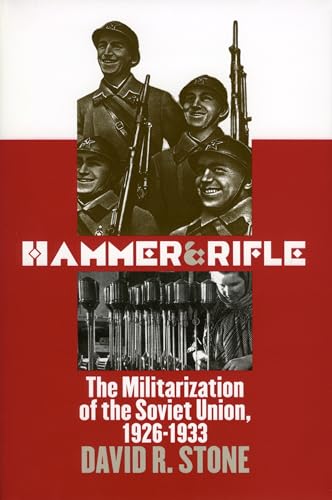
From 1926 to 1933, a vast transformation swept through the Soviet Union, a massive militarization of society that was as powerful and far-reaching as the Revolution itself. This work chronicles this transformation and shows why it is so central to our understanding of Stalin's emergence and consolidation of power. While collectivization dramatically altered rural Russia and Stalin ruthlessly secured his control over the state apparatus, a military-industrial revolution remade the USSR into an immensely powerful war machine. As Stone reveals, the militarization of the Soviet economy - marked by a rapidly expanding defence industry, increasing centralized control and growing military influence over economic policies - was an essential element in Stalin's strong-armed revolution from above. Spurred by the Bolshevik's unrelenting suspicions of other nations, the Soviet state embraced rearmament and military preparedness as its guarantee for national survival. Soviet military thinkers, Stone shows, pushed for a ruthlessly centralized economy - one requiring total integration of state and society - as the necessary means for achieving victory in future wars. The result was an ever upwardly spiralling defence budget and increasing military domination of civilian society. Stone demonstrates how this domination emerged, evolved and entrenched itself. But he also suggests that this military-industrial revolution, theoretically designed to protect the Soviet Union's national security, instead nearly destroyed it at the beginning of World War II. The rigid and inflexible economy that resulted ultimately undermined the Soviet state itself, destroying from within much of what it had tried to defend. Based on the use of new archival sources, Stone's study also provides a cautionary tale about civil-military relations in an increasingly dangerous world.
"synopsis" may belong to another edition of this title.
Review
"Based on extensive research in newly opened Russian archives, this careful study is the best analysis to date of the central role of militarization in the development of state, society, and economy in the U.S.S.R. between the end of the 'New Economic Plan' in 1926 and the conclusion of the first 'Five-year Plan in 1933.'"--Publishers Weekly
"Makes for indispensable reading. It has relevance for economists, military historians, analysts of civil-military relations, historians of the Soviet Union, students of Stalin and Stalinism, the disclosures from the archives a treasure-trove in their own right."--John Erickson, Journal of Slavic Military Studies
"Based on prodigious research in newly-accessible Russian archives, Stone's landmark book makes a significant contribution to our understanding of the advent of the Soviet garrison state. Touching on nearly every significant issue of the period, he deepens, challenges, or modifies many existing interpretations and cuts through the fog of conjecture, theory, and half-truths that still cloaks the era between 1926 and 1933."--Bruce Menning, author of Bayonets before Bullets: The Imperial Russian Army, 1861-1914
"An important contribution to the field of Soviet military, economic, and political history."--Steven Miner, author of Between Churchill and Stalin and Stalin's Holy War
Synopsis
From 1926 to 1933, a vast transformation swept through the Soviet Union, a massive militarization of society that was as powerful and far-reaching as the Revolution itself. This work chronicles this transformation and shows why it is so central to our understanding of Stalin's emergence and consolidation of power. While collectivization dramatically altered rural Russia and Stalin ruthlessly secured his control over the state apparatus, a military-industrial revolution remade the USSR into an immensely powerful war machine. As Stone reveals, the militarization of the Soviet economy - marked by a rapidly expanding defence industry, increasing centralized control and growing military influence over economic policies - was an essential element in Stalin's strong-armed revolution from above. Spurred by the Bolshevik's unrelenting suspicions of other nations, the Soviet state embraced rearmament and military preparedness as its guarantee for national survival. Soviet military thinkers, Stone shows, pushed for a ruthlessly centralized economy - one requiring total integration of state and society - as the necessary means for achieving victory in future wars.
The result was an ever upwardly spiralling defence budget and increasing military domination of civilian society. Stone demonstrates how this domination emerged, evolved and entrenched itself. But he also suggests that this military-industrial revolution, theoretically designed to protect the Soviet Union's national security, instead nearly destroyed it at the beginning of World War II. The rigid and inflexible economy that resulted ultimately undermined the Soviet state itself, destroying from within much of what it had tried to defend. Based on the use of new archival sources, Stone's study also provides a cautionary tale about civil-military relations in an increasingly dangerous world."About this title" may belong to another edition of this title.
Search results for Hammer and Rifle: The Militarization of the Soviet...

Seller Image
Hammer and Rifle: The Militarization of the Soviet Union, 1926-1933 (Modern War Studies)
Published by
University Press of Kansas, 2000
ISBN 10: 0700610375
ISBN 13: 9780700610372
Used
Hardcover
Seller: -OnTimeBooks-, Phoenix, AZ, U.S.A.
Seller rating 5 out of 5 stars

Condition: good. A copy that has been read, remains in good condition. All pages are intact, and the cover is intact. The spine and cover show signs of wear. Pages can include notes and highlighting and show signs of wear, and the copy can include "From the library of" labels or previous owner inscriptions. 100% GUARANTEE! Shipped with delivery confirmation, if you're not satisfied with purchase please return item! Ships via media mail. Seller Inventory # OTV.0700610375.G
Stock Image
Hammer and Rifle: The Militarization of the Soviet Union, 1926-1933
Published by
University Press of Kansas, 2000
ISBN 10: 0700610375
ISBN 13: 9780700610372
Used
Hardcover
Seller: ThriftBooks-Dallas, Dallas, TX, U.S.A.
Seller rating 5 out of 5 stars
Hardcover. Condition: Very Good. No Jacket. Former library book; May have limited writing in cover pages. Pages are unmarked. ~ ThriftBooks: Read More, Spend Less. Seller Inventory # G0700610375I4N10
Seller Image
Hammer and Rifle: The Militarization of the Soviet Union, 1926-1933 (Modern War Studies)
Published by
University Press of Kansas, 2000
ISBN 10: 0700610375
ISBN 13: 9780700610372
Used
Hardcover
Seller: MERS Goodwill, Saint Louis, MO, U.S.A.
Seller rating 5 out of 5 stars
Condition: acceptable. Used - Acceptable: All pages and the cover are intact, but shrink wrap, dust covers, or boxed set case may be missing. Pages may include limited notes, highlighting, or minor water damage but the text is readable. Pages may include limited notes and highlighting, but the text cannot be obscured or unreadable. Any access codes or passwords originally included with the book may be expired, used or no longer valid. Image is stock photo and cover art edition may be different than pictured. Seller Inventory # MERV.0700610375.A
Stock Image
Hammer and Rifle: The Militarization of the Soviet Union, 1926-1933 (Modern War Studies)
Published by
University Press of Kansas, 2000
ISBN 10: 0700610375
ISBN 13: 9780700610372
Used
Hardcover
Seller: Midtown Scholar Bookstore, Harrisburg, PA, U.S.A.
Seller rating 5 out of 5 stars
hardcover. Condition: Good. Torn/worn dj. Good hardcover with some shelfwear; may have previous owner's name inside. Standard-sized. Seller Inventory # mon0000359623
Stock Image
Hammer and Rifle: The Militarization of the Soviet Union, 1926-1933 (Modern War Studies)
Published by
University Press of Kansas, 2000
ISBN 10: 0700610375
ISBN 13: 9780700610372
Used
Hardcover
First Edition
Seller: J. Mercurio Books, Maps, & Prints IOBA, Garrison, NY, U.S.A.
Seller rating 5 out of 5 stars
Hardcover. Condition: Fine. Dust Jacket Condition: Fine. 1st Edition. Full number line starting with 1. Unclipped DJ in archival cover. Clean, no writing, no marks. Seller Inventory # 016198
Stock Image
Hammer and Rifle: The Militarization of the Soviet Union, 1926-1933 (Modern War Studies)
Published by
University Press of Kansas, 2000
ISBN 10: 0700610375
ISBN 13: 9780700610372
Used
Soft cover
First Edition
Seller: Kisselburg Military Books, Potomac, MD, U.S.A.
Seller rating 4 out of 5 stars

Soft cover. Condition: Fine. Dust Jacket Condition: Fine. 1st Edition. very nice copy. Seller Inventory # 046907
Seller Image
Hammer and Rifle: The Militarization of the Soviet Union, 1926-1933
Published by
University Press of Kansas, 2000
ISBN 10: 0700610375
ISBN 13: 9780700610372
Used
Hardcover
Seller: Klondyke, Almere, Netherlands
Seller rating 5 out of 5 stars
Condition: Good. Original yellow boards, dust jacket, 8vo. Seller Inventory # 374348-XA48
Buy Used
£ 12.14
£ 17.15 shipping
Ships from Netherlands to U.S.A.
Ships from Netherlands to U.S.A.
Quantity: 1 available
Stock Image
Hammer and Rifle: The Militarization of the Soviet Union, 1926-1933 (Modern War Studies)
Published by
University Press of Kansas, 2000
ISBN 10: 0700610375
ISBN 13: 9780700610372
New
Hardcover
Seller: GoldBooks, Denver, CO, U.S.A.
Seller rating 5 out of 5 stars
Hardcover. Condition: new. New Copy. Customer Service Guaranteed. Seller Inventory # 92G70_27_0700610375
Stock Image
Hammer and Rifle (Hardcover)
Published by
University Press of Kansas, Kansas, 2000
ISBN 10: 0700610375
ISBN 13: 9780700610372
New
Hardcover
Seller: Grand Eagle Retail, Bensenville, IL, U.S.A.
Seller rating 5 out of 5 stars
Hardcover. Condition: new. Hardcover. From 1926 to 1933, a vast transformation swept through the Soviet Union, a massive militarization of society that was as powerful and far-reaching as the Revolution itself. This work chronicles this transformation and shows why it is so central to our understanding of Stalin's emergence and consolidation of power. While collectivization dramatically altered rural Russia and Stalin ruthlessly secured his control over the state apparatus, a military-industrial revolution remade the USSR into an immensely powerful war machine. As Stone reveals, the militarization of the Soviet economy - marked by a rapidly expanding defence industry, increasing centralized control and growing military influence over economic policies - was an essential element in Stalin's strong-armed revolution from above. Spurred by the Bolshevik's unrelenting suspicions of other nations, the Soviet state embraced rearmament and military preparedness as its guarantee for national survival. Soviet military thinkers, Stone shows, pushed for a ruthlessly centralized economy - one requiring total integration of state and society - as the necessary means for achieving victory in future wars. The result was an ever upwardly spiralling defence budget and increasing military domination of civilian society. Stone demonstrates how this domination emerged, evolved and entrenched itself. But he also suggests that this military-industrial revolution, theoretically designed to protect the Soviet Union's national security, instead nearly destroyed it at the beginning of World War II. The rigid and inflexible economy that resulted ultimately undermined the Soviet state itself, destroying from within much of what it had tried to defend. Based on the use of new archival sources, Stone's study also provides a cautionary tale about civil-military relations in an increasingly dangerous world. From 1926 to 1933, a transformation swept through the Soviet Union - a militarization of society that was as powerful and far-reaching as the Revolution itself. This work chronicles this transformation and shows why it is central to the understanding of Stalin's consolidation of power. Shipping may be from multiple locations in the US or from the UK, depending on stock availability. Seller Inventory # 9780700610372
Stock Image
Hammer and Rifle: The Militarization of the Soviet Union, 1926-1933 (Modern War Studies)
Published by
University Press Of Kansas, 2000
ISBN 10: 0700610375
ISBN 13: 9780700610372
Used
Hardcover
Seller: Anybook.com, Lincoln, United Kingdom
Seller rating 5 out of 5 stars
Condition: Fair. This is an ex-library book and may have the usual library/used-book markings inside.This book has hardback covers. In fair condition, suitable as a study copy. Dust jacket in fair condition. Please note the Image in this listing is a stock photo and may not match the covers of the actual item,600grams, ISBN:9780700610372. Seller Inventory # 4318303
Buy Used
£ 20
£ 13.60 shipping
Ships from United Kingdom to U.S.A.
Ships from United Kingdom to U.S.A.
Quantity: 1 available